To avoid these ads, REGISTER NOW!

Craftsman Socket Evolution 1948-2024

To avoid these ads, REGISTER NOW!

pugsl

Active member
Joined
Apr 15, 2020
Messages
40
Location
side
Great Idea I have Craftsman sockets from the 60's and worked for Sears as a mechanic for 30 years and never knew this. Sockets in a box now as I have just moved and not unpacked them yet. Will be looking at them to see what I have now.
 
OP
L

Lesserstore

Well-known member
Joined
Mar 18, 2020
Messages
863
Location
Texas
No. That discussion has broken out on a few different threads from time to time. It's very safe to say it usually comes down to Long C BE/(H)/(U)(K) and =V=. There's not too many people out there arguing for -VV- or EE etc. My take is that most of the =V= proponents have never really truly held a Long C tool in their hands and their opinion is skewed by emotion. The =V= line is what they think of as Grandpa's tools, Dad's tools, and the pinnacle of good old Made in the USA Craftsman "modern" production, but mainly because everything before that is considered antique or bulky etc., which is not true. To be fair, the Long C proponents are just as susceptible to bias. 'The tools that won the war,' etc. I am one of them. When you get past that, I do think there is a consensus that the 30's to the 50's was their sweet spot.

Those definitely were the best years, although I tend to extend it to the 60s. To be honest my friends and I are just happy to have U.S. made tools (unless it's oxwall) because we unfortunately don't live in a time where you can just buy affordable U.S. tools from a store.:( But EE sockets were not near the quality of v series. I took a =V= 7/16 and an EE 7/16 socket and measured the wall thickness at their thickest point. V was .064 and EE was .095.
Having trouble with the picture will upload later.

Most of the sockets we had at my high school were craftsman =V= series. We also had a few V series ratchets and some Wizard sockets. The way my school is I was expecting harbor freight.:lol:
 

Shiftless

Well-known member
Joined
Mar 9, 2014
Messages
14,454
Location
East Bay SFO
You said...

“But EE sockets were not near the quality of v series. I took a =V= 7/16 and an EE 7/16 socket and measured the wall thickness at their thickest point. V was .064 and EE was .095.“

You’re saying that the thinner sockets were higher quality? Better steel or ???
 

woody 73

Well-known member
Joined
Apr 14, 2009
Messages
11,540
Location
The Great State Up North
Yes from the 1930's to the 1950's was the golden years, but I also like the silver years of the 1960's (many good memories). The 1970 years were the bronze years and anything after 1980 was the dreck years in my opinion.
 
OP
L

Lesserstore

Well-known member
Joined
Mar 18, 2020
Messages
863
Location
Texas
You said...

“But EE sockets were not near the quality of v series. I took a =V= 7/16 and an EE 7/16 socket and measured the wall thickness at their thickest point. V was .064 and EE was .095.“

You’re saying that the thinner sockets were higher quality? Better steel or ???

Well I had always heard that thin walled sockets were better because that usually means better steel which requires less material to make it strong. It made sense to me so I thought it was true in most cases.
 

Shiftless

Well-known member
Joined
Mar 9, 2014
Messages
14,454
Location
East Bay SFO
I don’t know either.

Does anybody on this thread have equipment or know of somebody with equipment to perform destructive testing ( measure torque up to failure point ) of a few samples of each? In the interest of science, I would donate samples to such an enterprise.
 

ganymede

Well-known member
Joined
Nov 29, 2012
Messages
2,332
Location
New England
Here are a few more pictures of my Cad plated =v= tools.
-Don
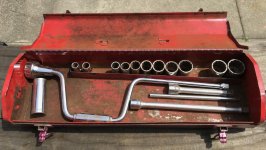
Thanks for showing those.
A couple of years back I posted a 1/4 breaker bar that I thought might be cadmium plated. A lot of folks thought it was just dirty or worn or something.
I hoped it was just zinc instead.
Oh well, just an excuse to buy another.
 

d42jeep

Well-known member
Joined
Oct 22, 2014
Messages
16,480
Location
Northern California
I’ve bought and sold quite a few Craftsman tools over the past few years. In my opinion, the best Craftsman sockets within the range of the title of the thread are the =v= sockets made by Moore Drop Forge during the mid to late ‘50s. I picked up this partial Heritage set at a Berkeley Estate sale in 2018. It came with =v= sockets with the pointed A and I’ve added to it over time with matching tools. The set in the catalogs stayed pretty much the same during the late ‘50s.
-Don
 

Attachments

  • D4561702-990A-4400-A6F0-2C2D4186A99B.jpg
    D4561702-990A-4400-A6F0-2C2D4186A99B.jpg
    152.5 KB · Views: 48
  • 88DCC370-22AB-4563-808F-F5B5140EAE2E.jpg
    88DCC370-22AB-4563-808F-F5B5140EAE2E.jpg
    132.3 KB · Views: 58
  • C598FB31-6916-4A5E-8326-61C87467E749.jpg
    C598FB31-6916-4A5E-8326-61C87467E749.jpg
    83 KB · Views: 48
  • C45DEA56-6387-40B2-B383-F0C5AA6A1D57.jpeg
    C45DEA56-6387-40B2-B383-F0C5AA6A1D57.jpeg
    55.6 KB · Views: 48
  • 0990D2B8-7A03-42D0-9B4F-3650FAFE9F0C.jpg
    0990D2B8-7A03-42D0-9B4F-3650FAFE9F0C.jpg
    74.8 KB · Views: 47
  • 36F09E10-5DCC-45D9-8772-8950814F0AF5.jpg
    36F09E10-5DCC-45D9-8772-8950814F0AF5.jpg
    155.4 KB · Views: 47
  • 51C3E394-01C7-412F-A393-DC407A3642CC.jpg
    51C3E394-01C7-412F-A393-DC407A3642CC.jpg
    154.6 KB · Views: 54
Last edited:

Jim C.

Well-known member
Joined
Jan 8, 2010
Messages
2,598
.........Craftsman =v= sockets with the pointed A....

Although I have no scientific data to prove this, I think those sockets are some of the best ever offered by Sears. It’s just my opinion......

Jim C.
 
OP
L

Lesserstore

Well-known member
Joined
Mar 18, 2020
Messages
863
Location
Texas
I think I might have found a catalog picture of a flank drive style socket, but I want to be sure before I put it in part II. What do y'all think, flank drive or not?
 

Attachments

  • Screenshot_20200519-130245.jpg
    Screenshot_20200519-130245.jpg
    20.3 KB · Views: 43

Downwindtracker 2

Well-known member
Joined
Jun 13, 2019
Messages
1,715
Location
BC
My first metric 3/8 socket set was an Oxwall made in Japan, bought in '67 .Utter garbage . I slowly added Craftsman sockets, one at a time. I'm sure I had knurled metric sockets in'76, I fixed up a '71 Simca then sold it. I then went north and those were the last Craftsman sockets I bought new. So I think their knurling might have started a year or two ahead.

I love those short, thin walled, deep broached sockets for working on cars. MY SK, J.H.Williams and Gray are clunky in comparison.
 
OP
L

Lesserstore

Well-known member
Joined
Mar 18, 2020
Messages
863
Location
Texas
My first metric 3/8 socket set was an Oxwall made in Japan, bought in '67 .Utter garbage . I slowly added Craftsman sockets, one at a time. I'm sure I had knurled metric sockets in'76, I fixed up a '71 Simca then sold it. I then went north and those were the last Craftsman sockets I bought new. So I think their knurling might have started a year or two ahead.

I love those short, thin walled, deep broached sockets for working on cars. MY SK, J.H.Williams and Gray are clunky in comparison.

I wouldn't be too surprised if they made them a year earlier and they didn't make it in the catalogs till 1977. You may have also lived in a "test area" were Sears got feedback on products not listed in the catalog yet or sold in all stores, then if the feedback was positive, they would make it available in the stores nation wide and in the catalog.

I'll change it to: "1977-198? (Possibly as early as 1976)"
 
Last edited:

JoCoSawdust

Well-known member
Joined
Nov 19, 2018
Messages
2,416
Location
Eastern NC
I wouldn't be too surprised if they made them a year earlier and they didn't make it in the catalogs till 1977. You may have also lived in a "test area" were Sears got feedback on products not listed in the catalog yet or sold in all stores, then if the feedback was positive, they would make it available in the stores nation wide and in the catalog.

I'll change it to: "1977-198? (Possibly as early as 1976)"

Let me add my name to the list of those commending you for your efforts. Great to see someone from the younger generation that's interested in the old stuff. I agree that changes that we see in the catalogs generally occur at least in the year prior to seeing it in the catalog. I've spent countless hours researching Craftsman tool boxes and I've found this rule to be pretty much across the board for the boxes so it makes sense it'd apply to other items as well.

As far as which era of rats and sockets were the "best", as someone else said, it's totally subjective. My collector interest dies out with the =V= series but my user box is full of -V- stuff that I got in high school and it's still going strong. Personally I think the BE/Circle H series was the high point for Sears as I've got a ton of it and only one cracked socket from that era. I find plenty of =V= and -V- with cracked sockets.

Again, thanks for your efforts and I'm looking forward to what I can learn on here.
 

JoCoSawdust

Well-known member
Joined
Nov 19, 2018
Messages
2,416
Location
Eastern NC
This is very cool. I'm a bit of a Craftsman nut, especially with the Gray/Red toolboxes and rollers. I wish someone would do more research on the toolboxes documenting the differences between them.

You have my attention and I'm subscribed!

I've got a ton of notes on the Gray/Red boxes and need to organize it and run it by Taumac and Rileysan to get input. I made the mistake of "publishing" my research on the Heritage era boxes too early. The more I dug in the more mistakes I realized I made so I took it down. Researching Craftsman is a slippery slope. The more you learn the more you realize you don't know.
 
OP
L

Lesserstore

Well-known member
Joined
Mar 18, 2020
Messages
863
Location
Texas
Let me add my name to the list of those commending you for your efforts. Great to see someone from the younger generation that's interested in the old stuff. I agree that changes that we see in the catalogs generally occur at least in the year prior to seeing it in the catalog. I've spent countless hours researching Craftsman tool boxes and I've found this rule to be pretty much across the board for the boxes so it makes sense it'd apply to other items as well.

As far as which era of rats and sockets were the "best", as someone else said, it's totally subjective. My collector interest dies out with the =V= series but my user box is full of -V- stuff that I got in high school and it's still going strong. Personally I think the BE/Circle H series was the high point for Sears as I've got a ton of it and only one cracked socket from that era. I find plenty of =V= and -V- with cracked sockets.

Again, thanks for your efforts and I'm looking forward to what I can learn on here.

Thanks! I definitely know what you mean about cracked v series sockets, fortunately I have only have one: a =V= 1/2 drive, 1/2 6 point that is cracked in 3 places! I think Sears may have went too thin.

Update to Part I: Metric socket dates: top knurling 1977- c.85 (possibly as early as 1976), bottom knurling c.1985-2011.
 

Downwindtracker 2

Well-known member
Joined
Jun 13, 2019
Messages
1,715
Location
BC
I commend you an your research. Understanding both the age and the manufactures' histories really brings a life to old tools. Tools were expensive and expected to last. That's why I bought sockets one or two at a time during the semi annual tool sale. A full set was well beyond my means.

I don't think it was test area. In Canada, Craftsman in those days was sold by Simpsons-Sears, a partnership of Simpsons and Sears. We never got the full range of Craftsman tools. The store I bought it from was in Richmond, B.C. A long ways from even the Canadian headoffice. Funny how early tool purchases are so clear in my memory.
 

DadsTools

Well-known member
Joined
Jul 27, 2017
Messages
1,852
There is a case study on the forum on the Craftsman RHFT ratchets by member b.well that's a collaborative effort and is nearing completion, which promises to shed new light on the fuzzy transitional years between =v= and -v-, and between pointed-A and flat-A. One of the unique aspect about this is that the patent markings provide an external source (the USPTO) for confirming hard dates. The other is that there are four variations in rapid succession right in the middle of this transitional period. The USPTO dating gives us a reference point far more precise than owners' recollections or the Sears catalogs themselves (we all know catalogs are notorious for sometimes providing misleading and inaccurate information, simply by the nature of how they were compiled before the computer age, and how long they stretched out using old line art and images before they broke down to pay for new art). A couple of details that are already being confirmed:

The =v= marking was in use as late as 1968.
The transition to the -v- marking was occurring as early as 1968-69.
The transition from the pointy-A to the flat-A was also occurring as early as 1968-69.
The use of model numbers on the tools occurred as early as 1971 (the proposed 1970 version did not yet have a model number).

While we can't say for certain that these transitions occurred across the entire Moore/Easco Cman line at the same time, we can say with high confidence that the corporate decision to change the markings over from =v= to -v- and from pointed-A to flat A was made at least as early as 1968-69. The USPTO external hard dates have to be taken as more reliable than what might be depicted in the catalogs, especially since Sears' huge distribution channel of retail stores did not necessitate the catalogs being the end-all of when an item was first offered. .

The thread is https://www.garagejournal.com/forum/showthread.php?t=454332.
 
To avoid these ads, REGISTER NOW!
OP
L

Lesserstore

Well-known member
Joined
Mar 18, 2020
Messages
863
Location
Texas
There is a case study on the forum on the Craftsman RHFT ratchets by member b.well that's a collaborative effort and is nearing completion, which promises to shed new light on the fuzzy transitional years between =v= and -v-, and between pointed-A and flat-A. One of the unique aspect about this is that the patent markings provide an external source (the USPTO) for confirming hard dates. The other is that there are four variations in rapid succession right in the middle of this transitional period. The USPTO dating gives us a reference point far more precise than owners' recollections or the Sears catalogs themselves (we all know catalogs are notorious for sometimes providing misleading and inaccurate information, simply by the nature of how they were compiled before the computer age, and how long they stretched out using old line art and images before they broke down to pay for new art). A couple of details that are already being confirmed:

The =v= marking was in use as late as 1968.
The transition to the -v- marking was occurring as early as 1968-69.
The transition from the pointy-A to the flat-A was also occurring as early as 1968-69.
The use of model numbers on the tools occurred as early as 1971 (the proposed 1970 version did not yet have a model number).

While we can't say for certain that these transitions occurred across the entire Moore/Easco Cman line at the same time, we can say with high confidence that the corporate decision to change the markings over from =v= to -v- and from pointed-A to flat A was made at least as early as 1968-69. The USPTO external hard dates have to be taken as more reliable than what might be depicted in the catalogs, especially since Sears' huge distribution channel of retail stores did not necessitate the catalogs being the end-all of when an item was first offered. .

The thread is https://www.garagejournal.com/forum/showthread.php?t=454332.

When I was looking through the catalogs I noticed that in 1970 when the RHFT was first available through the catalogs that it had a flat A. I decided to look through the catalogs again and I noticed in 1966 the example of a 3/4 socket has a flat A, what do y'all think? The first flat A socket or an error?
 

Attachments

  • Screenshot_20200523-145114.jpg
    Screenshot_20200523-145114.jpg
    21.1 KB · Views: 32
Last edited:

DadsTools

Well-known member
Joined
Jul 27, 2017
Messages
1,852
When I was looking through the catalogs I noticed that in 1970 when the RHFT was first available through the catalogs that it had a flat A. I decided to look through the catalogs again and I noticed in 1966 the example of a 3/4 socket has a flat A, what do y'all think? The first flat A socket or an error?
I think what we have here is yet another installment in the Craftsman Dating Lottery, but this time it falls under "don't completely trust the catalogs" principle.

I'm looking through what catalogs are available on the Blackburn site. There are two observations that are important.

First, its earliest Craftsman catalog posted is 1933, the underline logo. Take a look at the logo on the cover. It has a flat-A. Even after the war when the underline was eventually removed, all the logos on all subsequent catalogs have a flat-A. So the flat-A has been with us from the very beginning. The question then is, not when the flat-A was introduced, but when it was applied to the tools themselves.

Which brings us to the second issue. Plain B&W photos, no matter the quality, just weren't good enough to present distinctly and clearly the outlines and markings when reproduced in such catalogs. So as was common at the time, all images are artist-enhanced. The images were either photos that were artist-enhanced, or they were drawn form scratch. Therefore, it was up to the art director how the artists enhanced these details.

For example, take a look at the large raised panel wrenches on page 10 of the 1964 catalog. The As are curved almost like a arch. I've never seen an actual Cman tool marked that way. Now take a look at the big adjustable on page 11. The A is squared off at the top--you could call it a box-A. Again, never saw a Cman tool with an A rendered that way. All these are artist enhanced where the name had to be inked in by hand because it would never display prominently just from the native photos and the low resolution rendering needed to make for an affordable catalog production.

Cruising through the 1964 cat, I see a lot of pointed-As, but also other 'unnatural' As too. Here's one--take a look at the hammer handles on page 13--they actually look more like conventional As as you'd print by hand, inverted-V As if you will. Clearly rendered this way by the artist who was assigned to do the hammers.

The big chisel on page 17 has a cross between a pointed-A and a flat-A. A 'hybrid' A. All hand-inking by artists.

The socket image you have is rendered as a pointed-A in 1964, and as a flat-A in 1966. But you can see that both are hand-inked in. You can even see the socket next to this one inked in with a more pointed-A, right next to one another. It's how the artist inked it. By the way, they reused the big adjustable art on page 87 so it still has the block-A. Looks like they reused the artwork for the big end wrenches too with the arched-A on pg 86. And we still have the hybrid-A chisel on page 81. You'll find other examples cruising through these catalogs. It was a standard practice to reuse art work instead of creating new if it was close enough.

This is why its difficult to form any definite conclusions from the catalog artwork because it was hand-inked and so not an exact representation of the actual tool markings. As I learned the hard way from my fishing collectible reference book, you can only trust the catalogs so far.

So I would say that the 1966 image is not hard evidence that the physical 1966 socket actually had a flat-A.
 
Last edited:
OP
L

Lesserstore

Well-known member
Joined
Mar 18, 2020
Messages
863
Location
Texas
I think what we have here is yet another installment in the Craftsman Dating Lottery, but this time it falls under "don't completely trust the catalogs" principle.

I'm looking through what catalogs are available on the Blackburn site. There are two observations that are important.

First, its earliest Craftsman catalog posted is 1933, the underline logo. Take a look at the logo on the cover. It has a flat-A. Even after the war when the underline was eventually removed, all the logos on all subsequent catalogs have a flat-A. So the flat-A has been with us from the very beginning. The question then is, not when the flat-A was introduced, but when it was applied to the tools themselves.

Which brings us to the second issue. Plain B&W photos, no matter the quality, just weren't good enough to present distinctly and clearly the outlines and markings when reproduced in such catalogs. So as was common at the time, all images are artist-enhanced. The images were either photos that were artist-enhanced, or they were drawn form scratch. Therefore, it was up to the art director how the artists enhanced these details.

For example, take a look at the large raised panel wrenches on page 10 of the 1964 catalog. The As are curved almost like a arch. I've never seen an actual Cman tool marked that way. Now take a look at the big adjustable on page 11. The A is squared off at the top--you could call it a box-A. Again, never saw a Cman tool with an A rendered that way. All these are artist enhanced where the name had to be inked in by hand because it would never display prominently just from the native photos and the low resolution rendering needed to make for an affordable catalog production.

Cruising through the 1964 cat, I see a lot of pointed-As, but also other 'unnatural' As too. Here's one--take a look at the hammer handles on page 13--they actually look more like conventional As as you'd print by hand, inverted-V As if you will. Clearly rendered this way by the artist who was assigned to do the hammers.

The big chisel on page 17 has a cross between a pointed-A and a flat-A. A 'hybrid' A. All hand-inking by artists.

The socket image you have is rendered as a pointed-A in 1964, and as a flat-A in 1966. But you can see that both are hand-inked in. You can even see the socket next to this one inked in with a more pointed-A, right next to one another. It's how the artist inked it. By the way, they reused the big adjustable art on page 87 so it still has the block-A. Looks like they reused the artwork for the big end wrenches too with the arched-A on pg 86. And we still have the hybrid-A chisel on page 81. You'll find other examples cruising through these catalogs. It was a standard practice to reuse art work instead of creating new if it was close enough.

This is why its difficult to form any definite conclusions from the catalog artwork because it was hand-inked and so not an exact representation of the actual tool markings. As I learned the hard way from my fishing collectible reference book, you can only trust the catalogs so far.

So I would say that the 1966 image is not hard evidence that the physical 1966 socket actually had a flat-A.

I thought so, just wanted to make sure.
 

c1504

Well-known member
Joined
Mar 24, 2019
Messages
362
As everyone else has said, Lesserstore, this is pretty cool that you have done all this research. I too am a high school senior and it is awesome to know that I am not the only young guy out there that is into this kind of stuff.

Maybe I am missing something simple, but several of you guys have said that Craftsman sockets seem to be the best up through the 50's, with the ones from the 60's being slightly less. My understanding from this thread is that the standard sockets stayed the same from 1949 to 1968ish when they changed from =v= to -v-. So I guess my question is how do you tell the 1950's =v= sockets from the 1960's =v= sockets?
 
OP
L

Lesserstore

Well-known member
Joined
Mar 18, 2020
Messages
863
Location
Texas
As everyone else has said, Lesserstore, this is pretty cool that you have done all this research. I too am a high school senior and it is awesome to know that I am not the only young guy out there that is into this kind of stuff.

Maybe I am missing something simple, but several of you guys have said that Craftsman sockets seem to be the best up through the 50's, with the ones from the 60's being slightly less. My understanding from this thread is that the standard sockets stayed the same from 1949 to 1968ish when they changed from =v= to -v-. So I guess my question is how do you tell the 1950's =v= sockets from the 1960's =v= sockets?

Thanks, I am also glad that there is someone in my age range interested too!
To answer your question there really isn't a way to tell unless you were to look at the metallurgy of the socket like grain structure and hardness, but even then how could you tell if it was 50s or 60s, and there might not even be a difference. The only way to know for sure if there's a difference is if somebody finds documentation of a change in metallurgy.
 

DadsTools

Well-known member
Joined
Jul 27, 2017
Messages
1,852
As everyone else has said, Lesserstore, this is pretty cool that you have done all this research. I too am a high school senior and it is awesome to know that I am not the only young guy out there that is into this kind of stuff.

Maybe I am missing something simple, but several of you guys have said that Craftsman sockets seem to be the best up through the 50's, with the ones from the 60's being slightly less. My understanding from this thread is that the standard sockets stayed the same from 1949 to 1968ish when they changed from =v= to -v-. So I guess my question is how do you tell the 1950's =v= sockets from the 1960's =v= sockets?
What Lesserstore said. But also a bit of external observation that may play a role. One of the visual characteristics of the Craftsman end wrenches around the 1960s was an increase in the thickness of the metal overall. This thickness appears to have creeped upward in later years as well. The differences are noticeable and significant. One member noted that there began a marked rise in vanadium prices during the 1960s. It is believed that Moore began to 'dilute' the quality of its alloy and so had to make the wrenches thicker to meet the same tensile strength tests. Perhaps the same was being done with the sockets, but you can only make then so thick without making them clunky looking. Perhaps this provides some grounds for the observation that the quality began dropping in the 1960s.
 
OP
L

Lesserstore

Well-known member
Joined
Mar 18, 2020
Messages
863
Location
Texas
What Lesserstore said. But also a bit of external observation that may play a role. One of the visual characteristics of the Craftsman end wrenches around the 1960s was an increase in the thickness of the metal overall. This thickness appears to have creeped upward in later years as well. The differences are noticeable and significant. One member noted that there began a marked rise in vanadium prices during the 1960s. It is believed that Moore began to 'dilute' the quality of its alloy and so had to make the wrenches thicker to meet the same tensile strength tests. Perhaps the same was being done with the sockets, but you can only make then so thick without making them clunky looking. Perhaps this provides some grounds for the observation that the quality began dropping in the 1960s.

After reading this I looked through the catalogs and in the catalogs from Spring of 62 and before it says "Super Tuff Steel" and in the fall of 62 it says Super Tuff Molybdenum Steel, so I think that the hypothesis about vanadium is correct.
 
OP
L

Lesserstore

Well-known member
Joined
Mar 18, 2020
Messages
863
Location
Texas
Update: I got kind of lazy on part III and I completely forgot about National Hand Tool so today I fixed that.
 

ttpete

Well-known member
Joined
Mar 8, 2011
Messages
6,737
Location
Dearborn, MI
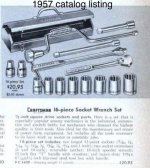
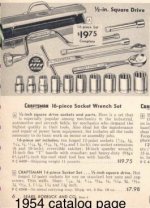
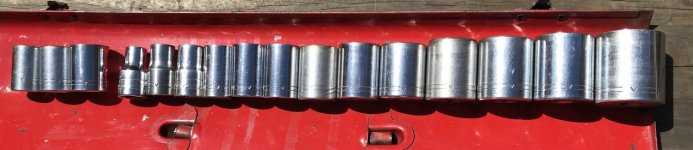
I don’t know if your socket research has led you to read through the Heritage thread, but back in November I happened on a set of =v= 1/2” drive sockets that were Cadmium plated rather than the much more common Chrome plating. There was some discussion at that time and I looked through my Craftsman tools and realized that I had several more Craftsman Cadmium plated tools. I looked at a couple of catalogs and noticed that Sears had bragged about “TRIPLE PLATED***chromium over nickel over copper” in the 1949 catalog but by 1951 they mentioned that the tools were simply “plated, finished and machine polished for protection against rust.” My take on the difference in advertising indicated that they had gone to less expensive Cadmium plating as a cost cutting measure. I suspect that the resulting dull finish wasn’t a hit with customers used to shiny Chrome tools and that Sears quickly switched back to Chrome in order to regain their popularity. Here are some pictures of the set, other cad plated tools and the two different catalog pages.
-Don

During the years that the cad plating was used, the Korean war was going on, and there was a severe shortage of nickel. Cars made during that time had inferior chrome plating because they plated chromium directly over copper without the nickel in between. The chrome didn't bond well with the copper and peeled badly. I think that Craftsman wouldn't plate like that because of the peeling problem, so they used cad plating instead.
 
OP
L

Lesserstore

Well-known member
Joined
Mar 18, 2020
Messages
863
Location
Texas
During the years that the cad plating was used, the Korean war was going on, and there was a severe shortage of nickel. Cars made during that time had inferior chrome plating because they plated chromium directly over copper without the nickel in between. The chrome didn't bond well with the copper and peeled badly. I think that Craftsman wouldn't plate like that because of the peeling problem, so they used cad plating instead.

Makes sense, same reason why companies didn't do it in WW2.
 

c1504

Well-known member
Joined
Mar 24, 2019
Messages
362
Thanks Lesserstore and DadsTools. I figured there was no simple way to tell. I have definitely noticed that the wrenches got thicker over time, but I don't have enough sockets to have noticed the change on them.
 
OP
L

Lesserstore

Well-known member
Joined
Mar 18, 2020
Messages
863
Location
Texas
Updates: Details on steel used added to part I. Also I found V series sockets in a fall of 1947 catalog so I changed the name on all parts, does anybody know how to change the name on the thread?
 

Cruzan80

Well-known member
Joined
Jul 22, 2015
Messages
4,155
Location
Denver, CO
Thanks! I am noticing it only seems to have Fall/Spring catalogs, instead of hand/power tool catalogs. Still going to grab quite a few.

Edit: I keep getting a file not found on any of them. Anyone else having this issue?
 
Last edited:

Shelbylex

Well-known member
Joined
Jan 20, 2018
Messages
3,096
Location
MA
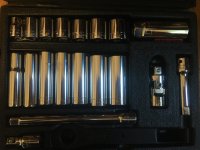
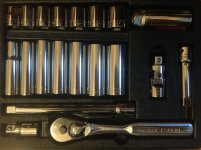
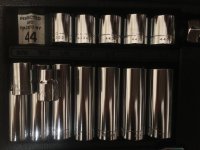
I got this set from the garage sale. It was missing a ratchet.
All deep sockets (minus spark plug one) and swivel are -V- (6 point), the rest are -G- (12 point), the extensions are -G-
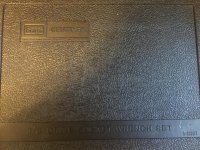
Pictures: the top of the box, the picture as it came, … not sure which ratchet was there originally, put a -V- one; and almost forgot to put a picture of the insert...
Interesting - except for 2-3 the sockets appear unused (and even the 3 were just a little dirty inside)

I guess sockets were combined from different factories

From the original attachment in the first post:
"-V- with model number- (Possibly as early as 1968) 1972-1986
VV- 1974-1989
G- 1979/80-1989"

 

Attachments

  • Craftsman1.jpg
    Craftsman1.jpg
    158.8 KB · Views: 24
  • Craftsman2.jpg
    Craftsman2.jpg
    146.2 KB · Views: 26
  • Craftsman3.jpg
    Craftsman3.jpg
    150.2 KB · Views: 23
  • Craftsman4.jpg
    Craftsman4.jpg
    132.4 KB · Views: 24
Last edited:
OP
L

Lesserstore

Well-known member
Joined
Mar 18, 2020
Messages
863
Location
Texas
I got this set from the garage sale. It was missing a ratchet.
All deep sockets (minus spark plug one) and swivel are -V- (6 point), the rest are -G- (12 point), the extensions are -G-
Pictures: the top of the box, the picture as it came, … not sure which ratchet was there originally, put a -V- one; and almost forgot to put a picture of the insert...
Interesting - except for 2-3 the sockets appear unused (and even the 3 were just a little dirty inside)

I guess sockets were combined from different factories

From the original attachment in the first post:
"-V- with model number- (Possibly as early as 1968) 1972-1986
VV- 1974-1989
G- 1979/80-1989"

Nice! I wish I could find a set in just usable condition. I never find stuff like that at garage sales in my area. I would buy online, but even if the price is good, shipping is just too high.
 

Shelbylex

Well-known member
Joined
Jan 20, 2018
Messages
3,096
Location
MA
Lesserstore, there are fixed price boxes in USPS. I wonder if buying a larger set of tools would be worth a shipping for you...
 
To avoid these ads, REGISTER NOW!
Top Bottom