To avoid these ads, REGISTER NOW!

Dr_Clyde's Shop Projects

dr_clyde

Well-known member
Joined
Jan 7, 2009
Messages
6,423
Location
Holland, MI
I figured it's about time for me to start a shop projects thread. This way I don't have to make a new thread for the little stuff.

My shop is a blend of fabrication and machining. I do a lot of one offs, repairs, prototypes, custom jobs and some small runs of production welding occasionally, but I try to avoid it when I can. I also do sanitary pipefitting on occasion, installing stuff like tanks and filters. It also gives me a nice place to work on my motorcycle and buddies hot rods.

To start things off, here are some photos of a job I'm finishing up right now. This is a flow control panel. There will be hard piping run to the back side, then as the brewers want to change the path of flow of whatever's inside the pipe, they change jumpers around on the front ports. Kind of like an old telephone switchboard.

I started with a piece of 1/4" stainless plate laser cut to my drawing.

22410068458_d0d076e80e_c.jpg

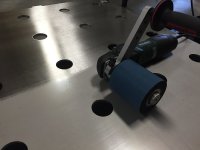
The laser shop said they only had a 2B finish, and it would be at least a week for the #4 brushed I needed. No sweat, an hour or two on the Metabo burnisher gives me a satisfactory finish.
22839567501_e4ca6e07da_c.jpg

22828375925_6969fc4c97_c.jpg

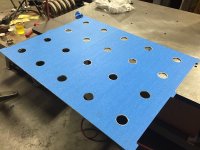
I covered the plate in masking tape to prevent scuffs and scratches for the rest of the build.
22814863102_f34e378d41_c.jpg
Next up was welding the two ferrules back to back through the plate.

22206047244_739d763c20_c.jpg

Each weld is purged and I rotate them as I weld so I can do it in one pass. I used my Miller Dynasty set to 35 amps with the lift arc enabled, walking the cup.

22410463527_528beb767a_c.jpg

These welds need to be sanitary, so I check the inside after each one to make sure they look like this.

22206085724_3783e096f8_c.jpg

Each weld then gets sanded with the tube sander so it fits into the hole and lines up with the others.

22206080194_459aafbf08_c.jpg

I set the plate on the table and make a frame for the outside. This keeps such a large plate from flexing. Then I block the frame up so the ports are exposed evenly on each side. They get tacked, then re-purged for the fillet welds to hold them in place. When I tack them, I run a piece of square tube across them and hold them down with clamps. This makes sure they don't move out of plane. The flat ground table helps by having a plane big enough and flat enough to fit such a large plate.

22640329310_352e1fc995_c.jpg

After a bit of welding, it looks like this. They are all held in place by the jumpers while welding. This serves two purposes, it gives a path for the purge, and prevents them from moving.
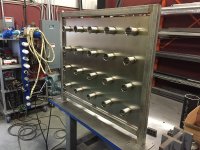
22409945407_e3e0b45103_c.jpg

I will finish welding the floor plates on, then passivate and clean each weld. Then the pipefitter will run the hard pipes to the back while I start on the next job. I'll try to get a photo when it's complete and installed.

That's all for now. Thanks for looking.
 
To avoid these ads, REGISTER NOW!

JonnyMac

Well-known member
Joined
Dec 15, 2012
Messages
845
Location
Victoria, Australia
Awesome... so for the less capable of us out here can you explain your technique for turning whilst welding, my circular welding capability is **** at the best of times i cant imagine how i could concentrate enough to turn the pipe at the same time as welding it!!
 
OP
D

dr_clyde

Well-known member
Joined
Jan 7, 2009
Messages
6,423
Location
Holland, MI
Awesome... so for the less capable of us out here can you explain your technique for turning whilst welding, my circular welding capability is **** at the best of times i cant imagine how i could concentrate enough to turn the pipe at the same time as welding it!!

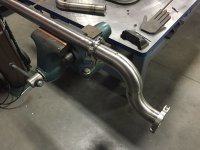
It probably sounds more complicated than it really is. What I do is attach something called a "purge spool" and really that's just a fancy term for a length of pipe with 2 ferrules on the ends. What that allows me to do is get ahold of whatever I'm welding and manipulate it while purging and welding without burning myself.

In the case if the flowplate the ferrules were tacked inside the plate then attached to the spool. In more general work, I rest the spool in the copper vise jaws and slowly rotate it with my left hand while walking the torch with my right.

Here you can see the purge spool hooked up to the gas supply on the left and the work clamped on the right.

22819975072_72bf8195d6_c.jpg

22807478276_0c77ab1c81_c.jpg

The copper jaws act like a slip ring and let me weld while spinning the work without any arcing, although it works without them.

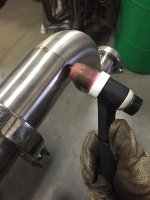
This is how I hold the torch. All I do is wait until my puddle is hot enough and then walk the puddle all the way around, resulting in a 100% penetration sanitary weld.

22833491325_c3175520f5_c.jpg
 

bonneyman

Well-known member
Joined
Apr 22, 2010
Messages
8,754
Location
Desert SW
Slick! :thumbup:

I wish I could weld like that. My welding gets the job done, but they often look they were done by a buck-toothed beaver.:lol_hitti
 
OP
D

dr_clyde

Well-known member
Joined
Jan 7, 2009
Messages
6,423
Location
Holland, MI
Another quick shop project I did the other day, I made a tree for my clamps. They were EVERYWHERE and it was a pain to get at them when I was working on something. This thing is within arms reach of the welding bench so I can grab a clamp at any time.

Pretty simple, just a chunk of 1-1/2" steel plate with a pipe and some rings welded on, but it does the job.


Started out looking suspiciously like another kind of pole... :pimpflash

22210728004_fb5ac0910a_c.jpg

Rolled some steel rings

22212329233_83995634f6_c.jpg

Tubing was notched with a 2" end mill in my Cincinnati universal for a nice fit.

22807445226_07d97014a6_c.jpg


All loaded up.

22819962782_10621987e6_c.jpg


Small clamps up top.

22819958822_9c6de28022_c.jpg

Big ones on the bottom.

22645474840_c1a103d9d6_c.jpg

Works really great, I plan to add casters to the bottom and probably paint it at some point, although I may not due to it getting all banged up.
 
To avoid these ads, REGISTER NOW!
OP
D

dr_clyde

Well-known member
Joined
Jan 7, 2009
Messages
6,423
Location
Holland, MI
Here is a strange little device I made called a Hop Candle. It is used in dry hopping beer during fermentation. Basically, beer is pumped from the fermenter and swirled into a smaller auxiliary vessel with a bunch of hops. As the hops mix into the beer and yeast they break down and get smaller. Once small enough they can pass through the holes in the screen and return to the fermenter via the 3" port in the bottom with the beer.

The first one I made was too thin and collapsed when it got clogged, so this one is a slightly beefed up version. Turns out a 10HP pump can generate a pretty good vacuum. :willy_nil

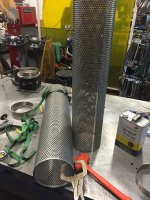
First thing was to roll a few cylinders out of perforated sheet. This is 11ga stainless with 1/4" diameter holes rolled to 8" in diameter.

22322653104_a573b50317_c.jpg


Fitup was basically a game of musical clamps. I held them together with ratchet straps then used vise grips to hold the sheet together where I was tacking.

22322633764_e3a4eb6df4_c.jpg

I made a little copper backer pad for the welding. It's made from a 1/8" thick drop from some other parts I made a while back. I had my buddy Duane at the sheet metal shop bump it in the press brake to get the inside radius of the inside of the screens. That way I had something to clamp against and allowed the weld to not get all oxidized. Its kind of a pain to purge perforated steel...:lol_hitti

22945355395_0284834402_c.jpg

Once seamed up I made a cap for the top and the cone triclamp assembly for the bottom.

22956469131_d2b0e6b8e6_c.jpg

22324183263_9d88a2f284_c.jpg

Getting the rolled cylinders to match up with the sanitary parts was kind of tricky. They weren't exactly 8", so some fudging was necessary. It was a welded joint though, so it doesn't need to be perfect.

22526978597_1bd1ca1759_c.jpg

I also added a 3/4" thick support bar structure in the middle to help prevent collapse. The black crunk you see in this picture is actually grit from the buffing pad I was using on the outside. The perf. acts kind of like a cheese grater.

22945324585_ded345bd13_c.jpg

All welded up. Finished length was about 7 feet long.

22324188593_37dd159cab_c.jpg

Thanks for looking.
 

JonnyMac

Well-known member
Joined
Dec 15, 2012
Messages
845
Location
Victoria, Australia
Got a buddy who is a brewer in a large craft brewery. Ive had a few tours of the place. The stainless work is great to look at i recommend having a look around any brewery if you like quality welding!!
 
OP
D

dr_clyde

Well-known member
Joined
Jan 7, 2009
Messages
6,423
Location
Holland, MI
I recently bought a new lathe for my shop, and as I have been settling in to using it I am noticing the slight differences between my old Sheldon R15 and the new LeBlond. (thread on the new lathe: here)

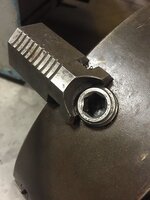
Anyway, whilst inspecting the new 14" four jaw chuck I noticed that it had a hex drive for the chuck jaws. I hadn't noticed and just assumed that the chucks were keyed alike. Oh well, I guess I hafta make a chuck wrench.

23138409481_55eaa1046a_c.jpg

I started with this. Some 9/16" hex stock for the business end, some 1-1/4" cold rolled for the body, and some 5/8" stainless for the handle.

22734901969_1160381b75_c.jpg

Astute observers will notice that the chuck jaw is rather close to the drive socket, so I needed to turn down the body a bit to clear the jaw when it's retracted all the way.

I chucked it up in the LeBlond and buzzed it down to 7/8", which matched the wrench from the Kalamazoo. While it was spinning I added a small radius to the corners to make it easy on the hands. I also bored the end 5/8", which is slightly smaller than the vertices of the hex stock.

22734614689_646ae734c4_c.jpg

Next stop was the Bridgeport mill to poke a 5/8" hole for the handle. Pretty much cream cheese machining, no tolerances, no prints, just whatever looks right and feels good in the hand works.

23138400381_df90b6e39c_c.jpg


The drive key I just knicked the edges off so it would slide into the hole I bored in the body.

23138445981_f8582ef26b_c.jpg

22504159024_d46f54a00e_c.jpg

Because the handle is stainless steel and the body is CRS I used 309 stainless filler wire to weld the handle onto the body. And just for ha-has I welded the hex in with the 309 too. Mostly because I already had it in my hand.

22505657523_4ea74429ab_c.jpg

23100803826_ab044ef11d_c.jpg

Looks like she's a runner.

22734557219_bc3961d4be_c.jpg

22734548679_e80cf711d1_c.jpg

Thanks for looking.
 

readhead

Well-known member
Joined
Dec 8, 2012
Messages
6,175
Location
Durango, Co.
Very nice work. Reminds me of my sheet metal days in San Diego. Worked on call at the VanCamp tuna plant for three years doing custom SS work and process piping. The taco "meat " machine went down at the Jack in the Box plant and they needed an auger built to get back on line. The company said five weeks. No good, so they brought me the mangaled one and said make a new one. Quite the puzzle. Didn't have a tool to roll the flatbar into that tight of a sprial. Did some ciphering and cut a bunch of donuts and cut them and stretched them to make a sprial. Got them back on line in three days.

I like the clamp tree. It looks like you must be the only one that uses the clamps. All the pads are on the Bessy 's. They seem to go missing in my shop and nobody knows where they go. As of January first I will have no more employees. It will be just my son and myself and boy am I looking forward to that.
 
OP
D

dr_clyde

Well-known member
Joined
Jan 7, 2009
Messages
6,423
Location
Holland, MI
For a couple of months now, I've had a NOGA Mini-Cool sitting in my toolbox awaiting the ambition to make all the needed bits to hook it up. Well today I had to do a few deep slots in the mill and was annoyed by the sprayer pump on the bottle not working very well. I decided "the hell with it, I'm going to get that NOGA hooked up.

If you're un-aware, siphon style coolant misters have a nasty habit of creating a noxious fog if you run then for extended periods of time. You can fix this by making a positive pressure coolant system instead of a siphon style. This also has the advantage of being able to do flood coolant, which is nice for some operations. Parting stainless on the lathe comes to mind.

Unfortunately, this amounts to more than just hooking it up to the air, dropping the line in a bucket and going to town. I needed to modify the linework, create a pressure vessel, and do some plumbing.

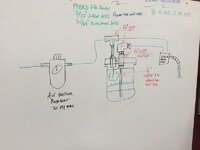
Here is my chicken sketch on the whiteboard.

23595816495_d6b2e11464_c.jpg

Pretty simple when you break it down to the component level. Regulated air goes both to the mini cool directly, and back pressures the coolant tank to provide the needed push to get the coolant to the nozzle without a siphon.

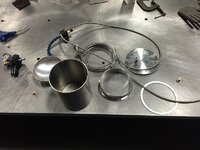
Here is my pile of parts I scrounged from the far corners of the shop.

23595813445_1fa7c5c822_c.jpg

My plan was to make a 6" diameter tank with a dished bottom, removable top, and be easy to clean. Coolant gets pretty funky if you let it. I decided to use a sanitary triclamp connection for the top, because it's easy to get apart repeatedly, and makes a seal that can handle pressure. The rest of the parts are just 6" sanitary tube weld parts and standard NPT fittings.

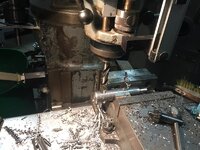
First step was to bore a couple of holes in the cap to accept the pipe couplings. The first one was easy, because it was centered, and I could just bore it in the lathe.

22968739983_1868c0cd20_c.jpg

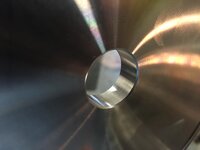
Not a bad finish for a surface you'll never see.

23487238612_c9742e1bb0_c.jpg

The next one I did in the mill, purely because I didn't want to set up the 4 jaw to bore an offset hole. Way faster to do it in the bridgeport.

22968721593_ae6e0bd8b4_c.jpg

23487230212_67beee81c8_c.jpg

I needed to do the lid first so I could use the pipe connections for the argon purge when I weld the tank.

22968707353_2821f0d20d_c.jpg

Here is the tank tacked and getting the purge set up.

22967605294_19b7f31a25_c.jpg

23487205552_d98cb802f9_c.jpg

23513350541_0df3793589_c.jpg

The odd shape and location of the supply and vent holes meant I needed to purge at a low CFH and for a long time. Since I don't have an oxygen meter yet, I prefer to err on the side of caution. I set the purge gas for 5 CFH and then went to dinner for 2 hours. When I got back, I bumped the purge up to 30 so I'd have some back pressure to support the weld pool.

Between welds I needed to let my torch cool, so I set about making the dip tube. This consisted of boring a hole in a brass plug and silver soldering in a length of copper tube.

23595738705_b575d5cd82_c.jpg

22967569304_0e1c543d49_c.jpg

Words of experience here, copper vise jaws are terrible for brazing or soldering small things. They **** the heat out faster than you can put it in.

I ended up just threading the plug into a coupling, and it heated up almost too fast.

22968669913_21ed83775a_c.jpg

The tank weld outside before buffing. Welded autogenously at 65 amps, no root gap, walking the cup.

23513461431_694ca6cfbb_c.jpg[/url]

And the inside. The advantage to using the argon purge makes it possible to get a clean, smooth root face all tied in with full penetration, all from the outside of the vessel.

23569828156_46523681d8_c.jpg

Getting there.

23513461621_0eb6a9ef00_c.jpg

I buffed the oxides off with a scotchbrite deburring wheel on a die grinder while the part spun on the lathe. Makes it easier to get a nice consistent finish.

23513451131_5bcda370f5_c.jpg

All put together with the hanging hardware and connected to the mini cool.

22968778563_5b1acb4ffe_c.jpg[/url]

22968767743_9a9c6dd11c_c.jpg

23595821915_d590eea120_c.jpg

22967560724_e24959a055_c.jpg

That's all for now, I'll get some action shots when I get it mounted on the mill. I did test it and it works great. I'm still trying to work out some kind of cleat/disconnect to make it easy to move around from machine to machine.

Thanks for looking.
 

Jeeper

Well-known member
Joined
Dec 25, 2006
Messages
2,124
Location
Round Rock, TX
So pretty and shiny.

Seriously, awesome work. Thanks for taking the time to share. I will refrain from showing my booger welds on this thread. Wouldn't want to sicken everyone.
 

plow

Well-known member
Joined
Feb 12, 2013
Messages
1,024
Location
Louisiana
I made one from a portable fire extinguisher (SS Shell) very similar to yours (in operation ONLY) with bits and pieces laying around. It works pretty good.
 
OP
D

dr_clyde

Well-known member
Joined
Jan 7, 2009
Messages
6,423
Location
Holland, MI
It's been too long since my last post, I apologize. Things have been really busy lately, but I will fill you in on what's been going on.

For starters, I am moving my shop. Due to some unfortunate circumstances with my current landlord, I have to relocate. I had it too good for too long, and it was only a matter of time before the other shoe dropped. I am downsizing a bit, not really by choice, but that's life. I found a place within my budget that will allow my business to continue unhindered, but on a slightly smaller footprint. I'll just have to be more careful about what rusty junk I drag home. :D

For the last few years, I have worked full time out of my shop in conjunction with my day job. It was a mutually beneficial arrangement that worked great but its time to move on. Trying to run a business in the evenings and weekends and also work full time is starting to wear me a bit thin, so this has been a good opportunity to re-assess my priorities and where my career is headed. It is an exciting point in my life with some great potential.

For now, I can't leave the day job, but I will continue to grow my shop until I can make it pay for all my bills, and not just itself. The work is not showing any signs of slowing down, and I have no intention of slowing down. I am in the process of moving now, and I am anxious to get the spindles turning again.

Here is a shot of the empty new digs. Machinery goes live in 2 weeks. :rocker:

24984982795_49b41c3e4a_c.jpg
 
To avoid these ads, REGISTER NOW!
Top Bottom