
You are using an out of date browser. It may not display this or other websites correctly.
You should upgrade or use an alternative browser.
You should upgrade or use an alternative browser.
Above 1200 Sq/FT Eastern Washington Workshop
- Thread starter slodat
- Start date
Wokspaces above 1200 squarefeet.
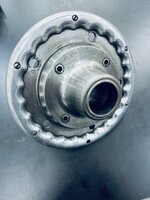
The holes on the end are for through spindle coolant. I don’t know what the side holes are for. I did some looking online and I haven't found anything. Hive mind suspects Haas is rebranding YG1 shrink fit holders. That's consistent with what I see in their catalog. I don't find a reference to the holes on the outside though. They are threaded..What are the holes around the circumference and on the face of the tool holder projections?
The big jet grinder is working out really well for the steel parts I’m making. I have decided to keep the tool rests in place.
The magnetic chuck has been a game changer for sanding small parts.

Some of what I made today:

And a few variations on this, with welded gussets.
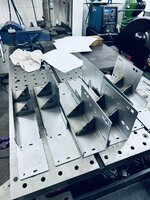
Close up one of the better looking welds.

The magnetic chuck has been a game changer for sanding small parts.
Some of what I made today:
And a few variations on this, with welded gussets.
Close up one of the better looking welds.
Cross posting as requested::
I make a lot of parts out of 14ga cold rolled, and 11ga HRPO (hot rolled pickled & oiled) steel sheet. I cut on a CNC plasma. The plasma is tuned as good as I’m able to get it. Minimal dross. I then make a pass around all cuts with a big beefy pedestal grinder to knock the dross off. Through holes always require a pass with a roloc disc. Then I sand both sides with 60 grit on a RO sander. The process works great and I’m happy with the results for the parts I’m making.
Deep down I know I’m breathing in metal dust from these processes. I wear a full face respirator when I’m working on a big batch, but not always. This has me considering a downdraft table. I saw this one on Grizzly’s site. They are out of stock and I’m not a huge fan of Grizzly generally speaking. Not a deal breaker as all the import resellers are selling stuff from the same factories.
That got me looking and I found this model from GMC tools, another seller of import machines.

This unit is wider, and about the same price. And in stock.
I’ve seen the Baleigh and similar offerings. I do think I like this style. All I’m seeing on the used market is beat up shite.
Interested what others have, recommend, or know of that I may be missing. Hoping to stay under $10k.
Thanks in advance!
I make a lot of parts out of 14ga cold rolled, and 11ga HRPO (hot rolled pickled & oiled) steel sheet. I cut on a CNC plasma. The plasma is tuned as good as I’m able to get it. Minimal dross. I then make a pass around all cuts with a big beefy pedestal grinder to knock the dross off. Through holes always require a pass with a roloc disc. Then I sand both sides with 60 grit on a RO sander. The process works great and I’m happy with the results for the parts I’m making.
Deep down I know I’m breathing in metal dust from these processes. I wear a full face respirator when I’m working on a big batch, but not always. This has me considering a downdraft table. I saw this one on Grizzly’s site. They are out of stock and I’m not a huge fan of Grizzly generally speaking. Not a deal breaker as all the import resellers are selling stuff from the same factories.
That got me looking and I found this model from GMC tools, another seller of import machines.
This unit is wider, and about the same price. And in stock.
I’ve seen the Baleigh and similar offerings. I do think I like this style. All I’m seeing on the used market is beat up shite.
Interested what others have, recommend, or know of that I may be missing. Hoping to stay under $10k.
Thanks in advance!
Last edited:
Short answer is definitely not. Longer answer:
Guessing $2500 in filters, proper blower, motor controls, steel, paint, etc. It would easily take me more than a week to design, fabricate, paint, assemble. Not to mention the time to get all the parts.
Time is my most limited resource. That’s not to say I’m rolling in dough. If I had the time to design and make a downdraft table of comparable features, performance, and quality compared to what I’m considering buying- I would use that time to run parts that I have in the queue.
Things are different once the shop and tools are how a guy makes a living. I think the downdraft table could easily be a 100 hour project to do it reasonably well.
I have definitely considered making one. Once I started really looking at the three stage filtration systems I’m seeing, I realized I’m better off buying one. There’s more to a proper setup than a fan and filter.
My day to day reality is just adding something to the shop that is ready to go when it gets here is still a challenge when it comes to time.
GREAT suggestion. Thank you! Typing this out made it even easier to make a decision.
Guessing $2500 in filters, proper blower, motor controls, steel, paint, etc. It would easily take me more than a week to design, fabricate, paint, assemble. Not to mention the time to get all the parts.
Time is my most limited resource. That’s not to say I’m rolling in dough. If I had the time to design and make a downdraft table of comparable features, performance, and quality compared to what I’m considering buying- I would use that time to run parts that I have in the queue.
Things are different once the shop and tools are how a guy makes a living. I think the downdraft table could easily be a 100 hour project to do it reasonably well.
I have definitely considered making one. Once I started really looking at the three stage filtration systems I’m seeing, I realized I’m better off buying one. There’s more to a proper setup than a fan and filter.
My day to day reality is just adding something to the shop that is ready to go when it gets here is still a challenge when it comes to time.
GREAT suggestion. Thank you! Typing this out made it even easier to make a decision.
lilscorpion
Well-known member
One trick I leaned for welding gussets (regarding your “better looking” comment) is to minimize the weld on the gusset to just what’s needed for it to perform its function. If you have penetration you won’t need more that 1/2” of weld. I’d run a half inch bead on either tip and spot in the root of the triangle, maybe even remove it in favor of a chamfer. Would cut your welding time by a 3rd I’d bet too. Reducing the heat put into the part will help prevent warpage which is never a bad thing too.
What size wire are you using?

What size wire are you using?
Matt - thank you for the advice! That makes a lot of sense! They are fully welded because that's what's called out on the drawing. The drawing originally called for full weld on both sides. I was able to convince the engineer one side is plenty adequate. They over engineer the **** out of these parts. That is 11ga (0.120").
What I was saying about the weld is I'm finally starting to get MIG welds that look like the photos I see online. I'm completely self-taught. I really appreciate and welcome feedback and advice in general, and especially so with welding!
What I was saying about the weld is I'm finally starting to get MIG welds that look like the photos I see online. I'm completely self-taught. I really appreciate and welcome feedback and advice in general, and especially so with welding!
lilscorpion
Well-known member
Fully welded is wat stronger. I forget that you’re building parts to a spec…that does make difference
I have watched your thread for years, I'm 100% sure with a 100 hours you could design and build something superior to what is on the market in the 7-10k price range. It is also custom to you and your space and needs. They are relatively simple, I've build quite a few for painting and composites work. Filtration is not rocket science. Pick the right filter, put the right amount of airflow through it, win. That information is readily available on the interweb. You can get fancy with baffles and cyclone for larger particles and filter life if you really want to.Short answer is definitely not. Longer answer:
Guessing $2500 in filters, proper blower, motor controls, steel, paint, etc. It would easily take me more than a week to design, fabricate, paint, assemble. Not to mention the time to get all the parts.
Time is my most limited resource. That’s not to say I’m rolling in dough. If I had the time to design and make a downdraft table of comparable features, performance, and quality compared to what I’m considering buying- I would use that time to run parts that I have in the queue.
Things are different once the shop and tools are how a guy makes a living. I think the downdraft table could easily be a 100 hour project to do it reasonably well.
I have definitely considered making one. Once I started really looking at the three stage filtration systems I’m seeing, I realized I’m better off buying one. There’s more to a proper setup than a fan and filter.
My day to day reality is just adding something to the shop that is ready to go when it gets here is still a challenge when it comes to time.
GREAT suggestion. Thank you! Typing this out made it even easier to make a decision.
That being said, I understand. It is completely an economic question. If you think it is $2.5k in parts and a hundred hours. If you are making $50 an hour and building your brand anything less then $7.5k it makes absolutely no sense to build it. If you are bringing in $200 an hr that number jumps to $22.5k. Semi annually on GJ we have the conversation about Grainer/MSC/Snap Un/etc. Yes I can find tools and material cheaper, but it is not worth my time to search out a better price, order, invoice and wait. It is worth it to make a 30 second call, have the items show up quickly and have all the accounting automatically taken care of. The build buy discussion is the exact same. Time is money.
Thank you! I agree on all those points. It’s not that I don’t think I can make something that works well. I can. It comes down to there’s only so many hours in a day. I worked 42 hours Monday - Wednesday of this week to get a project done and shipped. Generally speaking, I’m at or approaching the point where if I don’t need to do it for a client, I probably need to at least consider buying or paying someone to do it. Like I said before, I’m not rolling in dough. The value of my time continues to increase.
A functioning, well built anything is probably going to be better than my first go at it. I definitely don’t have the time or interest in iterating on a downdraft table design. As one example. I really appreciate the conversation and ideas.
I’ve been looking at a comfortable PAPR as well. I like what I read about the Optrel Swiss Air.
We got a project to rebuild a section of switchboard that was damaged. It was dropped or something. Hard to tell exactly what happened. We made the replacements for damaged internal bottom frame structure, one of the other internal supports, and all of the external covers on three sides.
What we started with:
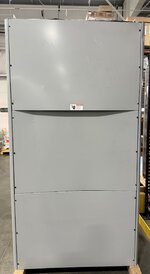

There was both a lot of damage, and a lot of parts that were unharmed. We first got the frame put back together and square.
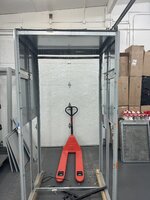
The painted front and back are what I made here.

Then I started on the skins. Started with the most difficult looking part. It has 288 small square holes.

I modeled the part and put together the CAM to cut the holes. I programmed it to skip around to help spread the heat being put into the part. It worked well.

I ran into some challenges with the plasma and finally sorted through a somewhat random problem I was noticing. With that sorted out we were in business. This little hassle was my fault, cost me about six real hours of productivity, and created scrap out of 3.5 sheets of 14ga CRS.
The new cover sitting in place:

Getting there:
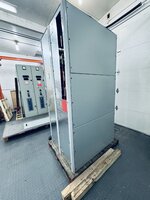
A LOT of work, some frustration, even more learning, and a lot of success resulted in this:

Wrapped up and on the way!

The end user would have had to wait 6+ months for a replacement. Fun project. Hoping to do a lot more of them.
A functioning, well built anything is probably going to be better than my first go at it. I definitely don’t have the time or interest in iterating on a downdraft table design. As one example. I really appreciate the conversation and ideas.
I’ve been looking at a comfortable PAPR as well. I like what I read about the Optrel Swiss Air.
We got a project to rebuild a section of switchboard that was damaged. It was dropped or something. Hard to tell exactly what happened. We made the replacements for damaged internal bottom frame structure, one of the other internal supports, and all of the external covers on three sides.
What we started with:
There was both a lot of damage, and a lot of parts that were unharmed. We first got the frame put back together and square.
The painted front and back are what I made here.
Then I started on the skins. Started with the most difficult looking part. It has 288 small square holes.
I modeled the part and put together the CAM to cut the holes. I programmed it to skip around to help spread the heat being put into the part. It worked well.
I ran into some challenges with the plasma and finally sorted through a somewhat random problem I was noticing. With that sorted out we were in business. This little hassle was my fault, cost me about six real hours of productivity, and created scrap out of 3.5 sheets of 14ga CRS.
The new cover sitting in place:
Getting there:
A LOT of work, some frustration, even more learning, and a lot of success resulted in this:
Wrapped up and on the way!
The end user would have had to wait 6+ months for a replacement. Fun project. Hoping to do a lot more of them.
Finallygotit
ALLIANCE MEMBER
Steven, how long did that project take from receiving it to shipping it back out?
6+ months is a long lead-time to get a replacement.

6+ months is a long lead-time to get a replacement.
Finallygotit
ALLIANCE MEMBER
Long days but the end result looks great. I'm sure the end customer is quite happy as well.
I modeled the part and put together the CAM to cut the holes. I programmed it to skip around to help spread the heat being put into the part. It worked well.
I saw the video on your IG of cutting it out and was curious why it was skipping around...makes sense now! Thanks for explaining
I selected each of the 288 squares in the most random way I could. It was nearly painful. The result was the torch ran back and forth. I didn’t see any evidence of excessive heat. I didn’t have time available to test to see if letting Fusion do its optimal path would be okay.I saw the video on your IG of cutting it out and was curious why it was skipping around...makes sense now! Thanks for explaining
lilscorpion
Well-known member
When I stated reading the post I thought you’d switch the squares to holes and drill them instead since your setup is equipped. Impressed the remaining material didn’t end up a twisted mess. Nice job! Bet the customer was happy as piss. It having ti wait months to put it into service.
Thanks, Matt! I started with the most difficult cover first. The grill area looked intimidating at first. The CAD is getting so much easier these days. I wanted to do everything I could think of to help manage the heat input into the material.When I stated reading the post I thought you’d switch the squares to holes and drill them instead since your setup is equipped. Impressed the remaining material didn’t end up a twisted mess. Nice job! Bet the customer was happy as piss. It having ti wait months to put it into service.

And a little closer:

The most difficult part was selecting each square in a somewhat random order. I am really happy with how well it turned out. There was a bit of a warped section in the center grill, but it was sorted out by the press brake turning the flanges.
The interesting thing about the customer side is that we don't really hear anything from the end user, the contractor, etc. It's more a thing of no news is really good news. The repaired section was at the jobsite and being slid in place early yesterday morning. Pretty cool!
@rvieceli Ron - I'm always interested to hear firsthand feedback on machines, tools, etc. '
Another project through the shop. Customer needed a panel interior mounted in a NEMA3R enclosure. Pretty straightforward. They had some specific size constraints. First I made a backplane to mount the interior. This attaches to the factory standoffs.

I made it out of way too thick of material. Lesson learned. It was on the table, and it sounded like a good idea. In the end, 14ga would have been fine. The studs are (obviously) welded from the back.
A small chunk had to be trimmed off the vertical rails in order to get it inside the flanges of the new enclosure.

At that point the interior was in.


Next up was making the side covers.
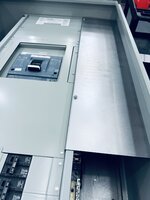
I had to go with a two piece cover so it will pass the door flanges when being installed. Last part to make was the bottom cover. It needed to be 1/4" shorter.

Painted and ready to package.

Wrapped up and ready to send down the road.

I've been working on my supply chain this year. The words "supply chain" sound a little ridiculous for some reason. Nonetheless, I am now getting better pricing on the foam I use in the tooling kits. My initial order:

Another project through the shop. Customer needed a panel interior mounted in a NEMA3R enclosure. Pretty straightforward. They had some specific size constraints. First I made a backplane to mount the interior. This attaches to the factory standoffs.
I made it out of way too thick of material. Lesson learned. It was on the table, and it sounded like a good idea. In the end, 14ga would have been fine. The studs are (obviously) welded from the back.
A small chunk had to be trimmed off the vertical rails in order to get it inside the flanges of the new enclosure.
At that point the interior was in.
Next up was making the side covers.
I had to go with a two piece cover so it will pass the door flanges when being installed. Last part to make was the bottom cover. It needed to be 1/4" shorter.
Painted and ready to package.
Wrapped up and ready to send down the road.
I've been working on my supply chain this year. The words "supply chain" sound a little ridiculous for some reason. Nonetheless, I am now getting better pricing on the foam I use in the tooling kits. My initial order:
The forklift continues to be a great addition to the shop. I picked up my biggest load of sheet metal yet in the F150. 1500 pounds - 10 sheets of 14ga CRS and two sheets of 11ga HRPO.

The truck squatted a little. I could tell there was some weight in the bed. It handled it well. The 14ga is on top. It gets unloaded onto the 4x8 table:

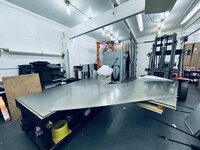
There's 12 sheets of 14ga and two 12ga. Quite a bit of weight. I definitely can not roll the table on the floor tile with this much weight.
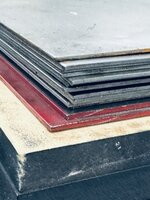
This works really well. When I need 14ga its easy to slide a sheet onto the plasma. Once that's unloaded, the 11ga is stacked on pallet.
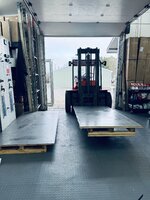
Haas had another one of their ******* sales!

The two boxes top center and top right I already had, the rest of the pin gauges, pin gauge holders, setup blocks, and all the thread gauges came from the Haas sale. Came in right at half price. At some point I'd like to get pin gauges up to 1". Can't complain, just tends to hit the checkbook kinda hard
A guy advertised a new in the box Atlas collet chuck. It's a modern copy of the Hardings Sjogren style. A 2J version came with my Pacemaker. These are really nice for collet work. Much better than a draw bar style collet closer for my Acra lathe. On the Acra the lever bears on the belt cover which is made of fiberglass. It's bound to crack or break with a lot of use. Anyway the advertised new chuck was not near the "you'll never see a better deal" he advertised. This got me back on ebay looking at used. A couple of low ball best offers and I ended up with a 2J and a 5C version for the Acra. For much less than the so called good deal. The 2J is in great shape and ready to put in work.
The 2J collets go up to 1-3/8. I have a set in sixteenths up to 1-3/8. I have a very comprehensive collection of 5C collets, so it's not all lost having a 5C version as well. I think it needs a bath in evaporust. Or maybe just a disassemble and trip through the ultrasonic. The action is smooth and threads are in good shape. I really like the older style metal hand wheels.

As I continue production on my products I make improvements where I can. The work in progress blocks for the brass pins worked out really well.

The CNC Hardinge is doing a great job on these small turned parts. SO much better than turning and threading on a manual lathe.
The truck squatted a little. I could tell there was some weight in the bed. It handled it well. The 14ga is on top. It gets unloaded onto the 4x8 table:
There's 12 sheets of 14ga and two 12ga. Quite a bit of weight. I definitely can not roll the table on the floor tile with this much weight.
This works really well. When I need 14ga its easy to slide a sheet onto the plasma. Once that's unloaded, the 11ga is stacked on pallet.
Haas had another one of their ******* sales!
The two boxes top center and top right I already had, the rest of the pin gauges, pin gauge holders, setup blocks, and all the thread gauges came from the Haas sale. Came in right at half price. At some point I'd like to get pin gauges up to 1". Can't complain, just tends to hit the checkbook kinda hard
A guy advertised a new in the box Atlas collet chuck. It's a modern copy of the Hardings Sjogren style. A 2J version came with my Pacemaker. These are really nice for collet work. Much better than a draw bar style collet closer for my Acra lathe. On the Acra the lever bears on the belt cover which is made of fiberglass. It's bound to crack or break with a lot of use. Anyway the advertised new chuck was not near the "you'll never see a better deal" he advertised. This got me back on ebay looking at used. A couple of low ball best offers and I ended up with a 2J and a 5C version for the Acra. For much less than the so called good deal. The 2J is in great shape and ready to put in work.
The 2J collets go up to 1-3/8. I have a set in sixteenths up to 1-3/8. I have a very comprehensive collection of 5C collets, so it's not all lost having a 5C version as well. I think it needs a bath in evaporust. Or maybe just a disassemble and trip through the ultrasonic. The action is smooth and threads are in good shape. I really like the older style metal hand wheels.
As I continue production on my products I make improvements where I can. The work in progress blocks for the brass pins worked out really well.
The CNC Hardinge is doing a great job on these small turned parts. SO much better than turning and threading on a manual lathe.
One of the Cadet Hot One heaters gave up the ghost. I had nursed the motor for years and it finally seized. I looked high and low for another. Looks like Cadet sold to a bigger outfit and is no longer making these. The main thing I liked about the Cadet was how quiet they are for an electric forced air heater.
Reluctantly, I ordered a different heater. This Dyna-Glo from the depot. Much to my surprise, it is as quiet, or quieter than the Cadet. I wanted a simple control system because I manage the heat with a smart thermostat and HVAC relay. So far so good.
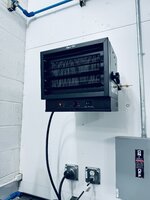

Reluctantly, I ordered a different heater. This Dyna-Glo from the depot. Much to my surprise, it is as quiet, or quieter than the Cadet. I wanted a simple control system because I manage the heat with a smart thermostat and HVAC relay. So far so good.
Finallygotit
ALLIANCE MEMBER
To be fair, their "sales" have cost me over $20k this year. And, I'm really grateful for their offerings, and price point. Or I wouldn't have near the setup I do. I have a buddy that said the same thing I did when we both got the email the other day.I laughed out loud at this one!

rmack898
Well-known member
You’re going to really like those collet chucks.
Absolutely! I’ve been eyeballing them for the Acra since I dragged it home two years ago.You’re going to really like those collet chucks.
With the Okuma in front of the roll up door, there’s no chance of using the Mohawk lift anytime soon. Quite a while back I ordered a socket to fit the lift arm lock nuts. I finally got tired enough of tripping over the arms yesterday.
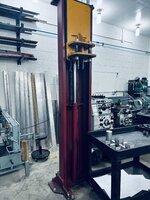
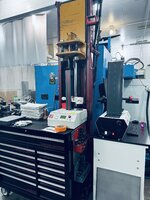
I raised the carriages to buy a touch more floor space. I think it worked out well. I’d rather store the lift in place for now than have to muscle it around. At some point I’ll be able to put it back in service. Some day.
It really opened up this area.
Last edited:

Finallygotit
ALLIANCE MEMBER
You will like that height gage. Mitutoyo makes some great inspection equipment.
Are you trying to single-handedly keep the economy rolling in the PNW?
Are you trying to single-handedly keep the economy rolling in the PNW?
NEW MACHINE DAY!!
Haha! Not really a new machine.
The Pioneer mini splits have performed okay over the years and have left a lot to be desired. I have had HVAC techs out three or four times to service them in the 8 years they have been in service. They leak down, and the techs never succeed in locating the leak. That, and they don't put out much heat to speak of below about 35F ambient outside temperature. When I installed them they fit my budget and they have been nice to have. A while back I had the local HVAC company come out and quote a new Mitsubishi mini split with their Hyper Heat. These units claim to heat down to -13F ambient outside temperature. The plan the whole time was to upgrade when it made sense.
Well.. today was the day for the first one.

A peek at the unpainted wall behind the old indoor unit.

Outdoor unit is significantly larger than the old unit. They are both 24k units.

I must say, I'm already impressed. My electric heaters have had to run to keep the shop above 65F for the last month since temps dropped. The Pioneer in the main bay struggled to put any heat out at all. The new Mitsubishi is cranking the heat out! Time will tell if this can handle the heat load of this 1200 sq ft bay.
I fired up the CNC router the last couple of days to make some parts for a client.

The router doesn't see a lot of use lately. It's still a rock solid, reliable machine.
Haha! Not really a new machine.
The Pioneer mini splits have performed okay over the years and have left a lot to be desired. I have had HVAC techs out three or four times to service them in the 8 years they have been in service. They leak down, and the techs never succeed in locating the leak. That, and they don't put out much heat to speak of below about 35F ambient outside temperature. When I installed them they fit my budget and they have been nice to have. A while back I had the local HVAC company come out and quote a new Mitsubishi mini split with their Hyper Heat. These units claim to heat down to -13F ambient outside temperature. The plan the whole time was to upgrade when it made sense.
Well.. today was the day for the first one.
A peek at the unpainted wall behind the old indoor unit.
Outdoor unit is significantly larger than the old unit. They are both 24k units.
I must say, I'm already impressed. My electric heaters have had to run to keep the shop above 65F for the last month since temps dropped. The Pioneer in the main bay struggled to put any heat out at all. The new Mitsubishi is cranking the heat out! Time will tell if this can handle the heat load of this 1200 sq ft bay.
I fired up the CNC router the last couple of days to make some parts for a client.
The router doesn't see a lot of use lately. It's still a rock solid, reliable machine.
Andrew S
Well-known member
I have been amazed at how much heat the Hyper Heat units can put out in our winter climate. I think you will like them very much.
It does pump out a lot of heat. The old unit was a trivial amount of heat. This thing is putting it out. I'm not sure it's enough capacity to heat this big space 30 x 40 x 13' without any electric heat to help it along. It will take some time to get a feel for what it can really do. I tend to keep it rather warm in the winter. A lot of my work is at the computer.I have been amazed at how much heat the Hyper Heat units can put out in our winter climate. I think you will like them very much.
So far, it is doing great. No electric heat to help it along today and it's a comfy 69F with an outside ambient of 36F.
cycle61
Well-known member
I'm going to try and figure out how to fit that 2-post lift in my residential garage that has only ever had a car inside once.
It’s funny.. the HVAC tech was just sure the new heat pump would be able to keep the main bay of the shop up to temp. I left it on max heat (88F) overnight. Ecobee remote sensors are showing 60F with an outside ambient of 27F. Definitely a lot more heat output than the previous unit. I’ve had a hunch that I’d need two units to keep up in that bay. 1950’s construction, essentially no insulation. I’m not mad, as I kinda knew a second unit would be what it takes. Maybe in the springtime.
rattle_snake
Well-known member

My shop has yet to go below 75, but it's nice to be able to have the doors open.
Good luck with the Mitsu. I went with a decent brand (Daikin) and have had no issues for 5 years.
I’m pretty sure if I added a second unit to this bay it would all but eliminate the need for the electric heat.
My shop has yet to go below 75, but it's nice to be able to have the doors open.
Good luck with the Mitsu. I went with a decent brand (Daikin) and have had no issues for 5 years.
I plan to replace the other unit in the machine room first.
I spent two weeks in the field working with a client on a switchboard retrofit project in a historic building in San Francisco. The building was opened in 1941 right around the time of the attack on Pearl Harbor. It was originally a bank. This photo is in the lobby showing the tellers from that era:

I took this photo through the door glass:

It’s worth saying, I’m a total sucker for old buildings. And tools, cars, all the things. We completed the first phase of the project on this mobilization. The existing equipment is in a concrete room with a fence style gate at the accessible end.
Once the utility cut power, things go really quick, in spurts. This is after demo:

I cut templates out of 1/8 mdf to layout the concrete anchor holes. These proved to be worth the effort. I was told all 36 anchors went in without incident.
Front view after demo:

The gear components were built by a few shops, and it was assembled offsite prior to installation. This really helped with confidence in things going together as designed. Significant disassembly was needed to get the sections in the space and tipped upright by the riggers.
The overhead main bus was not able to be made or modified offsite. This was done onsite. Some good friends of mine own another company that was on this project. They have a mobile fab shop trailer purpose built for these type of projects. They just added a small iron worker to their trailer. It made ALL the difference in getting the copper bus fabrication done onsite.
The overhead bus:

That’s @cycle61 up on that bus. He was up there the better (worse?) part of 14+ hours. At one point or another all of the three phase bus was removed, then back up there, and many holes punched with a portable electro-hydraulic punch they named the Honey Badger. The three phase bus had to be moved toward the wall on the left of the photo so it would line up with the new gear’s bus.
The project took about 61 clock hours. Most of the crew took breaks long enough to recharge a little and headed back in. It was a LONG weekend. I’m still recovering to some extent.
After:

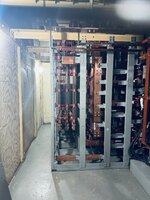
There’s three more sections to retrofit for phase two. They are small molded case breakers and it should be a lot less work. We will have to modify the overhead bus. Less, but still a lot of work.
My truck was loaded to the gills with tools and supplies.

Since we are only finished with one of two phases, it’s too early to exhale fully and call it a success. The lights are on and what was done is done well.
I took this photo through the door glass:
It’s worth saying, I’m a total sucker for old buildings. And tools, cars, all the things. We completed the first phase of the project on this mobilization. The existing equipment is in a concrete room with a fence style gate at the accessible end.
Once the utility cut power, things go really quick, in spurts. This is after demo:
I cut templates out of 1/8 mdf to layout the concrete anchor holes. These proved to be worth the effort. I was told all 36 anchors went in without incident.
Front view after demo:
The gear components were built by a few shops, and it was assembled offsite prior to installation. This really helped with confidence in things going together as designed. Significant disassembly was needed to get the sections in the space and tipped upright by the riggers.
The overhead main bus was not able to be made or modified offsite. This was done onsite. Some good friends of mine own another company that was on this project. They have a mobile fab shop trailer purpose built for these type of projects. They just added a small iron worker to their trailer. It made ALL the difference in getting the copper bus fabrication done onsite.
The overhead bus:
That’s @cycle61 up on that bus. He was up there the better (worse?) part of 14+ hours. At one point or another all of the three phase bus was removed, then back up there, and many holes punched with a portable electro-hydraulic punch they named the Honey Badger. The three phase bus had to be moved toward the wall on the left of the photo so it would line up with the new gear’s bus.
The project took about 61 clock hours. Most of the crew took breaks long enough to recharge a little and headed back in. It was a LONG weekend. I’m still recovering to some extent.
After:
There’s three more sections to retrofit for phase two. They are small molded case breakers and it should be a lot less work. We will have to modify the overhead bus. Less, but still a lot of work.
My truck was loaded to the gills with tools and supplies.
Since we are only finished with one of two phases, it’s too early to exhale fully and call it a success. The lights are on and what was done is done well.