To avoid these ads, REGISTER NOW!

Evolution of socket drive sizes over time

mikey03

Well-known member
Joined
May 17, 2024
Messages
2,038
I’m only in my 20s but I like to learn about history and talk to people who been wrenching for decades. Theres something I noticed and I’m wondering if I’m right if you guys agree.

seems like back in the day 3/8 drive didn’t exist it was all 1/4 and 1/2 drive.

then cars got a bit smaller as gas was getting more expensive in the 70s due to war or something. So 3/8 drive became handy to get to spots 1/2 was too big and 1/4 didnt havnt enough strength to handle the torque

now it seems like sockets and ratchets are getting stronger and 1/4 can do stuff that it didn’t honestly used to be able to do plus epa regs on mpg making cars even smaller so a need for smaller tools then before.

of course nobody giving up there 3/8 drive but it seems like you could go back to 1/4 and 1/2 again if you needed to. the upper end of 1/4 limits is getting higher with better tools. Just interesting if it’s true.
 
To avoid these ads, REGISTER NOW!

BlakeTheCarGuy

ALLIANCE MEMBER
Joined
Oct 10, 2018
Messages
9,313
Location
Roanoke Virginia
I think they have all been around for quite awhile. One you don’t hear much about is like 9/32nds drive I think it’s 9/32nds if I remember correctly and Allen head drive. Those are really old but I think it’s safe to say 1/4,3/8 and 1/2 have all been around for 50+ years if not longer. 3/8 is my most used drive and I couldn’t imagine wrenching without it. But I’m also in my 20s so maybe I’m not as qualified as some to answer but that’s just based on my antique tools and the old wrenchers I know.
 

jblnut

ALLIANCE MEMBER
Joined
Jan 17, 2015
Messages
6,964
Location
In the Middle of MN
I have two Husky sets in 9/16 hex drive and 13/16” hex drive. I use them but not often as they’re sort of collector items. There are more oddball drive styles out there than the standard ones we use today.

You need to dive into the world of big drive stuff. I am putting together a #5 spline drive set of sockets and am eyeing an IR impact that’s rated at 5,450ft/lbs. Gotta keep that out of the hands of the lube guys or you’ll never get those oil drain plugs loose :lol_hitti

Here is a picture of a 1” square to #5 spline adapter.
IMG_3348.jpeg
 

dnschmidt

Well-known member
Joined
Oct 3, 2014
Messages
7,261
Location
Phoenix, AZ
In Europe and Asia 1/4" and 1/2" are far more common than 3/8" drive. TOPTUL, for example, has extensive 1/4" and 1/2" drive stuff but much less 3/8" drive and they sell into both markets. 3/8" is king in America and has been for at least 50 years. 1/4" is getting more popular every day whereas 1/2" has become somewhat specialized to be only used on bigger stuff like suspension components.
 

Dave455

Well-known member
Joined
Mar 19, 2013
Messages
5,796
Location
Sussex, England
If you go way back, by which I mean late 19th / early 20th century, the type of drive hadn’t even been standardised at all. Many manufacturers utilised a hexagonal drive, for example.

But once square drives became standardised, 3/8” was one of the earliest.

Sure, some manufacturers were not big into it - Blackhawk, for example, first introduced their interchangeable socket wrenches in 1/2” drive, but by the late 20’s 3/8 was well established.

Snap On called it “Ferret”, and that legacy still lives on - 3/8 drive part no’s start with an “F”!

In the 1930’s Blackhawk introduced 7/16 square drive, purely as an attempt to make one drive size that would fulfil both roles.
 
Last edited:

four.cycle

Well-known member
Joined
Oct 19, 2015
Messages
28,525
Location
Tacoma, Washington
@mikey03 -
You are opening a can of worms here.
I'm not sure if anyone here has actually drawn up a chart of all the various drive sizes and their evolution through the years.

List of Socket Drive Sizes:

1/8" square drive (Snap-on - see post #18)

1/4" square drive
1/4" hex drive

9/32" square drive

5/16" hex drive (Walden 5/16" hex drive socket set)

3/8" square drive
3/8" hex drive

7/16" square drive (Blackhawk)
7/16" hex drive

.448 hex drive (Britool)

1/2" square drive
1/2" hex drive

9/16" square drive
9/16" hex drive (Hazet see post #47)(also HERE)

5/8" square drive
5/8" hex drive (Accles & Pollock - U.K)

11/16" hex drive

3/4" square drive

13/16" hex drive

7/8" hex drive (?)(not sure on this one) :headscrat

1" square drive
1" hex drive (Walden Worcester)

1-½" square drive (Snap-on)

^ I left the spaces deliberately... I think I'm missing quite a few. I'll update this as more entries are added to the thread. I can't remember all of them off the top of my head.
 
Last edited:

Dave455

Well-known member
Joined
Mar 19, 2013
Messages
5,796
Location
Sussex, England
@mikey03 -
You are opening a can of worms here.
I'm not sure if anyone here has actually drawn up a chart of all the various drive sizes and their evolution through the years.
Off the top of my head, we've seen:

1/4" square drive
1/4" hex drive

9/32" square drive

5/16" hex drive (Walden 5/16" hex drive socket set)

3/8" square drive
3/8" hex drive

7/16" square drive (Blackhawk)
7/16" hex drive

1/2" square drive
1/2" hex drive

9/16" square drive

5/8" square drive

11/16" hex drive

3/4" square drive

13/16" hex drive

7/8" hex drive (?)(not sure on this one) :headscrat

1" square drive
1" hex drive (Walden Worcester)

^ I left the spaces deliberately... I think I'm missing quite a few.
In the U.K. Accles and Pollock used 5/8 hex drive as one of the sizes for their “Ferret” interchangeable socket wrenches.

There was another size but I can’t remember it.

Britool used a .448 hex drive for many years. The tools had a certain following, and continued to be produced (in parallel with 3/8 and 1/2 inch drives) well into the 1960’s.
 

ArcIndWeld

Active member
Joined
Mar 2, 2025
Messages
28
Location
Bay Area ,CA
With the production of these 3/8 head 1/4" body ratchets lately I pretty much never grab 1/4" drive anything anymore. Very uncommon I can't fit my 3/8 stuff now. I even use 3/8 impacts for lugnuts usually cause its whats on hand.
 

ecotec

Well-known member
Joined
Oct 5, 2010
Messages
5,409
If you go way back, by which I mean late 19th / early 20th century, the type of drive hadn’t even been standardised at all. Many manufacturers utilised a hexagonal drive, for example.

But once square drives became standardised, 3/8” was one of the earliest.

Sure, some manufacturers were not big into it - Blackhawk, for example, first introduced their interchangeable socket wrenches in 1/2” drive, but by the late 20’s 3/8 was well established.

Snap On called it “Ferret”, and that legacy still lives on - 3/8 drive part no’s start with an “F”!

In the 1930’s Blackhawk introduced 7/16 square drive, purely as an attempt to make one drive size that would fulfil both roles.

I did not know any specific dates of 3/8” drive tools. I find plenty of WWII era 3/8” drive tools around here. You can find bare metal versions in Cosmoline for very little in industrial cities to this day.

This stuff is war time 3/8” in bare metal. Sometimes I give it away to apprentices and other people who need tools. IMG_4978.jpeg
 

Dave455

Well-known member
Joined
Mar 19, 2013
Messages
5,796
Location
Sussex, England
I did not know any specific dates of 3/8” drive tools. I find plenty of WWII era 3/8” drive tools around here. You can find bare metal versions in Cosmoline for very little in industrial cities to this day.

This stuff is war time 3/8” in bare metal. Sometimes I give it away to apprentices and other people who need tools. IMG_4978.jpeg
Very standard in WW2 tool kits.

Those Snap On extensions look to be superb, even in bare metal. You can see the quality.

I still have brand new (in the packing) WW2 “Lend Lease” tools from the U.S. Much of what arrived in the U.K. (certainly the earlier shipments) had some finish, as at that stage the U.S. was not at war.

The very earliest tools were produced to U.S. peacetime standards and were much desired. Still are.
 

ecotec

Well-known member
Joined
Oct 5, 2010
Messages
5,409
A lot of stores basically gave up on these. They didn’t make enough on them, per sale, to justify their time selling them. There is probably tonnage of tools, that was put into Cosmoline in 1951, still sitting in warehouses to this day.

HJE sells Snap-on F6Es for $6. A couple local stores around here sell them for a dollar. I remember salespeople complaining, in the 1970’s, about even having to touch this stuff. You could, easily, find WWI surplus when I was a kid. I would get the European sweaters when I was a kid. When I was in middle school, I fit in the surplus clothes. People were smaller back then.
 

AEAdam

Well-known member
Joined
May 27, 2023
Messages
2,712
Location
SE PA
I don’t know the answer, if there even is one. My GUESS is that for the tasks required, 3/8” drive ratchets weren’t strong enough. When I was young and had craftsman ratchets, if I pulled hard enough, my long 3/8” flex head ratchet would reverse on me.

So I did what I believe people have been doing for the last 100yrs. I moved up to 1/2” drive. 1/2” drive ratchets, with their bigger anvils and bigger heads, had the strength required to easily handle torques up to 150ftlbs. My guess is old 3/8” ratchets topped out around 80-100ftlbs.

Today, a snap on 3/8” dr ratchet is good to around 250ftlbs, which is practically more than we can comfortably generate. I would say 3/8” drive is well suited to car and light truck work just due to the size and torque wrench.

The next question is what caused the change. Again, my GUESS is the reduction in the cost of precision machining, due to CNC machining, and the prevalence of carbide tooling. Not sure if the tiny paws inside a dual 80 are machined or wire EDM. Anyone know? I think the ratchet guts, common today, we’re not economically possible 20 yrs ago.

Last would be the low cost of high quality materials, and batch heat treating. In the past, tiny gears etc were produceable but not for prices we would have been willing to pay.

So these last 2 things have conspired to make the tiny gears in a 3/8” ratchet strong enough to work well. And of course, Snap On is behind the dual pawl ratchet design that greatly increased ratchet mechanism strength.
 
Last edited:

NoahG

Well-known member
Joined
Feb 24, 2013
Messages
1,046
Location
Detroit, MI
Me and and a buddy at work have been finding a lot of female drive 1/2” ratchets lately. Which has me wondering, why was that style so popular? Is it the simple fact that no reverse lever = cheaper to make?
 

wantedabiggergarage

Member Emeritus
Joined
Feb 25, 2006
Messages
3,897
Location
Independence, MO, USA.
I have an old Husky, female 1/2" ratchet, some sockets, and a wobble, as well as a SK, not marked SK 1/4" ratchet from my grandfathers 1920's garage. I also have a set of Indestro? Hex drive sockets from around the same era or earlier (model T I think).
My grandfather took possession of my fathers 3/8 SK set in the early 60's when he went off to be part of that Norad Missile stuff.

I could see going back, but 3/8" tends to be good around the house stuff. What I could see going back to first, is the dual wrench sets, duel open end, and a set of offset dual box end wrenches, first.

EDIT: I seem to remember 9/32 was a war drive set. These were military things that if left, the enemy didn't have the drive size.
 
Last edited:

Lou's Garage

Well-known member
Joined
Feb 12, 2008
Messages
580
Location
Anderson, SC
If you will check my avatar, you'll notice Lou's Esso Servicenter. This was my dad's and where I started my lifetime career in the auto industry when I was about 9. Here's what I remember about socket sets.

In the later 50's we used mostly 3/8 drive but still a lot of 1/2 inch. I was very young then so I probably used more 1/2" than necessary for the leverage. Quarter inch sat in the toolbox but rarely used.

By the late 60's I was working in a transmission shop and we were mostly working with 3/8 drive; half inch was for wheels and trucks that didn't require 3/4". I don't remember much about 1/4 inch but we were mostly taking transmissions in and out as well as engine repairs. We used to wear out a lot of universal sockets and ratchets.

In the 70's and 80's I was running my own shop and amassed full sets of 3/8 and 1/4 inch in both standard and metric. They were in constant use. My tools were stolen at one point and I immediately replaced the 1/4 & 3/8 but bought 1/2 inch piecemeal. I only recently acquired full socket sets in that drive. I wouldn't have bothered at this point in my life but someone made me an offer I couldn't refuse.

Since that time I've watched 3/8 stay as, probaly, the most popular drive for auto repairs. Quarter inch is probably a close second, partly due to all the plastic now used on cars. Outside of tires, I usually only use 1/2 inch on my 58 F-100, my Excursion, or my motorhome.

Lou Manglass
 

AEAdam

Well-known member
Joined
May 27, 2023
Messages
2,712
Location
SE PA
1/8 drive looks a little too small and 1/4 too big I’m holding out for a 3/16 drive
This got me thinking about, if we started over, what might our drive sizes be? I was thinking 8mm and 13 or 14mm maybe. But I don't feel we really need smaller drives. We have 1/4" and 1/4" hex drives, whch really cover the myriad of small things.

3/8" drive, thanks to new ratchet technology, is pretty perfect for automotive. I'm thinking about the "best fit" of the size and the torque capability to the size of fasteners and their attending torque reqts.

If I could only have a single drive size, 3/8" would be it. Bigger nuts would be a problem for me, but over 90% of what I do could be done with 3/8" alone. I reach to 1/4" frequently, but not because I need a smaller socket or more head side clearance. Its the ratchets' weight and back drag that cause me to switch. I could really build FC72 style tools, 1/4" ratchets with 3/8" anvils. And one thing you don't see much of here is converting the longer flex head 1/4" ratchets. I could see that being very helpful. Its pretty rare that I encounter fasteners smaller than 8mm. When I have in the past, they were screws in plastics, maybe better handled with a nut driver, not a ratchet.

I'm fairly close, but I could foresee an automotove kit with really just 3/8" chrome, a bunch of different ratchets, a 1/4" hex drive ratcheting screwdriver with a bunch of attachments, and 1/2" impacts in a wide range of sizes with at least 2 different guns- high torque and a low or mid torque stubby. This may well be what mechanics end up with in the future. We may be unknowingly transitioning from a 1/4" & 1/2" culture to a 3/8" dominated culture.
 
To avoid these ads, REGISTER NOW!

JradM

Well-known member
Joined
Sep 4, 2019
Messages
1,811
Location
Alberta
It seems to me that while the history is important and interesting, the value of the existing drive sizes has basically gone "beyond" the factors that influenced their initial evolution.

For example:
  • torque is transferred differently in impact tools at different drive sizes, even with the same motors and socket sizes. So while you might have the right socket in both 1/4" and 3/8" sizes, there might be times when you want 1/4" to be compact and others where 3/4" power is useful.
  • sockets are available in far broader ranges now for a given size. I have 5.5mm to 26mm in 3/8" and it's my default working size because I can use just ONE set for most things.
  • ratchets can be extra-skinny, or extremely low-profile. I.e. where you needed 1/4" to fit in the past, you might easily use a 3/8" now (e.g. 3/8" drive in a 1/4" ratchet body).
  • similarly, there are extra-short, extra long, and a myriad of ratchet flavors available now (roto, flex, folding, pass-thru...).
  • Like the OP mentioned, the smaller sizes are capable of achieving higher loads - but that doesn't just mean 1/4" overlaps with 3/8", but also that 3/8" overlaps 1/2".
I guess what I'm thinking is that, just because you can achieve a sufficient strength, might not be a reason to prefer 1/4" over 3/8" in all contexts. If there are reasons that aren't just spanning the size ranges or achieving the right durability, then the fact that those were the original reasons is interesting, but less important.
 

ecotec

Well-known member
Joined
Oct 5, 2010
Messages
5,409
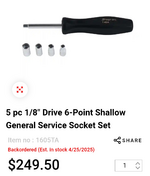
I have always wanted to find one of those 1/8” drive sets at an estate sale. I could never justify purchasing it for anywhere near what they cost. I couldn’t justify half what they cost…
 
OP
M

mikey03

Well-known member
Joined
May 17, 2024
Messages
2,038
3/8" drive, thanks to new ratchet technology, is pretty perfect for automotive. I'm thinking about the "best fit" of the size and the torque capability to the size of fasteners and their attending torque reqts.
what’s the largest size fastener you think 3/8 can work up to
 

1Bad55Chevy

Well-known member
Joined
Feb 20, 2025
Messages
608
@mikey03 -
You are opening a can of worms here.
I'm not sure if anyone here has actually drawn up a chart of all the various drive sizes and their evolution through the years.

1/8" square drive (Snap-on - see post #18)

1/4" square drive
1/4" hex drive

9/32" square drive

5/16" hex drive (Walden 5/16" hex drive socket set)

3/8" square drive
3/8" hex drive

7/16" square drive (Blackhawk)
7/16" hex drive

.448 hex drive (Britool)

1/2" square drive
1/2" hex drive

9/16" square drive

5/8" square drive
5/8" hex drive (Accles & Pollock - U.K)

11/16" hex drive

3/4" square drive

13/16" hex drive

7/8" hex drive (?)(not sure on this one) :headscrat

1" square drive
1" hex drive (Walden Worcester)

^ I left the spaces deliberately... I think I'm missing quite a few. I'll update this as more entries are added to the thread. I can't remember all of them off the top of my head.
My grandfather had a complete set of 7/16 drive Blackhawk! SAE set shallow and deep sockets, breaker bar, extensions, short ratchet, long ratchet, speed handle... everything. I am pretty sure my cousins stole it out of his shop the day of his wake with a lot of other things that came up missing that day. I would love to have that set in my box today just to look at it every time I open my socket drawer.
 

bobg03

Well-known member
Joined
Aug 29, 2020
Messages
3,420
Location
conway sc
I got my first I believe it was a Bernzamatic 3/8 socket set in a little steel box. I was 10 years old in the 60's and it was my christmas present from mom and dad so I could work on my bicycles.

My dad only had a hexagonal socket set with the sockets (only SAE) placed on to the L shaped handle. Two years later my cheap japanese set was junk and I got an SK in 3/8 from my paper route profits all SAE, and purchased one for Dad too for his Birthday.

1/2 was for heavy duty work
1/4 was for furniture and delicate things
 

bobg03

Well-known member
Joined
Aug 29, 2020
Messages
3,420
Location
conway sc
Do you lie awake at night thinking of these topics?
Y'all know some folks wanta drive the biggest truck they can buy
some want the GF with the most ample chest
some collect coins, comic books or cards

These are the "Lookit Me folks"

I guess some wanta have the most full toolbox as their badge of honor...
 

NoahG

Well-known member
Joined
Feb 24, 2013
Messages
1,046
Location
Detroit, MI
what’s the largest size fastener you think 3/8 can work up to
For my taste, 3/4” is as large as I like to go. I’ve pushed it to 15/16” but I’d MUCH rather have that in 1/2DR

7/8 is funny cause I’m often using it on lock nuts and I don’t mine driving that with 3/8.
 

AEAdam

Well-known member
Joined
May 27, 2023
Messages
2,712
Location
SE PA
what’s the largest size fastener you think 3/8 can work up to
There are a couple issues:
1) How much torque can I comfortably generate? With a long enough ratchet, I could generate just about any torque. I think pulling with 100lbs of force is a lot. Right now I think my longest 3/8" drive ratchet is roughly 18" long (or in that range). So I could probably generate 150ftlbs with it.

2) Next is what the drive is good for. Snap On 3/8" dr is good to roughly 250ftlbs. Lets say 200ftlbs is the upper working limit.

3) Third, what size fasteners require that sort of torque and how big are their hex heads? So if you have my chart handy you can look. M14 Gr8.8 torques to roughly 100ftlbs. Head sizes are 21, 22, or 19mm. I have 21 in my box, but not 22. M16, same grade, is 158ftlbs, which is pushing closer to the limits of the drive but doable. That would be a 24mm. That would probably be top end for me and I don't own one, but some manufacturers make them.
 
OP
M

mikey03

Well-known member
Joined
May 17, 2024
Messages
2,038
3) Third, what size fasteners require that sort of torque and how big are their hex heads? So if you have my chart handy you can look. M14 Gr8.8 torques to roughly 100ftlbs. Head sizes are 21, 22, or 19mm. I have 21 in my box, but not 22. M16, same grade, is 158ftlbs, which is pushing closer to the limits of the drive but doable. That would be a 24mm. That would probably be top end for me and I don't own one, but some manufacturers make them.
I saved your chart man its really awesome work!

but honestly I think the chart is fastening torque, not removing torque. It might take 300 foot pounds to remove a fastener that got 100 foot pounds torque spec since maybe it’s rusted on
 

AEAdam

Well-known member
Joined
May 27, 2023
Messages
2,712
Location
SE PA
I saved your chart man its really awesome work!

but honestly I think the chart is fastening torque, not removing torque. It might take 300 foot pounds to remove a fastener that got 100 foot pounds torque spec since maybe it’s rusted on
300 ftlbs is a lot. When you are talking about installing @100ftlbs, and removal needing 300, I think corrosion is the problem. In that case, impact is the solution, not a cheater bar. You want an impulse to crack free the corrosion, overcome the static friction, and move on. You'd be better off hitting a breaker bar with a steel hammer, than leaning on it.

Again, if you think about it: 3/8" drive + 1/2" impacts makes a lot of sense. It's essentially all I use- except for the 1/4" stuff I like to use just for the ratchets.
 

Kscardsfan

Well-known member
Joined
Apr 28, 2020
Messages
1,650
Location
The Little Apple
There are a couple issues:
1) How much torque can I comfortably generate? With a long enough ratchet, I could generate just about any torque. I think pulling with 100lbs of force is a lot. Right now I think my longest 3/8" drive ratchet is roughly 18" long (or in that range). So I could probably generate 150ftlbs with it.

2) Next is what the drive is good for. Snap On 3/8" dr is good to roughly 250ftlbs. Lets say 200ftlbs is the upper working limit.

3) Third, what size fasteners require that sort of torque and how big are their hex heads? So if you have my chart handy you can look. M14 Gr8.8 torques to roughly 100ftlbs. Head sizes are 21, 22, or 19mm. I have 21 in my box, but not 22. M16, same grade, is 158ftlbs, which is pushing closer to the limits of the drive but doable. That would be a 24mm. That would probably be top end for me and I don't own one, but some manufacturers make them.
Where can I find this chart?
 

Dave455

Well-known member
Joined
Mar 19, 2013
Messages
5,796
Location
Sussex, England
To return to the O.P’s original question, I can add a bit more info from ’across the pond’.

Here in the U.K. 3/8 drive was pretty much the “go to” for the average man.

The main reason for that was car sizes. An average post war car would have been something like a Morris Minor.
IMG_1460.jpeg

90% of the fasteners on one of these can be dealt with using 3/8 drive. Same applies to an Austin 7 or Ford 8 from a generation before, or a Mini Metro or Ford Fiesta of a generation later.

If you own a classic Mini, then I think the whole thing is held together with just 1/4” and 5/16“ bolts, so unless you are doing major work, you don’t need much more than 7/16“ and 1/2” sockets.

The same 3/8 drive was common in places like the aerospace industry too. Most of what you needed to deal with an aircraft or aero engine was 3/8 drive.

1/2“ drive was always the choice of the more serious engineer. Standard in any workshop or industrial environment, and needed for more serious automotive jobs - hub nuts, cylinder head bolts etc etc, but not something an average guy would necessarily own.

1/4“ drive I use more now than at any point in the past. Partly because I need to remove so many plastic covers, metal panels or under trays before I can start work properly, and partly because I find so many cap screws and Torx screws.

But ultimately, aside from being metric, the 3/8” drive set I carry around isn’t that different from the 3/8” drive set‘s my Dad or Grandfather carried.
 

JradM

Well-known member
Joined
Sep 4, 2019
Messages
1,811
Location
Alberta
I have always wanted to find one of those 1/8” drive sets at an estate sale. I could never justify purchasing it for anywhere near what they cost. I couldn’t justify half what they cost…
Where can I see a 1/8" drive ratchet and socket set?

I want to believe it exists.
 

i84x

Well-known member
Joined
Nov 1, 2024
Messages
91
Location
Earth
Personally never use 1/4" drive, 3/8" can use 7mm-24mm comfortably enough so for me there is no point, sometimes go the 1/2" with bigger 24mm+ and tight bolts but I have various length and size 3/8" drive stuff that its no real problem for me.
 

AEAdam

Well-known member
Joined
May 27, 2023
Messages
2,712
Location
SE PA
To return to the O.P’s original question, I can add a bit more info from ’across the pond’.

Here in the U.K. 3/8 drive was pretty much the “go to” for the average man.

The main reason for that was car sizes. An average post war car would have been something like a Morris Minor.
IMG_1460.jpeg

90% of the fasteners on one of these can be dealt with using 3/8 drive. Same applies to an Austin 7 or Ford 8 from a generation before, or a Mini Metro or Ford Fiesta of a generation later.

If you own a classic Mini, then I think the whole thing is held together with just 1/4” and 5/16“ bolts, so unless you are doing major work, you don’t need much more than 7/16“ and 1/2” sockets.

The same 3/8 drive was common in places like the aerospace industry too. Most of what you needed to deal with an aircraft or aero engine was 3/8 drive.

1/2“ drive was always the choice of the more serious engineer. Standard in any workshop or industrial environment, and needed for more serious automotive jobs - hub nuts, cylinder head bolts etc etc, but not something an average guy would necessarily own.

1/4“ drive I use more now than at any point in the past. Partly because I need to remove so many plastic covers, metal panels or under trays before I can start work properly, and partly because I find so many cap screws and Torx screws.

But ultimately, aside from being metric, the 3/8” drive set I carry around isn’t that different from the 3/8” drive set‘s my Dad or Grandfather carried.
These things are so darned cute. The colors of these cars are also amazing and no longer found. The depth of color of old fashioned painted cars is amazing. But especially post war Britain's industrial (stately?) car colors (and interiors) is really special. I feel like American cars went from being all black to brown and then to a series of ugly greens, maroons, then worse. The British cars, if green, had gray under tones, they might be putty colors, or taupes.

Living in West Dorset, it was a great privilege to be only a short drive to the Hayne's Motor Museum, which has big collections of cars from this era. I went often just to visit some of the cars I really loved. It was a place I liked to take visitors who loved cars. They didn't have workshop tours when I lived there (that I know of). Would have liked to see that. Maybe next time I visit my old haunts!
 
To avoid these ads, REGISTER NOW!
Top Bottom