To avoid these ads, REGISTER NOW!

Generator Selection and Install

Rick_Br

Well-known member
Joined
Apr 8, 2014
Messages
408
Location
Winston Salem, NC
I live in central NC so power outages due to weather are somewhat unusual. I have thought about a whole house generator (like a generac) but the cost doesn't seem to be justified. So I am considering a portable generator.

In a perfect world we would like to power kitchen circuits, bedroom lighting and outlets and gas fired furnace.Is this reasonable for a portable unit?

The second and maybe more important considerations is I don't want to deal a mile of extension cords. Is it possible to use the existing house wiring (through the panel) with a portable generator?

I'm sure there are a dozen pieces of info I haven't provided so fire away.

Thanks
Rick
 
To avoid these ads, REGISTER NOW!

The Metric System

Well-known member
Joined
Apr 28, 2025
Messages
268
We are in Western NC and have exactly the setup you are describing, it works very well.

Our panel has a dedicated "generator input" circuit that is interlocked with the main breaker so that they both cannot be On at the same time. It's real simple, just a sliding sheet metal guard.

This generator input circuit ends at a dedicated 30A outlet, we plug a Pulsar PG2200BiS dual-fuel suitcase generator into it and this feeds all the 120V circuits in the house with no extension cords required. We can run lights, TV, internet, refrigerator, and device charging simultaneously no problem, and if we unplug the refrigerator temporarily we can run a coffee pot or hot plate for cooking.

During the extended Helene power outages we would run it for about 3 hours in the morning to cool the fridge down and make coffee and 3 hours each evening to re-cool the fridge, make dinner, and have lights but we certainly could have run it all day if we had wanted.

We do not run building HVAC with it, as we rely on gas logs for heating when the power is out. You may want to double-check the power requirements for your furnace and confirm that the voltage and power draw is consistent with your planned generator but fundamentally there's no reason you could not also run it this way.

I like this setup very much, for a few reasons:
  • The suitcase generator is very quiet and fuel efficient
  • It is easy to set up, we can go from "no prep" to "full off-grid power" in less than 5 minutes
  • It's safe, since we are using the existing building wiring and breakers vs a bunch of extension cords strung between rooms
  • It's flexible, since the generator burns propane or gasoline and we can easily detach it and loan it to a neighbor etc as needed
  • It was cheap. The interlock breaker and outlet install only added a few hundred dollars during other electrical work, and the generator itself was less than $500.
I am sitting here right now watching the snow fall with lots more on the way and predictions of widespread power outages this weekend, and I'm very happy that we built this system into our house.
 

mercracing

Well-known member
Joined
Feb 14, 2015
Messages
156
Just to play devils advocate, we had a portable generator used like described above. It worked, but I wasn’t super keen to go outside in the rain and fire it up and connect it. The biggest deciding factor for us to move to a home sized generator is we travel enough we didn’t want to have a power loss while we were gone and the sump pumps wouldn’t run. We’ve had to redo the basement at least once completely so when we looked at the cost of that vs cost of a standby automatic generator it pushed us to the standby generator.

Where you live is different than mine, so ymmv.
 

larry4406

Well-known member
Joined
Jan 27, 2006
Messages
18,999
Location
Northern Virginia
@Rick_Br the devices you listed all appear to be 120V.

Do you have any 240V devices you need to run (well, septic pumps, etc)?

Plenty of capable 120V generators as well as larger 240V generators. I think this will be one of the first decisions you need to make - do you need 240V or not?

The generator interlock as mentioned is an easy way to safely utilize the house wiring with a generator while preventing dangerous back feed to the grid. You will have to install an appropriate backfeed breaker to match your generator. You will install an inlet plug on the exterior of your home to match the generator and the backfeed breaker.

Your existing electric main panel will determine the interlock kit you need and the type of breaker you will need to add.

You will need to study your generator's wiring schematic to remove the neutral/ground bond while you are powering the home. This is needed since there is supposed to only be one neutral/ground bond and that occurs at your main panel.

The interlock method gives you quite a bit of flexibility as you can enable and disable loads in the house based on the capacity of the generator. Conversely, if you are not careful, you can overload your generator if you leave all of the breakers on by mistake.
 

theoldwizard1

Well-known member
Joined
Feb 22, 2011
Messages
43,076
Location
SE MI
If you have NO 240V appliances that you need to keep running (well pump, stove, water heater, etc) then I think this an excellent choice !

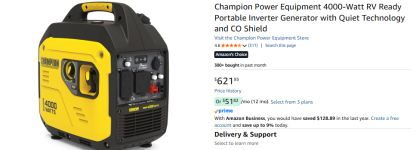
Champion Power Equipment 4000-Watt Portable Inverter Generator

Screenshot 2026-01-31 093353.png

This unit is powerful enough, you could run a typical window A/C !

The best way to connect it to you house is a generator inlet and a generator interlock kit on your breaker panel. Do not use one of those generator transfer panels you commonly see ! (They only cover a limited number of circuits.)

If you are comfortable with simple electrical work (like adding a circuit to you breaker panel), then this is a DIY job.
 
Last edited:

theoldwizard1

Well-known member
Joined
Feb 22, 2011
Messages
43,076
Location
SE MI
The interlock method gives you quite a bit of flexibility as you can enable and disable loads in the house based on the capacity of the generator.
With a little "trickery" (connect L1 to L2 in the cord), every 120V circuit can be used, as long as you don't exceed the capacity of the generator.

Conversely, if you are not careful, you can overload your generator if you leave all of the breakers on by mistake.
No real danger here ! You will just trip the breaker on the generator !
 
Last edited:

Leaflessshadetree

Well-known member
Joined
Aug 1, 2013
Messages
7,144
Location
Don't ask.
My portable runs my house and out buildings. We try to minimize how much electricity an not to use A/C when it is on but have tripped the 30A breaker once or twice.
I store the generator inside the garage. Easy enough to roll it out, connect the cord start the generator then switch the panel. Takes about 5 minutes and yes it will probably be in tangible weather.
I try to run it about once a month, I drain the gas and replace with fresh every year.
 
OP
R

Rick_Br

Well-known member
Joined
Apr 8, 2014
Messages
408
Location
Winston Salem, NC
Wow - some great information - thanks to all! At this point I am not viewing this as DIY and will likely hire an electrician. That may change - I have run 110 and 220 circuits and connected inside the panel.

We have a 200 amp panel with roughly 20 circuits. Most are 110. There is a 220 circuit going to the laundry, another for the outside AC unit and one for a shop 100 amp subpanel. All of the 220 will not be utilized in a power outage situation - although I could be talked into a 220 volt unit for AC but I doubt it.

Is there an estimate of wattage to run some overhead lights, gas furnace, kitchen appliances (keurig, microwave) and refrigerator?
 

dave*99

Well-known member
Joined
May 5, 2009
Messages
4,248
Location
Coastal NJ
Wow - some great information - thanks to all! At this point I am not viewing this as DIY and will likely hire an electrician. That may change - I have run 110 and 220 circuits and connected inside the panel.

We have a 200 amp panel with roughly 20 circuits. Most are 110. There is a 220 circuit going to the laundry, another for the outside AC unit and one for a shop 100 amp subpanel. All of the 220 will not be utilized in a power outage situation - although I could be talked into a 220 volt unit for AC but I doubt it.

Is there an estimate of wattage to run some overhead lights, gas furnace, kitchen appliances (keurig, microwave) and refrigerator?
Yes. Plenty of estimators on the web


larry4406

Well-known member
Joined
Jan 27, 2006
Messages
18,999
Location
Northern Virginia
Wow - some great information - thanks to all! At this point I am not viewing this as DIY and will likely hire an electrician. That may change - I have run 110 and 220 circuits and connected inside the panel.

We have a 200 amp panel with roughly 20 circuits. Most are 110. There is a 220 circuit going to the laundry, another for the outside AC unit and one for a shop 100 amp subpanel. All of the 220 will not be utilized in a power outage situation - although I could be talked into a 220 volt unit for AC but I doubt it.

Is there an estimate of wattage to run some overhead lights, gas furnace, kitchen appliances (keurig, microwave) and refrigerator?
Here is a wattage estimator that is in the manual for my Generac 7500W portable.

1769876963449.png
 

snickers muncher

Well-known member
Joined
Feb 19, 2018
Messages
938
Location
Northeast GA
I'm looking at doing this as well. I'm currently shopping for the parts needed. One thing that might be an issue is the possibly overloading the neutral on a multiple branch circuit if you have one. I went with a 4500 peak 3250 running watts inverter with gas or propane. It's not easy, but my wife can handle the generator.
 

Innovate1

Well-known member
Joined
Jul 28, 2014
Messages
4,272
Location
Illinois near St. Louis, Missouri
If you combine both legs to run 120V stuff make sure the neutral wire is big enough to handle the total current. We could power up enough stuff with just a 2200W honda generator - gas furnace, refer, freezer, and a few lights and TV. Running the AC would need a much bigger unit. I put a natural gas kit on it so I didn't have to mess with gas and worry about it going bad during the long unused periods. If you have natural gas I would go for one that has that capability. A lot of them now are inverter output which means it will throttle down when not fully loaded and saves lots on fuel so I highly recommend an inverter unit.
 

mm08822

Well-known member
Joined
Jan 13, 2012
Messages
5,848
Location
NJ
I'm looking at doing this as well. I'm currently shopping for the parts needed. One thing that might be an issue is the possibly overloading the neutral on a multiple branch circuit if you have one. I went with a 4500 peak 3250 running watts inverter with gas or propane. It's not easy, but my wife can handle the generator.
This is another reason for purchasing a 120/240 VAC gen. Neutral o/l is never a concern.

Secondly, any circuit can remain where it is located in the main panel or even sub-panel.

Use the proper main cb / gen inlet cb interlock with a power inlet box. Then the only thing left to manage is which cb to keep on. Many people color-code the cbs to quickly leverage the pre-thought that went into the who's who of circuits.

A multi-fuel gen should also be considered so you can use nat gas or LPG as the primary fuel source......much easier than gasoline, stabilizers, draining/running dry.
 
OP
R

Rick_Br

Well-known member
Joined
Apr 8, 2014
Messages
408
Location
Winston Salem, NC
I see there is a general requirement/suggestion to keep a generator 20 feet from the home. Would that be necessary even if a natural gas powered generator?
 

Innovate1

Well-known member
Joined
Jul 28, 2014
Messages
4,272
Location
Illinois near St. Louis, Missouri
I see there is a general requirement/suggestion to keep a generator 20 feet from the home. Would that be necessary even if a natural gas powered generator?
I don't see the fuel source affecting that. Guessing that is to prevent exhaust fumes from entering windows. Nothing magic about 20 feet IMHO although maybe they are worried about the generator catching fire. Aim the exhaust away from the house or anything it might affect and avoid placing it near open windows/doors. Basic common sense.
 

mm08822

Well-known member
Joined
Jan 13, 2012
Messages
5,848
Location
NJ
I see there is a general requirement/suggestion to keep a generator 20 feet from the home. Would that be necessary even if a natural gas powered generator?
Some home standby gens can be as close as 18" to the house but a minimum of 5' from any type of inlet. Larger distances help disperse concentration.

Each unit has its own directions, so follow them.

IMO, NG/LPG used outdoors is much safer than gas.
 

fitter30

Well-known member
Joined
Jun 23, 2019
Messages
2,960
Location
Peace Valley,mo
I'm very rural have lp for cook stove and emergency heat with a 500 gallon tank. Generator that uses lp or natural gas is better than gasoline. Use a generator subpanel with a outside recepltical for a 7500 peak watt generator. Power water heater, well pump, tv, Internet, cook stove, microwave, some lights and a 5k window ac to cool one bedroom if needed. Not all at the same time but we've been without power for as long as 8 days. 17698850905507253523036408405275.jpg
 

Junkman

Well-known member
Joined
Dec 18, 2006
Messages
6,598
Location
Northeastern CT
I have an 18 kW Lister-Petter 4-cylinder diesel generator that I bought about 15 years ago. It powers the whole house both summer and winter. It has a 20-gallon plastic tank under the unit for fuel, and it uses about 1/4 gallon per hour. It is extremely quiet with a hospital-quiet 2" steel pipe exhaust. I have it located in the 3rd by of an attached garage. That garage is separated from the home by an insulated firewall, so it is cold all winter. In extreme cold, it starts with no effort, thanks to its intake heater and glow plugs. I have a block heater on the engine, and if temperatures drop below zero, I plug it in. I bought it on eBay, and I have lost the contact information for the company that manufactured the unit. All I remember is they were in GA.
 

wyliesdiesels

Well-known member
Joined
Aug 14, 2012
Messages
19,983
Location
Modesto, CA
I live in central NC so power outages due to weather are somewhat unusual. I have thought about a whole house generator (like a generac) but the cost doesn't seem to be justified. So I am considering a portable generator.

In a perfect world we would like to power kitchen circuits, bedroom lighting and outlets and gas fired furnace. Is this reasonable for a portable unit?

The second and maybe more important considerations is I don't want to deal a mile of extension cords. Is it possible to use the existing house wiring (through the panel) with a portable generator?

I'm sure there are a dozen pieces of info I haven't provided so fire away.

Thanks
Rick

Theres quite a few threads on this very subject. use the search function

yes you could power all that with a portable. those are low current loads.

As far as how to connect the generator to the house, easiest and cheapest way is via an inlet and interlock. the inlet and wire connecting it needs to be sized to the output of the generator, the interlock needs to be listed for use with your specific panel, and you will need space near the main breaker to install the generator breaker.

post pics of your panel with the covers on and off and we can tell you if an interlock would work.
 

wyliesdiesels

Well-known member
Joined
Aug 14, 2012
Messages
19,983
Location
Modesto, CA
Wow - some great information - thanks to all! At this point I am not viewing this as DIY and will likely hire an electrician. That may change - I have run 110 and 220 circuits and connected inside the panel.

We have a 200 amp panel with roughly 20 circuits. Most are 110. There is a 220 circuit going to the laundry, another for the outside AC unit and one for a shop 100 amp subpanel. All of the 220 will not be utilized in a power outage situation - although I could be talked into a 220 volt unit for AC but I doubt it.

Is there an estimate of wattage to run some overhead lights, gas furnace, kitchen appliances (keurig, microwave) and refrigerator?

It actually is pretty simple and can be DIY. all you have to do is install an inlet, run the wire to the panel, install the breaker, and interlock. you stated you have ran 120 and 240v circuits and connected them in the panel, so you have experience already doing most of the work required for a generator inlet....
 
To avoid these ads, REGISTER NOW!

wyliesdiesels

Well-known member
Joined
Aug 14, 2012
Messages
19,983
Location
Modesto, CA
I'm very rural have lp for cook stove and emergency heat with a 500 gallon tank. Generator that uses lp or natural gas is better than gasoline. Use a generator subpanel with am outside inlet for a 7500 peak watt generator. Power water heater, well pump, tv, Internet, cook stove, microwave, some lights and a 5k window ac to cool one bedroom if needed. Not all at the same time but we've been without power for as long as 8 days.

fixed it for you :thumbup:
 

ericm

Well-known member
Joined
Apr 17, 2016
Messages
1,963
Location
Southern Oregon
Our panel has a dedicated "generator input" circuit that is interlocked with the main breaker so that they both cannot be On at the same time. It's real simple, just a sliding sheet metal guard.

This generator input circuit ends at a dedicated 30A outlet, we plug a Pulsar PG2200BiS dual-fuel suitcase generator into it and this feeds all the 120V circuits in the house with no extension cords required.

Generator inputs are generally 240v (mine are) and the Pulsar 2200 only has two 120v outlets. How do you connect it?

I'm asking because my new shop has a 30a 240v generator input and I'm looking for a small generator to have around to run the lights during an outage. I'm not finding smaller ones with 240v outlets.


For the OP, in our old house we ran all the lights, furnace and wood stove fans, computers, fridge and chest freezer, TV, microwave and toaster on a 5000w generator. More recently we got a 7000w generator and it would run the 3 ton A/C though that only happened by accident when I left it on.
 

wyliesdiesels

Well-known member
Joined
Aug 14, 2012
Messages
19,983
Location
Modesto, CA
Generator inputs are generally 240v (mine are) and the Pulsar 2200 only has two 120v outlets. How do you connect it?

I'm asking because my new shop has a 30a 240v generator input and I'm looking for a small generator to have around to run the lights during an outage. I'm not finding smaller ones with 240v outlets.

not sure what generally means... you can buy 120v inlets... but even if you cant find one, you can connect a 120v generator to a 240v inlet. you would have to jumper the hot lead from the generator to the other hot connector in the inlet

best way to do this is in the 120/240v plug on the end of the generator cord.
 

ericm

Well-known member
Joined
Apr 17, 2016
Messages
1,963
Location
Southern Oregon
Ok sure, but the ones I have are 240v. The post I was responding to mentioned A 30a inlet so I assumed that's 240v to serve all the circuits in the house.
 

Stuart in MN

Well-known member
Joined
Sep 8, 2005
Messages
22,993
Location
Minneapolis
A couple things:
- The generator inlet connector on the outside of the house for this sort of thing is male with prongs. Don't use a conventional female receptacle.
- If you connect up a 120VAC generator it will only run circuits that are on the same leg of the service. Rather than temporarily tying the two legs together, it's a better idea to shuffle the desired circuits around in the panel so they're all on that same leg - say, the furnace and a few important receptacle and light circuits (of course, don't move everything to one side, the panel needs to be balanced so there are equal loads on both legs when the power is on normally.)
- As for the comment about keeping the generator in an attached garage, even though there's a firewall separating the garage from the rest of the house it's still a dangerous thing to do as the generator fumes can come in through the tiniest of cracks. Roll the generator outside when it's running.

Here's one example of a 30A 120VAC generator inlet connector, but there are many others.

61lY5xSuU2L.jpg
 

wyliesdiesels

Well-known member
Joined
Aug 14, 2012
Messages
19,983
Location
Modesto, CA
it's a better idea to shuffle the desired circuits around in the panel so they're all on that same leg - say, the furnace and a few important receptacle and light circuits (of course, don't move everything to one side, the panel needs to be balanced so there are equal loads on both legs when the power is on normally.)

majority of panels nowadays have alternating phases on each side of the panel (eg. space 1 is phase A, space 3 is phase b/space 2 is phase A, space 4 is phase B) so putting everything on one side wouldnt put all those loads on just 1 phase.

only way to put everything on 1 phase is by skipping every other breaker space on both sides.
 

larry4406

Well-known member
Joined
Jan 27, 2006
Messages
18,999
Location
Northern Virginia
@Rick_Br

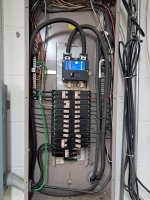
Please take pictures of your existing main panel with cover on and off. This will determine the interlock kit you will need and the breaker type as well.

Then provide a load list of devices you would like to have powered by the generator. This list should be itemized by device such as kitchen fridge 120V 4.3A, sump pump 120V 6.5A, etc.

With information such as this, the group can guide you thru this.

I agree with @wyliesdiesels that if you were wiring new 120V and 240V circuits to your panel, this project is well within your grasp.

With a manual interlock, I think labeling the panel with the critical circuits is the way to go.
 
OP
R

Rick_Br

Well-known member
Joined
Apr 8, 2014
Messages
408
Location
Winston Salem, NC
Pictures of existing panel attached

Box inside 1.jpgBox inside 2.jpgBox Outside 1.jpgBox Outside 2.jpg

It seems the first decision is type of power source the generator uses. I would like to use N G but if I need to move it 20' away from the house then that gets complicated to get gas to it doesn't it? I have the perfect spot right on the other side of the block wall where the panel is located but that would be right next to the wall. With LPG or gasoline there is the problem of running out/refilling. any thoughts?
 

Chuckster in NJ

Well-known member
Joined
Jan 26, 2010
Messages
2,276
Location
Hunterdon County NJ

wyliesdiesels

Well-known member
Joined
Aug 14, 2012
Messages
19,983
Location
Modesto, CA
Pictures of existing panel attached

Box inside 1.jpgBox inside 2.jpgBox Outside 1.jpgBox Outside 2.jpg

It seems the first decision is type of power source the generator uses. I would like to use N G but if I need to move it 20' away from the house then that gets complicated to get gas to it doesn't it? I have the perfect spot right on the other side of the block wall where the panel is located but that would be right next to the wall. With LPG or gasoline there is the problem of running out/refilling. any thoughts?

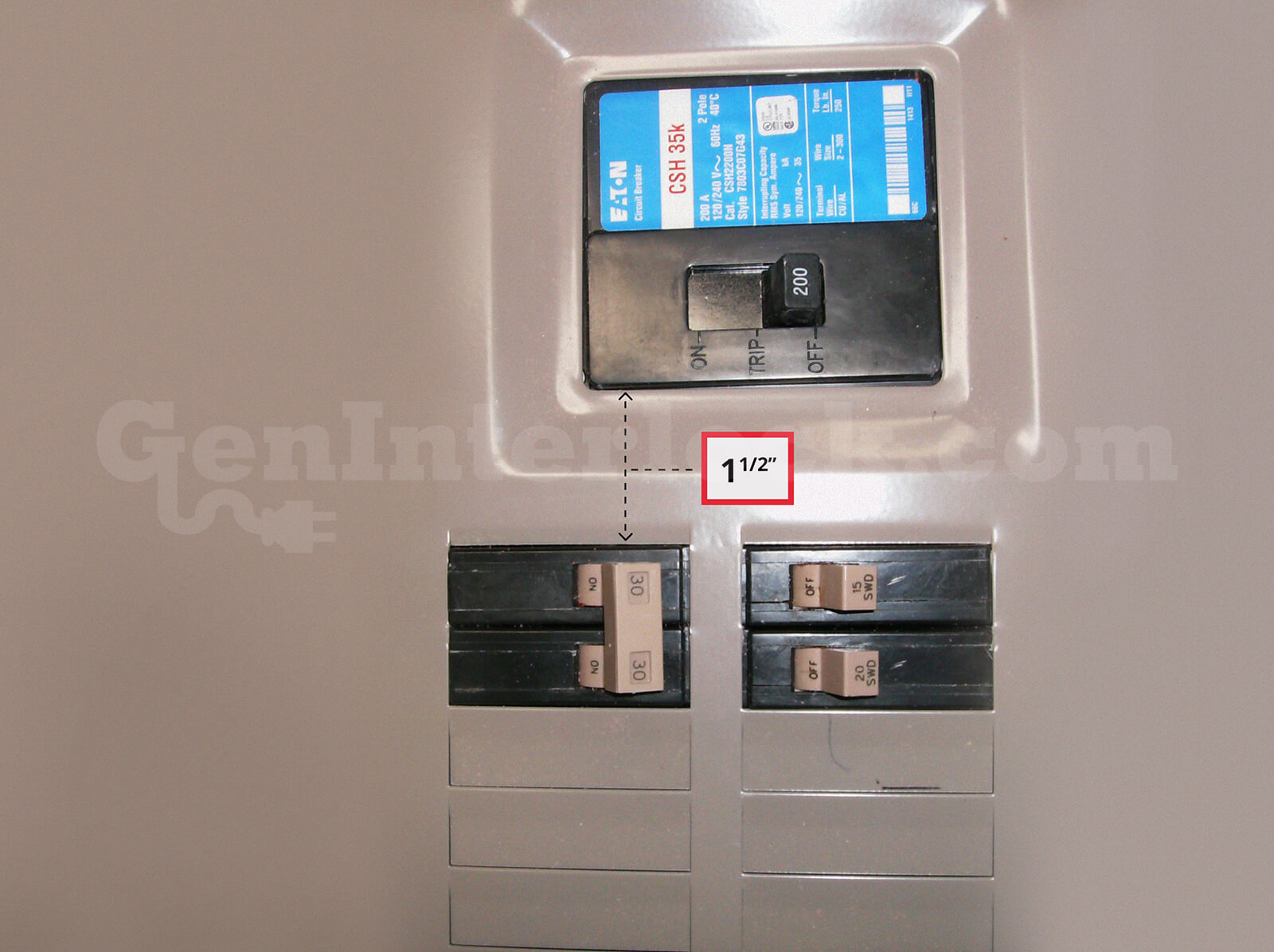
you will have to move one of the circuits on one of the top double pole breakers (50a or 30a) to the bottom of the panel which means splicing the wire.

you have 4 spaces available (1 on the left side, 3 on the right side).

Eaton CH is a top of the line panel...
 
Last edited:

wyliesdiesels

Well-known member
Joined
Aug 14, 2012
Messages
19,983
Location
Modesto, CA
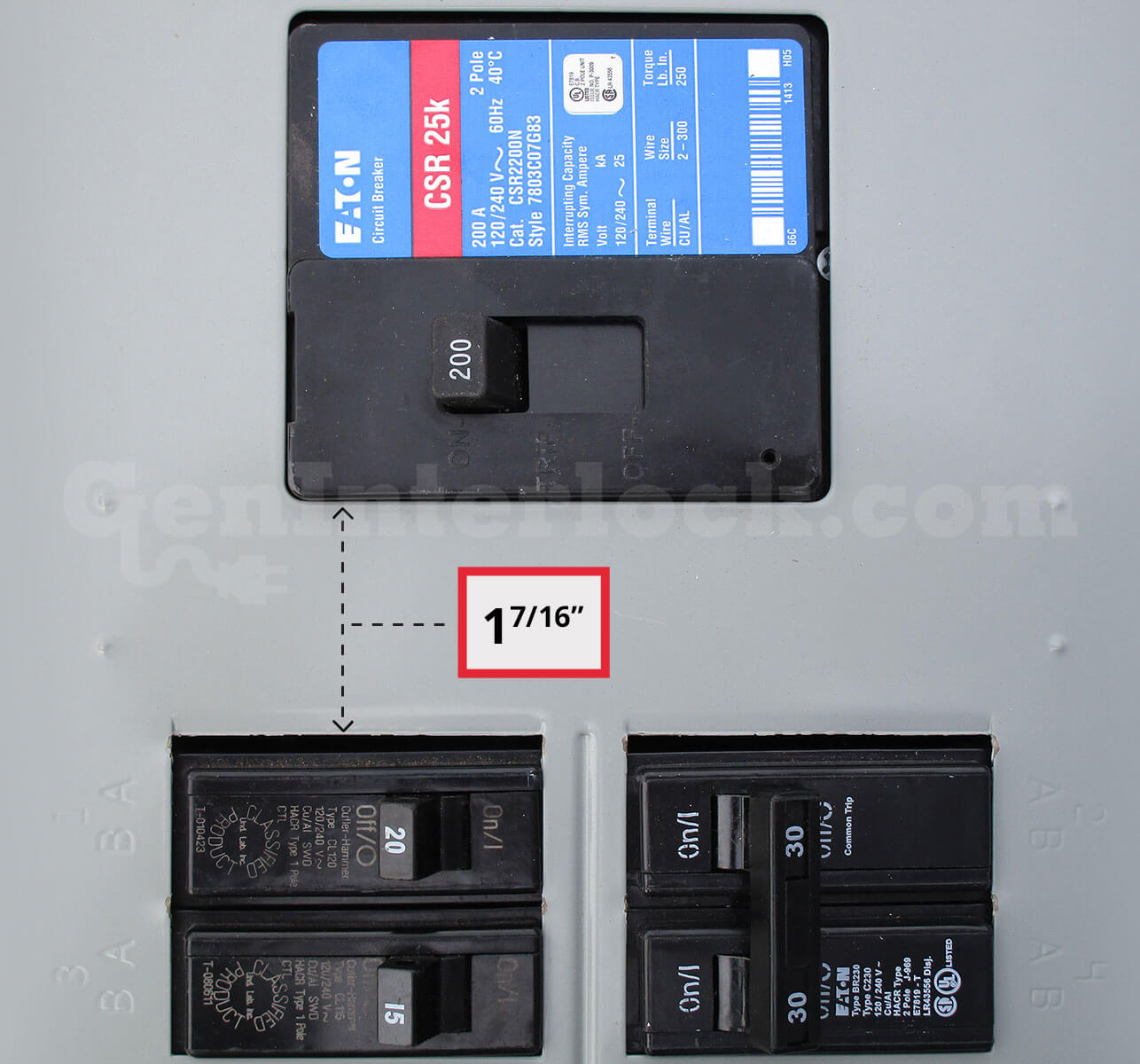
Here is the interlock kit for a CH panel, Plus they have everything you will need.……. Good company to deal with!

www.geninterlock.com

That is for BR series plug-on neutral panels ONLY. he has a CH panel (tan handle branch breakers) and it does not have the plug-on neutral bus. Notice the branch breakers pictured on that page you linked to dont have tan handle/ties?? They are BR breakers NOT CH breakers.

  • Fits 150 and 200 amp BR panels with PLUG ON NEUTRAL ONLY
 
Last edited:

wyliesdiesels

Well-known member
Joined
Aug 14, 2012
Messages
19,983
Location
Modesto, CA
this should be the correct interlock for your CH panel though i cannot tell if the gap is 1.5". you will need to verify this. you can get a left or right side version.


theoldwizard1

Well-known member
Joined
Feb 22, 2011
Messages
43,076
Location
SE MI
I have run 110 and 220 circuits and connected inside the panel.
Then you have the skill/knowledge to install a generator interlock kit ! One big thing is, you must have a main breaker panel.

If you haven't seen one, it takes 2 slots (just like any 240V circuit) that must be the closest ones to the main breaker. This may require moving existing breakers to other slots (jumper/extension inside the panel ARE allowed).
I could be talked into a 220 volt unit for AC but I doubt it.
Good ! This is the deciding factor between using a portable generator or a whole house unit,

Is there an estimate of wattage to run some overhead lights, gas furnace, kitchen appliances (keurig, microwave) and refrigerator?
A portable generator capable of 3000W continuous is more than capable ! Worst case, don't run the coffee maker and the microwave at the same time.
 

theoldwizard1

Well-known member
Joined
Feb 22, 2011
Messages
43,076
Location
SE MI
I'm very rural have lp for cook stove and emergency heat with a 500 gallon tank. Generator that uses lp or natural gas is better than gasoline. ...

17698850905507253523036408405275.jpg
I dislike that style of transfer switch ! The switch is more expensive than an interlock kit and breaker. It is also much more difficult ($$$ if you are hiring it out) to install.
 

Spacecoastz

Well-known member
Joined
Dec 7, 2022
Messages
50
I installed a four-pin power inlet box on my house which feeds to the main panel with a dedicated 30amp 2-pole breaker and interlock. Besides my 3500 watt 120v generator, I have a long generator cord that is intended to be used for 240, but also have a small converter cord that plugs into my generator (three pins), and feeds the generated 120v to both legs of that main cord that plugs into my power inlet box. That way all 120v circuits to the house are fed by the generator 120v power, single phase. Just don't overload the generator.
 
Last edited:

ericm

Well-known member
Joined
Apr 17, 2016
Messages
1,963
Location
Southern Oregon
I installed a four-pin power inlet box on my house which feeds to the main panel with a dedicated 30amp 2-pole breaker and interlock. Besides my 3500 watt 120v generator, I have a long generator cord that is intended to be used for 240, but also have a small converter cord that plugs into my generator (three pins), and feeds the generated 120v to both legs of that main cord that plugs into my power inlet box. That way all 120v circuits to the house are fed by the generator 120v power, single phase. Just don't overload the generator.

My old Honda non inverter generator's manual made a big deal about trying to balance the loads on the two legs. A random 120v inverter generator manual I found doesn't mention that. Maybe its not a problem for inverter generators?

Also won't tying both legs together mean that 240v appliances will not work? That's ok for my application, but if that can cause damage I'd have to make sure I turn those breakers off.
 

wyliesdiesels

Well-known member
Joined
Aug 14, 2012
Messages
19,983
Location
Modesto, CA
Also won't tying both legs together mean that 240v appliances will not work? That's ok for my application, but if that can cause damage I'd have to make sure I turn those breakers off.

correct the 240v appliances wont work.... it shouldnt cause damage because you arent completing the circuit (120v from same phase on both feeds to the appliance) but best to just shut off the breakers
 
Last edited:
OP
R

Rick_Br

Well-known member
Joined
Apr 8, 2014
Messages
408
Location
Winston Salem, NC
WOW so much useful information in this thread - its over whelming. I started this thread wanting to determine if the idea of a portable generator functioning through the main house panel was a feasible idea. I now know that it is not only feasible but pretty common.

So now lets get to specifics in an organized manner. Given that I would like to use a NG generator but don't want hard exterior piping - is it reasonable to say that I could park the generator 24" from a block wall, have a gas line run to the inside of that wall and then through that wall with a quick disconnect for a flexible line that I could install/remove as needed. Let's keep this big picture for now - is my idea reasonable. If so I will probably get an estimate from a plumber for that work

Rick
 
To avoid these ads, REGISTER NOW!
Top Bottom