AntiqueBen
Well-known member
- Joined
- Aug 4, 2021
- Messages
- 1,442

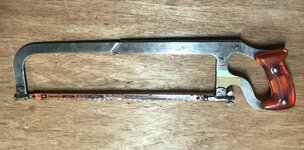
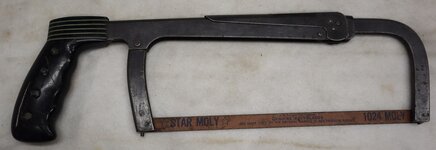
Nice no. 84 Don. I like the sturdy construction of this saw. I will definitely use it.This No. 84 came with my Cabin and still gets used occasionally. Nice hacksaw.
-Don


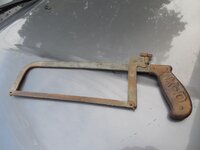


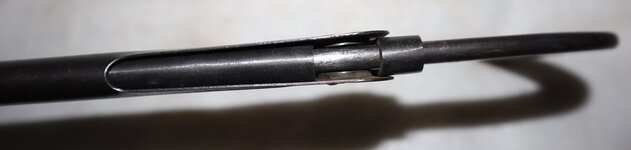
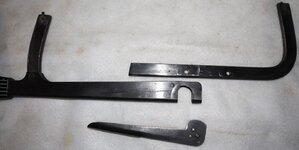
Patented (1,382,448) in 1921 by G.H. Wilkins of Greenfield, Mass. As I said in the K-D thread when I posted my example there, I have not been able to determine if K-D licensed it or bought him out, but they used his design until 1947. I also admire the use of the large "K-D" raised lettering as a handle grip pattern. It appears in the 1934 and the 1942 catalogs, but is replaced by a similar but newer convertible design, patented by Kulp in 1946, in the 1948 catalog. I posted photos of both the early and later models together in the K-D thread, linked here. @tombell572 has one of the early models as well. His is posted in this thread. See #126.Check out that unique tensioning mechanism.
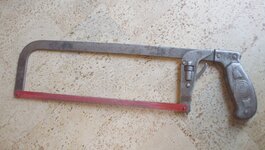


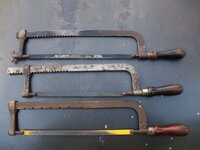
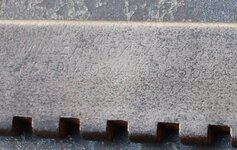
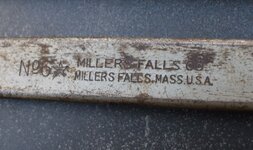

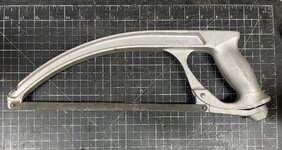
No "may be" about it, it was made between Sep 24, 1946, when K-D submitted their patent application, and Nov 21, 1950, when it was granted. They first show up in the 1948 catalog. I posted an example with the patent (2531135) stamped on it, patent excerpts, and K-D catalog excerpts back in 2022, linked here. Note that it has the same model number as the older K-D convertible hacksaw frame, with a different adjusting mechanism, that you just posted back on October 9, in post #406, just a few posts above. If you're interested in further information, in reply to that October 9 post (#407, just a few posts above), where I gave you information (patents, catalog excerpts, etc) on the c. 1921-1946 model, I mentioned the 1947 replacement model, I mentioned that I owned both of them, and I posted a link to more info and photos of them both together.An interesting design, but what struck me was that it was marked "Patent applied for", which means it may be an earlier example of its type.
Note that it has the same model number as the older K-D convertible hacksaw frame, with a different adjusting mechanism, that you just posted back on October 9, in post #406, just a few posts above.
Agreed. More interesting still that Kulp did not own the first patent. They were a licensee. So they had a few (17) years to think about it.It is interesting that both variants with the same patent number do both use screws bearing on the main frame to tension the blade, they just moved the screw from the top to the bottom on the later one, and they dropped the nice ruler that was stamped into the frame.

Neither one tickles the 'simple but elegant' funny bone in this old engineer's evaluative heart. But complex tools, even overly sophisticated, often have more appeal as collectibles, and that's true of these for me.I can see how the later version might be better in the respect that it does not have the adjuster on top to catch on things in tight places, but it's small diameter adjuster seems to me as if it would take more effort to operate than the adjusters on most common hacksaws.
Or "for peanuts," as I like to say, which is why I prefer flea markets.I like that old saws usually attract zero interest at estate and garage sales, so they can usually be had for less than a song-and-dance.


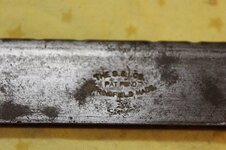

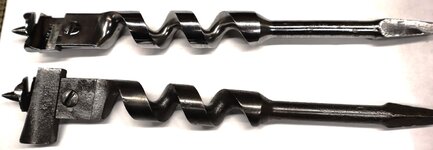

Thanks. Has a postmark of 1913 so that helps too.S. & I. / S. & I. Co., 55-57 Governor St., Springfield, MA / "Never Break" "Reliable" "Rival" /
postcard. not a lot of information but confirms name of company
Very interesting. Thanks. Wonder who S&I were?July 10 1907 "Hardware"
"Springfield, Mass.—The S. & I. Co. recently erected and equipped a plant for the manufacture of metal specialties to order,
also stampings, punches, dies and special tools, and it is now in complete operation."
Thanks. Sometimes all hacksaw look similar. I see features in the patent but not how the frame locks into place. We all know sometimes the item doesn't always match the patent. While it matches the Springfield MA. the patent was assigned to somebody else, not S&I.Well, just to stir **** into the fire, I used USPTO to search for patents for hacksaw and Springfield.
The specific piece i am looking at is the double split on the frame back to match Eric's pic, hereare someis an option (1) this is from 1912-04-16
US1023216A - Hacksaw-frame. - Google Patents
patents.google.com
This patent is not in DATAMP
Trying to go back from the address of 55-57 Governor
gives me a Chilton hit, and its still only S&I

The Automobile Trade Directory
www.google.com
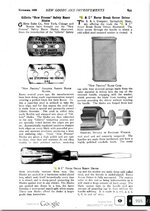


July 10 1907 "Hardware"
"Springfield, Mass.—The S. & I. Co. recently erected and equipped a plant for the manufacture of metal specialties to order,
also stampings, punches, dies and special tools, and it is now in complete operation."
Very interesting. Thanks. Wonder who S&I were?
^ The question remains unanswered until such time as some snippet out of a contemporary magazine or trade journal turns up more evidence.
It's a very slow process picking through them one page at a time looking for clues.



This is all great info. Thank you all for taking the time to find. When I put this info into the auger list you will be given some credit.More names

Metal Worker, Plumber and Steam Fitter
books.google.com
Patents
US787592A - Sash-cord fastener. - Google Patents
patents.google.com
Leads to
Google Patents
Search and read the full text of patents from around the world with Google Patents, and find prior art in our index of non-patent literature.patents.google.com
OK, this looks closer. The pins & holes (9 & 10) are closer to what you haveThanks. Sometimes all hacksaw look similar. I see features in the patent but not how the frame locks into place. We all know sometimes the item doesn't always match the patent.
Yes, you are on to something. The pins and holes seem the same. Thanks.OK, this looks closer. The pins & holes (9 & 10) are closer to what you have
US990839A - Blade-clamp for saw-frames. - Google Patents
patents.google.com

I'm thinking that S&I were not the owners of the patents, and they were simply a small manufacturer that were willing to produce for others. Their line is a hodgepodge of items. No real focus. There is no evidence so far that they relocated before the house was built on their property in 1925. So thinking they were only in business from about 1906 up to 1925. Doesn't sound long, less than twenty years, but that is still a long time. Perhaps their building burned down or something? I contacted the Springfield Historical Society asking for help, but not holding my breath.Rutherford Coffron
b. Mar 17 1890 Washington DC
d. Aug 3 1924 Detroit, MI
patents
US 990839 May 2 1911
GB 191109138A (with Arthur Cowsill) Jun 6 1911
Arthur Cowsill was a builder in Washington DC.
I'm not seeing the connection to Stauffer or Ives here.
In poking around for addresses, seems like in 1920 someone was at one of the three (53-55-57) in that year.. There is no evidence so far that they relocated before the house was built on their property in 1925. So thinking they were only in business from about 1906 up to 1925. Doesn't sound long, less than twenty years, but that is still a long time. Perhaps their building burned down or something?.
Just a quick glance at google books shows them 1908 - 18, so plus or minus a year or so is a good guess.In poking around for addresses, seems like in 1920 someone was at one of the three (53-55-57) in that year.
I was gonna poke into the S&I years of operation later, but would love for someone else to go down that rabbit hole.
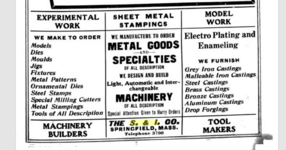
In poking around for addresses, seems like in 1920 someone was at one of the three (53-55-57) in that year.
I was gonna poke into the S&I years of operation later, but would love for someone else to go down that rabbit hole.
My searches so far dealing with the men's names seems to indicate that Ives may have died in 1913. I may have looked at the wrong Ives though, there were a lot of them. I did find a hacksaw for sale that I bought that looks similar to the top of the frame in the Coffron patent. It does not have the fancy clamp, just the holes and pins that match. It has some markings, but will need to receive it and clean it up to maybe read.Just a quick glance at google books shows them 1908 - 18, so plus or minus a year or so is a good guess.
Google Search
www.google.com
From 1908


Actually, just bought both. Add to my collection.^ So... you have that other one ordered and it's on it's way now? Am I understanding that correctly?