RoninB4
Well-known member
-You've brought up a very good point/question I purposely omitted in my replies to avoid boring everybody. With wide ranges of acceptability it's very difficult to pick ONE brand of fastener to use as the "standard". Back-in-the-day brands like HK and Unbrako were the readily available brands and were of good/consistent quality so these were used. With the rallying cry of "Outsourcing" everything changed and not always for the better. Cold header shops packed it in and went overseas to companies that cared more about the bottom line than having a well respected name for quality products. Steels and the heat treating for them changed which often affected things out in the field.Are tools designed to be used with the best bolts or the worst bolts? I have never broken a hex key, but I have seen many mangled bolts that were made of cheese, as others have said.
I've had my share of (IMO) poorly made SHCS that wouldn't have come from HK or Unbrako in the 90's. I've also noticed that some makers (they're always unknown) seemed to have changed the socket dimensions so that some hex keys are a looser fit. Why? My guess is an attempt to boost profits by reducing some sizes that are close to each other. A 5/16 and 8mm are close, so are 3/16 and 5mm. Yes they are different sizes (I can do the math) but hex keys aren't exactly to nominal size either. The reduction in different tooling and eliminating storage of different products can mean more profits. I can see where some whiz kid suggested doing and the corporate bean counters enthusiastically agreed. Either that or there was simply a mix up in packaging, both are equally possible. There is also the distinct possibility of material substitution for fasteners based upon application. Many companies have re-designed products, shaving the factor of safety ever closer to the edge of failure because over-built is wasted money.
Some of the above thoughts apply, some don't. It's difficult to paint with a broad brush and each product/brand has it's own circumstances. Hex keys fall into some of the same conditions as well. Can't speak for other companies but Eklind used a particular type of steel (8650 IIRC) in the 90's. Hex stock in coil was made in the USA by a couple of mills. Another competing maker of hex keys decided to buy up all available supplies of hex keys coil stock, thereby attempting to cut us off at the knees. Eklind had to buy "spot market" stock (not always 8650) available (offshore) in order to maintain production. Was the public notified? Of course not. Do these sort of shenanigans go on across all sorts of manufactured products? Of course they do. Some intentional, some not intentional. There was personality/ego clashing back then, I imagine this sort of thing goes on in many different industries still.
Also important to remember that a SHCS takes a lot of abuse and they must periodically be replaced when the socket begins to "round". The interface between the hex key and the SHCS is one of mutual abuse. The socket slightly deforms the key, Rc hardness comes into play here but that's another long subject and the audience is barely awake as is. The slightly deformed key goes to another SHCS and slightly deforms the socket. They mutually abuse each other until one/both of them need replacing. In stamping dies all SHCS are taken out for periodic sharpening/maintenance on a far more regular basis than any automotive application will ever see. The in/out/in/out cycle of mutual abuse goes well beyond any predictable life cycle expectancy for either. Makers of both take note what is expected of their product, especially when replacement is part of the product life cycle.
"I am surprised that someone who designed tools views them as disposable. Is this true for sockets and wrenches as well, or is that opinion particular to hex keys?"
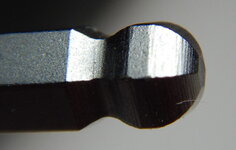
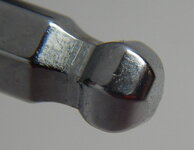
-I don't believe I called them "disposable", I did refer to hex keys as being "perishable". There's a subtle but distinct difference between the two, to me anyway. What is considered disposable is something that has no useful life left in it and will fail in the function of it's intended design, like nyloc nuts or lock washers. Use them once and they will no longer perform the task they're supposed to do, so you get a new one. All shops I've been in have what are called perishable tooling like drill bits, cutters, and hex keys. They do have a service life but that life can be renewed by proper service maintenance. Drills and cutters aren't thrown away, they're often re-sharpened and ready for another go. Hex keys can be ground back, usually 1-1/2 times the diameter, and they're good as new but a tad shorter. This is done every day in shops across the world as to be considered a common occurrence. They can/are ground back drastically for clearance situations as well, I have several that are "custom" for a particular procedure. I wouldn't normally consider sockets and wrenches to be perishable tooling but I have altered/modified many standard tools to suit a particular application. In design and in the shop I always ask myself "What's more important the tool or the task?". Plan and execute accordingly.
Hope this helped someone somehow.