To avoid these ads, REGISTER NOW!

Homemade electrolysis. What do you use?

To avoid these ads, REGISTER NOW!

BlueBomber

Well-known member
Joined
Sep 14, 2013
Messages
3,201
Location
Outside Boston, MA
Looks good Blue'. :)


It's an inconsequential point as to what you use on the cathode side as the connection wire. I've always used copper wire to connect pieces.
Thanks, Fretters. Here's what greeted me after an hour of cooking.

4c24eeef4e215e129a4bd2ae7a432c28.jpg

[emoji1] [emoji1]

I'm so excited, I threw in some more tools to the soup. Here's the before pic:

fd649090650971041f1cb0331f17b6a6.jpg
 

Fretters

Well-known member
Joined
Jan 25, 2014
Messages
4,217
Location
South Yorkshire, England
Any after photo's as yet Blue'?

Adding to the aluminium discussion, it appears that it's somewhat hit and miss with aluminium & its alloys. I'm not sure whether it's related to purity/alloy or such, but I've had one piece in there for a few days which has shown no notable improvement for being in the vat. It's a fan blade out of a blower housing, which has quite bad moisture corrosion on there. It deosn't seem to have improved any for some time in the vat.
 

bagged89s10

Well-known member
Joined
Mar 13, 2005
Messages
4,607
Location
CT
Bagged: Did you see that Fretters did an experiment with aluminum parts with paint on them just a few days ago?


Bags, page 23, post 447....Cheers


Thanks. I also read on another site that you could try a few short periods in the e-tank with aluminum so it doesn't get etched. It said short 15 min periods. I need to strip and paint the housing to a Thor speedway grinder but I don't want to have to use paint stripper. I'll try short periods to see if it loosens the paint at all.

ImageUploadedByTapatalk1440588593.161742.jpg
 

BlueBomber

Well-known member
Joined
Sep 14, 2013
Messages
3,201
Location
Outside Boston, MA
Any after photo's as yet Blue'?

Adding to the aluminium discussion, it appears that it's somewhat hit and miss with aluminium & its alloys. I'm not sure whether it's related to purity/alloy or such, but I've had one piece in there for a few days which has shown no notable improvement for being in the vat. It's a fan blade out of a blower housing, which has quite bad moisture corrosion on there. It doesn't seem to have improved any for some time in the vat.
Will post some pics this weekend. Gotta admit to being a little disappointed. Sure the rust is gone (that process works as advertised), but the tools come out covered in the black gunk, which still needs to be wired wheeled off. Doesn't seem like I'm saving a lot of effort.

Am I not leaving them in long enough?
 
Last edited:

CwazyWabbit

Well-known member
Joined
Jan 9, 2015
Messages
1,189
Location
Surrey, UK
The black gunk is easier to remove than rust, especially if you don't let it dry at all. A scotchbrite will remove it, or a brass wire brush.
 

bagged89s10

Well-known member
Joined
Mar 13, 2005
Messages
4,607
Location
CT
Will pay some pics this weekend. Gotta admit to being a little disappointed. Sure the rust is gone (that process works as advertised), but the tools come out covered in the black gunk, which still needs to be wired wheeled off. Doesn't seem like I'm saving a lot of effort.

Am I not leaving them in long enough?


Try a heavy duty scotch brite. The black gunk comes right off with little effort.
 

BlueBomber

Well-known member
Joined
Sep 14, 2013
Messages
3,201
Location
Outside Boston, MA
The black gunk is easier to remove than rust, especially if you don't let it dry at all. A scotchbrite will remove it, or a brass wire brush.

Try a heavy duty scotch brite. The black gunk comes right off with little effort.

Got it. I'll try the scrub pad. I do think maybe I need to let the stuff cook longer.

Although, for immediate gratification, nothing tops the bench-grinder-mounted wire wheel (assuming you can get at every surface with it).
 

drivesitfar

Well-known member
Joined
Oct 23, 2013
Messages
36,008
Location
Pacific Northwest
Blue: great looking set up. even though the black scum is still on the piece coming out of the tank some guys wire wheel and some just pressure wash that off and it's ready to prep. it will flash rust quickly so you can put boiled linseed oil on it or even WD or other products while you are waiting to prep it.

did you glue the old top in the bottom or just set it there to keep the rebar from coming in to the middle?

great idea
 

bagged89s10

Well-known member
Joined
Mar 13, 2005
Messages
4,607
Location
CT
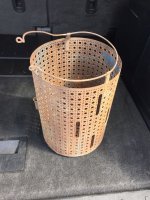
Got a rusty metal basket for my e-tank.

Got it at a sale for $1 which will be perfect for small parts.
attachment.php

ImageUploadedByTapatalk1440785412.707397.jpg
 

BlueBomber

Well-known member
Joined
Sep 14, 2013
Messages
3,201
Location
Outside Boston, MA
Blue: great looking set up. even though the black scum is still on the piece coming out of the tank some guys wire wheel and some just pressure wash that off and it's ready to prep. it will flash rust quickly so you can put boiled linseed oil on it or even WD or other products while you are waiting to prep it.

did you glue the old top in the bottom or just set it there to keep the rebar from coming in to the middle?

great idea

DIF: The plastic rim is snapped on to the rim of the bucket like a normal lid. Except that I cut six of the eight tabs off to make it easier to remove, if need-be.
 

Outlawmws

Well-known member
Joined
Aug 9, 2011
Messages
39,189
Location
The Badlands
Will post some pics this weekend. Gotta admit to being a little disappointed. Sure the rust is gone (that process works as advertised), but the tools come out covered in the black gunk, which still needs to be wired wheeled off. Doesn't seem like I'm saving a lot of effort.

Am I not leaving them in long enough?

The black sludge is converted rust.

As mentioned, lots of ways to knock it off, as it come off easily, if messily (I wear industrial rubber gloves, just 'cause it's so messy...)

I generally like to use a stiff Nylon scrub brush with a handle (The "fist" type) on it (any Grocery store has these in Cleaning), A stiff tooth brush helps in nooks and crannies. As CW said, do this part wet, then get it dried off quickly so you don't get flash rust.

After getting the parts semi dry (old towels?) I'll hit them with some heat to drive out the last of the damp. Bernz-O-Matic, Oven, Gas stove burner, lots of options.

Then get something on to keep rust off, whether you go for paint right away, or go for oil (use BLO if painting is planned). WD-40 is semi useless... I'll use that where I need to get inside something to get damp out as is IS "Water Displacement", but that is about the only benefit I'll grant it...
 
To avoid these ads, REGISTER NOW!

Chucktin

Well-known member
Joined
May 24, 2015
Messages
326
Thanks! Sould have known that, old oil painting lecture comes to mind and I just saw it on the shelf at Lowe's this AM. Can I claim that Erika, the (now) non-hurricaine, distracted me?
 

bagged89s10

Well-known member
Joined
Mar 13, 2005
Messages
4,607
Location
CT
:+1: Often a component of paint, or at least compatible, so won't cause issues later when you do paint. (And a tip of the hat to Fretters for that gem! :beer: )


Good tip. I usually just throw on motor oil until I have time to prep a vise for paint. Maybe I'll start using BLO. The strong smell of Hemp just makes my nose hurt. Maybe I'll wear a mask.
 

Fretters

Well-known member
Joined
Jan 25, 2014
Messages
4,217
Location
South Yorkshire, England
Add a dash of Gum Turpentine to the oil Bagged'. It'll mask the smell of the oil until it evaporates, (it'll give it a pine like aroma), and if you use BLO, that should be close to dry by the time the turpentine evaporates. A dash of Citronella Oil in there would be another pleasant way to mask the smell.

This is the vice which suffered, :D the initial Linseed Oil test.

guimage


guimage


That coating was left in place when it was painted. I had to do something with that vice, as it was going well beyond the normal flash rust after derusting, and was actively rusting again. Didn't coat it with engine oil as that would have been a devil to remove completely before painting, hence that vice became the test piece for a Linseed base. As you can see, it didn't affect the enamel paint applied on top of it.

guimage


guimage


That was also the piece which prompted me to try a Linseed Oil and enamel paint mix, which I had also been curious about for a while. All of my recent vices done in that Wine Red are actually a Linseed Oil and enamel paint mix, rather than just straight paint. It's quite useful in several ways. The oil thins the paint, and also makes it flow much better with the brush. Brush marks are pretty much eliminated, even on smooth surfaces. It does alter the way the paint dries somewhat, though not adversely. The first coat seems to remain tacky for longer, but the second coat can still be applied after a day or so regardless, and once that second coat goes on, the paint then cures quite quickly. The type of enamel paint used does seem to make a difference when making an oil & enamel mix. I tried the same mix with a cheaper enamel, and it's worked fine, but that did take longer to cure.
 
Last edited:

CwazyWabbit

Well-known member
Joined
Jan 9, 2015
Messages
1,189
Location
Surrey, UK
..... then get it dried off quickly so you don't get flash rust.

After getting the parts semi dry (old towels?) I'll hit them with some heat to drive out the last of the damp. Bernz-O-Matic, Oven, Gas stove burner, lots of options.
......

I find compressed air is quite good for drying quickly as well.
 

bagged89s10

Well-known member
Joined
Mar 13, 2005
Messages
4,607
Location
CT
Add a dash of Gum Turpentine to the oil Bagged'. It'll mask the smell of the oil until it evaporates, (it'll give it a pine like aroma), and if you use BLO, that should be close to dry by the time the turpentine evaporates. A dash of Citronella Oil in there would be another pleasant way to mask the smell.


This is the vice which suffered, :D the initial Linseed Oil test.


guimage


guimage


That coating was left in place when it was painted. I had to do something with that vice, as it was going well beyond the normal flash rust after derusting, and was actively rusting again. Didn't coat it with engine oil as that would have been a devil to remove completely before painting, hence that vice became the test piece for a Linseed base. As you can see, it didn't affect the enamel paint applied on top of it.


guimage


guimage


That was also the piece which prompted me to try a Linseed Oil and enamel paint mix, which I had also been curious about for a while. All of my recent vices done in that Wine Red are actually a Linseed Oil and enamel paint mix, rather than just straight paint. It's quite useful in several ways. The oil thins the paint, and also makes it flow much better with the brush. Brush marks are pretty much eliminated, even on smooth surfaces. It does alter the way the paint dries somewhat, though not adversely. The first coat seems to remain tacky for longer, but the second coat can still be applied after a day or so regardless, and once that second coat goes on, the paint then cures quite quickly. The type of enamel paint used does seem to make a difference when making an oil & enamel mix. I tried the same mix with a cheaper enamel, and it's worked fine, but that did take longer to cure.


I'll have to try citronella or gum turpentine. Now can you do this is using BLO as a wood finish?

When you treated that vise with BLO, what prep did you do before painting it?
 

Fretters

Well-known member
Joined
Jan 25, 2014
Messages
4,217
Location
South Yorkshire, England
I'll have to try citronella or gum turpentine. Now can you do this is using BLO as a wood finish?

The turpentine, definitely. Citronella, I can't see why not.


When you treated that vise with BLO, what prep did you do before painting it?

Nothing bar a quick wipe over to remove any dust. The enamel went straight onto the Linseed Oil coating.
 

torqueman2002

Well-known member
Joined
Jun 3, 2009
Messages
6,139
Location
SE Michigan
:+1: Often a component of paint, or at least compatible, so won't cause issues later when you do paint. (And a tip of the hat to Fretters for that gem! :beer: )
Good tip, indeed. I'll use it for sure.

I feel a Caution is in order, though.

Rags used with BLO are prone to spontaneous combustion.
http://www.naturalhandyman.com/iip/infpai/inflinspontaneouscombust.html

"What causes it [spontaneous combustion]? With linseed oil and other oils used to finish wood, including some exterior deck sealers and wood stains, heat is generated during the drying process.

This is because these oils do not dry like paint (through the evaporation of a solvent or water). Instead, they dry through the same process that generates fire... oxidation."


I do not intend to dismiss BLOs use, just be aware how to use it safely.
"To avoid fire danger, investigators suggest putting your used rags on a non flammable surface to dry, in an open area, like your driveway. "It is not bunched up in a corner but just nice easy way to do it. Just lay them out flat until they are completely dry. Once they are dry, you can clean them up. Use a hose if you have to or a washing machine," Lt. . Elmore explained.

If you wash them in a machine, remember, not to wash them with other clothes or fabrics. You can also put the rags in a tin can with a lid to keep out oxygen. Never store rags in your home or in the garage. Another important tip, always read the directions to make sure you are using the chemical properly and are aware of any possible dangers.

Because of the dangers, the Chesterfield Fire Department stopped using linseed oil to clean equipment. Lt. . Elmore says, in liquid form, linseed oil is relatively safe. He also adds, during warmer months, rags soaked in linseed oil will ignite quicker than during colder times of the year.
Copyright 2011 WWBT NBC12. All rights reserved."

http://www.nbc12.com/story/16034653/spontaneous-combustion-dangers-of-linseed-oil

:)
 

drivesitfar

Well-known member
Joined
Oct 23, 2013
Messages
36,008
Location
Pacific Northwest
Doc: great safety tip. i know that a stained rag can ignite and burn down a garage if left close to wood because one of our members had a garage build for that reason.

also one of my neighbors was staining wood and left a rag on his 1.125 plywood bench and it turned it to charcoal under the rag before he found it and put it out.

i do have metal benches and a rag metal bin i usually put rags in and on, but didn't know BLO had the same combustion ability as stain.

thanks for sharing.

Fretters: thanks again for doing the BLO paint testing.
 

Outlawmws

Well-known member
Joined
Aug 9, 2011
Messages
39,189
Location
The Badlands
VERY good point TM! Another way to deal with the Rag processing might be to use paper towels (Yeah Yeah even more flammable... hear me out,,,), but you still need to handle them properly, so maybe a wire basket well away from anything, and covered, to let dry. Prime candidate for lighting BBQ's in those briquette chimney's too!

Hmm maybe a wire "Clothes line" is in order...
 

BlueBomber

Well-known member
Joined
Sep 14, 2013
Messages
3,201
Location
Outside Boston, MA
Good tip, indeed. I'll use it for sure.

I feel a Caution is in order, though.

Rags used with BLO are prone to spontaneous combustion.
http://www.naturalhandyman.com/iip/infpai/inflinspontaneouscombust.html

"What causes it [spontaneous combustion]? With linseed oil and other oils used to finish wood, including some exterior deck sealers and wood stains, heat is generated during the drying process.

This is because these oils do not dry like paint (through the evaporation of a solvent or water). Instead, they dry through the same process that generates fire... oxidation."


I do not intend to dismiss BLOs use, just be aware how to use it safely.
"To avoid fire danger, investigators suggest putting your used rags on a non flammable surface to dry, in an open area, like your driveway. "It is not bunched up in a corner but just nice easy way to do it. Just lay them out flat until they are completely dry. Once they are dry, you can clean them up. Use a hose if you have to or a washing machine," Lt. . Elmore explained.

If you wash them in a machine, remember, not to wash them with other clothes or fabrics. You can also put the rags in a tin can with a lid to keep out oxygen. Never store rags in your home or in the garage. Another important tip, always read the directions to make sure you are using the chemical properly and are aware of any possible dangers.

Because of the dangers, the Chesterfield Fire Department stopped using linseed oil to clean equipment. Lt. . Elmore says, in liquid form, linseed oil is relatively safe. He also adds, during warmer months, rags soaked in linseed oil will ignite quicker than during colder times of the year.
Copyright 2011 WWBT NBC12. All rights reserved."

http://www.nbc12.com/story/16034653/spontaneous-combustion-dangers-of-linseed-oil

:)
Yep. Believe the warnings. Just click my build link below to see what happens if you don't.
 

gnpenning

Well-known member
Joined
Jan 25, 2015
Messages
2,754
Location
I have more questions than answers.
Years ago I built a trailer. I mixed BLO with the paint for the wood deck. I don't remember where I heard about it but.. It has held up for many, many years. It's due to be replaced now but it worked very well. Nothing else I've tried has even come close to lasting as long. It is something that I should do more often for exterior wood. The new deck will get it again.
 

bagged89s10

Well-known member
Joined
Mar 13, 2005
Messages
4,607
Location
CT
The turpentine, definitely. Citronella, I can't see why not.


Nothing bar a quick wipe over to remove any dust. The enamel went straight onto the Linseed Oil coating.


So I'm trying out the BLO after electrolysis. I wiped it on, wiped off the excess, the threw it in my baking oven for a few minutes to dry it.

attachment.php

ImageUploadedByTapatalk1440967281.410672.jpg

So I usually wipe down my parts with tsp and then acetone before painting them. You are saying just paint over then without doing that?
 

metalmagpie

Well-known member
Joined
Nov 1, 2011
Messages
798
Location
Seattle
I have been using electrolytic derusting (EDR) for years. I do not have one setup. For a tank I use something that's big enough to hold the workpiece and enough liquid, that is watertight. Recently I had an awkward workpiece, the base of an old Italian cold saw. To clean it, I knocked together a plywood box and just lined it with a 3 mil plastic trash bag.

For electrodes, I like to use sheet lead. I started with steel but as the part gets cleaner the steel anode gets rustier and less conductive so the process slows down. After steel I switched to graphite. But for me the solution turned inky black using graphite. Not as nasty as steel, but still unacceptable. Stainless has the problem that you can dissolve chromium into solution and hexavalent chromium is a very potent carcinogen. Sheet lead seems fine to me. Sure, it oxidizes, but lead oxide is just as conductive as lead metal (or close enough) so it doesn't slow things down. And the lead compounds are very insoluble in water. The roof of Notre Dame was laid down in what - 1040AD? It is sheet lead and it's still good.

I use an actual DC power supply. Mine is rated for 30 amps at 30 volts. It works. You can make it behave like a current source, which is nice because even if something is changing the supply will vary the voltage to keep the current constant.

I believe that the process is controlled by the current density. In other words, for a given sized object if you use more than a certain amount of milliamps per square inch it will bubble violently, and if you use a lot less, it will complete in weeks instead of hours. For things with some paint on them, I like to get them bubbling pretty good since the mechanical action of the bubbles forming tends to lift off the paint in big sheets. For delicate parts I sometimes use a relatively low current but let it go for a long time.

The black stuff is iron carbonate. As mentioned here, you can scrub it off under running water. What I almost always do with a piece of any size now is to put it down on my lawn on a piece of sheet metal and pressure wash it as soon as it comes out of the EDR bath. Even if some paint and grease remain, they are usually loosened considerably by the EDR bath and pressure washing often just cleans them entirely. Sometimes you do have to manually scrub afterwards, though. But it works! And it isn't sandblasting.

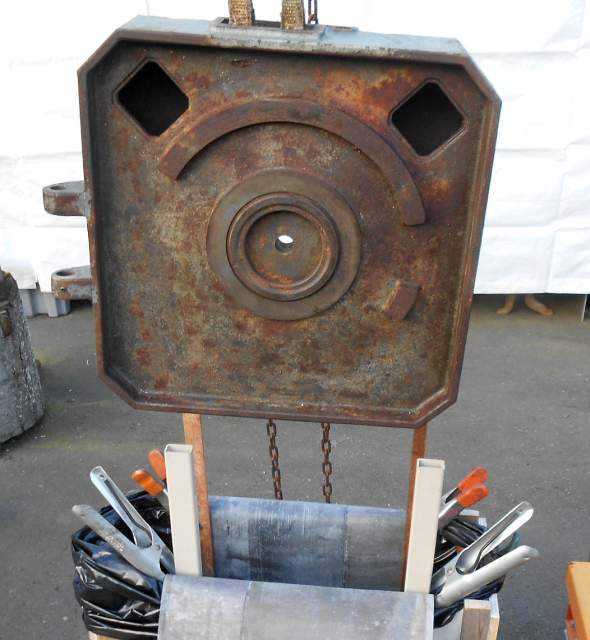
Here's a picture of that saw base before derusting:

sawBaseBeforeEDR.jpg


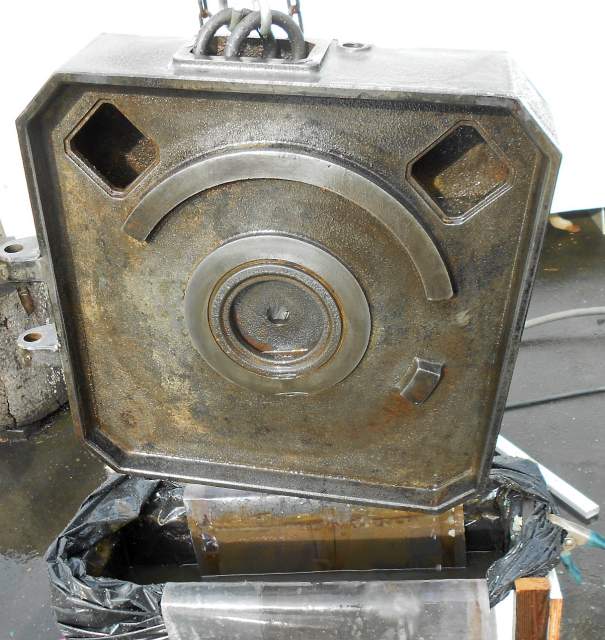
And after:

sawBaseAfterEDR.jpg


Note that this saw base has a cast-in fluid sump which was FILTHY. I hung an electrode down in there and as you can see a lot of junk came off.

Lately I try to wire the part with steel tie wire, and suspend it from a rod over the bath. That way I can connect the negative wire to the wire instead of running it down into the solution. You'd think that 16 gauge steel wire would get hot with a lot of amps running through it but that heat just goes into the bath. Seems to work fine, a cleaner approach than running copper wire down into the bath.

metalmagpie
 

Fretters

Well-known member
Joined
Jan 25, 2014
Messages
4,217
Location
South Yorkshire, England
So I usually wipe down my parts with tsp and then acetone before painting them. You are saying just paint over then without doing that?

Just do it in the same manner you would when painting. Prep/clean the metal, before you apply the oil, just as you'd prep/clean before painting, but once the oil is on there and cured, just straight on with the paint. No further prep is necessary. The Linseed is simply acting as a base coat.
 

bagged89s10

Well-known member
Joined
Mar 13, 2005
Messages
4,607
Location
CT
Just do it in the same manner you would when painting. Prep/clean the metal, before you apply the oil, just as you'd prep/clean before painting, but once the oil is on there and cured, just straight on with the paint. No further prep is necessary. The Linseed is simply acting as a base coat.


Sounds good to me. I took the vise out of the e-tank, scrubbed it down with a scotch broke pad and simple green, rinsed it, dried it, then applied BLO. I'll be spraying the paint on in the next day or so.
 

Fretters

Well-known member
Joined
Jan 25, 2014
Messages
4,217
Location
South Yorkshire, England
For electrodes, I like to use sheet lead.

I've used lead in the past, and must admit that I like it as an anode material too. Lasts longer than steel. Currently though, I'm using cast iron mainly. You still get some rusty scum, but less than with steel, and the cast anodes seem to last far longer than anything else I've tried so far.
 

Fretters

Well-known member
Joined
Jan 25, 2014
Messages
4,217
Location
South Yorkshire, England
VERY good point TM! Another way to deal with the Rag processing might be to use paper towels (Yeah Yeah even more flammable... hear me out,,,), but you still need to handle them properly, so maybe a wire basket well away from anything, and covered, to let dry. Prime candidate for lighting BBQ's in those briquette chimney's too!

Hmm maybe a wire "Clothes line" is in order...

A clothes line is a viable option. Hanging the rags like that prevents them generating notable heat as such. The fires I've heard of have happened due to the rags being piled, so they're retaining the heat. Keep the rags either in a metal container with an airtight lid, else hang them to dry, and they should be fine.
 

bagged89s10

Well-known member
Joined
Mar 13, 2005
Messages
4,607
Location
CT
A clothes line is a viable option. Hanging the rags like that prevents them generating notable heat as such. The fires I've heard of have happened due to the rags being piled, so they're retaining the heat. Keep the rags either in a metal container with an airtight lid, else hang them to dry, and they should be fine.


Yes the worst this to do is crumple up the rags. That's when they heat up faster when drying and catch on fire. Putting some water in your metal rag container is a good idea too.

Anyone know where to find a metal tag container that won't break the bank?
 
To avoid these ads, REGISTER NOW!
Top Bottom