To avoid these ads, REGISTER NOW!

Homemade electrolysis. What do you use?

555

Well-known member
Joined
Nov 10, 2007
Messages
2,290
Location
Nomad-Arkansas & Georgia
I've only done it once and used a battery charger and a plastic tub like nearly everyone else. It did a nice job but was a very slow process. I've had better luck removing rust with vinegar.
 
To avoid these ads, REGISTER NOW!

torqueman2002

Well-known member
Joined
Jun 3, 2009
Messages
6,139
Location
SE Michigan
.... Doc: i still love that Parker with the swiveling dynamic jaw. i've never seen one in person so if you want to put it in your suitcase i'll buy lunch and beverages if you show up at my door with it.

cheers
I wish we were closer, I'd be happy to see you get it. :thumbup:

My son and his wife are headed back to the Twin Cities this summer, so it looks like no trips to the Pacific NW in the near future. :sad:
 
Last edited:

ed4banger

Well-known member
Joined
May 28, 2016
Messages
470
Location
Virginia
Maybe dumb question, couldn't go through all the pages of this post. I have a lot of steel C-channel which I think will make excellent anodes. Question, should I remove the blackish finish of these steel pieces? Believe its an oxide finish, not sure.
 

dogdog

Well-known member
Joined
Nov 15, 2011
Messages
12,711
Maybe dumb question, couldn't go through all the pages of this post. I have a lot of steel C-channel which I think will make excellent anodes. Question, should I remove the blackish finish of these steel pieces? Believe its an oxide finish, not sure.

If it conducts electricity... it don't matter much.... anode you mean it is for sacrificial anode.... ? I have used old steel drum / brake disc or anything steel I don't want anymore.... just connect more than one anode .... to the + around the whole solutions ..... if you have a larger object.

I used a HF charger for it... works wonder... tougher more stubborn 30+ years old paint / rust on large old radiators took me about a week in a plastic tub.... I have to flip it a few times in between since tub can't fit the whole radiator. The stubborn paints I have to start with a 24V higher voltage supply... But you could destroy your piece if you are not too careful. Something about hydrogen embrittlement .... with higher voltages.
 
Last edited:

don long

Well-known member
Joined
Mar 31, 2012
Messages
8,845
Location
southern california
Thanks Drives for directing me to this thread
I have a ton of old rusty tools and things that need to be cleaned up and I remembered reading about electrolysis and thought I'd try my luck at it.
I pulled up articles on the web and searched the GJ and felt ok building my tank.
I took a 5 gal bucket 6 2x12" electrodes (mild steel) drilled holes in the top of the bucket evenly spaced and the metal pieces, put a brass bolt through the hole and mounted each piece of metal grabbed some #6 wire and some connector ends and linked each electrode together. I notched the top of the bucket on either side to mount a piece of copper tubing (water pipe) for suspending my tools. I wired up each tool with copper wire and wrapped it around the copper pipe filled the bucket with tap water and put the negitive side of my old battery charger on the copper pipe and the positive cable on the bolt coming through the bucket. I didn't catch a pic. of my first batch or set up .

My tools turned out looking like this


IMG_1205 by don long, on Flickr

These tools looked as bad as the vicegrip before sitting in the bucket over night

IMG_1182 by don long, on Flickr


The above picture is my second attempt to clean a vice grip plier.
This time I fastened 2 smaller grips on the sides of the big vicegrip and fastened my negative cable to the vicegrip and my positive cable to the bolt again

IMG_1204 by don long, on Flickr

I did make a mistake with the process.
I wanted to add a small vice to the tank and without turning off the battery charger I wired up the vice and dropped it in the water while trying to wrap the copper wire around the vicegrip. When I touched the wire to the vicegrip it created a spark that caused a small explosion and I ended up wearing that ugly orange foam on my shirt
 
Last edited:

Outlawmws

Well-known member
Joined
Aug 9, 2011
Messages
39,188
Location
The Badlands
Don, two things, and you already learned about one of them:

Those bubble are full of hydrogen and can be explosive, so power off when making or breaking connections, and set it up a well ventilated area with no ignition sources.


All the copper and brass is fine EXCEPT for the copper wires down in the soup. Copper is a heavy metal and you don't want the copper in there. The process with iron or ordinary steels (Nor stainless steel, that's a whole conversation by itself) is completely safe and toxin free, unless you get heavy metals involved... heck you can safely put it in with iron loving plants in your garden.

Get some Re-bar Tie wire (couple of bucks a roll in the masonry department of any big box store) which is soft iron. Use that to go to the tools in the soup. I usually just make hooks and hang them off the top bar.
 

Craptain

Well-known member
Joined
Apr 18, 2013
Messages
4,028
Location
Tampa Bay FL
Congratulations Don. As usual you made a proper job of it. I am using a larger tote for my tank, but it is still wired with battery clips and twisted wire. The hangers should be iron or steel though rather than copper as that will dissolve faster than the rust. At least I think that's the reason. I use old coat hangers.

Sent from my SM-G900T using Tapatalk
 

6PTsocket

Well-known member
Joined
Mar 12, 2014
Messages
4,593
I don't know if baking soda will work straight out of the box but washing soda is sodium carbonate and baking soda is sodium bicarbonate. If you heat baking soda in the oven, it becomes washing soda. I don't remember the exact temp. and time but as I recall it was not very long or super hot. As baking soda is a food ingredient, I would not hesitate to do it in a kitchen oven, not like powder coating.People have complained about having trouble finding washing soda but many supermarkets have it. I found it in Walmart.

Sent from my SM-G900V using Tapatalk
 

Craptain

Well-known member
Joined
Apr 18, 2013
Messages
4,028
Location
Tampa Bay FL
It is not a big deal what you use. The purpose is to make the solution, ie water, conductive. This would happen with either acid or alkaline solutions. But acid in this case is not really acceptable. Washing soda or baking soda will both function adequately, I have even used borax. But Washing soda dissolves more readily, and so is the go to for most of us. It will also help if there's any grease or oily residue left. And the big thing is that it is safe. Whatever you use, don't make it to strong. It only takes enough to enable the current to flow. I use about 2 cup full in a 20 gallon tote and get good results.

Sent from my SM-G900T using Tapatalk
 

gman007

Well-known member
Joined
May 17, 2017
Messages
2,726
Location
West Michigan
Hi all

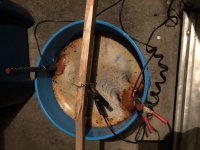
I have in the past used other methods of de-rusting but now for the first time I am trying electrolysis. I am using the recommended rebar and Arm & Hammer Super Washing Soda, 12V 2 Amp etc. All is going well but I am not sure how long each piece needs to be processed.

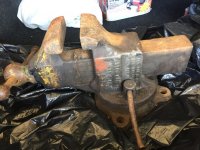
I guess this is a loaded question as obviously the length of time depends on how bad the corrosion is. In my case (a 50lb Reed 204 vise manufactured around 1914) it appeared to be just surface rust (see photo). I first processed the vise static jaw housing for like 6 hours last night which after rinsing it looked reasonably clean and free of rust. I then dried and left it over night.

This morning in day light I noticed there were few spots that could do with some more processing. So I started with a new solution and to my amazement after 7 hours now, still rusty crud/scum seems to be bubbling up to the top.

I really want to get going and I have not even gotten to the dynamic jaw/bar and swivel base and screw etc. At this rate it will take 3-4 days or may be even longer.

Is there any good indicator (eg no more bubbles or the amps drop to near zero, etc) when a piece is done? Am I over doing it?

Thx much in advance for any advice
007
 

Attachments

  • Reed 204 elect  IMG_2394.jpg
    Reed 204 elect IMG_2394.jpg
    142.6 KB · Views: 56
  • Reed 204 IMG_2356.jpg
    Reed 204 IMG_2356.jpg
    144.9 KB · Views: 69
Last edited:

Craptain

Well-known member
Joined
Apr 18, 2013
Messages
4,028
Location
Tampa Bay FL
Hi all

I have in the past used other methods of de-rusting but now for the first time I am trying electrolysis. I am using the recommended rebar and Arm & Hammer Super Washing Soda, 12V 2 Amp etc. All is going well but I am not sure how long each piece needs to be processed.

I guess this is a loaded question as obviously the length of time depends on how bad the corrosion is. In my case (a 50lb Reed 204 vise manufactured around 1914) it appeared to be just surface rust (see photo). I first processed the vise static jaw housing for like 6 hours last night which after rinsing it looked reasonably clean and free of rust. I then dried and left it over night.

This morning in day light I noticed there were few spots that could do with some more processing. So I started with a new solution and to my amazement after 7 hours now, still rusty crud/scum seems to be bubbling up to the top.

I really want to get going and I have not even gotten to the dynamic jaw/bar and swivel base and screw etc. At this rate it will take 3-4 days or may be even longer.

Is there any good indicator (eg no more bubbles or the amps drop to near zero, etc) when a piece is done? Am I over doing it?

Thx much in advance for any advice
007
Don't keep going. After all the rust is gone it will start damaging the metal. The bubbles will keep going as long as you have voltage and an electrolyte.
If you are not getting all the rust it could be the orientation of the anodes.

Sent from my SM-G900T using Tapatalk
 

gman007

Well-known member
Joined
May 17, 2017
Messages
2,726
Location
West Michigan
Don't keep going. After all the rust is gone it will start damaging the metal. The bubbles will keep going as long as you have voltage and an electrolyte.
If you are not getting all the rust it could be the orientation of the anodes.

Sent from my SM-G900T using Tapatalk

Craptain
Thanks much for the info. I just noticed (after posting by first response to you) that you are from Tampa and I hope that you were not adversely affect by Harvey and Irma.

Now, finally this morning I noticed that no more rusty foam/bubble/scum was gathering at top and I took the vise static housing out and rinsed it with water and then brushed it (plastic bristles) and dried it. I then cleaned it several times with kitchen tissue (dampened with gasoline).

Until this morning, previously I kept removing the build up rusty scum/foam from the top of the electrolyte solution and after several hours more rusty color scum would build up at the top so I am assuming this was rust for real. The piece does not look damaged (so may be the timing was right).

I rinsed the bucket thoroughly and cleaned the rebars (anodes) and then used 60 grits sand paper to remove any rust off the rebars. I then made a new electrolyte solution and now have the draw bar/dynamic jaw being processed. Based on my first ever experiment, I think I will process this piece until mid night (about 16 hrs)

Kind Regards
007
 
Last edited:

Fretters

Well-known member
Joined
Jan 25, 2014
Messages
4,217
Location
South Yorkshire, England
Don't keep going. After all the rust is gone it will start damaging the metal. The bubbles will keep going as long as you have voltage and an electrolyte.
If you are not getting all the rust it could be the orientation of the anodes.

It won't cause any damage to the metal, regardless of how long it's in there.

Gman', most of the rust you see in the solution is from the anodes. The process is finished when you decide you're happy with the result.
 

drivesitfar

Well-known member
Joined
Oct 23, 2013
Messages
36,007
Location
Pacific Northwest
Fretters: while you and a few others are on board with this E Tank discussion is there really a time when you can have a project in the tank TOO LONG? i remember you using yours 24/7 for maybe a week or two on low amps and wondering if any of this talk about an E Tank maybe destroying a piece if it's left in too long.

any truth to that or does it just sit in the tank waiting for us to pull it out and clean it off?

007
: sounds like you are doing what you should and i heard most of the guys don't clean up after every project so you might be able to use the tank a few times before cleaning that much. just saying and wondering what the guys say that use theirs all the time do?
 

Fretters

Well-known member
Joined
Jan 25, 2014
Messages
4,217
Location
South Yorkshire, England
The only adverse effects from leaving something in the tank for longer than necessary is wasted electricity and excess anode corrosion. The cathode piece could be in there for months, if desired, (and sometimes is where maritime pieces are concerned), with no detrimental effect.

Regarding cleaning the tank, I sometimes scoop a bit of rusty froth off, but rarely. Rarely bother draining and refilling either. I occasionally scoop the crud out of the bottom from the anodes, but again, rarely.

I've currently got a cast iron leg in the vat. Been in there for a week or so at around 500 to 750 mA, and I can honestly say I'm not concerned about it staying in there until I get my **** into gear. :D
 
Last edited:

Craptain

Well-known member
Joined
Apr 18, 2013
Messages
4,028
Location
Tampa Bay FL
It won't cause any damage to the metal, regardless of how long it's in there.

Gman', most of the rust you see in the solution is from the anodes. The process is finished when you decide you're happy with the result.
Fretters, it's good to see you back.

I will take your word for it about the damage or lack of. I am basing it on what I saw on a pipe wrench (Stilson) which accidentally got left for a week or so.

Sent from my SM-G900T using Tapatalk
 

Fretters

Well-known member
Joined
Jan 25, 2014
Messages
4,217
Location
South Yorkshire, England
Cheers. :) Did you happen to turn the supply off? What happened to the Stilson you left in there? Curiosity has me now. :D Even with no current passing, an alkaline solution should keep the piece fairly safe.
 

drivesitfar

Well-known member
Joined
Oct 23, 2013
Messages
36,007
Location
Pacific Northwest
Fretters: thanks for the 411 and always like seeing what you are cooking so how about posting up a few things as you have time to if you have any new projects.

also on the Vise Repair 101 thread i asked a question if i could change the guts off my Record 6 inch quick release that is in average condition to a like new Record 6 inch that looks almost identical? can you post up your thoughts over there when you get a minute if you might have some idea cause i've yet to take apart a quick release vise?

thanks and cheers buddy

Craptain: i haven't ever heard of anybody leaving anything in a tank and having the part get damaged so i'm curious too. i've left some tools in vinegar too long and vinegar will eat cast iron and maybe steel and chrome so you'd need to rinse and dry it off completely. if you have more details please do tell?

007: as you keep learning you'll be able to pass on the information as we do and best of luck with your projects.

ALL: so i'm not sure if i or anybody asked this, but if you have a big tank do you need a lot more anodes and maybe 2 or 3 battery chargers? can you have too many ANODES? also are the guys using graphite anodes liking the results and is the only benefit just eliminating the rust scum?

anybody else have a little explosion like Don did when he put a copper wire in his E Tank that was charged? as far as i've read and heard you could light a match (NOT RECOMMENDED) in a closed garage with an E tank running and no issues reported, but not confirmed by me.
 
To avoid these ads, REGISTER NOW!

Fretters

Well-known member
Joined
Jan 25, 2014
Messages
4,217
Location
South Yorkshire, England
Not doing much recently, DIF. The cast iron leg is one of a pair of Drummond legs I've had knocking about a few years. Cleaning them up now as I got a Myford manufactured Drummond M type lathe the other week, so wanting to get a stand made for that. No bench space left to mount it on. :D

Currently using four cast iron sash weights in my large vat. One each corner. Current, I still limit to between 500mA and 2A, depending.

With regard to that vice, honestly couldn't say. Never seen that later type of QR which Record did, so not sure what alterations they made to the plain castings for those. Easiest way to tell is to compare the undersides of the plain and the QR bodies.
 
Last edited:

Outlawmws

Well-known member
Joined
Aug 9, 2011
Messages
39,188
Location
The Badlands
Fretters, it's good to see you back.

I will take your word for it about the damage or lack of. I am basing it on what I saw on a pipe wrench (Stilson) which accidentally got left for a week or so.

Sent from my SM-G900T using Tapatalk

Were the leads reversed? That will eat a part pretty quick...

I'm with Fret. longer is just burning energy to no purpose...

Too long in some acids like vinegar, - ask Drives about that one!

On the other hand, Phosphoric Acid won't touch the good steel/iron...
 

Craptain

Well-known member
Joined
Apr 18, 2013
Messages
4,028
Location
Tampa Bay FL
Cheers. :) Did you happen to turn the supply off? What happened to the Stilson you left in there? Curiosity has me now. :D Even with no current passing, an alkaline solution should keep the piece fairly safe.
Well 1st off, I use carbon electrodes, and things always look black as the ace of spades anyway when they come out. But in this case they were also covered with what looked like lesions, sort of like you get on aluminium when it is getting corroded. As for the current, well it started off about 1 amp, but apparently someone knocked off the connections accidentally and re-connected the way they thought it was. So it's possible that polarity was reversed for a day or two. Then he disconnected again when I didn't show up for a couple more days. Anyway the clips were in about the right areas when I got there, ie positive and negative close to the correct places on my lash up.

Sent from my SM-G900T using Tapatalk
 

slow_runner

Active member
Joined
Jan 8, 2016
Messages
30
Location
New Zealand
I just found this thread and have skim read.
I may be repeating what has been written of previously but here goes....
My rig is a 1/2 44 gallon plastic drum with an old semi magnetic s/s dryer drum for the anode.
The power supply is basically an old multi tap transformer, diodes/ali heatsink and amp meter.
The crud does not attach to the s/s and drops to the bottom of the drum-there is only small residual staining of the s/s.
Items to be treated are either soaked in a caustic stew or washed clean in kero prior to electrolysis.
After treatment, items are scrubbed clean and given a dilute Phosphoric acid wash then a water rinse then blown dry.
I use gloves to prevent contact with the liquid. When I feel that the contents of the electro rig require cleaning, I decant into another drum and pour the remaining small amount of gunge into a lined tray. This is left in the sun to evaporate then the dry remnants are disposed of safely. Nothing goes down the drain or on the lawn.
For cathode connection I use gas welding wire, typically 1/8"
I normally use old bolts to connect the cathode to the item or a couple of small g clamps I have for that use.
Recently I discovered(?) another use for those small neo magnets; they save a shed load of time connecting the cathode to the item to be cleaned
 
Last edited:

drivesitfar

Well-known member
Joined
Oct 23, 2013
Messages
36,007
Location
Pacific Northwest
ALL: didn't we agree that Stainless, Nickel, Chrome and maybe even copper shouldn't be in the tank cause residue might be harmful or maybe toxic?

Outlaw: maybe that is what your link says, but i haven't read it and have to run finish up hanging a light?

ALL: on another not does the size of the tank effect the size of battery or power needed to power it up or will a small battery charger do ok up to 50 or 100 gallons?
 

Shiftless

Well-known member
Joined
Mar 9, 2014
Messages
14,525
Location
East Bay SFO
I still haven't put my tank together, but from a scientific point of view, the speed of the process depends on several variables some of which are the closeness of the electrodes to the object and the total area of the sacrificial pieces.
Except for the problem of impatience, there is nothing wrong with slow. The process should slow down to a halt when the rust is off of your object. Do you guys find that to be true?

Do any of you put a fuse or circuit breaker in the circuit to protect your power supply in case of overload, or accidental short circuit? Seems to me that would be a good idea since this process is not something that a person will sit and watch until its done. :)
 

Craptain

Well-known member
Joined
Apr 18, 2013
Messages
4,028
Location
Tampa Bay FL
I use a lightbulb in series with the power supply to limit the current, so even a dead short can do no harm.

Sent from my SM-G930T using Tapatalk
 

Shiftless

Well-known member
Joined
Mar 9, 2014
Messages
14,525
Location
East Bay SFO
I use a lightbulb in series with the power supply to limit the current, so even a dead short can do no harm.

Sent from my SM-G930T using Tapatalk

Interesting idea!

What are the specs on the bulb you use? It obviously can't have too much resistance or your current flow through the tank would drop substantially.
 

Craptain

Well-known member
Joined
Apr 18, 2013
Messages
4,028
Location
Tampa Bay FL
Interesting idea!

What are the specs on the bulb you use? It obviously can't have too much resistance or your current flow through the tank would drop substantially.
I don't recall right now, but I think it is just a sidelight or turn signal bulb.
I tried a few until I got an acceptable current.

Sent from my SM-G930T using Tapatalk
 

Shiftless

Well-known member
Joined
Mar 9, 2014
Messages
14,525
Location
East Bay SFO
I don't recall right now, but I think it is just a sidelight or turn signal bulb.
I tried a few until I got an acceptable current.

Sent from my SM-G930T using Tapatalk

Thanks!
Like I suppose most of us do, I have a few of those in a parts drawer,
maybe even a socket to go with it. :D

To increase current flow, a fellow could put 2 or more of them in parallel and than wire that array in series with the electrolysis tank.
 
Last edited:

slow_runner

Active member
Joined
Jan 8, 2016
Messages
30
Location
New Zealand
You may want to reconsider the SS for an Anode:
Done right electrolysis is safe and procures NO haz Waste or hexavalent waste. If you want a "Clean" anode use graphite. Available cheaply...

Thanks Outlaws.

I use a lightbulb in series with the power supply to limit the current, so even a dead short can do no harm.

I have a similar set up. An incandescant lamp fitting before the transformer. Although I have 6 taps off the trans, the lamp fitting allows further control by use of different wattage lamps. It works well enough.
 
Last edited:

Unruh

Well-known member
Joined
Aug 12, 2017
Messages
1,431
Location
Silverdale, Washington
So I’m getting ready to do a project. I set up my tank and have my solution ready. Then I realized the om
Nay wire I have to hang my rusty object with is galvanized wire. Is this going to be an issue? I was hoping to save myself a trip to the store.
 

mikegt4

Well-known member
Joined
Sep 12, 2005
Messages
3,266
Location
sw ohio
I don't know about galvanized wire (I would avoid it myself), I use re-bar tie wire. Cheap, readily available and useful for a lot of other things like hanging items for painting.

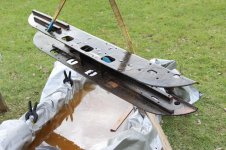
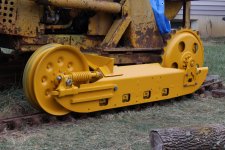
Last fall I used electrolysis on a track frame for my Oliver front loader. It was my biggest electrolysis project yet. I did the front idler, drive sprocket and track frame and they all turned out great although they each took several days of cooking.
 

Attachments

  • IMG_2137.jpg
    IMG_2137.jpg
    161.1 KB · Views: 93
  • IMG_2141.jpg
    IMG_2141.jpg
    158.8 KB · Views: 78
Last edited:

RacerX

Well-known member
Joined
Mar 27, 2007
Messages
377
Location
Caldwell, Tx
So I’m getting ready to do a project. I set up my tank and have my solution ready. Then I realized the om
Nay wire I have to hang my rusty object with is galvanized wire. Is this going to be an issue? I was hoping to save myself a trip to the store.
Galvanized puts off toxic stuff. I wouldn't use it. Plain ole bailing wire or coathanger shoud do the trick

Sent from my hammer and chisel using Tapatalk
 
To avoid these ads, REGISTER NOW!
Top Bottom