torqueman2002
Well-known member
x2No worries. ... Fretter post helped quite a bit. Thanks "Fretter"



x2No worries. ... Fretter post helped quite a bit. Thanks "Fretter"

Fretters: refresh my memory if you don't mind. does the negative wire attach to your cage so anything touches the bottom or sides of it are getting the de rusting?
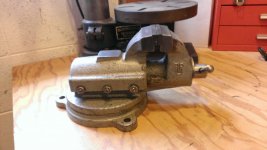
i like my 3 inch Bison (FPU) vice and i'm thinking that 80 mm is also a 3 incher. does it look something like mine?
post it up on the vise thread or your own thread when you get a chance because your burgundy vices are warming me up.
not like the light RED of DOC's Parker.
 Mines a more standard style. I believe Bison Bial's model designation for this one is 1250. They have the weight listed for the 80mm as 6.6kg, so approx. 15lb in weight. These are the original photo's of it. I'll post some of it when it's finished in the vices thread.

This is the little mesh basket that I dropped a bollock with, btw.


Honestly thought it was brass mesh, and never noted the colour of the cut ends due to the artificial lighting. It was only when I pulled it out of the vat after an overnight session that I noted it was aluminium, due to some of the anodizing having been removed.
On a positive note, it performed admirably.
Doc & Harley: Regarding the aluminium side of things, I'll have a dig around when it's light for a test piece. I've been trying to think of something to try, and seem to recall having a sump from a little Villiers four stroke somewhere, which is quite badly oxidised and which has some shreds of original paint left on it. That should be a perfect test piece for the vat.
What he said!Fretters. .. Thank you, that would be very much appreciated. I'm really looking forward to the results as I'm sure TM and others are. ....
I like the mesh basket idea. I was thinking about making one to fit my tank. Maybe a large one and then a small one for smaller parts. Wiring each piece is sometimes annoying, but still beats manually wire wheeling off rust.
Fretters, thank you for doing the test and reporting your findings. .. I think it will be a tool to use in certain situations on reviving some of these grinders. .Regarding aluminium, the best advice would be to not use electrolysis on finely finished pieces. Ran the test, and with the painted portions versus the bare portions, the overall effect was akin to etching a PCB. Underneath the paint the metal was untouched, but the bare metal around the paint was etched/eroded slightly, leaving a raised land where the paint was masking the metal.
For stuff like rough cast aluminium, it wouldn't be a problem, but on well finished pieces, its use wouldn't be advisable. It does remove/loosen the oxide layer well though. You can pretty much just rub the oxide off with your finger when it comes out of the vat.
Yes, thank you for your experimenting and sharing the results.I'll take a photo of the piece later and show some before & after photo's so you can see the effect it has. I scraped some of the old paint which was on there with the edge of a copper coin, and the paint came off easily enough. I'll take another photo of that little basket too, so you can see the effect it's had on that. It's removed pretty much all traces of the anodizing from it.


Thanks!Looks good Doc! Looking forward to seeing your results..

Thanks!
I wonder if it is 'cooking' at the proper level, though.
The current is a little lower than I use but it is fine. It will just take a bit longer but the results will be better.Thanks!
I wonder if it is 'cooking' at the proper level, though.
I don't know? When I did mine, I was told it will start kind of bubbling, and mine was (I didn't check the voltage or current). But mine WAS bubbling, and it did work. I'm sure yours is cooking.
Thanks guys.The current is a little lower than I use but it is fine. It will just take a bit longer but the results will be better.
Sent from my LG-D801 using Tapatalk

Thanks guys.
I checked it at noon and it was still slow cooking.
It must be working as you say, because even-though it wasn't terribly rusted to begin with, the paint now just peels away with a light scratching with a finger nail.
I decided to use the lower resistance bulb and I saw an immediate increase of bubbles ******* from the rebar.
I'll take some voltage and current readings a bit later and post them up.
Thanks again for the help and advise.
Many "automatic" chargers will not work at all. The earlier ones have current limiters and switch down if the current goes to high. Then back again when the current goes to low.So without a bulb for resistance/load, your battery charger wasn't putting out any or enough amps?
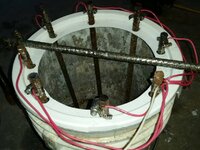
I mixed up the 'soup', used rebar tie wire, and an old Heathkit-friend with these vise pieces that have been cleaned with Simple Green.
Dynamic jaw hooked-up/suspended from the buss bar, and cooking for about 5 min.
The charger didn't like the above set-up.
A bulb will be used to drop the load on the charger and keep it from cycling between the Green and Red zones.
A measure of a 2 filament bulb non-load resistance.
The charger is 'happier' with the 3 Ohm load in series with the vise pieces.
3+ hours.
Total voltage is 10.72 VDC.
Voltage after the bulb, as supplied to vise pieces is 2.066 VDC.
Current in the system is 348 mA (0.348 Amps).
Anywhere in series will work. Just find a convenient place for it. Positive or negative side.So you put the bulb in series between the charger negative(-) on the charger and the vise or parts you are de-rusting?
So without a bulb for resistance/load, your battery charger wasn't putting out any or enough amps?
It was cycling from ON to OFF (needle would be in the Green Zone {fully charged} then the Red Zone {check battery} on the chargers meter). I believe the charger's self protection circuitry prevented it from charging continuously.
Many "automatic" chargers will not work at all. The earlier ones have current limiters and switch down if the current goes to high. Then back again when the current goes to low.
The bulb limits current to the safe area.
What he ^ said. Thanks, Craptin.
Sent from my LG-D801 using Tapatalk
So you put the bulb in series between the charger negative(-) on the charger and the vise or parts you are de-rusting?
Essentially yes.
Although, in this case the bulb is in series in the Positive (Red wire) circuit between the charger and the rebar.
I don't see what electrical difference it would make, which circuit from the charger the bulb is placed. Someone correct me if it does. I see the Craptin posted that while I was composing.
I'll post my comments in Blue.


TM, double check your polarity (Use the volt meter...), the rebar typically does NOT do the fizzing, the parts should be doing it..
Thanks, I will.
I went back through the pictures, the charger:
- Positive/Red lead goes to the rebar
- Negative/Black goes to the vise/parts
Is that correct?
If it is, I wonder if the 40 year old Heathkit went and switched sides/polarity? ("Not that there's anything wrong with that." J. Seinfeld)
I went out and verified (with a voltmeter) the charger leads are correct and the connections matched the diagram.The diagram and description are correct, the leads being bas-akwards is why I suggested verifying the charger...

Done, Thanks!I'd switch to a piece of scrap until you get this sorted out, you do NOT want to run a good part backwards!


I too plan to make a wire basket.
One question, what 'size' is the mesh/opening and thickness/gauge of the piece. Sorry, I don't know the proper terms.

Could I have the Sodium Carbonate/Water solution too concentrated?

Very good point, voltage drop across a load when the circuit is powered up is the preferred method.Just a note on bulb resistance. When you measure resistance with a meter you are measuring cold. The resistance changes significantly hot.
It doesn't matter for our purpose but is something to be aware of. High wattage bulb is low resistance and low wattage is high(er) resistance. Just try a couple of different ones individually or together to achieve what you need.
Sent from my LG-D801 using Tapatalk
That's my thought also, Drives. There was 'scum', just not brown.Doc: Since your red parker wasn't that rusty you didn't seem to get the brown scum on top of the water. You said paint was coming off. Any pics and did swivel jaw loosen up?


That's my thought also, Drives. There was 'scum', just not brown.
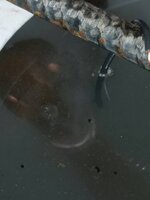
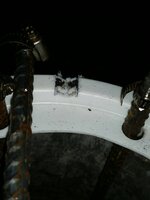
Here's a pic. of the tank just before I pulled the 1st batch of vise pieces out.
The dynamic jaw as it emerged from the tank.
Here is the d. jaw after 15 min. of easy scraping and wire brushing.
I wiped the parts down with Kroil and put a couple of squirts into the hole with the broken bolt/pin that holds the jaw from swiveling.
Tomorrow I will have a go at removing it. The jaw wants to move, as there is easy, but slight side-to-side rotation now.
Right now the tank has a hunk of iron with a bit of rust on it, to run a check and compare with the vise results.


 The Channellocks and the strippers were also sale scores.