
To avoid these ads, REGISTER NOW!

How do Vessel Screwdrivers compare to Snap-on ?

CGarage

Well-known member
Joined
Nov 23, 2018
Messages
2,997
Location
United States/Switzerland
The only thing I would add to the above is
1) This conclusion assumes you are a U.S. based tool user and
2) The Vessels seem to fit all Philips perfectly, and same with Flat / Slotted fasteners.

I have a few Snap-On screwdrivers, but my gosh, they want a pretty penny for them.

Lifetime warranty is nice, but quality seems to drop with the replacement spares from my experience, compared to the original.
 
To avoid these ads, REGISTER NOW!

nabs

Active member
Joined
Jun 5, 2014
Messages
33
Location
Herts, UK
  • SAE vs Metric fasteners and screwdrivers definitely makes a difference:
I think this is the last part of the jigsaw we are missing - based on the frequency of reports about problems in the past, my guess is there is an incompatibility between the old patented Phillips crosshead tip design and crosshead screws produced in Japan. I think it is also probable that this has been subsequently resolved by harmonisation work in SAE and we are now all following the same standard. Having said that this is all theory - it would be good to get the evidence, which means seeing copies of the relevant standards.

Of course, the existence of standards does not mean all manufacturers follow them and - given the standards harmonisation work in this area has been going on for over 60 years - there is no way of knowing whether our motley collections of old screwdrivers align with current specifications or not. I think this is the main the reason a lot of the JIS myths have persisted so long: the discussion encouraged a lot of us to go out and buy some decent screwdrivers which were better to use than our old ones :)
 
Last edited:

Jack Ryan

Well-known member
Joined
Jun 2, 2022
Messages
339
Location
Adelaide, South Australia
I think this is the last part of the jigsaw we are missing -

Missing? What's missing?

based on the frequency of reports about problems in the past, my guess is there is an incompatibility between the old patented Phillips crosshead tip design and crosshead screws produced in Japan.

No need to guess, the JIS standard was created to get around what the Japanese perceived as faults in the Phillips standard. They are different.

I think it is also probable that this has been subsequently resolved by harmonisation work in SAE and we are now all following the same standard. Having said that this is all theory - it would be good to get the evidence, which means seeing copies of the relevant standards.

The purpose of the latest ISO standards was to harmonise the pre-existing standards (mostly) in favour of the JIS standards.

I think the end result is an ISO/JIS screwdriver that works - assuming, of course, the that new standards are adhered to. JIS cross point screwdrivers always worked with Phillips head screws and old Phillips cross point screwdrivers never (subjectively) worked well on anything - particularly not JIS standard cross point screws. I don't think SAE/Metric was ever a cross point issue - it was a standards issue.

As far as I have seen, the bulk of the confusion comes from the likes of the Vessel importers that seem to have had trouble translating or interpreting what was published by Vessel and the JIS.

The main problem has been the lack of a definitive English source.

Jack
 

CGarage

Well-known member
Joined
Nov 23, 2018
Messages
2,997
Location
United States/Switzerland
👆Good post. I agree. The Vessel importers never seemed like the sharpest tools in the shed. Lost in translation occurs so often between manufacturer and distributor, especially foreign distributor.
 

nabs

Active member
Joined
Jun 5, 2014
Messages
33
Location
Herts, UK
Missing? What's missing?


No need to guess, the JIS standard was created to get around what the Japanese perceived as faults in the Phillips standard. They are different.
like I say, the way to get rid of the guesswork is to look at the actual Phillips standard and see how it differs from the JIS standard. I don't doubt they do differ, I've just never seen the Phillips specification.

The poorly worded/translated materials from Vessel's importing agents haven't helped, but a lot of the really daft stuff - that the Phillips crosshead was designed to cam out, JIS being obsolete etc etc - seems to have gained a life of their own on internet forums.
 

Dakotadadv8

Well-known member
Joined
May 30, 2021
Messages
1,483
I have 1 vessel screwdriver, pozidriv from Amazon, needed one quickly. Works ok but don't have the pozidriv from Snap on to compare. IMHO the regular SO screwdriver set instinct handle are nice if you are willing to spend the $, SGDX80BR.
 

Jack Ryan

Well-known member
Joined
Jun 2, 2022
Messages
339
Location
Adelaide, South Australia
that the Phillips crosshead was designed to cam out,
I think many just assume that because it does, it is meant to. It is not mentioned in the original patent (as far as I remember).


JIS being obsolete etc etc -
That came from the US importer who seems to think that JIS identifies that particular driver. It is the standards organisation and the relevant JIS standard is still current.

Jack
 
Last edited:

Jack Ryan

Well-known member
Joined
Jun 2, 2022
Messages
339
Location
Adelaide, South Australia
I have 1 vessel screwdriver, pozidriv from Amazon, needed one quickly. Works ok but don't have the pozidriv from Snap on to compare. IMHO the regular SO screwdriver set instinct handle are nice if you are willing to spend the $, SGDX80BR.
I'm sure that if the Snap-On driver is made to the ISO, JIS or equivalent US standard, it will work as well as the Vessel driver.

Ergonomics and style are not covered in those standards (H and Z are covered by the same standards in most jurisdictions) leaving plenty of scope for individual favorites.

Jack
 
To avoid these ads, REGISTER NOW!

RTM

Well-known member
Joined
May 13, 2019
Messages
13,137
Location
SF Bay Area
that the Phillips crosshead was designed to cam out,

I think many just assume that because it does, it is meant to. It is not mentioned in the original patent (as far as I remember).
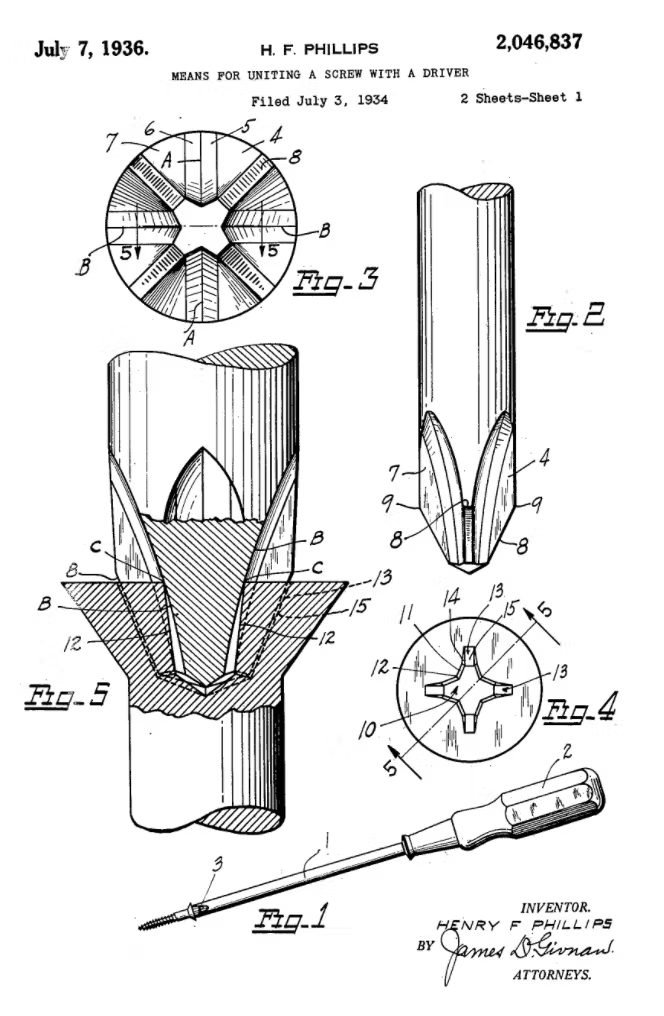
Read for yourself.


I say no. But put that question into google, and everyone says yes, with no patent information to back it up.

What it says is, if there is **** in the recess, the shape of the screw and driver will cause the **** to “cam out”
 

Jack Ryan

Well-known member
Joined
Jun 2, 2022
Messages
339
Location
Adelaide, South Australia
Read for yourself.


I say no. But put that question into google, and everyone says yes, with no patent information to back it up.

What it says is, if there is **** in the recess, the shape of the screw and driver will cause the **** to “cam out”
I think I have read all of the Phillips patents, not just that one, but not for some time.

None of the claims are that the driver will "cam out" but the geometry is described as having "tapers" which, in my opinion, would translate rotational torque to a linear force that might cause the driver to "cam out". So, there is no "cam out" claim, but the claimed geometry would result in "camming out". One would have to assume that is an unintended consequence of the design because it is not claimed.

Fortunately, the Japanese fixed (or at least addressed) the problem.

Jack
 

nabs

Active member
Joined
Jun 5, 2014
Messages
33
Location
Herts, UK
Read for yourself.


I say no. But put that question into google, and everyone says yes, with no patent information to back it up.
agreed - there is a continuation patent filled by Phillips in the same year where he specifically says

"One of the principal objects of the invention is the provision of a recess in the head of a screw which is particularly adapted for firm engagement with a correspondingly shaped driving tool or screw driver, and in such a way that there will be no tendency of the driver to cam out of the recess when united in operative engagement with each other. ".


So an urban myth. It has a long history - I found a patent by Black and Decker from 1971 saying the tendency cam-out was a feature not a bug in the original design, so perhaps a bit of mischief making by competing manufacturers helped keep the rumour going...

What it says is, if there is **** in the recess, the shape of the screw and driver will cause the **** to “cam out”
yep, it is a pity that Ford did not choose Robertson screws for his production lines as we'd all have avoided a lot of bother!
 

F-22

Well-known member
Joined
Jan 23, 2022
Messages
1,830
yep, it is a pity that Ford did not choose Robertson screws for his production lines as we'd all have avoided a lot of bother!
Robertson is a bit weird for being square. There's not many square things in engineering. The sharp corners give notching effects. I think if you take into consideration small screws (M4 and smaller, or SAE equivelants), the strong taper of a phillips actually keeps the screw head stronger. Especially countersunk screws. And you can have a relatively large phillips drive even in small diameter fasteners.

Allen head uses a wider angle (120°) so it's more of a circle, distributing the forces better. Torx is a long complex curve. But robertson is 90° angles, just seems like a very "agressive" transition. Not an expert on this but it is probably not very great for the stamping die either - I assume the sharp corners blunt out fast, so making phillips may be cheaper.
 

nabs

Active member
Joined
Jun 5, 2014
Messages
33
Location
Herts, UK
with many thanks to Brandon for digging out the original specs, we now know for sure that the ASME cross tip screwdriver standard conforms to the ISO standard, which in turn is based on the JIS spec from the 1950s, the only difference in the modern specifications being agreed (tighter) manufacturing tolerances.

It doesn't really make sense to talk about JIS screwdrivers - a screwdriver made to the 1954 JIS spec will also conform to the equivalent international specs (ASME, DIN, ISO, BSI etc etc) and all of them should be expected to work on Japanese automotive equipment of any era.

I could not find any documentation to prove it, but presumably snap-on also follow the current standards and this is why people are happy using them on their Japanese bikes and cars.

I've added the details and screenshots to my article, for those that are interested

PS the oldest US standard Brandon could find was from 1986 and it also conforms to the 1954 Japanese spec, so it seems the above situation has been true for quite some time...
 
Last edited:

BrandonV

Well-known member
Joined
Jun 9, 2023
Messages
4,030
Location
Arizona
I could not find any documentation to prove it, but presumably snap-on also follow the current standards and this is why people are happy using them on their Japanese bikes and cars.

I would assume that is a given. The latest ANSI/ASME standard (along with the prior) have a few Snap-on representatives on the subcommittee.

1723336920935.png
 
To avoid these ads, REGISTER NOW!
Top Bottom
