theoldwizard1
Well-known member
Yeah i dont like the all in one gateways
The wifi strength is subpar and the features on some models is lacking
They suite me and my "customers" just fine, even when they are "only" DOCSIS 3.0 !

Yeah i dont like the all in one gateways
The wifi strength is subpar and the features on some models is lacking
You are paying for it ... somewhere !For comparison..........
Spectrum/Charter in my area supplies the modem for no cost ( well ... included) somewhere in the price. If you choose to use your own modem there no cost reduction.
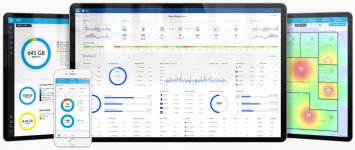
..... and the best one I have had experience with is from Ubiquiti Networks. Any larger and you'll need to get into commercial/enterprise systemswhich includes high power dish transmitter/receivers between large air gaps/buildings or just run cable......
In any case, nothing comes close to the refinement in execution that exists in the Ubiquiti user interfaces. They are genuinely plug and play systems, even at their enterprise level - simple to install and configure, which is clearly one of their engineering team's top design goals. In over 10 years of using Ubiquiti components, we have had zero issues in both enterprise and residential environments.
wyliesdiesel - I have xfinity Blast with 300 Mbps down/10 Mbps up and their monthly rental ARRIS Group, Inc. TG1682G modem/router/wifi gateway all in one device. I have internet only, no voice line.
You are paying for it ... somewhere !
Wait until your current contract expires.
Yeah i dont like the all in one gateways
The wifi strength is subpar and the features on some models is lacking
The caveat with regards to the Ubiquiti products is when it comes to the UniFi management software. If they have a product line that doesn't use it I can't speak to that, but the wireless products they do have that use UniFi could be a challenge for a non-IT person to setup.
Think of it as hosting a controller on your computer for the Ubiquiti hardware device(s). For a general setup that would cover 90% of regular home use you can setup your hardware using the UniFi software, send that configuration to the hardware and be good to go. If you need to make changes later you can fire up the software again (hope you remembered the login!) to do so.
If things don't work perfectly for you, it can get very difficult very quickly to resolve them for novice users. An example is an AP I setup recently had to be manually configured to connect to my UniFi system before it would allow itself to be properly adopted by it. This involved terminaling into the hardware to enter some command line inputs. Not a show stopper for me, but for a guy used to setting up DLink routers it might be.
They suite me and my "customers" just fine, even when they are "only" DOCSIS 3.0 !
The caveat with regards to the Ubiquiti products is when it comes to the UniFi management software. If they have a product line that doesn't use it I can't speak to that, but the wireless products they do have that use UniFi could be a challenge for a non-IT person to setup.
Think of it as hosting a controller on your computer for the Ubiquiti hardware device(s). For a general setup that would cover 90% of regular home use you can setup your hardware using the UniFi software, send that configuration to the hardware and be good to go. If you need to make changes later you can fire up the software again (hope you remembered the login!) to do so.
If things don't work perfectly for you, it can get very difficult very quickly to resolve them for novice users. An example is an AP I setup recently had to be manually configured to connect to my UniFi system before it would allow itself to be properly adopted by it. This involved terminaling into the hardware to enter some command line inputs. Not a show stopper for me, but for a guy used to setting up DLink routers it might be.
Agree.....It’s ( the cost) in there somewhere .......been with them six years, no contract.
Already went through the One year bundle discount 5 years back. The cost of internet is what, what it is. Spectrum has been ok, and TDS fiber is coming to the area with 1 gig. Spectrum already went from 100 to 200 Mbps at not extra cost. Suspect they will giving away 400 Mbps upgrade soon to offset TDS offers.
But like I said.......there’s no discount if I supply a modem. They do rent routers......which is not a bargain.
A better setup is via the cloud key dongle. no computer needed.
Also, having the dongle makes it easier for someone else to remotely log in and manage it or change things for the customer if they cant figure it out themselves
Sure, but that adds to the cost of the setup, running java software is free. And for a single AP (that uses UniFi) it wouldn't make sense to bother with the dongle. I decided against it as well and setup a docker instance on my Synology NAS to run a UniFi setup.
What did you spend on it?
couldve bought one on amazon for cheaper
https://www.amazon.com/dp/B07N7QK8Z5/?tag=atomicindus08-20
The modem you need depends on your speed.
I have an Arris SB6183 that i bought used on craigslist for $25 and it has worked flawlessly for 2yrs. Good for up to 600Mbps and I just upgraded to 300Mbps/10Mbps and may change to 600Mbps so i can get 15Mbps upload...
https://www.amazon.com/dp/B00MA5U1FW/?tag=atomicindus08-20


I am still reading up on the Orbi systems based on Denwood's and Git's recommendations. The IT guy at work uses Eero's.
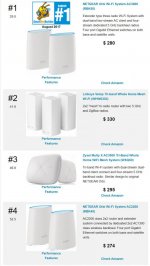
Netgear sure has a bewildering range of systems - RBK43 AC2200, RBK50 AC3000, RBK852 Wifi-6, etc
Costco has the RBK753S-100NAS at $499.99
Best Buy has the RBK43S-100NAS at $349.99 (this is more in my price point as I will need to buy a modem as well to go off rent from Xfinity)
Some of the reviews of these Orbi systems bemoan that one can't set up different SSID's for the 2.4 and 5 GHz radios. Why would one want to be able to do this? Is this really a negative? This seems to be the only negative recurring review I have seen.
Bear with me as I am not a computer geek. Our family as an assortment of Samsung tablets, Samsung phones, Apple Iphone, Ipad, Samsung TV's, HP wireless printers, and desk top computer.
Our home is a 2000 SF ranch style on one level on 3 acres. Existing gateway is in the middle of the home and coverage on the far end is poor. My barn is about 300' away and wifi is marginal there.
I am still reading up on the Orbi systems based on Denwood's and Git's recommendations. The IT guy at work uses Eero's.
Netgear sure has a bewildering range of systems - RBK43 AC2200, RBK50 AC3000, RBK852 Wifi-6, etc
Costco has the RBK753S-100NAS at $499.99
Best Buy has the RBK43S-100NAS at $349.99 (this is more in my price point as I will need to buy a modem as well to go off rent from Xfinity)
Some of the reviews of these Orbi systems bemoan that one can't set up different SSID's for the 2.4 and 5 GHz radios. Why would one want to be able to do this? Is this really a negative? This seems to be the only negative recurring review I have seen.
Bear with me as I am not a computer geek. Our family as an assortment of Samsung tablets, Samsung phones, Apple Iphone, Ipad, Samsung TV's, HP wireless printers, and desk top computer.
Our home is a 2000 SF ranch style on one level on 3 acres. Existing gateway is in the middle of the home and coverage on the far end is poor. My barn is about 300' away and wifi is marginal there.
Best Buy has the RBK43S-100NAS at $349.99 (this is more in my price point as I will need to buy a modem as well to go off rent from Xfinity)
I just looked at my Orbi and I currently have 27 devices connected on WIFI. Of those 27, 13 of them are on the 2.4g band. Most of them are IoT devices - a wireless printer, a couple of thermostats, Rachio sprinkler controller, one Roku, and a couple of Amazon Echos. How much bandwidth do you think those devices use in a day? I would hazard a guess, not very much.
I never felt the need to have separate SSIDS, but your situation is probably different and you have your own devices to deal with. That is why I suggested you buy something from Costco. You can play around with it, even for several months, if it does not work to your satisfaction - just return in. Costco even pays return shipping and will send UPS to your door (at least in my area) to pick it up for a full refund.
A lot of people like Unifi on this forum, and are quick to recommend it, same thing with Snap-On, but in the end, it is money out of YOUR pocket, not theirs.
dream machine: 300
nanoHD1: 180
AClocos/Litebeams: 160
NanoHD2/FlexHD(for shop):180
$650 total, plus tax. Personally, I don't want my home internet to be my hobby, and I could care less about looking at a 'unified interface' so I can see what is using how much bandwidth. But I get it, some people like that kind of thing. Me, I just want my internet to work
If I was in your shoes, I think I would pick up an Orbi 2 Pack from Costco when it comes back in stock and try it out.

If this kind of thing your after, then if the Orbi doesn't work out, go Unifi

I agree with you about the Access Points. If you already have a decent router or are using something like pfSense, those would be a great way to go. The only negative is they are hardwired versus the Orbi which you can place anywhere as long as you have power and the satellite is in range of the main unit.
You'll find more recommendations towards Orbi for residential mesh as they have a third, dedicated backhaul frequency and are reviewed amongst the fastest systems out there. It is nice to have both 2.4Ghz and 5Ghz bands available for clients, as you'll always get more range in "dark" corners with 2.4Ghz. The ubiquity wifi generation is a bit slow at AC1300 class. Nice price point though.
In my opinion, the best (not crazy overkill) wifi setup would be Ruckus Wireless. You should be able to get by with a single R510. I'd add H510's or a second R510 if you have dead spots. Ruckus Unleashed will allow the access points to work together to force client handoffs and apply band steering (selecting best band between 2.4 & 5 Ghz both setup with same SSID).
Channelfly and Beamflex are industry leading and, again in my professional opinion, can't be beat.
I say all of this after more than a decade in the Integrated Systems space pressing networks and wifi systems to their limits. I've installed everything under the sun (ubiquity, MikroTik, Aruba, Cisco, Meraki, Ruckus, All Consumer Only Brands, Engenius, Package, Luxul, etc. etc. etc.)
I have a 24 port Ruckus POE switch that I picked up off of eBay for a decent price (actually it's a Brocade ICX6450). This type of stuff, in my opinion, is just too complicated for the average Joe trying to get decent WIFI in his house. If I didn't have someone who talked me through it (updating the firmware and installing the license files, etc) I don't think I could have done it on my own. Cisco console cable, tftpd64, weird *** commands - I hope I don't have to mess with it again...

I am certainly not an 'expert' but it would be a shame not to use all that cabling you installed.
If I was you, I think I would look into something like jeepxj proposed in post 96
Using some hard wired Unifi access points for the WIFI along with your existing router to keep costs down. If you have an old computer laying around or something you could repurpose I would look into installing pfSense as the router/firewall instead. The software is completely free, well supported and there are tons of YouTube video tutorials out there. I have a home server with several virtual machines running - PLEX, Blue Iris, etc so it worked out well to create a VM just for pfSense, but is a little on the geek side
I think the 'easiest' way to get up and running is with something like the Orbi system. You just plug the satellites in and as long as they are in range your good to go since they have a dedicated channel for the wireless backhaul
I really like the Lawrence Technology videos on pfSense - if your interested:
This is a rather tech-heavy read but it does illustrate why separate SIDs etc. can make home performanc ea lot more predictable: https://www.smallnetbuilder.com/wir.../33195-wi-fi-roaming-secrets-revealed?start=0Kwood, there is a ton of misinformation out there, but Tim over at Smallnetbuilder does a really good job of clearing the hype and doing very thorough tests:
https://www.smallnetbuilder.com/tools/rankers/wifi-system/view
This is working well, mostly, but having some bandwidth issues when wife, kids and I are all trying to video conference.
With using UniFi, or any other access points, can I just wire in to any location in the house, set them up on bridge mode and be good to go? All this still using my current Airport extreme as the router?

The ubiquiti AC-Pro APs are great, but more spendy and a slight PITA to set up for home use.
Totally newb question....
With using UniFi, or any other access points, can I just wire in to any location in the house, set them up on bridge mode and be good to go? All this still using my current Airport extreme as the router?
Candidly the Apple setup was pretty idiot proof. I just plugged it all in and the setup wizard did it all. I know a 'little' more now than when I set all this up but by no means looking to get a minor in networking
Pizza - Reconfigured AP to have 1,6 and 11 on the 2.4ghz channel. thanks for that advice.
As for question on am I running out of bandwidth... I hate to admit it but I don't know, how can I test this? I have ~200Mbs from my ISP and typically get close to 175Mbps confirmed by speedtest.net
Thanks for the help!
connect laptop directly to modem. see speed there. then plug network in normally and connect over wifi. see speed. under 10% difference? you're fine. not much worth tweaking.
It’s less than 10% difference hardwired vs WiFi. Have my Apple TV hardwired and can run Speedtest on that.
youre not going to noticable a reasonable difference in internet life with that remaining 10% IMO