To avoid these ads, REGISTER NOW!

Inside Doc's Shop...

To avoid these ads, REGISTER NOW!

bugnut

ALLIANCE MEMBER
Joined
Jul 14, 2012
Messages
3,850
Location
Central Ohio
Yes, in the early 70's I started pulling handles on a Warner Swasey which lasted for many years. Then moved to CNC mills and lathes, then programming. I recall smelling of cutting oil and being fully engaged in my work when operating any turret style lathe.
 

dutchgray

Well-known member
Joined
Sep 28, 2014
Messages
6,462
Location
Dorset. England.
Never ran a turret lathe.
If I had the room for one I would have one, they are only worth scrap money now where I am and one could be useful for small production jobs, as it is if someone wants more than about a dozen of anything I won't do it.
 

MattV

Well-known member
Joined
Nov 29, 2020
Messages
93
Location
Canada
For those of you the know a little something about paintball, here's another video for ya!


Best guess is the gun was customized some time in the 90s, and has been sitting, dismantled, for most of that time. The current owner received it from a now-deceased uncle, and wanted it fixed back up into playable condition. I didn't get too carried away trying to polish out all the corrosion marks, out of both time and sentimentality reasons.

This one was kind of rushed, as I'm currently up against more than a couple deadlines, let me know what'cha think, and feel free to critique.

Doc.
Nice work. I had a VM68 at one point, they were fun guns
 
OP
D

DocsMachine

Well-known member
Joined
Sep 16, 2006
Messages
1,848
[...]and being fully engaged in my work when operating any turret style lathe.

-I can imagine. Most of what I've been using this turret for has been drilling, since the ram makes that easy. In this case, adding the tapping cycle just adds the stop-and-shift and reverse cycles.

But I haven't even gotten into using the power feed or a box turner, and thanks to the high amperage draw when bumping the 2-speed motor up to high range (which sometimes trips out my rotary converter) I only rarely use that, too.

I can see certain parts requiring multiple speed changes, power feed and changing feed rates between surfacing and drilling, flicking the box turner retract... It could be quite the workout.

Nice machine but kind of old school now.

-Oh, no question. The day of the turret lathe ended in the sixties, when the NC and tape machines really started to come into play.

In my case, though, I'm still much better at mechanical thinking, than digital- I can have this thing tooled up and have run fifty parts before I could figure out, program, bug-fix and run one part in the CNCs. :)

And, for this particular setup, I still don't have a tapping head for the CNC lathe (which can't rigid tap) and the inside threading bars I have are too big for that pitch. Those are both on the list to be ordered, when funds are available again, but in the meantime, I had the turret tooling and it works great.

If I had the room for one I would have one, they are only worth scrap money now where I am and one could be useful for small production jobs, as it is if someone wants more than about a dozen of anything I won't do it.

-Yep and yep. Since I started looking for one ma decade ago, I've seen a bunch of these go to scrap. No one wants them, which comes as no surprise since they're specialized enough it's tough to do "normal engine lathe" parts on one, and few people need to make dozens of the same part.

For me, however, it's ideal, since I do produce 'runs' of parts, but generally not particularly large ones- 20 to 100 is typical.

Yeah, the CNCs are a much better choice- faster, more accurate, less labor- but I'm also considerably less experienced with those than I am the mechanical stuff. I understand this machine and it's operation on a level I simply don't on the digital stuff. (That is, I understand the mechanical operation of the CNCs, it's the software I don't grok. :) )

AND... for those interested in seeing the other half of that part...


For you paintballers, those are specialized valve bodies for a couple different styles of Nelson-based pumps. Primarily Phantoms and the standard 007 profile.

Tried to play with the editing to give a better idea of the "order of operation", but yeah, I need a little more practice. :)

Doc.
 
OP
D

DocsMachine

Well-known member
Joined
Sep 16, 2006
Messages
1,848
Mass production the Old Fashioned Way!

I thought this would be an interesting look into small-shop small-run production.

Smart money would, of course, have this entire piece done on a 4-axis turning center with live tooling. Then again, that smart money also wouldn't be using a $120,000 machine to make forty or fifty parts at a time. :)

Theoretically, I could have set up this last procedure in the Trak mill with the indexer, but I'm still much too inexperienced with that to get the job done in anything like a reasonable timeframe.

So, I have to fall back to the Old Magic. The way production was done back in those dim, dark, pre-transistor days.

This is the part we're currently dealing with. A specialty valve body for the Phantom pump, that adapts an ICD lever-style 12-gram changer directly. (Rather than screwing in to a backbottle ASA, at an angle.)

production01.jpg

All the main machining has been completed, I just have to add the two small 'divots' on the small diameter, where the setscrews for the lever-changer body seat, and the blind, 10-32 drilled-and-tapped hole, where the main body thumbscrew goes.

The Big Trick™ here is keeping the three features indexed to each other. The two divots need to be 180° from each other, and the threaded hole 90° in between them.

I could just plunk the part in a vise and drill any one of them... but how do I align that one to make sure the next one is drilled in the right place? A CNC mill with a toolchanger, and a digital indexer, could do this easily.

To do it manually, and on a single machine, would mean trying to accurately index 90° twice, plus moving the zero, plus at least three tool changes- that is, manual tool changes.

That is, point in fact, how I did the last batch of these I made back in 2021. I held the part in a 4-sided 5C block, and simply did a bunch of manual tool changes and position changes to get each one done. Laborious indeed, but it did the job.

I was gearing up to do this batch, and an old idea occurred to me. In the old days of manual machines, a production factory would have hundreds, if not thousands of machines. And each machine would be set up to make a single cut, each.

That is, rather than one machinist on one machine doing dozens of cuts and tool changes, one machine would take a blank, set it in a fixture, and make one cut. Take that part out, put another blank in, make that one cut. Lather, rinse, repeat.

The next machine would take those parts with the one cut, and with another fixture, would make a second cut to each blank. A third machine would make a third cut, and so on. There was an article in an old gun magazine years ago, that described Smith & Wesson upgrading from the old manual machines to modern CNC. ("Modern" at the time being the late 80s or early 90s.)

It occurred to me that if I kept the part in that same 5C block, I'd need three machines, each with its own vise. There'd be some walking between machines, but in my little shop, that's only a few steps, and it would save literally hundreds of tool changes.

So here's what I came up with. The first machine is the Grizzly mill, with it's 5" vise. A clamping vise stop locates the block in the right place, and the shoulder of the part locates itself to the collet.

With the block in place, the part is inserted and the nut snugged to clamp it.

production02.jpg

With the appropriate drill and the depth stop set, the first divot is drilled.

production03.jpg

The whole block is flipped over and the second divot drilled.

production04.jpg

No measuring, no checking, the vise stop and depth stop assures the divot is drilled in the correct location.

The whole block, with the part still in place, is moved over to the Exacto mill, and its 6" mill vise.

production05.jpg

A second mill stop, seen at the right, again locates the part- the block is simply turned one flat between the two divots. Then, the mounting hole is drilled.

production06.jpg

Again, the whole block is moved to a third machine, the Arboga drill press. Although in this case, the drill isn't even turned on, it's basically just playing the part of a "pillar tool".

production07.jpg

I didn't have a convenient stop for this one, so I just aligned the block with one edge of the vise jaws. And, with a tapping point in the chuck to help support the tap, it's easy to get a good, square tap on the previously drilled hole.

production08.jpg

The blcok is then returned to the first machine, placed back in the vise, the nut loosened, and the completed part removed.

production09.jpg

Total cycle time, approximately one minute, twenty seconds. (Nearly half of which is just in the tapping.)

production10.jpg

Certainly more labor intensive than pushing the "cycle start" button, and I sure won't be impressing anyone with anything like a proper production shop- but then again, no one with a "proper production shop" would be bothering with the tiny, niche-market 20 to 100-part runs I do, either. :)

As I gain experience with the CNCs, I will of course be having them do more and more- trust me, I'm fully aware how absurd it is to be using half a dozen machines to make one part. :) But for the time being, the "old ways" worked just as well as they did years ago, and got the job done. I'm calling that a win.

Doc.
 

dutchgray

Well-known member
Joined
Sep 28, 2014
Messages
6,462
Location
Dorset. England.
Those videos are making me want a turret lathe.
Just as well I don't have the space really as I really wouldn't have much work for one.

I have just bought an Arboga radial arm drill, the little 2' one.
 

tool_scrounge

Well-known member
Joined
Jul 20, 2010
Messages
4,170
Location
Southern California
Those videos are making me want a turret lathe.
Just as well I don't have the space really as I really wouldn't have much work for one.

I have just bought an Arboga radial arm drill, the little 2' one.
I had the same desire to have one too. I even bought a $100 Burgmaster #6 turret drill press - basically the drill press equivalent. I really like the neat auto indexing mechanism. But the reality is that unless you are doing some level of production the setup time is longer than if you just used a normal drill press. So years later I finally sold it off to make more bench space.
 
OP
D

DocsMachine

Well-known member
Joined
Sep 16, 2006
Messages
1,848
Not really machining content, but I snapped this just as I was closing up shop this evening:

sunlathe.jpg

I had some dead trees taken out of the yard this past summer, and now the sun, for a few hours on a bare few days, can shoot through some gaps, through the front door of the shop, and shine on the back wall above the big Springfield lathe.

I tweaked the exposure a bit- in camera- to get the right tone, and I think it came out pretty well.

Doc.
 
Last edited:
OP
D

DocsMachine

Well-known member
Joined
Sep 16, 2006
Messages
1,848
I've been running some production parts in my shop- and for those that aren't familiar with my frayed-shoestring-budget garage shop, one of my machines is a small Logan 11" lathe converted to CNC using a Centroid Acorn system.

nextbatch09.jpg

I've been having some issues with variable tolerances and random tapers, in a straight OD turn. Only up to about .002" max, so it's by no means critical to the part, but it still annoys me.

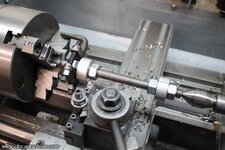
The taper issue I suspected came at least in part from a worn tailstock, that due to the length of the part, needs to be extended out about 2/3rds of its range, just to be able to reach the part. I got tired of using "cut and try" to dial in the tailstock alignment, so I decided to fall back to the old tried-and-true "two collars" test bar method.

Just to be clear, I don't claim to have come up with or invented any of this. :) I can't recall when or where I saw this specific idea, but it's been a good long time- easily twenty years or more. And of course a version of it is briefly mentioned in SouthBend's How To Run A Lathe back in 1941. :D

Anyway, I started with a chunk of Home Depot 5/8" allthread, and a set of matching nuts.

testbar01.jpg

The allthread I cut into two pieces, one about six or seven inches long, and another about a foot long. Each of these I faced, chamfered and gave a nice deep centerdrill to both ends:

testbar02.jpg

The short one for the job at hand (nominally a 6" workpiece) and the longer one for later use, since I need to double-check the alignment of the big Springfield tailstock.

testbar03.jpg

For a set of collars, I dug a chunk of 1-1/2" aluminum round stock out of my junk bin, and drilled it out to 5/8".

testbar04.jpg

As the little lathe doesn't part heavy rod well, I simply bandsawed two thick rings off.

testbar05.jpg

Those got chucked up, faced and slightly beveled:

testbar06.jpg

Then it was a simple matter of clamping the two discs more or less at either end of the rod, and snugging them down.

testbar07.jpg

Some people have used plain washers, or cut discs from 1/4" plate, etc. You can use anything you want- diameter wise, material wise, thickness wise. I simply recommend aluminum as it's easier to cut, and to make them thickish (as opposed to just a washer, say) simply to make it easier to measure.

This method is, I think, an improvement over the solid machined bar, simply becasue it's easier to make, and a little more "reusable". If the discs, through repeated re-truing, get too small, just swap them.

Then again, most typical home shop types will only use something like this a few times at most, so no worries either way.

Now, I don't have a dog drive plate, so here's the older'n me trick: Just chuck up a random chunk of mild steel, and turn a 60-degree point in it. As long as you don't take it out of the chuck, regardless of how worn or eccentric your chuck is, the point will be accurate and concentric to the spindle's axis of rotation.

testbar08.jpg

Then, simply attach your favorite drive dog, mount the bar up between the centers, and rest the dog-leg on one of the chuck jaws.

testbar09.jpg

After that, simply take a light skim cut of the disc nearest the chuck. You don't have to take much off, just enough you know the disc is now round and centered.

testbar10.jpg

Then, flip the bar end-for-end, and take a skim cut on the other disc.

testbar11.jpg

In this case, we're just getting the discs to round and concentric- you want them close, but the final cut will be next.

Now, take another fine skim cut...

testbar12.jpg

Then flip it end for end again, and without moving the cross slide or compound, take a final skim cut on the other disc. Theoretically, the two discs should be not only the exact same size, but also exactly concentric with the drilled centers.

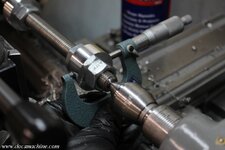
Now, measure the two discs to be sure;

testbar13.jpg

According to my Mitutoyo 1-2" mic with a tenths vernier, both were exactly 1.4835".

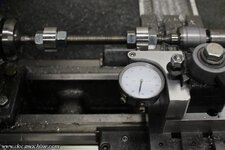
Now, with it still in place, I could plunk my dial indicator in place, and move the cross slide 'til it zeroes.

testbar14.jpg

Again, without moving the cross slide, I moved the carriage to indicate the other disc- which appears to be .001" off center. (Towards the operator.)

testbar15.jpg

With a little care and light use of the tailstock adjusters, I was able to zero it, or at least, very close to it.

testbar16.jpg

Now, in order to move over to the Logan, I needed that headstock center. I don't need to spin the rod this time, so no need for a dog or driver, but I still needed the accurate center. I know the 3-jaw is a couple of thou out, so I switched back to the collet assembly, and re-turned the point:

testbar17.jpg

Moving that same point and collet over to the Logan, I chucked it all up, making sure to check the tailstock with the barrel extended about as far as it needs to in use for this particular part. I then moved the indicator over (the tool center height on both machines is the same) and while it's hard to tell, I 'zeroed' it at the 6:00 position.

testbar18.jpg

I did that so there was minimal preload on the tip, and it could just 'walk up' on the other disc- I wouldn't have to pull on the stem to get it past the edge.

This time the tailstock was .002" off, with everything snugged and locked.

testbar19.jpg

And it was about here I found another problem: There appears to be a LOT of slop in the X-axis ballscrew. According to the indicator, and the MPG dial on the Centroid remote, I could run the slide in to zero the dial, but backing it out, I could dial in 7-8 thou before the needle started to move.

Clearly the X-axis ballscrew was either not that great to begin with (most likely- I was buying cheap Import parts) or has worn rapidly (also not unlikely, again cheap import stuff.)

I may have to tear this thing down and see if I can't find a better quality replacement screw. Or one of the imports with the double ballnut...

In the meantime, I dialed in the tailstock as best I could...

testbar20.jpg

And added an old manual machinists' trick to the program. The 'conversational' programming has it's own built-in tool retract between passes- and it's not that much. So I edited the program to add another .100" to the retract- in the hopes that would take some of the slop out of the motion as it moves the tool back into the work.

After that I ran about two dozen pieces. Less taper, but still about .002" part-to-part variance on the overall sizes. Probably the best I'm going to get until I can do something about that ballscrew (if that is indeed the problem...)

Stand by, more to come. :)

Doc.
 

bugnut

ALLIANCE MEMBER
Joined
Jul 14, 2012
Messages
3,850
Location
Central Ohio
Doc, it has been many years since I have seen anyone perform test bar work on a lathe. I believe @zmotorsports, did also a while back. A though comes to m ind, if the taper is repeatable, can you not use the centroid and program in offsets at each end of the part to remove the taper? I have done this on SBL CNCs to correct wear and misalignment.
 
OP
D

DocsMachine

Well-known member
Joined
Sep 16, 2006
Messages
1,848
That's just it, it's not repeatable. I can cut one part that's a perfect 1.000" on one end, and 1.000" on the other. (About 6" long.)

The very next part will be 1.001/1.003, the part after that will be 1.001/1.002, after that 1.002/1.002, etc. etc.

The tolerance doesn't hurt the part in question in the least, it mainly just annoys my sensibilities. :) As I said toward the end up there, the indicator showed more slop in the X axis screw than I'd anticipated. I'm strongly considering cracking the thing back open, and seeing if I can't replace that cheap eBay ballscrew with a better quality one, preferably with a double or anti-backlash ballnut.

Doc.
 
OP
D

DocsMachine

Well-known member
Joined
Sep 16, 2006
Messages
1,848
Okay, I threw a couple of indicators at it and started surveying.

With an indicator between the toolpost and a section of mounted work, I could shake an easy .005 to .006 out of it. It tended to always return to zero, though, when I'd let go.

BUT... an indicator between the apron and the cross slide, showed very little- maybe .0005" at worst. That tends to rule out the cross-slide ballscrew.

Also, an indicator on the cross slide- the cover over the belt- showed nearly no movement when I was getting .005" out of the toolpost. I could feel something "clunk".

That 'clunk', as it turns out, was coming from the rear of the carriage- the back, flat way. Either I had never properly adjusted the gib back there, or it had worn since I did- almost certainly the former, as neither the way nor the gib show notable wear.

I snugged that up- probably a bit too much, but I'll tweak it later- and cut another part. Nope, still got .002" taper. Cut a second, to see if it was at least a consistent taper. Nope, again. This one was perfect- 1.000/1.000".

Then I double-checked the previous part; now it only showed .001" of taper.

Now, they're pretty warm when they come off the machine, but by no means too warm to touch. I haven't measured, but they might be as warm as 90F. Have I been chasing- at least in part- temperature related variances?

I can't put coolant OR cutting oil on this thing, despite the fact I have a pump, nozzle and reservoir already set up on it. (Leftovers from it's turret lathe days.) Simply because I have zero splash guarding, and no easy way to add it. (Plus the issues of the steppers and drives not being water or oil-proof.)

But, I just ran five parts, one after the other, trying to keep the order of operations consistent- tension on the tailstock lock, pressure on the handwheel, etc. After I've had a quick snack, I'll go out and measure each one, see how consistent and/or tapered they are once they're cool.

Doc.
 

Wilson12789

Member
Joined
Sep 2, 2016
Messages
5
Anyone here ever run a turret lathe as an actual job?

Doc.
Previous job used a lot of turret lathes until early 2000s and still a few in use within last few years for just a handful of low run parts not justified to put on cnc lathes. Did you have questions about them?
 
To avoid these ads, REGISTER NOW!
OP
D

DocsMachine

Well-known member
Joined
Sep 16, 2006
Messages
1,848
First for a quick check, I took the temp of a fresh-from-the-machine part, which again, was warm but not really hot. It barely hit 70F, which shouldn't be enough for a significant dimensional change. Especially when just measured with calipers.

These showed less taper, but there was still some inconsistency- through five parts/ten ends, the smallest was .9965" and the largest .999, or a range of about .0035.

The .'65 was an outlier, though, with most being .998" or .997", closer to just .001 to .002.

That might be the limit of accuracy of this machine- keeping in mind it WAS homebuilt, on a tight budget, using a lot of eBay and import parts, and by a guy who had never built- or even used- something like this before.

AND... it's also worth noting that... well, I'm an idiot. :D I'm sure most of you don't exactly need to be told that, but once I took the time to measure more than a few spots on one of these things? Turns out the expanding collet of course expands the material, too.

Not much, but when 'let go', the end held in the headstock- by the collet- 'springs back' and is nominally .001 to .002 smaller. And, often enough, slightly out of round, too.

So... loose gib, measuring a portion of the part that's undersized due to the workholding, a sloppy tailstock, measuring a warm part... how many other ways can I screw this up? :)

Doc.
 

Monza Harry

Well-known member
Joined
Dec 29, 2018
Messages
1,433
Location
Windsor ON
Doc did you rebuild/replace the headstock bearings? The lathe in our plant (#2) is an older TOS SN50, the front bearing seems properly tight but this machine has consistency issues as well, another well-seasoned toolmaker/machinist/machine repair person I work with has come to the conclusion that the mid or rear bearings are loose. I can't find a hole in his theory. Rebuilding this isn't likely here, as the lathes accuracy isn't a huge deal in most mould shops. 😞 Hard to test with what we have on hand and the companys' priorities. Harry
 
OP
D

DocsMachine

Well-known member
Joined
Sep 16, 2006
Messages
1,848
The previous owner replaced the spindle bearings, and near as I can tell, they're still in fine shape and properly preloaded. After literally several hours of running at 1400 RPM- pretty much top speed for this 1956 lathe- the headstock in the front bearing area only reads about 75-78F.

Basically, it's a homebrew machine, with cheap steppers, eBay ballscrews and a worn tailstock- I should probably consider myself lucky I can hold as close as .002". Hell, my old WW2 Springfield? The original cross-slide dial was only marked in .002 increments...

Doc.
 
OP
D

DocsMachine

Well-known member
Joined
Sep 16, 2006
Messages
1,848
So, over three weeks later- after taking time off to finish, print and market two more TWB books- I finally ran the other end of these gas-thru grips:


Still need an OD turn, and threading for the inlet port, but that's coming.

I really need to go ahead and splurge on that floating tap holder that Omni sells, as well as more options to hold drills. Those two collet holders shown in the second half are literally 67% of my entire drill-holding capabilties. (Save for some plain bushings, but I only have those in even 1/16" increments, and they won't work on short tools like the center drill.)

But hey, it's only money... :)

Doc.
 

bugnut

ALLIANCE MEMBER
Joined
Jul 14, 2012
Messages
3,850
Location
Central Ohio
Doc, liked the video! Your peck drill sequence looks like it is very slow, are you using the g83 canned code?
 
OP
D

DocsMachine

Well-known member
Joined
Sep 16, 2006
Messages
1,848
Doc, liked the video! Your peck drill sequence looks like it is very slow, are you using the g83 canned code?

-I hadn't used a proper peck drilling cycle before, and I couldn't get G83 to cooperate. I've also had issues with the threading cycles- I need to figure out to properly configure those...

But in this case, since I was only running fifty or so parts, which only took a little over an hour, it kind of wasn't worth spending two hours fighting with it. :)

So I just whipped up a "manual peck cycle", but didn't bother to put in any rapids for the retract. I certainly could have optimized it, pecking deeper each time, fewer passes, rapids, etc. but again I just had the relative handful of parts to do, so I wasn't overly worried about the cycle taking twenty seconds or so longer than maybe it should have.

Doc.
 
OP
D

DocsMachine

Well-known member
Joined
Sep 16, 2006
Messages
1,848
And finished the old-fashioned way! :)

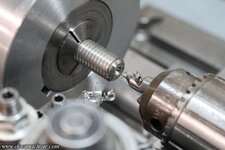
Since I still don't have a floating tap holder for the Omni (some $300 plus collets) I had to do the 1/8"NPT inlet threading on the turret lathe:

nextbatch77.jpg

Thankfully it's still fun to crank the handles on this machine, and I only had a relative handful of parts to do.

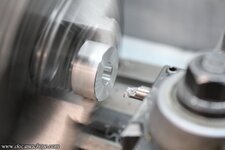
After that, the last part was to turn the OD, just to smooth up the surface before sending them off to anno. I could have set this up on the Logan, and if I'd had more than that relative handful to do, I would have.

But, it was just as easy to throw the centers back in the Sheldon, and take a .005" to .008" skim cut off each one.

nextbatch78.jpg

And that's it! While it's only a small fraction of the total I'm working on, this is the first part of this latest batch ready to clean and ship.

nextbatch79.jpg

Now, if I can just finish that thing for the Omni so I can do the rest... :)

Doc.
 
OP
D

DocsMachine

Well-known member
Joined
Sep 16, 2006
Messages
1,848
Latest video! Making a "Speedwheel" for a Splatmaster!


A Splatmaster is a marker from the very earliest days of paintball- this particular example is roughly 40 years old. :) The (pretty much one and only) hot trick for them back in the day, was a plug for the CO2 cartridge that simply had a bigger knob, for easier gripping. They called these "Speed wheels". :)

I've manufactured these in low numbers for several years, since there's still the occasional enthusiast that shoots them. I had a special order for a small handful, and so whipped up a video of the process.

It's more "machining video" than "paintball video". :)

Yeah, the sound effects at the beginning aren't all that great, but most of the rest isn't too bad. Let me know what you think!

Doc.
 
OP
D

DocsMachine

Well-known member
Joined
Sep 16, 2006
Messages
1,848
Part one of what will likely prove to be a comparatively complex part. Not complex in and of itself- like it has a tiny V12 engine in it or something, but rather complex to make. And, to clarify that even further, to make automatically, as in to program a limited-capability gang-tool CNC turning center to make.

I've only ever used up to five tools for one part before, this one's going to take six or seven- and I may have to make a couple of those.

So, first off, I need a collet. The one 7/8" collet I have is a cheap import, and as most of those are, they're ground spot on spec- 0.875". My bar stock, however, is slightly oversized, measuring 0.877". In this setup, I want to start using a bar puller- let the robot do the work :) -so the bar needs to slide fairly easily in the collet.
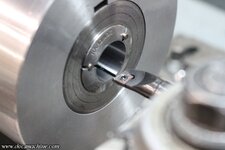
For just this sort of thing, they make what are commonly referred to as "emergency" collets- unhardened ones you're meant to machine to size or shape. Longtime readers will know I'm a big fan of the 5C collet- four of my lathes take them, and I have over a hundred floating about the shop- so what I do is periodically pick up a handful of used (partially machined) 'emergency' collets off of eBay, often for a few cents on the dollar.

I picked one of these out of my stash, and set it up in the Sheldon lathe, like so:

changer001.jpg

For those of you that haven't used such things before, there's three little pins at each of the "slices", so you can tighten the collet in place, and are still clear to bore the center out to whatever size you need.

After a little careful drilling- it's in effect an interrupted cut- and some even carefuler boring, I got it opened up to right at 0.8775".

changer002.jpg

That gave me a snug, but smooth-sliding fit to the bar stock.

changer003.jpg

Now, here's where we start running into trouble. In a "real" machine shop, using "real" machines, we'd have a bar-feeder on this turning center, that could feed a full-length (12 foot in this case) bar into the machine at intervals. Turn, part, feed; turn, part, feed; turn, part, feed, ad nauseum.

I don't have a bar feeder. I don't have the room in the shop (they can be 20 feet long) I don't have the money for one (a well-used one in need of repair can be $5,000- the one made by the maker of my lathe is ten thousand) and most often, it'd be a waste if I'm just making 20 or 30 parts anyway.

I do have that bar puller I mentioned, though, and have been looking forward for a chance to use it. But, there's a limit to how long I can leave the bar. I tried cutting off a 36" piece, and it sticks out the back of the machine over a foot:

changer004.jpg

Now, that's 7/8" stock, and shouldn't "whip" too much. I also fabbed up a delrin collar- you can barely see it under there- to help keep the bar centered as much as possible, 'til the bar works its way into the spindle. BUT... that's an awful lot of stickout, if I'm gonna turn that thing at over 3,000 RPM. I'm going to have to do a little testing to see how safe or stable it is- if that bar bends, it could cause considerable damage.

The other issue- common to many gang-tooled machines- is the stock doesn't clear the tooling table.

changer005.jpg

I'm going to have to have the cutter extended out quite a ways- which risks chatter- and hope that once it's reduced in size a little, I can get the parting tool- shown above- to it. Else I may have to make an extended holder for that...

None of this is unsolvable, of course, and those of you that work in professional machine shops deal with this kind of thing regularly. But this limited machine, and my even more limited frayed-and-multiply-knotted shoestring budget, make it a bit more of a challenge. :)

Stand by, more to come.

Doc.
 
OP
D

DocsMachine

Well-known member
Joined
Sep 16, 2006
Messages
1,848
After much pondering and cogitation, the unfortunate fact is that, right now, I have way too much on my plates, and so at the moment, the top priority is time. Once it's up and running, the per-part time using the bar puller and whatnot, would be lower, and with less labor, but considering I may need to make two nontrivial tools, spend at least another $500 on tooling, and learn how to program and run no less than three different tools I've never used on a CNC (tapping head, knurling tool and bar-puller) the time from now 'til I have a binful of ready parts, would probably be considerably longer.

So for the time being, I'm going to fall back to the tried-and-true method of using individual blanks. Not as quick per part, but the overall process will take less time. As such, I took one of my short bars of material, and as per established protocol, lopped it into roughly equal chunks in the bandsaw:

changer006.jpg

Also as per established procedure, each one then got faced and lightly deburred on one end, in the (manual) lathe. This, of course, is our reference face.

changer007.jpg

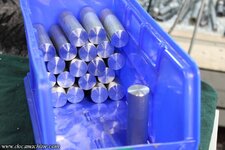
That one section, for the time being, produced a nice even 20 pieces...

changer008.jpg

Which will be more than enough to get the first end programmed and turned. My tap holders should be in tomorrow (dang it, I shoulda ordered some gun taps!) and I'll need to dig through the manual, as well as some online sources, on programming and using a tap holder on this machine.

Hopefully I won't break too many of them. :D

Doc.
 
OP
D

DocsMachine

Well-known member
Joined
Sep 16, 2006
Messages
1,848
I hate being this backed up. I can't seem to get anything done...

I was only able to steal a bare few minutes today to play with this, but I was able to program the part, prove the tools (then move them and re-prove, to make room for the rest of them) and get a couple of test parts cut.

One trick I came up with: In order to "cut air", I don't re-set the zeroes off to the side, I simply leave the workpiece out. But, I don't like running it with the collet not clamped- it probably doesn't hurt anything, but I worry that something might rattle around in there.

So I've been collecting little quicky-turned bits like this, as low-profile plugs for the collets to clamp on to:

changer009.jpg

I've made a couple different sizes now, and there's just enough of a "knob" to grab onto, but generally won't interfere with any of the tools:

changer010.jpg

After that I was able to run a part, tweak the tool offsets lightly, adjust a few settings, and run a couple more...

changer011.jpg

That got me the first part of the profile, as well as the drill for the front screw hole...

changer012.jpg

But that's as far as I was able to get this afternoon. Spent a little too much time on it as it was, and I'll be lucky if I can spend any more at all on it for the next couple of days.

I also got my tap holders in today, and that may be a bit of fun, trying to figure out how to program it before I run out of taps.:D

This machine has no G84 tapping cycle- I'll have to manually program it. It should be fairly straightforward- the spring-loaded tap holder should account for any inaccuracy in the process- but I can also see a couple breaks before I get it dialed in.

In the video that helped convince me to buy this machine, you can see the tapping retract step actually pulls the part slightly out of the collet. (Then again, he's got a later video of making the same thing in clear lexan, using the same tools, and it doesn't appear to do that.)

I might try talking to the factory, see what they recommend for programming a tapping cycle... I'm probably overthinking it, but it can't hurt to have the waterfowl in an linear organization before I try it.

Doc.
 
OP
D

DocsMachine

Well-known member
Joined
Sep 16, 2006
Messages
1,848
One of today's little jobs:

PicOtheDay-002.jpg

Local customer wants an odd little threaded coupler in steel. It's a bit delicate for the Springer, but she's great at peeling off a bunch of meat first.

Oh, and if I ever write an exercise book, one of the major workouts will be drilling multiple steps with a two hundred and fifty pound tailstock. :)

Doc.
 

Monza Harry

Well-known member
Joined
Dec 29, 2018
Messages
1,433
Location
Windsor ON
One of today's little jobs:

PicOtheDay-002.jpg

Local customer...

Oh, and if I ever write an exercise book, one of the major workouts will be drilling multiple steps with a two hundred and fifty pound tailstock. :)

Doc.
Doc have you considered drilling your tail stock for "air-ride" with a foot peddle so it floats on air when you want it to? It does help with the friction (A LOT!), inerta not so much, but easier is easier! Harry
 
OP
D

DocsMachine

Well-known member
Joined
Sep 16, 2006
Messages
1,848
Carriage mounted drilling arrangements are the way forward.

-Yep. I've been wanting to get one of the CXA toolblocks with the drill chuck. They ain't cheap, though, even well-used.

I have an ER holder in a boring bar block I've used, but that's not as convenient as a Jacobs style chuck.

Doc have you considered drilling your tail stock for "air-ride" with a foot peddle so it floats on air when you want it to?

-That was suggested back when I was rebuilding this machine, along with somebody that apparently had spring-loaded rollers on the underside of his. (I can't recall if that was a factory option, his own mod, or what.)

I have considered it, but the tailstock has an oil reservoir and zigzag oil channels on the underside. An air blast would blow the oil back up the reservoir, and likely out the fill cap. (The silver thing right below the lower clamping nut on the tailstock.)

Doc.
 

dutchgray

Well-known member
Joined
Sep 28, 2014
Messages
6,462
Location
Dorset. England.
-Yep. I've been wanting to get one of the CXA toolblocks with the drill chuck. They ain't cheap, though, even well-used.

I have an ER holder in a boring bar block I've used, but that's not as convenient as a Jacobs style chuck.

Doc.
Drill chuck on a straight arbor in a boring bar holder or if they exist in Aloris type holders a morse taper holder. (In the UK where Dickson toolposts are kind of the standard the morse taper holders are very cheap used as no one seems to want or use them very much)

Though those drill chuck holders are nice because of their short length.

On my DSG lathe I have a carriage mount drilling bracket with a MT4 socket, you pull it back to a stop block on the saddle which aligns it and it clamps to dovetails on the cross slide. Except on my lathe the stop block was never fitted so I have to make one and fit it (which is weird as its supposed to be standard equipment so someone ordered the machine with it missing specifically)
 
OP
D

DocsMachine

Well-known member
Joined
Sep 16, 2006
Messages
1,848
Yeah, an MT tool block would work fairly well, too, but my overall collection of MT drills is pretty weak. I have a little over a dozen in MT2, half a dozen (and mostly duplicative sizes) in MT3, and only, like, two in MT4. (I have an MT2 tool block for the little AXA posts, and I've used that a time or three.)

On the other hand, I have literally over a thousand regular straight-shank drills, in everything from .031" up to 1-1/4".

Ideally I'd have a wide array of both, but I can buy dozens of straight shank for what a decent MT goes for- even used.

Doc.
 

bugnut

ALLIANCE MEMBER
Joined
Jul 14, 2012
Messages
3,850
Location
Central Ohio
Doc, straight shank drill chuck or a straight shank adapter to mount drill chuck should fit an aloris style holder.
 
To avoid these ads, REGISTER NOW!
Top Bottom