It has been modifiedIs the direction lever on this Midget M70-L (bottom of the pic) original? All the Midgets that have passed through my hands were a flat tear drop shape. Reminds me of something you would see on a Duro ratchet?

You are using an out of date browser. It may not display this or other websites correctly.
You should upgrade or use an alternative browser.
You should upgrade or use an alternative browser.
Lets make an all vintage Snap-on tool picture thread!
- Thread starter chad s
- Start date
Oldtuleguy
Well-known member
- Joined
- Nov 4, 2017
- Messages
- 10,476
Looks like someone brazed a glob on it, maybe to make it easier to change direction
d42jeep
Well-known member
Here are the levers on my wartime midget ratchets, including the late Roy’s 9/32“ drive version.
-Don
-Don
asavage
Member
Looks like I first posted my question in the wrong forum.
I bought a 100-600 ft/lb. Torqometer last week and I really like it.
The manual that came with it lists torque specs for common cars of the era, through 1964; I'm guessing mine is of that era.
My question is: I have the case for it, and there's a felt-padded spot for which something ought to nest, but I've been unable to determine just what should live there. Thoughts?


It's too low to accommodate the extension bar, which has been nesting where you see it for a long time, per the paint wear pattern. I wonder what that felt-lined riser is supposed to support.
I bought a 100-600 ft/lb. Torqometer last week and I really like it.
The manual that came with it lists torque specs for common cars of the era, through 1964; I'm guessing mine is of that era.
My question is: I have the case for it, and there's a felt-padded spot for which something ought to nest, but I've been unable to determine just what should live there. Thoughts?
It's too low to accommodate the extension bar, which has been nesting where you see it for a long time, per the paint wear pattern. I wonder what that felt-lined riser is supposed to support.
Old Radar
Well-known member
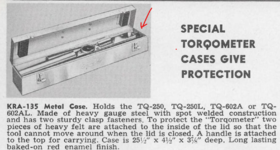
This is from the 1960 catalog X. It appears unused in this depiction, but given that the box is designed for more than one model of Torqometer, it's possible one of the other models uses it.
asavage
Member
Thanks for that.
Provincial
Well-known member
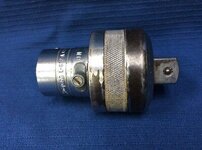
An accessory often used with the torque wrenches was a ratcheting adapter that mounted on the square drive.
Farmer J.
Well-known member
I like to use one of those ratcheting adaptors when doing wheel nuts.
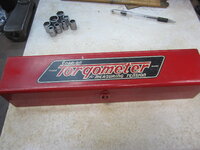
The horrible plastic case my 100ft/lb torqometer came in also has space for a mystery item and a load of extra length. I use it to store a torque adaptor extension.

The horrible plastic case my 100ft/lb torqometer came in also has space for a mystery item and a load of extra length. I use it to store a torque adaptor extension.


Farmer J.
Well-known member
Those metal storage boxes are so nice...A 9/32 drive RT250, 1942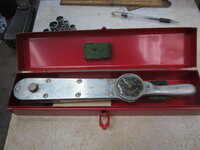

asavage
Member
I passed on several Torqometers that had no case, plastic case, or worst: broken/missing/brown lenses. It's not clear how a replacement lens can be obtained. One person said he used a "photography lens".Those metal storage boxes are so nice...
I recently acquired a medium-duty Class 6 truck, and the wheel lug nuts are to be torqued to 450 ft/lbs (dry), so I was looking for a tool to add to my collection -- I like tools. This is what I settled on. Clean crystal, nice metal case, and more-or-less local.
RTM
Well-known member
Not lenses, but possibly filters. Figure out the diameter you need, see what you can find. There are things like UV filters which are pretty benign visually.It's not clear how a replacement lens can be obtained. One person said he used a "photography lens"
37mm Filters
We Help Create the World's Greatest Images! Our business strategy for over 80 years, our strategy has always been to succeed through direct customer interaction and feedback by creating innovative products and services.
tiffen.com
I passed on several Torqometers that had no case, plastic case, or worst: broken/missing/brown lenses. It's not clear how a replacement lens can be obtained.
That’s a good pun there. I think the advise is worth looking into.
YMMV
d42jeep
Well-known member
The lens on my 1/2” drive was badly discolored. The retaining ring came off easily and plastic polish cleared the lens adequately.
-Don

-Don
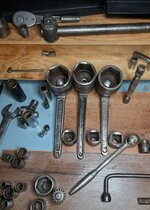
"The big 3 from Milwaukee" as I like to call them. Snap-on , MTF , and Husky (plus I gotta pay a little homage to Blackhawk even though I'm not a fan) so here's a side by side of a 2" 6pt and 1" 4pt by each of my big 3. All very similar, but the mtf sockets get much bulkier as the sizes get up there. Husky is almost identical.
Attachments
genog
Well-known member
Bought this set of vintage Snap On sockets from a nice kid.
They were once his Grandfather's....
I asked, why don't you keep them?
He said, he only has use for metric sockets


Missing 1/2 and 9/16
They were once his Grandfather's....
I asked, why don't you keep them?
He said, he only has use for metric sockets
Missing 1/2 and 9/16
Last edited:
Snaparxon
Well-known member
Bought this set of vintage Snap On sockets from a nice kid.
They were once his Grandfather's....
I asked, why don't you keep them?
He said, he only has use for metric sockets
Missing 1/2 and 9/16
Sounds like he's not your standard kid....
genog
Well-known member
Metric Boy 
Snaparxon
Well-known member
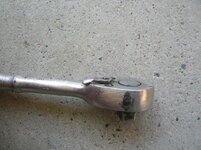
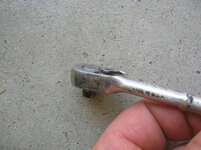
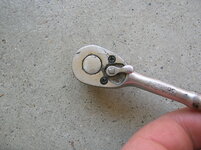
It is a legitimate lever, just don't think it is from Snap on. Maybe customised for a person wearing gloves?Looks like someone brazed a glob on it, maybe to make it easier to change direction
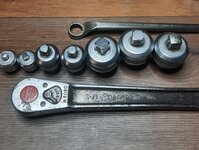
3baygarage
Well-known member
Interesting ratchets.
Macaxis- the lever looks familiar but I can’t place it.
Steven- if the length of the ratchet isn’t different and nothing else noticeable, could be possible it had a special mechanism that’s been swapped out.
Macaxis- the lever looks familiar but I can’t place it.
Steven- if the length of the ratchet isn’t different and nothing else noticeable, could be possible it had a special mechanism that’s been swapped out.
Oldtuleguy
Well-known member
- Joined
- Nov 4, 2017
- Messages
- 10,476
WW2 era nut spinner set
Attachments
-
 20240601_083403.jpg813.4 KB · Views: 22
 -
 20240601_083401.jpg791.6 KB · Views: 26
 -
 20240601_083355.jpg902.3 KB · Views: 29
 -
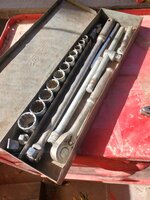 20240601_083120.jpg773.4 KB · Views: 29
 -
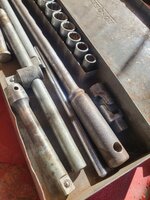 20240601_083125.jpg788.3 KB · Views: 30
 -
 20240601_083141.jpg673.5 KB · Views: 29
 -
 20240601_083216.jpg503.2 KB · Views: 28
 -
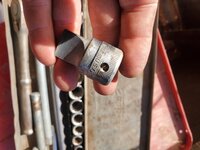 20240601_083237.jpg568.5 KB · Views: 30
Old Radar
Well-known member
^^^ What am I missing? I see three different drive tools but no spinner--why do you call it a nut spinner set?
d42jeep
Well-known member
The breaker bar and cross bar would be a spinner. Here is a socket that I found today that could have been out of that set. 41-W-3027 Socket 1" ½" Drive - Snap-on SW-320½ 1945

I also found this 1935 9/32” drive socket no. M-11

-Don
I also found this 1935 9/32” drive socket no. M-11
-Don
Last edited:
Private Lugnutz
Well-known member
could be possible it had a special mechanism that’s been swapped out.
But isn't that dust cover from a later era than the ratchet?A normal factory S71 would not have a dust cover.
I see three different drive tools but no spinner--why do you call it a nut spinner set?
In fact, Snap-on formally called the tool known colloquially as a "breaker bar" today a "Nut Spinner" in every catalog between 1931 and 1974, believe it or not. The 1975 catalog is the first time Snap-on ever formally referred to the tool as a "Breaker Bar," succumbing to the term rising up from the unwashed masses, where it was used primarily only for breaking loose stuck nuts. They formally called the sets they built around the Nut Spinner handle "Nut Spinner Sets". I think of nut spinner sets as smaller, with just the nut spinner, crossbar, and a range of sockets, in a very narrow box. I was under the impression that OTG's set, with a ratchet and a sliding tee and extensions, was called something else. I could be wrong.The breaker bar and cross bar would be a spinner.
For comprehensiveness, no Mfgrs were calling that drive handle a "breaker bar" in the vintage era. None. For my own convenience, here's a bit from a thread where this subject came up a few years ago...
This subject has come up before. I have always been cantankerous about the term "breaker bar" for the implicit limitation in its utility (i.e., breaking loose stuck bolts). If that's all they were designed for, why make them swivel at all?
In fact, the tool was not even called a "breaker bar" when it first appeared in the 1930's, as an evolution of fixed Offset Handles and Tee Handles and the earliest and later vintage examples always included cross-drilled holes near the end of the handle, for a cross-bar, explicitly for spinning.
Technically, in catalogs and other marketing, Blackhawk called it a "Hinged Offset Handle". Bonney and Plomb called it a "Hinge Handle". Cornwell, New Britain, and Williams preferred "Flex Handle." Sears, Roebuck & Co (Craftsman) used a hybrid variation ("Flex T Handle"), as did Herbrand ("Flexible Offset Handle") and SK ("Flex Head Handle"). There were some notably unique oddballs: Duro-Chrome preferred "Swing Head Handle", Snap-on liked "Nut Spinner Handle", and Thorsen got cute with "Linkjoint Handle."
As far as I have been able to determine, the term "Breaker Bar" wasn't used - and that only colloquially, in shops, etc, until the late 1960's. The earliest I can find it turning up as a technical term in any automotive technical literature is 1971 and that was not a catalog but a hot rod magazine, lending credence to the theory that it came off the street.
But isn't that dust cover from a later era than the ratchet?
Yes, but the repair kit, covers the S71 and also some later rats with dust covers, The factory S71 had 24 teeth, the repair kit has 32, may have be converted just to up grade, you would probably have to use the dust cover, as the gear would probably have a smaller flange top to make up for the cover. Or, it may have had a pin detent and was a special order (diff model number} and was converted from a pin detent to a ball
Yes, but the repair kit, covers the S71 and also some later rats with dust covers, The factory S71 had 24 teeth, the repair kit has 32, may have be converted just to up grade, you would probably have to use the dust cover, as the gear would probably have a smaller flange top to make up for the cover. Or, it may have had a pin detent and was a special order (diff model number} and was converted from a pin detent to a ball
Private Lugnutz
Well-known member
I understood that this was yours and 3bay's reasoning for an older S71 having a dust cap with a more modern logo. That wouldn't explain the N8080 stamping, though, would it? Or did I misread your replies to Steve's question?Yes, but the repair kit, covers the S71 and also some later rats with dust covers, The factory S71 had 24 teeth, the repair kit has 32, may have be converted just to up grade, you would probably have to use the dust cover, as the gear would probably have a smaller flange top to make up for the cover.
Edit
Disregard. I think I get it. You're saying if the factory installed the upgrade kit on an older surplus rat for retail, they stamped it with a specialty number to distinguish it.
/Edit
Last edited:
3baygarage
Well-known member
That’s not what Snapmom was saying. She’s saying there was a possibility it had a lock button instead of a ball bearing. Aka differet/special. Truth is none of us could know unless we see another (original) example.
Private Lugnutz
Well-known member
Thanks.
Provincial
Well-known member
I picked up a NS-4C flex-head speeder, a pair of 86C wire cutters, and an OEX-16 combo at the local flea market Sunday.

Beerhippie
Well-known member
Blue Point Rethreader Dies set, SAE 1/4-5/8" NF:
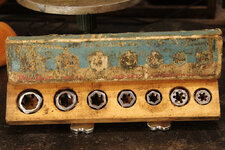
Unfortunately, the 1/4 and 5/16 aren't original or Blue Point.
Also unfortunately, I have almost no use for and SAE NF set. But it was cheap.
Unfortunately, the 1/4 and 5/16 aren't original or Blue Point.
Also unfortunately, I have almost no use for and SAE NF set. But it was cheap.
Ricky Joe
Well-known member
I have a couple of those sets, by Herbrand and Snap-on, and I have no use for them either. Until I do. They may have been used five times in fifty years, but I’m not cutting them loose yet!Blue Point Rethreader Dies set, SAE 1/4-5/8" NF:
Unfortunately, the 1/4 and 5/16 aren't original or Blue Point.
Also unfortunately, I have almost no use for and SAE NF set. But it was cheap.
bmwrd0
Well-known member
I have the same ones, except marked Cornwell. When you need them, boy do you ever!
It does have 32 teeth and my other one has 24 internals look the same. Can't really find any other differences so I think your probably right on the money here's another odd ball toolBut isn't that dust cover from a later era than the ratchet?
Yes, but the repair kit, covers the S71 and also some later rats with dust covers, The factory S71 had 24 teeth, the repair kit has 32, may have be converted just to up grade, you would probably have to use the dust cover, as the gear would probably have a smaller flange top to make up for the cover. Or, it may have had a pin detent and was a special order (diff model number} and was converted from a pin detent to a ball
Attachments

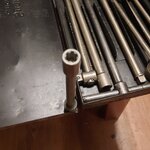
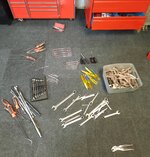
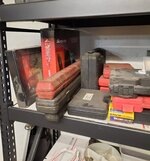
I must apologize in advance for going against the guidelines for this thread and for the long message also this will be the one and only time I do this. The classifieds are just too much of a hassle for me and I did want to directly reach the people I interact with the most on here just incase any of you have any use for some newer stuff. With the winter putting a damper on my motivation I'm realizing that I need to try to move at least a good chunk of what I acquired last summer to make room for new pickups. I am posting a few pictures as a sample but this is about 5% of what I am trying to find a new home for. Its hard to say what's left but as far as snap-on there probably isn't much that I don't have between hammer sets pry bar sets and screwdriver wrenches picks pliers nut drivers specialty and other sets and many ratchets. Also with a good amount of the other main US brands like Mac match craftsman Bonney proto ect and hundreds of vice grips and misc air tools and to be clear I can't give this stuff away but I would try to get as close to that line as I can for anyone here. Again I do apologize for any offense taken and will happily remove if necessary. And to avoid disruptive the theme of this thread the best way to inquire about anything you may need would be a private message.
Thanks.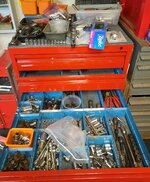

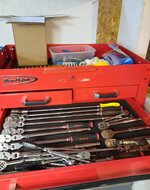
Thanks.

bmwrd0
Well-known member

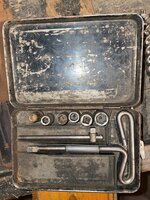
This came in the mail for me the other day. No sliding T and one less socket, both of which I had. A very early Snap-on 9/32" set, '30-'32 I believe. It would have had a decal on the inside, and you can see where it was from the paint wear. But no one made a case like this except SO, at least as far as I am aware. I might get a replacement sticker from Jim, slide it inside or something. Sadly, someone tried to paint it red at one point, not to surprising.
29 should be the last year with the knurled sockets. At least according to the catalogs although I have some non knurled sockets with a 28 code so consistency wasn't quite all there yet. Still it's safe to say this is a pre 1930 set. Still a couple sockets missing to be considered complete but cool set! I'm sure a lot of these sockets got lost due to them not being marked
This came in the mail for me the other day. No sliding T and one less socket, both of which I had. A very early Snap-on 9/32" set, '30-'32 I believe. It would have had a decal on the inside, and you can see where it was from the paint wear. But no one made a case like this except SO, at least as far as I am aware. I might get a replacement sticker from Jim, slide it inside or something. Sadly, someone tried to paint it red at one point, not to surprising.
Since this is a long one I will make a brief statement to summarize. I have decided that because of the limited amount of accurate information and pictures on sites like AA and collecting snap-on ect. I will take matters onto my own hands and also hope that some people here might choose to contribute to this endeavor with any little mysteries that I'm aware of
Having a hard time getting organized and I'm not quite there yet as far as condition goes with some of the tools in my vintage collection but I decided to take what I have so far and upgrade later for the project I ⁶ been working towards to make my own guide for collecting snap-on and also the other 2 brands I collect (mtf and husky) but without the errors and accounting for the oddballs that as of right now only can be proven with physical examples as there are no records of them. There's only one such tool here which is one of the mu8s that is dated 1928 which is befothey're ey were meant to exist. I'm not sure how I will progress this, but since there will be a lot of non snapon tools I will be posting the majority of my pictures in the thread I created. If you want to see some cool stuff you should check it out in the near future.
I'll have to edit later with a link to it for anyone who might want to check it out. But i will be posting some here if it feels appropriate.

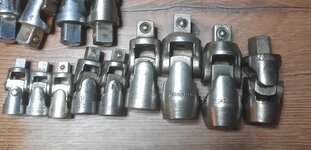
Having a hard time getting organized and I'm not quite there yet as far as condition goes with some of the tools in my vintage collection but I decided to take what I have so far and upgrade later for the project I ⁶ been working towards to make my own guide for collecting snap-on and also the other 2 brands I collect (mtf and husky) but without the errors and accounting for the oddballs that as of right now only can be proven with physical examples as there are no records of them. There's only one such tool here which is one of the mu8s that is dated 1928 which is befothey're ey were meant to exist. I'm not sure how I will progress this, but since there will be a lot of non snapon tools I will be posting the majority of my pictures in the thread I created. If you want to see some cool stuff you should check it out in the near future.
I'll have to edit later with a link to it for anyone who might want to check it out. But i will be posting some here if it feels appropriate.