To avoid these ads, REGISTER NOW!

Lets make an all vintage Snap-on tool picture thread!

Private Lugnutz

Well-known member
Joined
Mar 30, 2012
Messages
30,634
Location
The Authentic Jersey Shore
I’ve seen plenty of S-K and Plomb crossbars that are grooved to keep the crossbars centered when their hinge handles have the balls. Sort of the same thing as the grooves in the middle of sliding Tee handles.
Thanks. Either I don't have any hinge handle cross-bars like that, or I haven't paid attention to that feature.
The SO balls in the hinge handle holes may just be to stop the crossbars from falling out.
That's exactly what I always thought they were for.
None of the repack crossbars are grooved.
Thanks. But I was asking about the hinge handles. Do they have detent balls? Again, because mine is a "G", it has a detent ball, and the crossbar is not grooved. You were saying that the crossbar for JjKk's 1942 hinge handle is likely grooved because the hinge handle had the detent ball, almost as if you were assuming that wartime hinge handles did not have the detent ball. That's what made me curious about Cliff's stash.
 
To avoid these ads, REGISTER NOW!

d42jeep

Well-known member
Joined
Oct 22, 2014
Messages
16,573
Location
Northern California
I’ll check them out and let you know. Okay, mission accomplished. The 1945 9/32” drive hinge handles all have the ball to retain the crossbars. The 1945 1/4” drive hinge handles do NOT have the retaining balls.179CA0A1-F8F8-4132-9935-C7E5B6211B34.jpegBB5A2804-D6BF-4DD2-AB4C-01B72B103FE0.jpeg2AE2CF26-D44C-48D8-AC09-CC6F020F3F2F.jpeg
-Don
 
Last edited:

Provincial

Well-known member
Joined
Sep 21, 2011
Messages
6,872
Location
Near Salem, OR
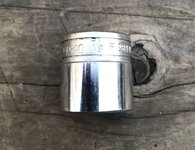
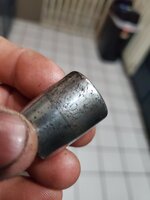
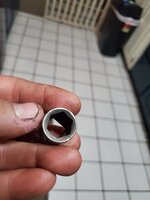
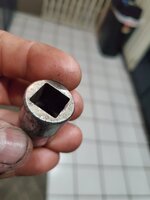
Today I found a special Snap-On 1/4 drive socket. It is a deep socket and has a D-shaped opening, like a hole with a flat on one side. The part number is S-9048 and date code squarish "0", so 1950. It has a phosphate finish.

It seems like a Stromberg carburetor jet tool, but those I have seen have a "double D" (flats on opposite sides) opening. Here are photos:
S-O S-9046 - Copy.jpg
S-O S-9046 1 - Copy.jpg
 

Private Lugnutz

Well-known member
Joined
Mar 30, 2012
Messages
30,634
Location
The Authentic Jersey Shore
Okay, mission accomplished. The 1945 9/32” drive hinge handles all have the ball to retain the crossbars. The 1945 1/4” drive hinge handles do NOT have the retaining balls.
Thanks.

EDIT:

Please indulge my curiosity about this distinction a little further, Don. Is the O.D. of the knurled handle on the M-10's the same as the O.D. of the knurled handle on the TM-10's? I don't have a TM-10 to measure or compare.

You see where I'm going with this, right? I'm wondering why one gets a crossbar retainer and the other doesn't.

The two midget sets are practically identical, just a 32/nd difference in drive stud diameter, and the concomitant differences in torque and sheer that I have described mathematically before. But the tools perform the same functions. Both hinge handles are used the same way, and are designed to be used the same way, with or without a crossbar. My point is there is no reason relative to their drive size distinction that one set should have hinge handles with crossbar retaining detent balls and the other not.

My thoughts turned to customer.

While losing a crossbar inside an aircraft engine compartment might could be a tad more catastrophic than losing one inside a wheeled or tracked vehicle, I can't imagine contract specifications for midget socket wrench sets being that nitnoid, and all my experience reading wartime documentation backs that up. The USAAF and the Ordnance Dept were simply buying fed spec standard stuff, and that was mimicked on leading commercial offerings.

So my thoughts turn to construction.

As I alluded to upthread, for the M-10, they milled the end after the handle was forged, they inserted the ball, they inserted the spring, and then they inserted a plug. You can see the outline of the plug in the end of the handle. I'm wondering if they determined there simply wasn't enough steel in the TM-10 handle to do the same. Postulating so, actually. Because I can't think of any other reason to not provide it.
 
Last edited:

Farmer J.

Well-known member
Joined
Sep 18, 2016
Messages
1,995
Location
UK, Cornwall/Hertfordshire.
so, actually. Because I can't think of any other reason to not provide it.
Maybe they were just feeling lazy? Or someone realised that they could make more profit by leaving out the difficult fiddly bit of the job and charging just as much for the item?:confused:
Sorry for my slightly cynical views just now, they easily come to mind as there's a plumbing job in progress here and the 2 reasons above seem to be priority for the chap who said he could do it! :rolleyes:
 

d42jeep

Well-known member
Joined
Oct 22, 2014
Messages
16,573
Location
Northern California
I agree. They probably quit putting the balls in as a cost saving measure. I think that the bars are the same size but I will measure them tomorrow to confirm. They look pretty similar in size in these pictures. They take the same crossbar.
-Don22735755-2419-47C6-A615-F77691B5F634.jpeg0971114D-0206-4F90-8462-BD472C34037C.jpeg
 

Private Lugnutz

Well-known member
Joined
Mar 30, 2012
Messages
30,634
Location
The Authentic Jersey Shore
Maybe they were just feeling lazy? Or someone realised that they could make more profit by leaving out the difficult fiddly bit of the job
I agree. They probably quit putting the balls in as a cost saving measure.
The production in question was not sequential. The production was simultaneous, as I alluded to. It's not as simple as they were doing it, then they weren't. The 9/32 drive hinge handle got the ball. The 1/4 drive hinge handle didn't. Made at the same time. That's the whole source of the curiosity.
 

Provincial

Well-known member
Joined
Sep 21, 2011
Messages
6,872
Location
Near Salem, OR
The 9/32 handle was already in production before the war. The 1/4 handle went into production mid-war, according to the discussion earlier in this thread, with handles that were different in design.
 

Old Radar

Well-known member
Joined
Apr 17, 2019
Messages
2,755
Location
San Antonio, TX
The production in question was not sequential. The production was simultaneous, as I alluded to. It's not as simple as they were doing it, then they weren't. The 9/32 drive hinge handle got the ball. The 1/4 drive hinge handle didn't. Made at the same time. That's the whole source of the curiosity.

Simultaneity doesn't necessarily preclude the cost savings theory. If manufacturers divined mid-war that 1/4 drive tools were the wave of the future (which came to pass) and that they could shave some cost by cutting some features, why build those features in only to cut them later? Whereas with the legacy 9/32 drive, it would undoubtedly cost more to curtail the retaining ball than any savings could justify.
 
Last edited:

Private Lugnutz

Well-known member
Joined
Mar 30, 2012
Messages
30,634
Location
The Authentic Jersey Shore
The 9/32 handle was already in production before the war. The 1/4 handle went into production mid-war,
I am well aware that 9/32 came first, as a drive size, Jock. But they were making both 9/32- and 1/4-drive at the same time for military customers. That puts the basic question - Why weren't the 1/4-drive handles provisioned the same as the 9/32 drive handles? - still very much begged into play. Was it cost savings? Maybe. Was it impractical in the 1/4-drive? Possibly. Was it customer preference?
If manufacturers divined mid-war that 1/4 drive tools were the wave of the future (which came to pass) and that they could shave some cost by cutting some features, why build those features in only to cut them later?
That very well may be for commercial production. But their military customers may have had something to say about the military production. If it was purely and only cost savings, and exclusively their discretion, they didn't have to put the detent balls in the 9/32-drive handles in 1945 when they were cranking out the 1/4-drive handles without them. They had to mill the end of the handle, then insert the ball and spring and plug to do that. It would've been very easy to just skip those steps after the hinge handle was forged.
 
Last edited:

Old Radar

Well-known member
Joined
Apr 17, 2019
Messages
2,755
Location
San Antonio, TX
I edited my original post with this clarification to my thought process and it may have happened too late for your reply post.

"Whereas with the legacy 9/32 drive, it would undoubtedly cost more to curtail the retaining ball than any savings could justify."

Whether the ball was needed or not, or whether there was a cost savings to be had, I would think the cost of changing the manufacturing process on a legacy tool would more than outweigh any savings on this particular change.
 

Farmer J.

Well-known member
Joined
Sep 18, 2016
Messages
1,995
Location
UK, Cornwall/Hertfordshire.
Simultaneity doesn't necessarily preclude the cost savings theory. If manufacturers divined mid-war that 1/4 drive tools were the wave of the future (which came to pass) and that they could shave some cost by cutting some features, why build those features in only to cut them later? Whereas with the legacy 9/32 drive, it would undoubtedly cost more to curtail the retaining ball than any savings could justify.
This, yes.
Maybe..... they had a quiet chat and decided "let's not bother with putting those goddam fiddly little balls in the 1/4 drive handles"..... and they got away with it because nobody with any power cared if they were there or not, and nobody noticed their little secret omission... for 76 years.. until Lugz came along and had a close look at them... and blew the plot!:giggle:
Also, it could have something to do with the human nature I have observed, that if people are used to you providing something for them and you then withdraw it they get annoyed. If they never had it they never miss it and don't feel deprived.. So they continued to put balls in the 9/32nd drive because they always had and people may complain if they were discontinued (especially if a cross bar slides out and blows up an engine and they get blamed at the inquest. For the 1/4 drive they never fitted them, so nobody ever missed them.
 
Last edited:

thehorse13

Well-known member
Joined
Mar 15, 2015
Messages
3,479
Location
Jefferson County, WV
I am well aware that 9/32 came first, as a drive size, Jock. But they were making both 9/32- and 1/4-drive at the same time for military customers. That puts the basic question - Why weren't the 1/4-drive handles provisioned the same as the 9/32 drive handles? - still very much begged into play. Was it cost savings? Maybe. Was it impractical in the 1/4-drive? Possibly. Was it customer preference?

That very well may be for commercial production. But their military customers may have had something to say about the military production. If it was purely and only cost savings, and exclusively their discretion, they didn't have to put the detent balls in the 9/32-drive handles in 1945 when they were cranking out the 1/4-drive handles without them. They had to mill the end of the handle, then insert the ball and spring and plug to do that. It would've been very easy to just skip those steps after the hinge handle was forged.
I say this only from the point of view from contract nonsense that I deal with everyday. Could this be as simple as a design spec in a contract? I deal with Govt. contracts all the time and situations similar to this one show up on occasion, especially with equipment. It often causes heartburn because legacy wording/specs can become obsolete between contract periods. The result is that certain equipment, intended for the exact same purpose, gets delivered with some minor differences.
 

Private Lugnutz

Well-known member
Joined
Mar 30, 2012
Messages
30,634
Location
The Authentic Jersey Shore
Whether the ball was needed or not, or whether there was a cost savings to be had, I would think the cost of changing the manufacturing process on a legacy tool would more than outweigh any savings on this particular change.
I can see that if a change is additive. In this case, I have to re-emphasize that the manufacturing process literally adds the detent ball after the hinge handle is completely made. They have a hinge handle. They mill the end to insert the ball, spring, and cap. So they'd be skipping laborious steps involving hours of work and machining. Like mfgrs skipping final finishing buffing and polishing on economy line tools, I'm sure that would result in a cost savings.
I deal with Govt. contracts all the time and situations similar to this one show up on occasion, especially with equipment.
That's the aspect I am hunting down, Sonny. I initially thought the detent ball was too small of a detail to be specified based on my experience reading 1939 federal specifications (which do not include midget sets) and Ordnance Dept catalogs (which do not include USAAF tools), but now I'm sort of arguing with my initial self, the argument gained a little credence when my survey (see Midget thread...) revealed that the Plomb situation mirrors the Snap-on situation (Plomb hinge handle WF-7, made for USAAF, has a detent ball; Plomb hinge handle 4766, made for other military customers and commercial sales, does NOT), and it gained a lot of credence when the survey revealed that the early prewar Snap-on M-10 did NOT have a detent ball.

That strongly suggests it was specified later, by a customer, and probably the USAAF. So, they were making them without the ball, then, when they started making them with the ball, they simply took the existing product, made with the existing process, and opened it from the **** end to add the detent ball, spring, and plug, as I have described now several times. Which is fascinating. But I don't like jumping to conclusions, so I'm going to think about it some more and wait for some other data.
 
Last edited:

Private Lugnutz

Well-known member
Joined
Mar 30, 2012
Messages
30,634
Location
The Authentic Jersey Shore
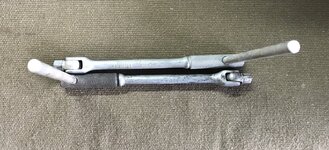
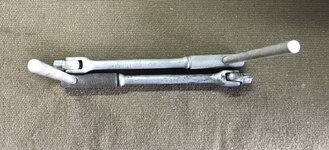
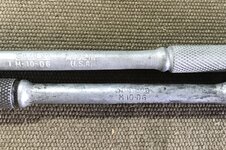
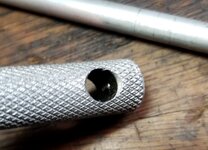
Here are some pics for context. These are all wartime (primarily 1945 "G" code) 9/32-drive tools. The hinge handle is a TM-10 with a "G" code. If I had a prewar TM-10 without a detent ball, that would show what that end would normally look like but you can imagine any of your typical hinge handles from any mfgr's set. A fully forged uniform handle with knurling and a smooth seamless end. If I could prevail upon Don to include some similar side by side photos of the end of one of his wartime surplus M-10's and one of his surplus TM-10's as long as he's pulling them out to take measurements, that would also show it. And if OTG is reading if he could add a photo of his prewar M-10 without the detent ball from the end, that would also be helpful.

20211114_070521.jpg20211114_071825.jpg20211114_070801.jpg
 

Oldtuleguy

Well-known member
Joined
Nov 4, 2017
Messages
10,460
The m10b, no detent. M10d, has detent. I have looked around a bit and it looks like both were available at same time during ww2.
 

d42jeep

Well-known member
Joined
Oct 22, 2014
Messages
16,573
Location
Northern California
Here are a bunch of pictures. The bottom line is that all of the midget handles are the same size. All of my 9/32” handles have the detent.
-Don

9/32” drive
5CFF4373-C911-4009-81E0-1398DDBBC68E.jpeg

8C174DB5-D8F1-4AC6-B1B9-1537DD6F81D8.jpeg

1/4” drive handles44AB60BE-D1F4-41E3-8CE8-E1B3208B5DB8.jpeg25AB0625-58E8-46B4-ACBD-28FFC3213D2E.jpeg1949 1/4” drive handleE4D70522-A2E9-41FE-A84F-E044E3600224.jpegOne size fits all CrossbarE72419D7-D8E0-4CF0-8AB6-8E276D8F4FA4.jpeg9/32” Snap-on repack bars all with the detentsE88F708C-A08D-4C93-8B7E-10DDD5CB96B4.jpegSide by side comparison431C5A7F-5508-4061-8B6D-102A96A981FE.jpeg
 
To avoid these ads, REGISTER NOW!

LesserSon

Well-known member
Joined
Feb 7, 2016
Messages
5,078
Location
PA USA
DETENT-BALL DILEMMA
I read through the discussion, and I think characterizing the difference as “cost-saving” aggregates multiple potential motivations. Time, labor, and material collectively contribute to final cost, but each could be a direct reason, independent of the others, for constructing the 1/4dr hinge handle without a detent ball. Skipping the detent ball means the production of 1/4dr would be faster than that of 9/32dr - greater volume or quicker delivery. The War demanded urgency. Production would move ahead even if the ball bearing supplier didn’t deliver.
 

Private Lugnutz

Well-known member
Joined
Mar 30, 2012
Messages
30,634
Location
The Authentic Jersey Shore
I have looked around a bit and it looks like both were available at same time during ww2.
Thanks, OTG, that lends further credence to my position.
The War demanded urgency.
Did you miss the fact the M-10's with the detent ball were being made throughout the war?

"The War" was not a monolith. Anything but, despite the efforts of the WPB. One of the reasons the Military-Industrial Complex grew so much more centralized after the war (DOD, DLA, GSA, etc) was how inefficient and ineffective acquisitions and logistics were with multiple technical services, bureaus, and contracting agencies within services. We managed to win the war despite that slogging quagmire, which is the theme of every major military institute's book on WWII.

I guess I can understand the fixation on why it was not provisioned in the 1/4 drive size, but that's only half the question. The equally if not more interesting and important half of the same question is, Why was it provisioned in the 9/32 drive size? And if you haven't been following my little survey in the Midget thread or my mini-reports back here where the question originated, it doesn't look like the answer is because 'they just always did it that way.' It doesn't look like the detent ball is a case of something industry was regularly doing, and then it was dropped to make the midget socket wrench portion of the war machine more efficient. Prewar Snap-on M-10's did not come provisioned with a detent ball. While Plomb never sold 9/32-drive tools commercially, their 1/4-drive hinge handles never had a detent ball. The hinge handle they made for the USAAF did, though. I think this is all looking like very strong derived evidence that the detent ball is something Snap-on and Plomb added explicitly because of the USAAF, the primary (and perhaps exclusive) customer for 9/32-drive midget tools. I just don't have the kinds of documents for the USAAF that I have for the Ordnance Dept and others to definitively prove it.

Expedience and cost-savings may have been the reason that the Ordnance Dept didn't specify detent balls in their 1/4-drive midget hinge handles (or, as I already suggested upthread, the hinge handles in standard commercial midget sets they used as a model were already being made without detent balls), but I am convinced that the USAAF considered that secondary in priority to keeping those tiny danged 9/32-drive hinge handle crossbars from becoming F.O.D. in and around their aircraft.
 
Last edited:

Private Lugnutz

Well-known member
Joined
Mar 30, 2012
Messages
30,634
Location
The Authentic Jersey Shore
How so? If the War demanded urgency, why didn't the War demand urgency in the case of the 9/32-drive hinge handles with detent balls? Please clarify.

EDIT: Also, if it already wasn't routine practice for midget socket tool hinge handles to be provisioned with detent balls, please help me understand how there was any influence from the The War (as an acquisitions monstrosity demanding expedience...) whatsoever in most midget hinge handles (other than USAAF, apparently) simply continuing to be made as they were routinely made? That seems highly relevant to me. To be more direct, it doesn't look to me like the war had any impact whatsoever on why there were no detent balls in 1/4-drive midget hinge handles. Conversely, it looks like the USAAF had a very direct impact on why their hinge handles did have them.

But note I am still gathering data. I think the empirical survey has given sufficient reason to do a more exhaustive catalog survey.
 
Last edited:

saukit

Well-known member
Joined
May 29, 2021
Messages
574
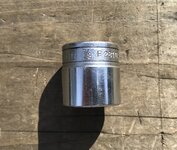
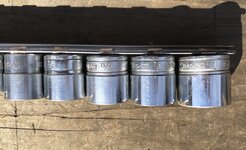
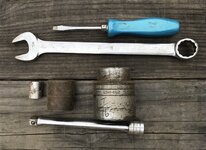
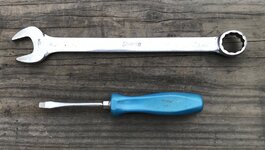
Here are a few Snap on pieces that I've run across lately: Large S20 1/2" extension, I forget the model of DBE, Blue Point XS-2024, 3/8" combo, FM 70 ratchet with 3/8" anvil, don't have # on needlenose either, the little sockets are kinda weird, I dug them out of a trailer full of mostly junk. A couple are marked GSTMD10 and GSTMD14. There are three 5/16", one 1/4", and one 7/16".


IMG_3503.jpg

IMG_3504.jpg
 

d42jeep

Well-known member
Joined
Oct 22, 2014
Messages
16,573
Location
Northern California
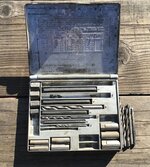
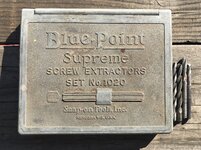
I found a Blue Point screw extractor set with a few pieces missing at an estate sale yesterday. The cases are pretty cool. I’ll add the missing drill bits. These were sourced from Ridgid.
-Don9C5F7A2C-DC38-498B-9306-C99C0084D804.jpeg
F4722870-25EB-4DBA-99E3-68DC94897430.jpegE4BD2127-F7E1-40F5-AC4E-DB04EE6C1E5C.jpegA978A4D7-F69C-4087-8FFB-A0FEA094F341.jpeg
 

humber2

Well-known member
Joined
Feb 13, 2011
Messages
1,768
Location
Downunder
I have a query here with a BluePoint Supreme wrench WTA910 dating.

The 5 looks just like it is typed here but does it represent 1945?

Accompanying it is the smallest Whitworth tappet wrench WST96A evidently not dated.

I’m not having any luck accessing Collecting SO sites Catalogs so would appreciate any screen shots of the listings for these two series of wrenches.

EB792F84-704F-4FDC-BBB5-A9D799700612.jpeg
 

Attachments

  • 79CE1701-4295-4775-8852-522B67ED0C72.jpeg
    79CE1701-4295-4775-8852-522B67ED0C72.jpeg
    254.7 KB · Views: 11
  • 82D5CDE5-98AD-48D4-B8AB-6663882FF037.jpeg
    82D5CDE5-98AD-48D4-B8AB-6663882FF037.jpeg
    173.9 KB · Views: 12

snapmom

Well-known member
Joined
Sep 4, 2008
Messages
3,522
Location
Florida
I have a query here with a BluePoint Supreme wrench WTA910 dating.

The 5 looks just like it is typed here but does it represent 1945?

Accompanying it is the smallest Whitworth tappet wrench WST96A evidently not dated.

I’m not having any luck accessing Collecting SO sites Catalogs so would appreciate any screen shots of the listings for these two series of wrenches.

EB792F84-704F-4FDC-BBB5-A9D799700612.jpeg
I vote 55 too. The A is probably late 30s, as the sloping handle style was used then.
 

d42jeep

Well-known member
Joined
Oct 22, 2014
Messages
16,573
Location
Northern California
I pulled my complete screw extractor set out of the NAF box for comparison with my new set and to possibly upgrade any worn pieces. I added drill bits to the recently found set. I suspect that my keeper set received its attractive green color during WW2.
-Don
12900D57-8BFC-4766-9DDE-241F2BAD1462.jpegE0AEA39B-B81D-45AC-8BE7-83ECAD1BCAAA.jpeg
 

snapmom

Well-known member
Joined
Sep 4, 2008
Messages
3,522
Location
Florida
6 point, maybe 34?20211217_065338.jpg
Yes, my 9507 is a six point with a 34 code. not sure its use. but a 95xx would be Chev. 93xx use is rare, would be Dodge.
sometimes the 5 looks like a 3 if worn like this one. If you look at it looks more like a 5
 
To avoid these ads, REGISTER NOW!
Top Bottom