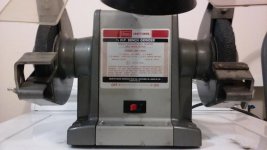
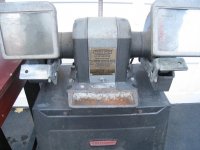
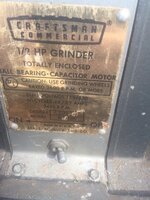
To simplify things, set up your 110v tool (e.g. compressor, grinder, etc). Without powering it up, measure the voltage at the switch relative to neutral. This should be 110v. Let's call this "v1". This is your open-circuit voltage (a.k.a. Thevenin voltage). Now, while the voltmeter is still on these wires, turn on the tool. You will now see a voltage lower than 110v (let's call this "v2") because of the voltage drop across the wire leading to the tool. The wire resistance is your Thevenin resistance. The difference of these two measurements (v1 minus v2) is the voltage drop across the wire leading to the tool. Remember this voltage drop value.
/QUOTE]
Absolutely, and let's go a bit further and put this in perspective.
My basement shop has a 50 foot run from the breaker box to the furthest wall. So 100' of 12AWG wire for the circuit (power and return). 12AWG is 1.588 ohms per 1000', so 100' amounts to .1588 ohms. With that 1/2hp block grinder drawing 6 amps under full load, the IR drop to it is .158 x 6, or roughly 1 volt.
I defy anyone to notice a 1 volt difference, especially when wall voltage varies 5-10 times that amount throughout the day. But of course there will be those that have 200' of run and believe they feel a marked improvement when they configure their grinder to run at 3 amps of draw on a 220v outlet. They might be ignoring the fact that it's different circuits making the difference rather than purely the voltage, or they have underspec wire running the distance.....
I see a 220 volt religion forming here.
EDIT: Bonus question.
Since most of the old block grinders were engineered to yield full power at 115 or 230 volts, and contemporary voltage is actually 120 or 240 volts, how many feet of 12 gauge wire can you use before the grinder drops below its rated design voltage?