
You are using an out of date browser. It may not display this or other websites correctly.
You should upgrade or use an alternative browser.
You should upgrade or use an alternative browser.
Let's show our wood (screwdrivers)
- Thread starter gungatim
- Start date


four.cycle
Well-known member
^ Tobrin Tool Co., Plantsville, CT but I don't know if yours is the model to which patent 1712484 applies. 
genog
Well-known member
The third one that I found recently
I just can't resist buying these

I just can't resist buying these
d42jeep
Well-known member
I have the same problem. If I see one at a sale it always comes home with me. This one was at the last garage sale.
-Don

-Don
Rmb8Ball
Active member
Some I found in a old tool box
Brand ECT posted like third here: https://www.garagejournal.com/forum...ox-set-hammers-odds-ends.471441/#post-9915097
Brand ECT posted like third here: https://www.garagejournal.com/forum...ox-set-hammers-odds-ends.471441/#post-9915097
Attachments

Private Lugnutz
Well-known member
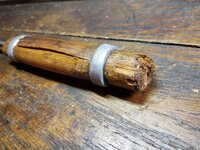
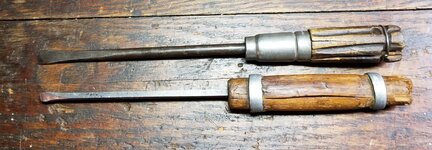
I picked this up at the flea a few days ago. Had to have it. Cleaned up well. It looks to me like the rings were jammed on as a fix to prevent it from further splitting. Square shank with a WRIGHT marking and what might be a part number ("L8 - V"), but I am not sure if that's the hand tool company or the aircraft company. It has a lot of character. Shown with my equally rustic-looking Nashua Paper Box Company screwdriver with the "Grover Handle", which has a similar repair.
Attachments




misterbill
Well-known member
- Joined
- Dec 24, 2015
- Messages
- 675
Wow, I'd say that one was "fully depreciated". I think Tin has this 1940 catalog https://www.garagejournal.com/forum/attachment.php?attachmentid=1076468&stc=1&d=1606855978 it might have some further info in it if you can get his attention.I picked this up at the flea a few days ago. Had to have it. Cleaned up well. It looks to me like the rings were jammed on as a fix to prevent it from further splitting. Square shank with a WRIGHT marking and what might be a part number ("L8 - V"), but I am not sure if that's the hand tool company or the aircraft company. It has a lot of character. Shown with my equally rustic-looking Nashua Paper Box Company screwdriver with the "Grover Handle", which has a similar repair.
RTM
Well-known member
For those who really get off on screwdrivers, and custom fitted screwdrivers, you may get a kick out of this book (droolworthy preview here)
No ties to it, other than I know of a few of the collectors whose work is shown.
The Hand Tool Chronicles - The Humble Screwdriver & Turnscrew Edition No. 12: A Photographic Presentation of Woodworking Hand Tools: Wilwol, Don: 9798370765933: Amazon.com: Books
The Hand Tool Chronicles - The Humble Screwdriver & Turnscrew Edition No. 12: A Photographic Presentation of Woodworking Hand Tools [Wilwol, Don] on Amazon.com. *FREE* shipping on qualifying offers. The Hand Tool Chronicles - The Humble Screwdriver & Turnscrew Edition No. 12: A Photographic...
www.amazon.com
No ties to it, other than I know of a few of the collectors whose work is shown.
Private Lugnutz
Well-known member
Thanks for the prompt. I just texted him.I think Tin has this 1940 catalog https://www.garagejournal.com/forum/attachment.php?attachmentid=1076468&stc=1&d=1606855978 it might have some further info in it if you can get his attention.
Mintgrun
Well-known member
I wonder if the two-ring handle could have been made that way (as a replacement). I'm thinking they may have intentionally split it, in order to hollow out the halves for the square shank and then drove the rings on to hold it together.
Private Lugnutz
Well-known member
That's what I thought when I found it, but it's not two halves put together, as far as I can tell. But maybe the rings are so tight I can't see the split.I'm thinking they may have intentionally split it, in order to hollow out the halves for the square shank and then drove the rings on to hold it together.
How would they have put the rings on so tight? Just curious about the procedure.That's what I thought when I found it, but it's not two halves put together, as far as I can tell. But maybe the rings are so tight I can't see the split.
Private Lugnutz
Well-known member
No idea. Honestly, I was hoping for more answers and theories than questions!  But you can see how deformed it is, right? How it's thicker in the middle between the rings? That the rings were each jammed on, one from one end, and the other from the other end, is unmistakable.
But you can see how deformed it is, right? How it's thicker in the middle between the rings? That the rings were each jammed on, one from one end, and the other from the other end, is unmistakable.RTM
Well-known member
Warm the rings, let them expand, bang them on, let them cool. The way barrel hoops are done too.How would they have put the rings on so tight? Just curious about the procedure.
Private Lugnutz
Well-known member
My uncle Tuffy was a hooper!
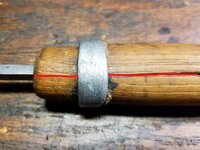
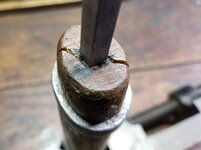
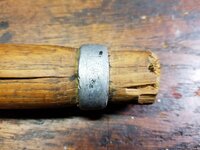
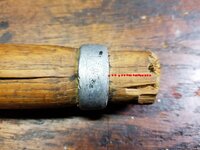
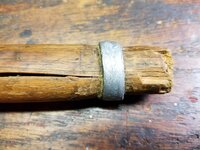
Tom, below are more photos. As you can see, it is split on two sides of the handle, or "in halves", sort of, at the end where the shank is installed. I am not convinced the somewhat jagged and uneven separation is planned, but I am open to all comments. Note, though, that it is not split all the way through the handle into halves on the other end. While that end is a mess with chips and other splits, the splits on either side of the handle in the middle do not continue past the ring near the end.
By the way, the wood is very hard. Despite the split and chips on the **** end, this thing is anything but fragile. I know it sounds almost counterintuitive to its looks, but it's very robust. My money is on it lasting 100 more years.
Tom, below are more photos. As you can see, it is split on two sides of the handle, or "in halves", sort of, at the end where the shank is installed. I am not convinced the somewhat jagged and uneven separation is planned, but I am open to all comments. Note, though, that it is not split all the way through the handle into halves on the other end. While that end is a mess with chips and other splits, the splits on either side of the handle in the middle do not continue past the ring near the end.
By the way, the wood is very hard. Despite the split and chips on the **** end, this thing is anything but fragile. I know it sounds almost counterintuitive to its looks, but it's very robust. My money is on it lasting 100 more years.
Attachments
-
 Inked20230110_172253_LI split.jpg621 KB · Views: 22
 -
 20230110_172253.jpg619.8 KB · Views: 15
 -
 Inked20230110_172243_LI split.jpg600.3 KB · Views: 15
 -
 20230110_172243.jpg602 KB · Views: 14
 -
 20230110_172215.jpg494.1 KB · Views: 16
 -
 20230110_172206.jpg639.3 KB · Views: 16
 -
 20230110_172247.jpg643.4 KB · Views: 13
 -
 Inked20230110_172247_LI no split.jpg649.5 KB · Views: 12
 -
 20230110_172258.jpg651.6 KB · Views: 12
 -
 Inked20230110_172258_LI no split.jpg657.2 KB · Views: 14
Mintgrun
Well-known member
Thank you for the additional photos. I'd zoomed in on the others, hoping for more clues, but I couldn't see the cracks continuing either. My next guess is that they drilled a round hole that was undersized and hammered the shank into the wood, which caused it to split and the rings kept it from coming apart. It's funny that they chose to make the handle oval shaped and not round. If not for the Wright marking, I'd have guessed that the whole tool was hand made. Guesses are all I have to offer. Thank you for humoring me.
Tom
Tom
Private Lugnutz
Well-known member
Totally with you on that. I try to imagine the handle whole and freshly made, without the rings, without the split, and without the **** end all mangled, and even then its shape, no ferrule, etc, just doesn't seem like it matches the age or style of the shank! But I am eager to be proven wrong by a catalog.If not for the Wright marking, I'd have guessed that the whole tool was hand made.
And myself! My photo folder names for tools without a clear identification (brand, model, etc) on my laptop are often mnemonic, something instantaneous that will stick with me for future recall. This tool is in a folder called "Wright Colonial Screwdriver". It's not THAT old, obviously, but it looks it!Thank you for humoring me.
Farmer J.
Well-known member
Hang some metal rings with a snug fit on the small branch of a tree in springtime, they will soon be a perfect tight fit. Later in the season trim the branch off, remove the bark, drill a hole in the end and drive or press the shank in.How would they have put the rings on so tight? Just curious about the procedure.
four.cycle
Well-known member
^ yeah but the rings would rust and stain the wood handle
Private Lugnutz
Well-known member
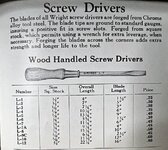
@tin medic sent me a scan from his 1940 Wright catalog, confirming that the square "WRIGHT L8" shank is indeed Wright Tool and Forge, fitted in a homemade handle.
Attachments


d42jeep
Well-known member
I picked up this Matchless screwdriver at an estate sale on Monday. It was a little difficult to remove the red paint. I didn’t find a part number, unlike my other Matchless screwdrivers. I may do a little more work on the tip but for now I’m letting it be.
-Don
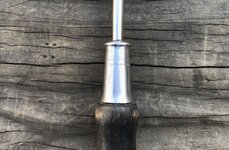
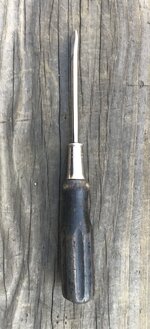


-Don
Rmb8Ball
Active member
Bad *** man
Ole Slewfoot
Well-known member
As usual I forgot to get a true before picture.
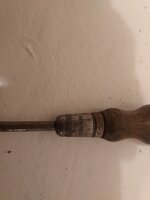
So here's one I found in a crusty old box my buddy dropped off in our shop after I degreased and wire wheeled it (including the wood). It was broken off, reground, and also severely bent, and clearly spent long periods immersed in puddles.

Took a few different pulls to get about straight, but it wasn't 12 tons of bent.

Sanded to 400, and wire wheeled the metal a bit more. Gotta stop and let the water from degreasing dry before I slop some finish on.


So here's one I found in a crusty old box my buddy dropped off in our shop after I degreased and wire wheeled it (including the wood). It was broken off, reground, and also severely bent, and clearly spent long periods immersed in puddles.
Took a few different pulls to get about straight, but it wasn't 12 tons of bent.
Sanded to 400, and wire wheeled the metal a bit more. Gotta stop and let the water from degreasing dry before I slop some finish on.


Old Radar
Well-known member
No, but the hairline cracks in your floor are in perfect focus! 
RTM
Well-known member
Dang, I was gonna say the Fuzzy Screwdriver company.No, but the hairline cracks in your floor are in perfect focus!
Is that the beehive pattern handle? The grooves look deeper than the others seen.
Half-fast eddie
Well-known member
So that’s where my missing mail is …
d42jeep
Well-known member
I have a couple of screwdrivers that look like this unmarked one I found yesterday at an estate sale. I wonder who the manufacturer was?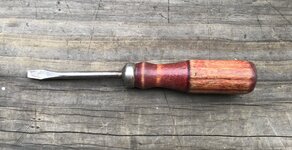
I was poking through an antiques spot yesterday, and probably would have purchased these if they had been priced. I’ll check on them another time. Last August, Lugz presented a gray&red handled driver here with no logo. Here’s one with. 
Private Lugnutz
Well-known member
Nice.
d42jeep
Well-known member
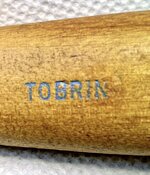
This lightly used handle stamped 9-1/2“ Tobrin perfect handle screwdriver arrived in the mail today. These match the specifications for a GMTK correct 41-S-1385 Extra Heavy Duty Screwdriver 5" Blade.

AntiqueBen
Well-known member
- Joined
- Aug 4, 2021
- Messages
- 1,442
Found this old 10 1/2" Stanley turn screw today. The stamp says Patented June 6, 71. When I looked up this patent on DATAMP (patent 115,582), it appears to be Stanley's first screwdriver patent in 1871. My question is, I don't see this particular Stanley logo on the Stanley logo list? Is there any Stanley buffs out there that knows anything about this logo?
Attachments


Man I love this thread!
Here is my small assortment. All of these screwdrivers were Grandpa's.
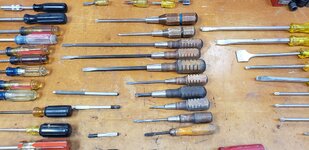 Grandpa's screwdrivers. by bjohnson388, on Flickr
 Grandpa's screwdrivers. by bjohnson388, on Flickr
Here's a lot I bought that all need to be cleaned and some restoration done.
 Mega Wood handle screwdriver haul by bjohnson388, on Flickr
Bret
Here is my small assortment. All of these screwdrivers were Grandpa's.
Grandpa's screwdrivers. by bjohnson388, on FlickrGrandpa's screwdrivers. by bjohnson388, on FlickrHere's a lot I bought that all need to be cleaned and some restoration done.
Mega Wood handle screwdriver haul by bjohnson388, on FlickrBret
d42jeep
Well-known member
I added the new Tobrin driver to the keeper box and took a couple pictures of the perfect handle screwdrivers. From top to bottom are two HD Smith originals, a Lenox, five Tobrins, two prewar and two postwar Irwins. I’m not sure who manufactured the bottom driverThis lightly used handle stamped 9-1/2“ Tobrin perfect handle screwdriver arrived in the mail today. These match the specifications for a GMTK correct 41-S-1385 Extra Heavy Duty Screwdriver 5" Blade.

The Tobrin screwdrivers

-Don
d42jeep
Well-known member
I’m not sure who made this Perfect Handle screwdriver with the 2“ blade but my best guess is Tobrin based on the triangle size marking.
-Don

-Don
AntiqueBen
Well-known member
- Joined
- Aug 4, 2021
- Messages
- 1,442
I picked up this Stanley #25 screwdriver. I've never seen one this long, it's 16 1/2" long. I'm thinking about just leaving the patina instead of making it all shiny. I don't quite understand what DATAMP means about the patent 1,839,835. It says only a few #25's had this patent? Would the #25 been manufactured before the Philips came out?
Attachments


No. DATAMP says models 25, 45, and 55 are only a few of the many screwdrivers Stanley made under this patent.I picked up this Stanley #25 screwdriver. I've never seen one this long, it's 16 1/2" long. I'm thinking about just leaving the patina instead of making it all shiny. I don't quite understand what DATAMP means about the patent 1,839,835. It says only a few #25's had this patent? Would the #25 been manufactured before the Philips came out?
This patent was granted about four years before the patent for Phillips, but I don’t see the relevance, because this patent covers the way the shank is held in the handle, not how the tip fits a screw.
Last edited:
AntiqueBen
Well-known member
- Joined
- Aug 4, 2021
- Messages
- 1,442
I was just curious because I've never seen a philips #25.
d42jeep
Well-known member
Speaking of large screwdrivers, I found this two fister at a Berkeley moving sale this morning. Here it is after some cleanup. I had to straighten the blade as well. 
 I couldn’t find any indication of who manufactured it.
-Don
I couldn’t find any indication of who manufactured it.-Don
I bought this because I had never seen a wood-handled screwdriver marked "Tiger" before. The ugly ferrule polished up to a nice brass color with a little bit of elbow grease.
I wasn't having much luck identifying the maker until I came across an almost identical screwdriver on e-bay. The difference was that the e-bay screwdriver also said "Made In Japan".
Nice looking screwdriver and I was surprised it was not U.S. made.
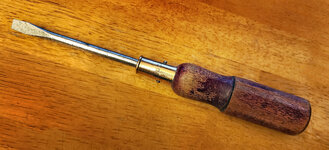
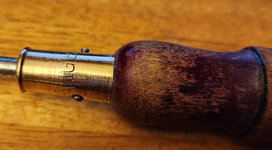


I wasn't having much luck identifying the maker until I came across an almost identical screwdriver on e-bay. The difference was that the e-bay screwdriver also said "Made In Japan".
Nice looking screwdriver and I was surprised it was not U.S. made.