To avoid these ads, REGISTER NOW!

MaxJax Concrete Cracking

IMC

Active member
Joined
Mar 17, 2018
Messages
30
Hey folks,

Wanted to get everybody's thoughts on this - I had MaxJax installed from an installer I found on their website about a week ago - and I've noticed cracks in 3 of the 4 corners on one of the posts:

68212431097__F778C8E9-A494-4940-8269-4F530FF23B69.jpgIMG_6743.jpgIMG_6742.jpg

Installer told me he's not concerned - but the other post is fine and showing 0 cracks.

They checked the concrete during install after drilling and mentioned it was thick enough, but did mention one side of the garage was thicker (the post on the thicker side is showing no cracks so far)

Thoughts? Is this something I should be concerned about? Or is this par for the course?

Thanks!
 
To avoid these ads, REGISTER NOW!

wssix99

Well-known member
Joined
Mar 2, 2011
Messages
5,155
Location
Chicago, IL
Yes, the MaxJax instructions say not to install the lift on any cracks.

I'm dissapointed in the MaxJax product on a number of levels. The anchor bolts shouldn't be installed even near edges of slabs or near expansion/control joints, but they only say "on".

It looks like your bolts are near the control joints in the floor. If you are closer than 2 times the depth, it would be too close for my comfort. Your installer could have also over-torqued the bolts, which is more problematic as one gets closer to the edges.

All this being said, I expect that MaxJax has a factor of safety in their product. I would call them, explain that your floor carcked during the install, describe how many bolts pass through a crack, and then get their advise if it is safe. (Their instructions say that installing the lift on any cracks can lead to injury or death.)
 

jack stand

Well-known member
Joined
Feb 29, 2012
Messages
3,300
Location
Lakes Region Maine
Is that a control joint rubbed in or something else?
I sympathize with your concerns. It may be nothing except something to watch, but certainly something that will be on your mind every minute you spend under it.
I really don't think that if you sent pictures to the company that they'd ok it's use and your concrete is not their problem.
Sorry for your ****** predicament you find yourself in.
 

MFortie

Well-known member
Joined
Aug 9, 2010
Messages
901
Location
San Diego County
I found a doc on the MaxJax site that states no closer than 6” to a concrete edge.

I also called and spoke to a ‘tech’ and asked about proximity to a control joint (my current planned layout straddles a 1/2” deep control joint (6”+ slab). He said “no problem”...

The control joint would be between the center and side bolts - about 3” from each.
 

Zeke

Well-known member
Joined
Aug 13, 2009
Messages
17,176
Location
Long Beach CA, the sewer by the sea.
I keep harping on expanding type anchors for this reason. Personally I wouldn't install any lifting device capable of handling a car w/o opening up the floor and placing footings with bolts embedded well down in the footing.

I've had a lot more success with expanding anchors in shear rather than in tension. If tension is the bigger factor I always look for an alternative. I found an interesting method here.

What I'd like to find or see developed is an oversized version of a butterfly or molly bolt that pulls against the bottom of the slab. There is a small version similar to what I would be looking for, but this is certainly a long way from being adequate:
 
  • Like
Reactions: IMC
OP
I

IMC

Active member
Joined
Mar 17, 2018
Messages
30
Is that a control joint rubbed in or something else?

Not sure - how can do I tell?

It looks like its just a small impression in the concrete - doesn't go all the way through to the bottom. But I could be wrong

I'm dissapointed in the MaxJax product on a number of levels. The anchor bolts shouldn't be installed even near edges of slabs or near expansion/control joints, but they only say "on".

I got 2 different replies, from 2 of their specialists (after I only sent 1 email...)

Reply 1:
Good morning sir, normally Id say small cracks like this is not a problem. However with the cracks in pictures 1 and 3 reaching all the way to the end of the slab it is a little concerning. I don't believe they need to be moved quite yet, nut I would closely monitor those cracks and if they get worse at all you will want to move your unit. If you have any other questions just let me know!

Reply 2:
I would get a concrete specialist to make that call
 

jack stand

Well-known member
Joined
Feb 29, 2012
Messages
3,300
Location
Lakes Region Maine
Not sure - how can do I tell?
Sorry, that was an incomplete thought. What I was wondering was that another (different) slab that was added and is actually the edges of each, or simply tho old way of putting in a control joint. Think sidewalk.
 
  • Like
Reactions: IMC

Zeke

Well-known member
Joined
Aug 13, 2009
Messages
17,176
Location
Long Beach CA, the sewer by the sea.
Looks like old fashioned scoring to me. I think shallow saw cuts done now are simply the economical way. Power trowel and machine cut. Neither method is fool proof. Real expansion joints work better but no place for a lift.
 
  • Like
Reactions: IMC
OP
I

IMC

Active member
Joined
Mar 17, 2018
Messages
30
Sorry, that was an incomplete thought. What I was wondering was that another (different) slab that was added and is actually the edges of each, or simply tho old way of putting in a control joint. Think sidewalk.
Ah - understood. This is all the same slab concrete - but yes looks like how they do sidewalk control joints

Zoomed out picture showing the control joints:

zoomed out.jpg

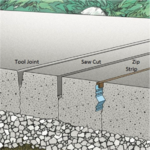
If I had to guess, they look more like the the "tool joint" from diagram below:

concrete-joints.png
 

BertoBuckeye

Well-known member
Joined
Dec 21, 2013
Messages
66
Man, not to pour salt on a wound but that installation is in a tough spot. The near post in the picture is near 1 control joint and on-top of another. If you want to be safe cut it out and re-pour a small pad.
 

MikeC55

Well-known member
Joined
Nov 1, 2020
Messages
418
Location
CT
I would saw cut a 4' x 4' area centered on each post or better, go all the way across, and dig out to 12 - 18", add steel reinforcement and pour. Then use epoxy anchors.
 

Denwood

Well-known member
Joined
Sep 22, 2014
Messages
4,180
Location
Thunder Bay, Ontario, Canada
That post farther from your building is straddling two control joints. I'd have to agree with Mike on this one. Same advice on the epoxy anchors.

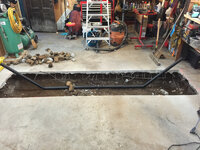
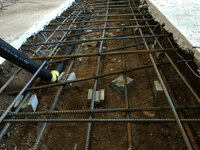
My slab was too thin so I just poured a new section for the lift: https://www.garagejournal.com/forum/threads/maxjax-install-concrete-too-thin.265806/

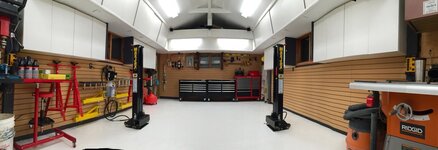
The upside to doing this is that you can run conduit with the new concrete and run a hydraulic hose through it. It was not a hard job to do after renting a concrete saw, picking up some rebar, and having the concrete delivered. That was eight years ago and the new slab section has zero cracks, no lift issues at all. I have piece of mind knowing the lift is installed into a very heavy slice of reinforced concrete.

pit5.jpg

rebar1.jpg

Just after the garage project was completed...

final2.jpg
 
Last edited:

MikeC55

Well-known member
Joined
Nov 1, 2020
Messages
418
Location
CT
Agree, it isn't that difficult. I rented a concrete saw and made the cuts so I could remove (lift) 1 square foot at a time. Digging it out wasn't too bad either but that may depend on what's under there.
 
  • Like
Reactions: IMC
OP
I

IMC

Active member
Joined
Mar 17, 2018
Messages
30
Thanks for all the feedback. Agreed the right way to do it is to cut, rebar and pour concrete.

Just frustrating that the [BendPak recommended] installer said there would be no issues, even after drilling and checking

Also ***** because I've been planning the lift install for a while, and its just disappointing to see it installed and start seeing issues so quickly after installed

Gives me more time to procrastinate on the car, I guess !
 

MikeC55

Well-known member
Joined
Nov 1, 2020
Messages
418
Location
CT
That definitely ***** especially when you pay someone to do it who should know better. But you need to have that piece of mind when getting under a car/truck held 4 ft in the air. It will be worth the added hassle/expense.
 

Denwood

Well-known member
Joined
Sep 22, 2014
Messages
4,180
Location
Thunder Bay, Ontario, Canada
I’d agree, disappointing. That said, the combination of a reinforced slab and the ALI cert on your lift (I have the older widow maker..ha) will make for a much safer work situation.
 
Last edited:
  • Like
Reactions: IMC
OP
I

IMC

Active member
Joined
Mar 17, 2018
Messages
30
Hey all, update on the lift situation:

- Have a concrete guy coming to pour 2 footings for the lift: 4'x4', 2' deep


Since I'm pouring new footings; is there any other type of anchor that I should consider? Or should I just buy another set of the MaxJax anchors?

Thanks!
 
To avoid these ads, REGISTER NOW!

Denwood

Well-known member
Joined
Sep 22, 2014
Messages
4,180
Location
Thunder Bay, Ontario, Canada
Agreed..better to do something like a 3’x12’ slab with rebar., 12” deep is plenty. Dig under your existing slab about 4” all around and your new slab will be underpinned just fine to existing.

Use the epoxy anchors…not a fan of the mechanicals.
 
Last edited:
OP
I

IMC

Active member
Joined
Mar 17, 2018
Messages
30
Hey all - thank you all so much for the suggestions and recommendations. Wanted to give a quick update

- Ended up following some of the advice here and just cut the slab and repour'd 2 footings. 4x4, 12inches deep
- When they cut the slab where the concrete was cracking... it appears there was a local thin area that was only 4 inches thick
- Oddly enough, it looks like there were 2x slabs that were 4 inches each?

tempImagetUsiAi.png


Also added rebar, finished product:

tempImageYRtMrv.png


All in all, I'm glad I ended up cutting and re-pouring. Worth it for just the peace of mind IMO. Put a few cars on the lift, and no cracking yet haha.

Thanks again all.
 

Attachments

  • tempImageGwWRyS.png
    tempImageGwWRyS.png
    7.6 MB · Views: 35

Imatk

Well-known member
Joined
Mar 13, 2008
Messages
322
Nice man... I'd be tempted to paint those new concrete squares black and red like your race deck :)
 

Denwood

Well-known member
Joined
Sep 22, 2014
Messages
4,180
Location
Thunder Bay, Ontario, Canada
@IMC ,great job. That extra margin of safety when lifting is something you'll never regret!

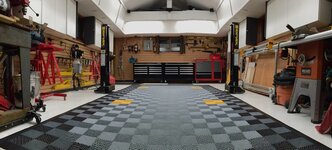
You may want to throw a few target tiles in there for the lift. I find the yellow tiles quite useful when lining cars up for the lift. Every vehicle is different but you can note where each should be for a balanced lift in relation to your target tiles. I just placed the tile squares (4 tiles each) equidistant from the lift columns, based on measuring a few different vehicle's wheel base. I use them every time I place a car for the hoist.

rd5.jpg
 

Imatk

Well-known member
Joined
Mar 13, 2008
Messages
322
Just make sure you always do the rocking test on a new car.


I had lifted loads of cars and knew where they "should" be until I lifted a mid-engined Ferrari and the damn thing was so front light had I not done that test I might have destroyed a nice car!
 

infinkc

Well-known member
Joined
Jan 19, 2012
Messages
862
Glad you got it fixed, noticed in your first install that you had stud anchors, curious why you didn’t install the flush anchors so you can move the lift out of the way, or is this a permanent install?
 

Zeke

Well-known member
Joined
Aug 13, 2009
Messages
17,176
Location
Long Beach CA, the sewer by the sea.
Glad you got it fixed, noticed in your first install that you had stud anchors, curious why you didn’t install the flush anchors so you can move the lift out of the way, or is this a permanent install?
Now that's a good question. What does one buy to accomplish this? I haven't ever had to do anything like that (surprisingly).
 

Denwood

Well-known member
Joined
Sep 22, 2014
Messages
4,180
Location
Thunder Bay, Ontario, Canada
Just make sure you always do the rocking test on a new car.


I had lifted loads of cars and knew where they "should" be until I lifted a mid-engined Ferrari and the damn thing was so front light had I not done that test I might have destroyed a nice car!

On the anchors, I found that the drop in (wedge type) would not hold torque, particularly after a few days, so ended up going with the epoxy versions. With bolts at 90 ft/lbs torque, the epoxy anchors have been rock solid for nine years now.

My process for lifting (call it peace of mind) goes as follows.

1. Center the vehicle at the lift points. I don't have weigh scales so honestly don't attempt mass calculations. The pillar behind the driver is a good bet. There are a ton of good reads out there on proper vehicle centering.

2. Locate frame lift points. This always is the most time consuming process for me as I have 3 and 6" extensions, and truck pads, so always try to find the best (safest) combination. The truck rail pads are always nice when you can use them as the pad cannot slip off the lift point.

3. Lift a few inches and check to see that the pads are where they are supposed to be.

4. Lift until tires are clear, go to the front or rear bumper and try to introduce as much push and twist as I can to check lift points.. Check to make sure the arm locks are engaged and locked. Do a quick scan for leaks.

5. Making sure no one is standing at the front or rear, I crouch down and watch carefully as the lift is done. I do the same during lowering..watch the underside to make sure lowering is level, lock bars are out, etc.

6. Depending on the job, throw two, or four short rise stands under and tension them with light loading.
 
  • Like
Reactions: IMC

mike93lx

ALLIANCE MEMBER
Joined
Dec 9, 2013
Messages
37,338
Location
Richmond, VA
I wouldn't use that for new work. I thought there would be something like a big nut, or coupling nut with j hook anchors attached. I've something here before but mainly flush anchors to attach chain to. Different stress.
Positioning the anchors correctly in New work might be tough for a newbie. If this was mine, I'd likely do an epoxy solution or come up with a welded assembly that can be embedded and hold all the spacing perfectly
 

Zeke

Well-known member
Joined
Aug 13, 2009
Messages
17,176
Location
Long Beach CA, the sewer by the sea.
Now you're talkin'. Unfortunately that sounds custom. Maybe another way to do it is to make the template and put long bolts or all thread in the flush anchors keeping it high enough for finishing. The all thread would keep mud out of the flush mounts as a bonus.
 

Denwood

Well-known member
Joined
Sep 22, 2014
Messages
4,180
Location
Thunder Bay, Ontario, Canada
It's a lot easier to locate your pillars after the pour, mark, drill (using the actual jack base as your template) and use the epoxy anchors.

That said, a J hook setup with a long coupling nut would do the trick for a flush mount setup and would be best for strength I would think. Replicate the lift's base hole pattern in a piece of plywood, bolt up your J-hooks and set in place during the pour.

You'd just need to sort appropriate bolts for the hoist base.
 
To avoid these ads, REGISTER NOW!
Top Bottom