Again, I strongly disagree with the post provided by Gabe above. I have refrained from providing more specific details, but can easily do so.
First of all - your statement that the procedure has been "tested" - that is a false statement. Period. It is true that the procedure has been "used". But not "tested". "Testing" of a partially installed anchor is simply not possible. The question here is not in fact whether the full stress and shear capacity of the anchor in question is requried. It is whether the anchor is set - or not. You have absolutely zero capability of providing stress and shear capacity on a "partially set" anchor. You and I have discussed this already, and suffice it to say that while my description is mechanically correct and supported by industry standard engineering processes, yours is not.
Second, the "torque values" provided by Wej-It were initially provided by a Wej-It representative - personally and directly. Gabe, you and I also both know that you specified to me a 60 ft-lbs torque rating - which I questioned and which is why I went directly to Wej-It.
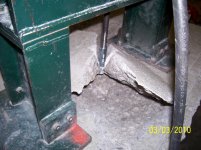
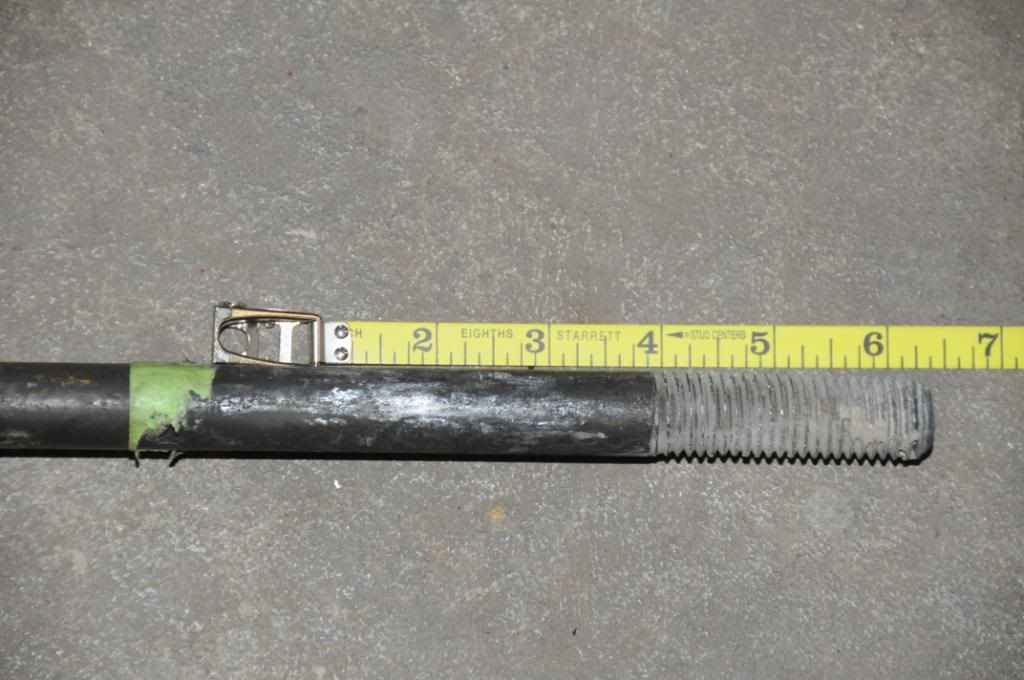
Third, your representation to whoever the person providing that email is not entirely accurate. We can easily get into a discussion of "dueling Wej-It representatives here" but let's get to the basics. Wej-It disagreed with your statements, to the extent that they provided me directly free product of a different type (which I have already received). Beyond that, it is simply not possible that "excessive torque" was applied. Nor is it possible that there is either "reverse spalling" or "insufficient concrete depth". Frankly, I can still prove this right this very second. The holes are now empty. The PD58s have been driven down into the substrait. Every single hole can easily be inspected at this point to determine both the constitution of the concrete matrix, as well as the depth and condition. That will not likely be the case after tomorrow, as I intend to inject epoxy and set replacement anchors, but it is the case right now. If you're interested in actually dealing with this rather than speculating or trying to avoid a liability issue, let me know asap. You have my phone number. But again - recognize that even the message you provided by an unknown Wej-It associate were gained using anchors tested by using the Wej-It instructions - not yours.
Also, please carefully recognize that I am not alleging the the actual metal anchor structurally failed. I am stating that the anchor "system" which includes the supplied PD58 combined with a concrete matrix which meets (or in this case exceeds) specified requirements using the supplied instruction set failed to meet minimum strength requirements for safe operation of this device.
Additionally, I specified to you up front that I was not at the time certain what kind of "damage" had been generated. I did not state that the floor was definitely "damaged" - other than the fact that by the anchors not setting as a result of this ineffective process (which I note you do not mention nor characterize in your post) I can no longer attempt to use PD58s in those holes. I was very clear to you via phone call, followed up by email (the last which you did not acknowledge) that I was going to test the anchors, drive all that failed into the substrait, and inspect for possible damage. You'll note my text in this thread accurately portrays exactly that.
Also, please do not attempt to malign the communication I've had with Wej-It and with Bendpak. Those communications were with not just "counter" people, but with engineers - including the chief engineer who designed the MaxJax product.
Again, I am very disappointed with the support thus far. For example, I did not mention that you (Gabe) personally during our 2nd conversation were recommending that you send me replacement anchors (Wej-It 7/8" x 4 1/2" wedge anchor) to be used "temporarily" (call took place on Tues Feb 23rd) even though the anchor would not fit through the baseplate nor was it supported in an installation where the concrete was drilled all the way through or where the concrete was at the given depth.
I did not intend this thread to bash anyone. I am truly concerned about the safety of these lifts if installed explicity as per the Dannmar instructions, and posted this simply to recommend people inspect their anchors.
Gabe, I challenge you to show me exactly where my testing method is invalid. I am not an 18yr old video gamer with no experience. The bottom line here is simple.
I have a completely cured concrete floor of at least 5 1/2" solid thickness exceeding 3000psi that currently has ten (10) holes in it that can be easily inspected to prove that the concrete is not the issue here. I have records of our initial and subsequent discussions concerning this beginning on Feb 22nd early in your day during which you promised to but failed to return a call that day. You and I both know that you acknowledged on the morning of Feb 23rd when I called you again that your instruction set was "incorrect" and that only at approximately 4:30pm (pacific time, not my time) that day when I returned yet another call you reversed that position.
This is a situation where the failure mode can result in death, and I'm disappointed.


You 100% happy so far?