To avoid these ads, REGISTER NOW!

Maxjax Installs: Post Here

mad1stgen

Member
Joined
Oct 29, 2009
Messages
19
Location
Michigan
In prep for a more permanent maxjax install, I am considering moving the lines.
I've seen several instances where people extended one or both lines to reach the remote control unit. Usually one of the lines is longer than the other.
I was wondering if it would be possible to extend the single line that runs from the pump to the diverter, relocate the diverter to the ceiling (or below floor if you chose to) and then have two equal length lines from diverter to the columns ? Not only would there be less line to run, but also, equal length lines would help with bleeding the air out of the system, right ?
 
To avoid these ads, REGISTER NOW!

ttod

Member
Joined
Apr 27, 2011
Messages
8
Location
Los Altos Hills, CA
Re: Maxjax Installs: Torque loads and more

I recently installed my own MaxJax and would like to describe some of the insights I gained in the process. First off, in reading through this thread, there was a lot of discussion about the installation process. My purchase of the unit was this March (2011) and I believe my copy of the Danmar instruction manual has the correct process, to wit: a washer and nut offset from the anchor by 5/8’s of an inch. The Wej-It instructions say ½”, so that was close enough. What I discovered in driving the anchor in was that the nut wanted to walk down the length of the bolt from the shock of the hammer blows, so I taped the nut to the bolt to keep it from rotating.
Followed the Wej-It instructions to the letter and the first anchor set below the surface of the concrete so all was well. Looking at the construction of the anchor I decided to epoxy the remaining anchors just above the expansion sleeve, insert and set all the anchors and immediately torque everything with the columns in place and let the epoxy set overnight. More on this later.

I want to share something about the torque values here that may be of use and is the primary reason for this post. There are a couple of calculators on the internet that for a given bolt size and torque will tell you what the tension is in the bolt.

Here’s one from Norbar

http://www.norbar.com/calculators/torque-tension-calculator.aspx

and another from “Engineer’s Edge” (with torque in inch-pounds)

http://www.engineersedge.com/calculators/torque_calc.htm

Norbar’s is better, and what’s impressive are the numbers. A grade 8 5/8” bolt has a maximum load of 19549 lbs, at a torque of 188 lb-ft. So the bolt is way over capacity. Of course you wouldn’t try to tighten the bolt/anchor combination that much, but just going to (say) 75 lb-ft yields 7750 lb’s of resistance in the anchor (move the yield stress slider in the Norbar calculator to vary the torque – all the numbers here are convenient rough approximations).

Danmar calculates 3238 lbs tension per bolt for a 3000 lb load with the arms fully extended so at 75 lb-ft of torque(7750 lbs) to set the anchor, you have more than double the capacity needed. In theory then, you could set your preload to 44 ft lbs (4480 lbs) and with the lift loaded be about at your installed AND TESTED capacity (4480 preload + 3238 load = 7718 total) for the anchor. There would be no guaranteed safety margin however, in my opinion.

You can play with your own parameters to decide how much torque you want to set the anchor at and feel comfortable. I went to 85 ft-lbs (8900 lbs/anchor). My entire car is 3180 lbs. That load is approx. 1500 lbs per bolt per the nominal lift extension. That gives me 8900-1500 or 7400 lbs of preload possible. So if I preset the bolts at say 50 lb-ft of torque, that uses (per the calculator) 5200 lbs of the 7400 lb budget and I remain below my tested installation conditions with a safety margin. Less preload would seem to guarantee more safety margin but I don’t think you would want to finger tighten the mounting bolts. It’s not clear to me what governs a minimum torque setting.

Anyway I hope this load discussion is clear, helpful, and of course correct. My big point is that when you torque the bolts you use some of the capacity of the anchor, when you load the car you use more, and the only thing you know for sure about your remaining margin is where you set the anchor. That is not necessarily the actual capacity of the anchor.

I want to mention a couple of other things.

My existing floor was 2500 psi concrete , less than 4” and cracked. A complete “no-go”. The rework in the ‘garage floor cutout’ attachment is an elongated “H” with the posts at the end. The maximum tension (i.e. the weight of the car) on the new “seven sack” pour is along the full width of the “H”. Any unbalanced load is along the height of the “H”.

A rule-of-thumb for the amount of rebar was to have the cross-sectional area be about 1-2%. The rebar was epoxied into the existing floor as shown in the ‘rebar’ attachment.

I made a template of the column bolt holes to position the rebar and insure that the anchors would drop in between the rebar. Later the template told me where to place the column to drill the holes.

The epoxy (Simpson Epoxy Tie) I put on the anchors was useful as a potential tell-tale. It smoothly bridges the anchor to the concrete (I smoothed it with my finger initially). After it hardened, I torqued the bolts, lifted the car and let it sit for a day. Taking things apart, I inspected the epoxy for any cracks to determine if the anchors had moved (as I said, they are set below the concrete). Didn’t see any so I have to assume that the anchors didn’t move with the additional car load.

Last thing - one of the construction guys in the neighborhood says NOT to gradually increase the drill size as you hammer/drill out the holes but just go with the final drill. Otherwise the bigger drill will “walk” a bit in the smaller holes. Also jam. I think he’s right as two of the holes I started that way were enlarged and I had to epoxy in Power-Serts, as my Power-Drops wouldn’t bite. The remaining holes were drilled his way.
 

Attachments

  • garage floor cutout.jpg
    garage floor cutout.jpg
    29.7 KB · Views: 357
  • rebar.jpg
    rebar.jpg
    54.9 KB · Views: 399
Last edited:

RicardoD

New member
Joined
May 22, 2011
Messages
4
I finished my MaxJax install yesterday. Followed the directions exactly except for the following:

1)bought 9 quarts of ATF instead of 7 (system took about 8)
2)I went straight in with my 7/8" bit and got very clean straight holes

All my anchors set properly. The problem I encountered is that one side of the lift would not drop (problem pictured below). My buddy and I determined that the problem followed the hose and then more specifically, one of the quick connect female connectors on the hose was the problem. We removed the hose for the problem cylinder and then manually dumped the fluid into a bucket by pushing in on the quick disconnect hose valve the cylinder would drop smoothly. I ended up plumbing that hose directly into the flow divider without the quick disconnect and now everything works fine. Strangest thing but and happy everything is working fine now.

All the best,
Ricardo
 

Attachments

  • lift.jpg
    lift.jpg
    126 KB · Views: 569

sgdawson

Member
Joined
Nov 26, 2010
Messages
18
First post, so take it easy on me. ;)

Thanks to all the pioneers here who posted about their experiences, I bought a MaxJax early this year. It has been a fantastic tool, despite a few bumps (wrong wheels shipped and, recently,several leaks) which Garage Equipment Supply has resolved - thanks, Gabe.

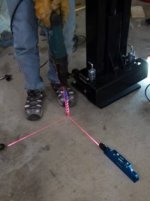
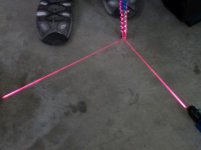
In the spirit of giving back, I'm posting the technique I used to drill the anchor bolt holes. The first set were done with a helper, but I was not happy with the results (not plumb, "wobbly" and not great alignment with the base plate holes). For the second set, I used a pair of laser levels at right angles as shown. Keeping the bit centered on the two beams kept the hole plumb and straight.

Those in the audience with calibrated eyeballs probably find this amusing, but it greatly improved the grip of the anchors (had to use a maul to drive them in and they tightened in less than one turn) and their alignment with the base plate. In all cases, I used a guide (plywood scrap with 7/8" hole) to start the hole.

Again, thanks to all the contributors who make this such a great forum. Hope someone finds this useful.


Steve
 

Attachments

  • drilling hole using laser levels1.JPG
    drilling hole using laser levels1.JPG
    34.6 KB · Views: 575
  • drilling hole using laser levels2.jpg
    drilling hole using laser levels2.jpg
    122.1 KB · Views: 526

dmeadow

Well-known member
Joined
Sep 3, 2005
Messages
952
Location
Houston, Texas
First post, so take it easy on me. ;)

Thanks to all the pioneers here who posted about their experiences, I bought a MaxJax early this year. It has been a fantastic tool, despite a few bumps (wrong wheels shipped and, recently,several leaks) which Garage Equipment Supply has resolved - thanks, Gabe.

In the spirit of giving back, I'm posting the technique I used to drill the anchor bolt holes. The first set were done with a helper, but I was not happy with the results (not plumb, "wobbly" and not great alignment with the base plate holes). For the second set, I used a pair of laser levels at right angles as shown. Keeping the bit centered on the two beams kept the hole plumb and straight.

Those in the audience with calibrated eyeballs probably find this amusing, but it greatly improved the grip of the anchors (had to use a maul to drive them in and they tightened in less than one turn) and their alignment with the base plate. In all cases, I used a guide (plywood scrap with 7/8" hole) to start the hole.

Again, thanks to all the contributors who make this such a great forum. Hope someone finds this useful.


Steve


Dang, I wish I had thought of that! I tried to use a framing square, but it didn't work that well.
 

petee_c

Well-known member
Joined
Oct 4, 2010
Messages
3,026
Location
KW area, Ontario CANADA
For the amount of money Bosch charges for their big drills, I wish they would have put a bubble indicator or 2 on the chassis of the drill....

Most of mine went in decently, but in reality they were all at slightly different angles. Good thing there's wiggle room built into the baseplate holes of the lift.

P
 

ttod

Member
Joined
Apr 27, 2011
Messages
8
Location
Los Altos Hills, CA
So on the Garage Equipment kit, I suggest you check the spec's on the inserts against the Simpson strong tie and the Wej-It. Epoxy really seems to be the better way to go and Simpson has published tested values for tension force that exceed those of the Wej-It expanding fasteners. You don't want to be guessing on whether its going to hold when you are under the car. Since these lifts were only tested with the Wej-It fasteners from an engineering viewpoint they (Danmar) deliver it the way it was tested. Don't switch without some assurance that it still works as good as or better than advertised. i.e. if you are going to change things you better have a pretty good idea of what you are doing. Free advice is worth what you paid for it.

the whole point of my post is that there's some simple math that tells you based on torque values if what you have is strong enough.

The Simpson epoxy applicator is pretty neat. There is a mixer that attaches to a two component tube that you can put in your caulking gun. Make sure to have enough on hand you don't want to run out in the middle of an insert.

Petee_c is right about having a bubble on the hammer drill. All my holes went in a little crooked. I suppose that's OK but if you try to straighten things out in the middle of drilling you will enlarge the hole, to the detriment of strength.
 

petee_c

Well-known member
Joined
Oct 4, 2010
Messages
3,026
Location
KW area, Ontario CANADA
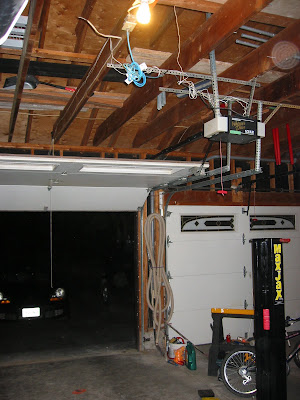
Last night, I spent a couple hours to move my normal trolley garage door opener from it's center mount, to the side of the door. According to the Chamberlain manual (Our house has the WhisperDrive opener), you can offset the opener by up to 4' from center. This should give me enough clearance for most vehicles to be at full height on the lift, some like my Boxster and Jetta should be able to be up on the lift even with my garage door up. Currently, I only have the standard lift tracks on a 7' tall door.

IMG_8491.JPG


IMG_8495.JPG

Pics are here:
http://peterchang1.blogspot.com/2011/08/blog-post_08.html
 

abstamaria

Well-known member
Joined
Jun 24, 2010
Messages
1,338
Location
Manila
Spacing between posts.

My MaxJax arrived finally, after literally a round-the-world trip, seeing as they are made in these parts.

My shipper delivered the packaged set on a truck with a rear elevator lift and several guys. We did unpack while on the truck, so delivery was painless.

I have only a few, but very different, old cars that I had wanted to get on the lift. My 1948 MG TC has very a narrow ladder frame, which would require I set the posts close together. On the other hand, my old Porsche GT3 has widely spaced lift points.

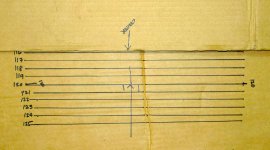
Following advice given on this thread and PMs, I marked the lift points of the cars on a large piece of cardboard, using a common mid-line for all the cars. I therefore drew only one side of each car (the right side). I stood one of the posts on another piece of cardboard and marked out the middle line for spacings of 115" to 125". This allowed me to move the cardboard with lift points drawn on it farther or closer to the post and to check whether the lift points were within the swing arc of the arms (27" minimum, 40" maximum).

A 115" spacing will just get the MG TC on the lift, it seems, but the Porsche will be a tight fit, with the arms fully at minimum. I think I will use 120", which seems to work well with the bigger cars (see photo), but means I may not be able to bring up the MG.

Anyway, the TC's ground clearance is so high, and the car itself so narrow, I can access most of its undercarriage even with all wheels on the ground.

The 120" setting will give an extra 5" clearance, which will be welcome.

Next, the dreaded drilling. I have contacted a specialist who suggests we use epoxy anchors, consistently with advice here.

Wish me luck.

Andy
 

Attachments

  • L1010612.jpg
    L1010612.jpg
    147.2 KB · Views: 2,656
  • L1010609.jpg
    L1010609.jpg
    146.4 KB · Views: 301
  • L1010605.jpg
    L1010605.jpg
    147.4 KB · Views: 215

RAYJAY

Well-known member
Joined
May 29, 2006
Messages
2,638
Location
UNION DALE PA
Re: Spacing between posts.

My MaxJax arrived finally, after literally a round-the-world trip, seeing as they are made in these parts.

My shipper delivered the packaged set on a truck with a rear elevator lift and several guys. We did unpack while on the truck, so delivery was painless.

I have only a few, but very different, old cars that I had wanted to get on the lift. My 1948 MG TC has very a narrow ladder frame, which would require I set the posts close together. On the other hand, my old Porsche GT3 has widely spaced lift points.

Following advice given on this thread and PMs, I marked the lift points of the cars on a large piece of cardboard, using a common mid-line for all the cars. I therefore drew only one side of each car (the right side). I stood one of the posts on another piece of cardboard and marked out the middle line for spacings of 115" to 125". This allowed me to move the cardboard with lift points drawn on it farther or closer to the post and to check whether the lift points were within the swing arc of the arms (27" minimum, 40" maximum).

A 115" spacing will just get the MG TC on the lift, it seems, but the Porsche will be a tight fit, with the arms fully at minimum. I think I will use 120", which seems to work well with the bigger cars (see photo), but means I may not be able to bring up the MG.

Anyway, the TC's ground clearance is so high, and the car itself so narrow, I can access most of its undercarriage even with all wheels on the ground.

The 120" setting will give an extra 5" clearance, which will be welcome.

Next, the dreaded drilling. I have contacted a specialist who suggests we use epoxy anchors, consistently with advice here.

Wish me luck.

Andy

Andy just drill a extra set of mounting holes for the MG
 

les_garten

Banned
Joined
Oct 8, 2010
Messages
660
Location
PSL, FL Next door to Megan FOX, and down the stre
Re: Spacing between posts.

My MaxJax arrived finally, after literally a round-the-world trip, seeing as they are made in these parts.

My shipper delivered the packaged set on a truck with a rear elevator lift and several guys. We did unpack while on the truck, so delivery was painless.

I have only a few, but very different, old cars that I had wanted to get on the lift. My 1948 MG TC has very a narrow ladder frame, which would require I set the posts close together. On the other hand, my old Porsche GT3 has widely spaced lift points.

Following advice given on this thread and PMs, I marked the lift points of the cars on a large piece of cardboard, using a common mid-line for all the cars. I therefore drew only one side of each car (the right side). I stood one of the posts on another piece of cardboard and marked out the middle line for spacings of 115" to 125". This allowed me to move the cardboard with lift points drawn on it farther or closer to the post and to check whether the lift points were within the swing arc of the arms (27" minimum, 40" maximum).

A 115" spacing will just get the MG TC on the lift, it seems, but the Porsche will be a tight fit, with the arms fully at minimum. I think I will use 120", which seems to work well with the bigger cars (see photo), but means I may not be able to bring up the MG.

Anyway, the TC's ground clearance is so high, and the car itself so narrow, I can access most of its undercarriage even with all wheels on the ground.

The 120" setting will give an extra 5" clearance, which will be welcome.

Next, the dreaded drilling. I have contacted a specialist who suggests we use epoxy anchors, consistently with advice here.

Wish me luck.

Andy

Hi,
Congratulations on getting your MaxJax!

I have a Porsche 930. What is the MIN and Max spacings your GT3 will work with. That's got to be close to what I would need for my 930.
 

abstamaria

Well-known member
Joined
Jun 24, 2010
Messages
1,338
Location
Manila
Spacing

Thank you, Ray Jay, I will think about that seriously.

Les, a contributor to this thread said 115" will work with the Porsche, but will be tight. I can confirm that with my measurements and so do not recommend this. That same contributor said up to 128" will work for a Porsche (I believe he has a 997). That is probably correct as the Porsche is actually a wide car. I think 120" to 125" should be safe and allow you to pick up smaller cars.

But of course do your measurements. I used a marker pen to mark the spot on the garage floor directly below each lift point. Then I moved the car, measured the distances between the jack point marks on the floor, and translated this onto a cardboard sheet. If you do this, yyou can check whether the jack points on the carboard are within the MaxJax arms' sweep. Is your lift with you already?

Andy
 

les_garten

Banned
Joined
Oct 8, 2010
Messages
660
Location
PSL, FL Next door to Megan FOX, and down the stre
Re: Spacing

Thank you, Ray Jay, I will think about that seriously.

Les, a contributor to this thread said 115" will work with the Porsche, but will be tight. I can confirm that with my measurements and so do not recommend this. That same contributor said up to 128" will work for a Porsche (I believe he has a 997). That is probably correct as the Porsche is actually a wide car. I think 120" to 125" should be safe and allow you to pick up smaller cars.

But of course do your measurements. I used a marker pen to mark the spot on the garage floor directly below each lift point. Then I moved the car, measured the distances between the jack point marks on the floor, and translated this onto a cardboard sheet. If you do this, yyou can check whether the jack points on the carboard are within the MaxJax arms' sweep. Is your lift with you already?

Andy

Thanx!

I had my 930 up on a friends older 2 post lift. The two problems I had were that it was a little low for the arms to go under. I had to Jack it up to get the arms under. I also had problems with the arms on min extension, swinging past the wheels. It was a long time ago and don't have any measurements.
 

abstamaria

Well-known member
Joined
Jun 24, 2010
Messages
1,338
Location
Manila
Hello, Les.

The MaxJax is supposed to have a 3.5" minimum pad height, lower than most 2-post lifts' (usually 4"+). The MaxJax might work for your 930. My MaxJax isn't installed yet, so I can't confirm.

The farther apart you space the posts the easier it should be for you to get the arms in, therefore avoiding the 2nd problem you had. If you will lift only the 930, then you have more flexibility with the spacing. Good luck.

Andres
 
To avoid these ads, REGISTER NOW!

les_garten

Banned
Joined
Oct 8, 2010
Messages
660
Location
PSL, FL Next door to Megan FOX, and down the stre
Hello, Les.

The MaxJax is supposed to have a 3.5" minimum pad height, lower than most 2-post lifts' (usually 4"+). The MaxJax might work for your 930. My MaxJax isn't installed yet, so I can't confirm.

The farther apart you space the posts the easier it should be for you to get the arms in, therefore avoiding the 2nd problem you had. If you will lift only the 930, then you have more flexibility with the spacing. Good luck.

Andres

Hi,
Thanx for all the info. The reason why I was asking about the Porsche 911 series was because mine is not here and won't be for a while. It's got a blown head gasket in North Florida and may be a while till I can get it. Meanwhile I have a MB 300TE and Toy LandCruiser I can use it on. My mom has a Crown Vic. I can check it with the MB and Toy, but it looks like I'll be safe around 125".
 

abstamaria

Well-known member
Joined
Jun 24, 2010
Messages
1,338
Location
Manila
I still have not installed the MaxJax. Equipment rental companies are non-existent here, so I cannot rent an SDS or other appropriate drill.

There is a company here that specializes in anchor bolt systems, using principally the Fischer brand. They recommended a threaded rod set in place with Fischer injection mortar FIS EM, which I understand is epoxy-based. A threaded rod system will be ok for a permanent installation, but will make moving or even positioning the post lifts very difficult. Also, Fischer products are metric; they recommended an M16 threaded rod and nut to fit in the lifts 3/4" hole. An M16 rod is smaller than 3/4" in diameter. Is this a problem?

The company also has Fischer drop-in anchors, but they are all mechanical. (They will not install the Wej-It anchors that come with the MaxJax.) They propose a Fischer anchor that will take an M20 machine bolt. Is that OK? I am getting an M20 bolt to see if it will fit in the 3/4" holes in the post's base.

If I go with the mechanical drop-in anchor, I thought I would ask them to apply epoxy(their injection mortar) to the anchors. Is that a good idea? Or a crazy one? The company says this is unnecessary, but they are willing to do it.

Ant advice will be appreciated.

Andy
 

les_garten

Banned
Joined
Oct 8, 2010
Messages
660
Location
PSL, FL Next door to Megan FOX, and down the stre
I still have not installed the MaxJax. Equipment rental companies are non-existent here, so I cannot rent an SDS or other appropriate drill.

There is a company here that specializes in anchor bolt systems, using principally the Fischer brand. They recommended a threaded rod set in place with Fischer injection mortar FIS EM, which I understand is epoxy-based. A threaded rod system will be ok for a permanent installation, but will make moving or even positioning the post lifts very difficult. Also, Fischer products are metric; they recommended an M16 threaded rod and nut to fit in the lifts 3/4" hole. An M16 rod is smaller than 3/4" in diameter. Is this a problem?

The company also has Fischer drop-in anchors, but they are all mechanical. (They will not install the Wej-It anchors that come with the MaxJax.) They propose a Fischer anchor that will take an M20 machine bolt. Is that OK? I am getting an M20 bolt to see if it will fit in the 3/4" holes in the post's base.

If I go with the mechanical drop-in anchor, I thought I would ask them to apply epoxy(their injection mortar) to the anchors. Is that a good idea? Or a crazy one? The company says this is unnecessary, but they are willing to do it.

Ant advice will be appreciated.

Andy

If it were me, I would consult MaxJax or a mechanical/structural engineer.

Maxjax is most likely to say, use our system or do something else at your own risk.

We are talking about your life here.
 

abstamaria

Well-known member
Joined
Jun 24, 2010
Messages
1,338
Location
Manila
Thanks, Les. I'll do that as soon as I receive the specs for the Fischer anchor.

I bought an M20 machine bolt yesterday to check for fit. It fits into the MaxJax 3/4" base plate mounting holes, but is huge in comparison to the bolt that comes with the Wej-It.

Andy
 

les_garten

Banned
Joined
Oct 8, 2010
Messages
660
Location
PSL, FL Next door to Megan FOX, and down the stre
Thanks, Les. I'll do that as soon as I receive the specs for the Fischer anchor.

I bought an M20 machine bolt yesterday to check for fit. It fits into the MaxJax 3/4" base plate mounting holes, but is huge in comparison to the bolt that comes with the Wej-It.

Andy

I'm sure there are other ways to mount it besides the wej-its. But it seems no matter how you cut it, you've got to get a hole drilled. So I'm not sure where the Fischers help you out. They need a hole drilled as well.

Unless what you are saying is that the guys who supply the Fischers will do it for you.
 

abstamaria

Well-known member
Joined
Jun 24, 2010
Messages
1,338
Location
Manila
Yes, that's what I mean, Les. There is a company here that does just anchor bolts and related stuff. They can drill the holes and install the anchors they supply. Fischers are a German product, I am told, apparently well-regarded.

Andy
 

les_garten

Banned
Joined
Oct 8, 2010
Messages
660
Location
PSL, FL Next door to Megan FOX, and down the stre
Yes, that's what I mean, Les. There is a company here that does just anchor bolts and related stuff. They can drill the holes and install the anchors they supply. Fischers are a German product, I am told, apparently well-regarded.

Andy

Maybe MaxJax will OK them?

You may be able to find an Engineer at a University who may be able to analyze the 2 systems without it costing you anything?

Personally, I would not want a stud sticking out of the floor. But it would depend on whether you want to take them down much.
 

les_garten

Banned
Joined
Oct 8, 2010
Messages
660
Location
PSL, FL Next door to Megan FOX, and down the stre
I think there is about zero chance of that scenario happening...

Just trying to help him out...

I've walked into Universities and got some free help on things many times. Depends on the School and the professor. They are teachers you know...

I can affirm that the chances are better than zero. I used to teach at the Masters and Doctoral level and I would not have turned anybody away.
 

Silverback51

Well-known member
Joined
Sep 20, 2010
Messages
71
Location
Covington, Wa.
We use Hilti epoxy anchor bolts all the time and they work fine. There is nothing wrong with them as long as you stay within their load limits.
 

abstamaria

Well-known member
Joined
Jun 24, 2010
Messages
1,338
Location
Manila
Load calculations

Thanks very much.

The factors going against the Wej-it are my not having an SDS drill, the unavailability of a 7/8" SDS bit in this metric town, and contractors' lack of familiarity with Wej-it drop-in anchors. I have a nice epoxy floor, so I get only one chance of drilling those holes, so prefer to get a professional with experience and the right equipment.

I was able to receive detailed calculations from suppliers of Fischer and Hilti, with the latter providing some very impressive printed analyses for the lift with the arms partially and fully extended. I have attached a picture below lifted from the Hilti report sent to me (free of charge).

The familiarity here is with chemical anchor bolts, and the general recommendation is that they would provide a more secure attachment method, with higher margins of safety. I might just go with Hilti chemical threaded rods, as I don't plan to move the lift around.

Andy
 

Attachments

  • hilti.jpg
    hilti.jpg
    9.4 KB · Views: 142

abstamaria

Well-known member
Joined
Jun 24, 2010
Messages
1,338
Location
Manila
Swapped Ports

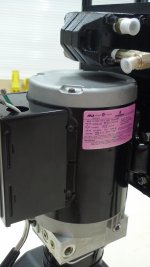
A kink in my assembly of the MaxJax occured when I was installing the hose that connects the flow divider to the power unit. The ports that the hose connects to are shown to be on the left side of the unit in both the instructions and the installation video. To my surprise, the port on the power unit is on the right side! See photo below.

Gabe of MaxJax responded quickly to confirm the port has been switched indeed, and that I should use the 2nd port from the rear on the left side of the power unit, as shown in this photo I send to him. Maxjax has provided good support so far, but did anyone else encounter this problem?

Best,

Andy
 

Attachments

  • maxjax right.jpg
    maxjax right.jpg
    142.7 KB · Views: 151
  • maxjax port.jpg
    maxjax port.jpg
    142 KB · Views: 165

petee_c

Well-known member
Joined
Oct 4, 2010
Messages
3,026
Location
KW area, Ontario CANADA
I'm in the process of installing my MaxJax and everything is now assembled except for the female quick disconnects that attach to the hoses. The hose threads did not come pre-wrapped with teflon tape and instructions are silent about this as well. Did you guys use teflon tape on these connections? I'm attaching a picture of the connections I'm talking about just in case. It's the ones covered with a blue cap.

Thank you in advance!
Alex.

Actually..... as someone with a maxjax that has been doing a lot of research on hoses, You don't necessarily need to teflon tape those ones.

The hose spec is NPTF which is compatible with NPT. You'd think that the F stands for 'Female', but infact it is for 'Fuel'.

Googling last night, you'd find the following references

http://www.cutting-tool-supply.com/TechTips/Tapping/NPTvsNPTF/NPTVsNPTF.htm - talks about tape, thread sealant.

http://www.ring-plug-thread-gages.com/ti-NPT-vs-NPTF.htm - lots of technical jargon

http://www.tractorbynet.com/forums/hydraulics/144053-npt-vs-nptf.html - real world examples of compatibility.


Princess auto in Canada does hydraulic hoses, crimping for cheap. The 3/8" hose is rated at 5000psi, at $1.89/ft, the crimps range from $4.99 to $12, depending if it's male, female, rigid or swivel, gold plated etc.

Anyways, I was able to combine the NPTF Male that came with the maxjax to a 3/8" NPT female, I put under 2 wraps of Teflon tape to it.

I was also able to get the NPTF Female quick connect to go on a NPT Male.

However, being stupid, I thought, hey, if 2 wraps of Teflon tape is good, 3 must be better. WRONG!. Screwed up the thread on my new 3/8" NPT Female that I had on my 2nd 18' extension. ARGHHH :mad:

Store is 30 minutes across town driving to go get a new fitting on it....

double whammy, the 18' length I cut isn't quite long enough for the installation I wanted....
 

abstamaria

Well-known member
Joined
Jun 24, 2010
Messages
1,338
Location
Manila
Anchors

In the end, I decided to use the Wej-it anchors that came with the lift. A contractor who specializes in installing anchors found the correct 7/8" SDS drill bit and came over with his crew to install the anchors.

As I said before, we are a metric town and use chemical threaded rods as a rule, not drop-in anchors. The contractor, a civil engineer, wanted to supervise his crew as they had never installed Wej-its.

We had three engineers and two workmen over, a bit of overkill, but the men were very experienced and drilled the 10 holes quickly and accurately. They had wire brushes for the holes and those syringe-like pumps to blow debris out. So, it was a good decision for me to farm this job out.

The Wej-its tightened up before they were flush with the floor surface, but seem to be holding strongly, so I hope this is OK.
 

Attachments

  • L1010698.jpg
    L1010698.jpg
    132.6 KB · Views: 308

daveyd

New member
Joined
Sep 24, 2011
Messages
1
I've worked with the civil service for almost 30 years as an automotive mechanic and have been around hundreds of two post vehicle lifts in my lifetime. I know enough about them that you will not catch me underneath a vehicle using this type of jacking apparatus. The government phased these systems out of our automotive shops a long time ago for safety reasons. You can epoxy the screws to the concrete and I'll be the first to tell you, it isn't a viable option. These units require constant attention, and daily safety inspections. Top it off, our concrete floors in the shops are much stronger than your average residential driveway or car port, and these type of lifts still randomly uprooted at the anchor points causing death or serious bodily harm. In this scenario, your chances of survival are slim to none, to get out quick enough if the anchors or concrete were to fail.

If you value your life, buy a four-post lift with a latching mechanism that locks as it goes up, as it is your safest bet.

Best regards,
David
 

Jvvmusme

Well-known member
Joined
Sep 25, 2011
Messages
566
Location
Bogota, Colombia
Yeah, i didn't have a TSC store near me so i got sodomized at the local hydraulic hose shop. I would have saved a bunch of cash had I ordered the hoses from Northern, and sourced the fittings online. All the stuff I bought is excellent quality and is made in USA (Ohio). For three Eaton Aeroquip hoses (13 ft, 12 ft, & 18 ft) with the ends crimped on, i paid $240- total. Then i got four FD-45 female disconnect fittings @ $29- each, and two FD-45 male ends @ $13- each. Total cost over $400-. But it sure is nice to have the hoses up off the floor. I was afraid of welding splatter burning through them, or them getting cut under my boots, and then having my jeep stuck up on the lift.

As noted in a prior post, i am leaving the unit on the cart rather than mounting on the wall. It is out of the way where it is. The bungee cord on the cart is real useful for holding the lowering valve lever open so I dont have to stay bending down when lowering the lift. I was thinking of relocating the power button from the front of the pump motor, to the front wall inside of the garage door so i can get a clearer view of the car going up.


I put a couple of disconnects right at the garage door, in case i wanted to leave the hoses connected to the lift, but run to the store, I could close the door this way. But i will usually just leave the hoses connected together and coiled up in the garage at night. I have yet to make a bracket to coil them up on when not in use.


I used a temporary bracket i made out of wood (scrap metal conduit through the top holes in the columns works to stabilize the piece of wood) to hold the hose up at the columns, until i figure out a more elegant solution. (But, since i am a procrastinator, i will probably never get around to doing that.) I made brackets to hold the hoses at the top of the garage doors and the top of wood blocks from scrap bed frame angle iron i welded together.


2010_1121_113750AAMedium.jpg


2010_1117_183459AAMedium.jpg


2010_1117_183452AAMedium.jpg


2010_1117_195014AAMedium.jpg


2010_1121_113717AAMedium.jpg


2010_1121_113727AAMedium.jpg


2010_1117_185818AAMedium.jpg


2010_1117_185746AAMedium.jpg


2010_1121_113738AAMedium.jpg


2010_1121_134624AAMedium.jpg
What I like most... Is the wood base on the lift to hold the hose. As soon as I install my mj you will have plenty to laugh about. Pictures will be posted...I will install my mj in Bogota, Colombia, South America.
 

demoderbydave

Well-known member
Joined
Nov 4, 2010
Messages
114
Location
Spencer Mass
I've worked with the civil service for almost 30 years as an automotive mechanic and have been around hundreds of two post vehicle lifts in my lifetime. I know enough about them that you will not catch me underneath a vehicle using this type of jacking apparatus. The government phased these systems out of our automotive shops a long time ago for safety reasons. You can epoxy the screws to the concrete and I'll be the first to tell you, it isn't a viable option. These units require constant attention, and daily safety inspections. Top it off, our concrete floors in the shops are much stronger than your average residential driveway or car port, and these type of lifts still randomly uprooted at the anchor points causing death or serious bodily harm. In this scenario, your chances of survival are slim to none, to get out quick enough if the anchors or concrete were to fail.

If you value your life, buy a four-post lift with a latching mechanism that locks as it goes up, as it is your safest bet.

Best regards,
David

So, in your opinion you are saying that all 2 post lifts and this particular model are unsafe? Also that the anchoring system that comes with it is deadly as well? Dannmar better get a GIANT team of lawyers on retainer PDQ!!:headscrat

I do agree that if ANY product is installed, maintained (or lack of same) and used incorrectly that the potential exsists for something BAD TO HAPPEN. But to say that all or every type of any product is unsafe (at any speed...remember Ralph Nader) is incorrect without some evidence to back it up. And I don't mean one or two either...
 
Last edited:

abstamaria

Well-known member
Joined
Jun 24, 2010
Messages
1,338
Location
Manila
Maxjax Installed.

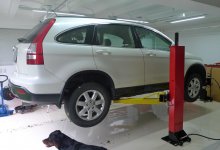
Today, I checked the anchors to see if any had pulled up. They seem all right, so I shimmed one of the posts, which was leaning forward and to one side just a bit, and torqued the anchor bolts to 75 lbs-ft.

One arm is less than half a inch lower than the other, now which I think is within the allowed margin.

I tried the lift with our Honda CRV. All seems well. the lift sure goes down faster with a load.
 

Attachments

  • L1010704.jpg
    L1010704.jpg
    131.6 KB · Views: 284

les_garten

Banned
Joined
Oct 8, 2010
Messages
660
Location
PSL, FL Next door to Megan FOX, and down the stre
Re: Maxjax Installed.

Today, I checked the anchors to see if any had pulled up. They seem all right, so I shimmed one of the posts, which was leaning forward and to one side just a bit, and torqued the anchor bolts to 75 lbs-ft.

One arm is less than half a inch lower than the other, now which I think is within the allowed margin.

I tried the lift with our Honda CRV. All seems well. the lift sure goes down faster with a load.

Any tips on how to drill the extra "stop" holes and get them straight and even?
 

regguy1

Well-known member
Joined
Dec 15, 2009
Messages
4,053
Location
On Mount Olympus with Zeus
Re: Maxjax Installed.

Today, I checked the anchors to see if any had pulled up. They seem all right, so I shimmed one of the posts, which was leaning forward and to one side just a bit, and torqued the anchor bolts to 75 lbs-ft.

One arm is less than half a inch lower than the other, now which I think is within the allowed margin.

I tried the lift with our Honda CRV. All seems well. the lift sure goes down faster with a load.

Looks great......:thumbup:
 
To avoid these ads, REGISTER NOW!
Top Bottom