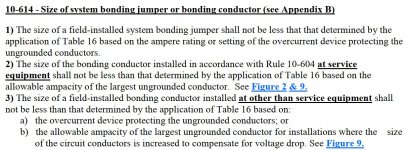
I'm not an electrician and I know enough to be dangerous to myself --nevermind someone else over the internet...
The NEC (national elec. code) is part 70 of NFPA (nat, fire protect act). You can go to nfpa website and sign up for free (but they spam --paper mail and email the **** out of you. So NEC is national electric code. Type into Google "what version of the NEC has my state adopted" and you'll get state maps.
So there's national code, then states adopt them at their own pace/timelines. My state recently adopted 2017, some states are still on 2014 and some are already adopting 2019. Then your local AHJ (authority having jurisdiction) might have rules (or exceptions) on top of the version of the national electric code they have adopted.
IRC I believe is International Residential Code. That's a guess --IBC is building code.
On top of that, you have to follow manufacturer's guidelines.
Basically what that means is you can't clip off the plug on your wife's curling iron, splice on a 30A electric dryer plug and shove it into your dryer receptacle... I mean technically you can... You have to follow it from the size of the breaker, followed by correct size wires, then correct receptacle. So using the dryer as an example: My compressor motor came with a 20A 240V cord-and-plug from the manufacturer. A 240v plug doesn't fit into a 240v 30A receptacle. A 6-20p doesn't fit into 10-30r so you can't do it.
Feels like there's a couple different things going on here.
What receptacles did the electrician install?
These other guys commenting in this lighting & electrical section are wayyyy more knowledgeable than I am with this stuff. I know about required circuits in kitchens & bathrooms or how to add up wattage on lighting circuits or bring neutrals everywhere so you can do smart switches in the future.
Others have commented about this too. The "proper 30A cord" thing is a red flag. Some bigger stuff comes without a cord. You either have to hard-wire it or follow code plus manufacturer's instructions and figure it out. But if it's a 120V motor that came with a cord and plug, you can't just slap a dryer cord on it and plug it in. First, you need to re-wire the motor from 120 to 240 (or else you will see sparks) and second you have to follow code. What I think you are describing is no different from clipping the plug off your wife's curling iron or hair dryer then splicing on a 30A clothes dryer cord/plug and trying to have a go at it...
Trust me: You don't want to plug a 120V appliance into a 240V circuit. I've seen people traveling from USA use "converters" but not "transformers". When you plug a 120V hair dryer into a 240V circuit you'll see sparks. (ask me how I know

Again, these other guys know WAY WAY WAY more than me. With motors the only thing that matters is the motor plate. It's just like your wife's hair dryer: If it came with a certain cord and plug... you gotta keep that cord and plug. If the plug you have doesn't fit then you are SOL. Other stuff (like my table saw motor) has a configuration to run on either 115V or 230V. It can be wired either way so then all you need to do is rewire the motor and follow code with regards to the cord and plug required. From there... As long as the plug and receptacle match, you should be good.
Well, for the 3rd one, what breaker, wire and receptacles are on the circuit?
Assuming you have a 2-pole 30A circuit with 10ga wire. Just Google and see if you can put 10ga wire on nema 6-20 receptacles. (I don't know) Or, maybe you can change the circuit over to 120V @ 20A (have to Google and see if 120v 20A receptacles will take 10ga wire). Or go to a big-box and look at the back of a receptacle. It should say right on the device. (or the box)
They make 15A and 20A 240V plugs/receptacles. Google "NEMA 6-15P" and NEMA 6-20P. P is plug, R is receptacle.
Open your microwave and look for the sticker inside the door. Watts divided by volts = amps. 1200 watts / 120V = 10 amps. a 120 Watt light bulb running on 120V draws 1 amp. A 1000 watt microwave running on 240 volts (making these numbers up) will draw 4.1 amps. Look at the motor plates on your motors. My radial arm saw motor says 17 amps @ 120v and 8.5 amps at 208-240v. So for example, my table saw motor draws 10.2 amps on 120V and my radial arm saw motor draws 17 amps on 120V. I can't pull 27A through a 20A circuit. I also can't plug those motors into a 120V 30A circuit because the manufacturer states the types of plugs and cords to be used with the motors.
So... My only other choice would be to switch them over to 240V because it chops the amps in half. Now I have my radial saw drawing 8.5 amps and my table saw draws 5.1 amps. So I could run my TS and radial saw on a 240v 15A circuit... But I can't just change out the cords and plugs on the motors and plug everything into a 30A receptacle/circuit...
That's a whole different issue. Over the last four years I've rewired four houses as DIY homeowner. (with permits) I flipped two houses, did our home and we bought a ski house. I am not an electrician. You can't go wrong with:
inside stuff = inside circuits
outside stuff = outside circuits
15a, 14ga for lights and 20a, 12ga for recepts
don't mix lighting with receptacles and don't ever mix motors and lights.
As I understand it, circuit breakers are very fast bi-metallic mouse traps. They are spring loaded switches that open when they get hot. They open 85% sustained or 125% on spikes. (I could be wrong, that's how I understand it) What does the motor plate on the lathe say? The motor plate on my compressor says 16 amps @ 240V --but it came with a 20 amp 240V cord and plug so that's what I use and I haven't ever had any problems. If your lathe is at 17 amps at 120v it should be same as my radial saw --it will draw 8.5A at 240V. Which means you'll be totally fine on a 240V 20A circuit. Also means you should be fine on a 20A 120V circuit but if the motor didn't come with a 30A cord or plug then you really can't attach it to a 30A circuit (120 or 240).
How do you lathe in the dark? When I added up the wattage in my houses with all LED lights I could do the whole house on one 15A 14ga circuit. I ended up having to break out lighting circuits just so that if a breaker ever tripped the whole house wouldn't go dark. You are kind of the opposite. You have so much on one circuit that it's dimming or tripping.
Good luck with your future electrical journey.
Yes and no. It depends. I have a lot of war-era old iron stuff. I feel like some runs better on 240 but a lot is no different 120/240. Really depends on what it is and what else is going on. Stuff I thought ran like **** on 120 but better on 240 had bad bearings in the motor. It didn't run like **** on 120, it just tripped breakers because it needed bearings.
Is that motor able to be wired/run on 240?
Sorry that got long.


 How does safety choose national boundaries?