To avoid these ads, REGISTER NOW!

Multiple 240v outlets on one circuit?

Aaron_W

Well-known member
Joined
Feb 6, 2018
Messages
2,892
Location
Northern California
Taking this tangent out of another thread where it came up.

I just had some 30A 240v outlets installed, one outlet per circuit. As always happens as soon as they were installed I immediately went out and added another machine that uses 240v.

Not a big deal I only use one at a time, so can unplug one and plug in the other, but in another thread it was mentioned that multiple outlets can be run on 240v as is commonly done with 120v circuits. It would be nice to simply move from one to the other without having to play with plugs.


Can it really be as as simple as just adding a second outlet to one of the existing circuits? The two machines would only be run one at a time, and even combined they account for less than 15A (1.5hp motor 8.5A and 3/4hp motor 4.5A if I recall correctly).

30A circuits were used simply to cover potential future needs.
 
Last edited:
To avoid these ads, REGISTER NOW!

jkeyser14

Well-known member
Joined
Dec 19, 2008
Messages
1,816
Location
(rural) Maryland
It's been a while since I looked this up, but I thought you are only allowed one device per 240v branch circuit. A quick google search shows many people believe otherwise.

Hopefully someone else can chime in with the actual section of code.
 
Last edited:
OP
A

Aaron_W

Well-known member
Joined
Feb 6, 2018
Messages
2,892
Location
Northern California
It's been a while since I looked this up, but I thought you are only allowed one device per 240v branch circuit. A quick google search shows many people believe otherwise.

Hopefully someone else can chime in with the actual section of code.

That was my belief as well, I ran across a mention of multiple 240v outlets on one circuit on another thread, which is what prompted my question.
 

anythingyoucanimagine

Well-known member
Joined
Feb 6, 2019
Messages
423
Location
New England
My rule of thumb is that a receptacle is one and a duplex is two. If they make a duplex then have at it. I'm not an electrician so if they only make single receptacles for it then I run dedicated circuits. Don't forget that 210.21 says stuff has to match.

That was my belief as well, I ran across a mention of multiple 240v outlets on one circuit on another thread, which is what prompted my question.

I have 20A circuits with 12ga wire and several 6-20R per circuit. 20A is no problem but I have no clue about 30A circuits. 210.21 says stuff has to match your breaker. 30A breaker needs 30A wire which needs 30A receptacles (outlets). Something seems fishy about your 30A circuits for "future protection" because if you have 30A breakers you should have 10ga wire and 30A receptacles. That also means you have 30A plugs and I own 4hp motors that came with 6-20P cord-and-plug. My gut says because it's 30A, no, you probably can't... but I'm not an electrician.
 
Last edited:

wyliesdiesels

Well-known member
Joined
Aug 14, 2012
Messages
19,983
Location
Modesto, CA
It's been a while since I looked this up, but I thought you are only allowed one device per 240v branch circuit. A quick google search shows many people believe otherwise.

Hopefully someone else can chime in with the actual section of code.

You wont find a code in the NEC prohibiting it because its not prohibited.
 

sberry

Banned
Joined
Jun 18, 2005
Messages
35,747
Location
Brethren, Michigan
You just need to make sure the stuff is allowed on 30. If it comes factory cord and plug then the plug is the limit. If it's field wired then the installer is required to tailor the circuit. Doesn't mean the cord has to be 10 but at least 14 on a 30.
Lots of this stuff is designed for 20A. This is 1 reason it's so much simpler to use it 120v on general circuits.
 
Last edited:

My Old Tools

Well-known member
Joined
Jun 4, 2014
Messages
5,427
Location
Hamrick Lake, TX
I have my shop wired with multiple 240v convenience outlets per breaker. I never run multiple machines at once, so no issues. Likewise for 3 phase. It's not an industrial environment.
 

sberry

Banned
Joined
Jun 18, 2005
Messages
35,747
Location
Brethren, Michigan
Sure. My helper can live from a 16 cord. Its second nature for him to manage load and do 1 thing at a time. My neighbor has a common garage, has air on its own, a welder outlet and 2 generals that run the whole rest of the place. He has quite a bit of stuff but uses it all 1 at a time. Most of it is so small that it could stand some simultenous operation if it did happen.
 

anythingyoucanimagine

Well-known member
Joined
Feb 6, 2019
Messages
423
Location
New England
Sure. My neighbor has a common garage, has air on its own, a welder outlet and 2 generals that run the whole rest of the place. He has quite a bit of stuff but uses it all 1 at a time. Most of it is so small that it could stand some simultenous operation if it did happen.

I'm not your neighbor but that's basically me. Technically i think my air is a branch because it goes to a 2gang with two duplex 6-20r. Then welder outlets, 2x 120v and one 2-pole branch.

We have a pretty big 3D printer and a big vacuum heat press that we run on the compressor circuit. If compressor kicks on while either of those two are on it trips. Other than that it's fine. I guess if she starts using the TS or radial saw I'll have to put in a circuit for dust collector.
 
OP
A

Aaron_W

Well-known member
Joined
Feb 6, 2018
Messages
2,892
Location
Northern California
The NEC does not prohibit it, the IRC does.

NEC is the one that applies in California correct? Not sure what IRC is, tried to Gts but nothing electrical in nature came up.

My rule of thumb is that a receptacle is one and a duplex is two. If they make a duplex then have at it. I'm not an electrician so if they only make single receptacles for it then I run dedicated circuits. Don't forget that 210.21 says stuff has to match.


I have 20A circuits with 12ga wire and several 6-20R per circuit. 20A is no problem but I have no clue about 30A circuits. 210.21 says stuff has to match your breaker. 30A breaker needs 30A wire which needs 30A receptacles (outlets). Something seems fishy about your 30A circuits for "future protection" because if you have 30A breakers you should have 10ga wire and 30A receptacles. That also means you have 30A plugs and I own 4hp motors that came with 6-20P cord-and-plug. My gut says because it's 30A, no, you probably can't... but I'm not an electrician.

These are professionally installed circuits, not DIY so 30A from the panel to the outlets.

Both of the machines are currently set up as 120v but will get a proper 30A cord (10g) and plug when wired for 240v. The only thing not 30A involved are the actual motors / draw.

My future comment was just going bigger than absolutely necessary. I had 3 circuits installed, 2 needed to be 30A (welder and a VFD controlled vertical mill), I had them do the 3rd one 30A as well to leave my future options open, rearranging the shop, new machines etc.

Had I known they make 240v 20A duplex outlets I might have gone that route instead. I thought 240v were always dedicated outlets, so it was a question I didn't even ask about until seeing the comments that led to my post.


You just need to make sure the stuff is allowed on 30. If it comes factory cord and plug then the plug is the limit. If it's field wired then the installer is required to tailor the circuit. Doesn't mean the cord has to be 10 but at least 14 on a 30.
Lots of this stuff is designed for 20A. This is 1 reason it's so much simpler to use it 120v on general circuits.

I've been told that 120v / 240v motors are happier on 240v. The lathe with its 17A on 120v really should be 240v if for no other reason than so it isn't pulling almost full capacity on the 120v circuit making the other outlets on the circuit useless when it is used. It is a nuisance having to shut off lights and the stereo to run it.

The mill was hardwired in its prior shop and I haven't decided for sure which way I'm going with it, at less than 5A I'm not so worried about running it on one of the 120v circuits since it isn't an amp hog.
 

sberry

Banned
Joined
Jun 18, 2005
Messages
35,747
Location
Brethren, Michigan
Yes, 17A on 120 is prone to tripping at start. As for happier, it's so minor. It would be better on long circuits. Where the bigger cord helps is on 120v.
 
Last edited:

alfredeneuman

Well-known member
Joined
Mar 3, 2011
Messages
4,580
Location
Fullerton, CA
NEC is the one that applies in California correct? Not sure what IRC is

The California Electrical Code is the 2014 NEC with the addition of the California
Title 24 Energy Regulations.

The International Residential Code is used a few places in the US, but not California
 
OP
A

Aaron_W

Well-known member
Joined
Feb 6, 2018
Messages
2,892
Location
Northern California
The California Electrical Code is the 2014 NEC with the addition of the California
Title 24 Energy Regulations.

The International Residential Code is used a few places in the US, but not California


I have been able to find the CA code online, and only saw reference to NEC and state additions, thank you for confirming.

I'll also note I specifically referred to it as 120/240 not the common 110/220 because of your "nagging" in posts, so mission accomplished. :beer:
 

anythingyoucanimagine

Well-known member
Joined
Feb 6, 2019
Messages
423
Location
New England
I'm not an electrician and I know enough to be dangerous to myself --nevermind someone else over the internet...

The NEC (national elec. code) is part 70 of NFPA (nat, fire protect act). You can go to nfpa website and sign up for free (but they spam --paper mail and email the **** out of you. So NEC is national electric code. Type into Google "what version of the NEC has my state adopted" and you'll get state maps.

So there's national code, then states adopt them at their own pace/timelines. My state recently adopted 2017, some states are still on 2014 and some are already adopting 2019. Then your local AHJ (authority having jurisdiction) might have rules (or exceptions) on top of the version of the national electric code they have adopted.

IRC I believe is International Residential Code. That's a guess --IBC is building code.

On top of that, you have to follow manufacturer's guidelines.

Basically what that means is you can't clip off the plug on your wife's curling iron, splice on a 30A electric dryer plug and shove it into your dryer receptacle... I mean technically you can... You have to follow it from the size of the breaker, followed by correct size wires, then correct receptacle. So using the dryer as an example: My compressor motor came with a 20A 240V cord-and-plug from the manufacturer. A 240v plug doesn't fit into a 240v 30A receptacle. A 6-20p doesn't fit into 10-30r so you can't do it.

Feels like there's a couple different things going on here.

These are professionally installed circuits, not DIY so 30A from the panel to the outlets.

What receptacles did the electrician install?

Both of the machines are currently set up as 120v but will get a proper 30A cord (10g) and plug when wired for 240v. The only thing not 30A involved are the actual motors / draw.

These other guys commenting in this lighting & electrical section are wayyyy more knowledgeable than I am with this stuff. I know about required circuits in kitchens & bathrooms or how to add up wattage on lighting circuits or bring neutrals everywhere so you can do smart switches in the future.

Others have commented about this too. The "proper 30A cord" thing is a red flag. Some bigger stuff comes without a cord. You either have to hard-wire it or follow code plus manufacturer's instructions and figure it out. But if it's a 120V motor that came with a cord and plug, you can't just slap a dryer cord on it and plug it in. First, you need to re-wire the motor from 120 to 240 (or else you will see sparks) and second you have to follow code. What I think you are describing is no different from clipping the plug off your wife's curling iron or hair dryer then splicing on a 30A clothes dryer cord/plug and trying to have a go at it...

Trust me: You don't want to plug a 120V appliance into a 240V circuit. I've seen people traveling from USA use "converters" but not "transformers". When you plug a 120V hair dryer into a 240V circuit you'll see sparks. (ask me how I know :)

Again, these other guys know WAY WAY WAY more than me. With motors the only thing that matters is the motor plate. It's just like your wife's hair dryer: If it came with a certain cord and plug... you gotta keep that cord and plug. If the plug you have doesn't fit then you are SOL. Other stuff (like my table saw motor) has a configuration to run on either 115V or 230V. It can be wired either way so then all you need to do is rewire the motor and follow code with regards to the cord and plug required. From there... As long as the plug and receptacle match, you should be good.


My future comment was just going bigger than absolutely necessary. I had 3 circuits installed, 2 needed to be 30A (welder and a VFD controlled vertical mill), I had them do the 3rd one 30A as well to leave my future options open, rearranging the shop, new machines etc.

Well, for the 3rd one, what breaker, wire and receptacles are on the circuit?

Had I known they make 240v 20A duplex outlets I might have gone that route instead. I thought 240v were always dedicated outlets, so it was a question I didn't even ask about until seeing the comments that led to my post.

Assuming you have a 2-pole 30A circuit with 10ga wire. Just Google and see if you can put 10ga wire on nema 6-20 receptacles. (I don't know) Or, maybe you can change the circuit over to 120V @ 20A (have to Google and see if 120v 20A receptacles will take 10ga wire). Or go to a big-box and look at the back of a receptacle. It should say right on the device. (or the box)

They make 15A and 20A 240V plugs/receptacles. Google "NEMA 6-15P" and NEMA 6-20P. P is plug, R is receptacle.

Open your microwave and look for the sticker inside the door. Watts divided by volts = amps. 1200 watts / 120V = 10 amps. a 120 Watt light bulb running on 120V draws 1 amp. A 1000 watt microwave running on 240 volts (making these numbers up) will draw 4.1 amps. Look at the motor plates on your motors. My radial arm saw motor says 17 amps @ 120v and 8.5 amps at 208-240v. So for example, my table saw motor draws 10.2 amps on 120V and my radial arm saw motor draws 17 amps on 120V. I can't pull 27A through a 20A circuit. I also can't plug those motors into a 120V 30A circuit because the manufacturer states the types of plugs and cords to be used with the motors.

So... My only other choice would be to switch them over to 240V because it chops the amps in half. Now I have my radial saw drawing 8.5 amps and my table saw draws 5.1 amps. So I could run my TS and radial saw on a 240v 15A circuit... But I can't just change out the cords and plugs on the motors and plug everything into a 30A receptacle/circuit...

I've been told that 120v / 240v motors are happier on 240v. The lathe with its 17A on 120v really should be 240v if for no other reason than so it isn't pulling almost full capacity on the 120v circuit making the other outlets on the circuit useless when it is used. It is a nuisance having to shut off lights and the stereo to run it.

That's a whole different issue. Over the last four years I've rewired four houses as DIY homeowner. (with permits) I flipped two houses, did our home and we bought a ski house. I am not an electrician. You can't go wrong with:

inside stuff = inside circuits
outside stuff = outside circuits
15a, 14ga for lights and 20a, 12ga for recepts
don't mix lighting with receptacles and don't ever mix motors and lights.

As I understand it, circuit breakers are very fast bi-metallic mouse traps. They are spring loaded switches that open when they get hot. They open 85% sustained or 125% on spikes. (I could be wrong, that's how I understand it) What does the motor plate on the lathe say? The motor plate on my compressor says 16 amps @ 240V --but it came with a 20 amp 240V cord and plug so that's what I use and I haven't ever had any problems. If your lathe is at 17 amps at 120v it should be same as my radial saw --it will draw 8.5A at 240V. Which means you'll be totally fine on a 240V 20A circuit. Also means you should be fine on a 20A 120V circuit but if the motor didn't come with a 30A cord or plug then you really can't attach it to a 30A circuit (120 or 240).

How do you lathe in the dark? When I added up the wattage in my houses with all LED lights I could do the whole house on one 15A 14ga circuit. I ended up having to break out lighting circuits just so that if a breaker ever tripped the whole house wouldn't go dark. You are kind of the opposite. You have so much on one circuit that it's dimming or tripping.

Good luck with your future electrical journey.

I've been told that 120v / 240v motors are happier on 240v.

Yes and no. It depends. I have a lot of war-era old iron stuff. I feel like some runs better on 240 but a lot is no different 120/240. Really depends on what it is and what else is going on. Stuff I thought ran like **** on 120 but better on 240 had bad bearings in the motor. It didn't run like **** on 120, it just tripped breakers because it needed bearings.


The mill was hardwired in its prior shop and I haven't decided for sure which way I'm going with it, at less than 5A I'm not so worried about running it on one of the 120v circuits since it isn't an amp hog.

Is that motor able to be wired/run on 240?

Sorry that got long.
 

pattenp

Well-known member
Joined
Jun 4, 2008
Messages
10,175
Location
Virginia - USA
The California Electrical Code is the 2014 NEC with the addition of the California
Title 24 Energy Regulations.

The International Residential Code is used a few places in the US, but not California

The IRC adoption map shows California. It's used far more than a few places.
 
Last edited:

alfredeneuman

Well-known member
Joined
Mar 3, 2011
Messages
4,580
Location
Fullerton, CA
The IRC adoption map shows California. It's used far more than a few places.

OK, but he asked specifically what Electrical Code he had to follow, and it is the NEC (Statewide).
The Energy Code (IRC based) doesn't have anything to do with it in this case.
 

sberry

Banned
Joined
Jun 18, 2005
Messages
35,747
Location
Brethren, Michigan
Anything g is starting g to think this thru. Good job. I will agree lots of guys here know some stuff, most way over my head. It's why I stay away from some of it cause I don't know squat about electricity and switching drives me crazy. I am a simple installer.
Size the wire to the load,to the breaker etc. So,,,,
You would be correct that you can't simply replace the plug for 30. Depending on design some equipment could be connected to 30A depending on design at 120v. The hairdryer probably not, some saws and maybe air comp either it's own thermal, or wire/internal design makes it allowable, probably small wire feeds too, they got 14 and thermal.
 
To avoid these ads, REGISTER NOW!
OP
A

Aaron_W

Well-known member
Joined
Feb 6, 2018
Messages
2,892
Location
Northern California
I'm not an electrician and I know enough to be dangerous to myself --nevermind someone else over the internet...

The NEC (national elec. code) is part 70 of NFPA (nat, fire protect act). You can go to nfpa website and sign up for free (but they spam --paper mail and email the **** out of you. So NEC is national electric code. Type into Google "what version of the NEC has my state adopted" and you'll get state maps.

So there's national code, then states adopt them at their own pace/timelines. My state recently adopted 2017, some states are still on 2014 and some are already adopting 2019. Then your local AHJ (authority having jurisdiction) might have rules (or exceptions) on top of the version of the national electric code they have adopted.

IRC I believe is International Residential Code. That's a guess --IBC is building code.

On top of that, you have to follow manufacturer's guidelines.

Basically what that means is you can't clip off the plug on your wife's curling iron, splice on a 30A electric dryer plug and shove it into your dryer receptacle... I mean technically you can... You have to follow it from the size of the breaker, followed by correct size wires, then correct receptacle. So using the dryer as an example: My compressor motor came with a 20A 240V cord-and-plug from the manufacturer. A 240v plug doesn't fit into a 240v 30A receptacle. A 6-20p doesn't fit into 10-30r so you can't do it.

Feels like there's a couple different things going on here.


What receptacles did the electrician install?


These other guys commenting in this lighting & electrical section are wayyyy more knowledgeable than I am with this stuff. I know about required circuits in kitchens & bathrooms or how to add up wattage on lighting circuits or bring neutrals everywhere so you can do smart switches in the future.

Others have commented about this too. The "proper 30A cord" thing is a red flag. Some bigger stuff comes without a cord. You either have to hard-wire it or follow code plus manufacturer's instructions and figure it out. But if it's a 120V motor that came with a cord and plug, you can't just slap a dryer cord on it and plug it in. First, you need to re-wire the motor from 120 to 240 (or else you will see sparks) and second you have to follow code. What I think you are describing is no different from clipping the plug off your wife's curling iron or hair dryer then splicing on a 30A clothes dryer cord/plug and trying to have a go at it...

Trust me: You don't want to plug a 120V appliance into a 240V circuit. I've seen people traveling from USA use "converters" but not "transformers". When you plug a 120V hair dryer into a 240V circuit you'll see sparks. (ask me how I know :)

Again, these other guys know WAY WAY WAY more than me. With motors the only thing that matters is the motor plate. It's just like your wife's hair dryer: If it came with a certain cord and plug... you gotta keep that cord and plug. If the plug you have doesn't fit then you are SOL. Other stuff (like my table saw motor) has a configuration to run on either 115V or 230V. It can be wired either way so then all you need to do is rewire the motor and follow code with regards to the cord and plug required. From there... As long as the plug and receptacle match, you should be good.


Well, for the 3rd one, what breaker, wire and receptacles are on the circuit?


Assuming you have a 2-pole 30A circuit with 10ga wire. Just Google and see if you can put 10ga wire on nema 6-20 receptacles. (I don't know) Or, maybe you can change the circuit over to 120V @ 20A (have to Google and see if 120v 20A receptacles will take 10ga wire). Or go to a big-box and look at the back of a receptacle. It should say right on the device. (or the box)

They make 15A and 20A 240V plugs/receptacles. Google "NEMA 6-15P" and NEMA 6-20P. P is plug, R is receptacle.

Open your microwave and look for the sticker inside the door. Watts divided by volts = amps. 1200 watts / 120V = 10 amps. a 120 Watt light bulb running on 120V draws 1 amp. A 1000 watt microwave running on 240 volts (making these numbers up) will draw 4.1 amps. Look at the motor plates on your motors. My radial arm saw motor says 17 amps @ 120v and 8.5 amps at 208-240v. So for example, my table saw motor draws 10.2 amps on 120V and my radial arm saw motor draws 17 amps on 120V. I can't pull 27A through a 20A circuit. I also can't plug those motors into a 120V 30A circuit because the manufacturer states the types of plugs and cords to be used with the motors.

So... My only other choice would be to switch them over to 240V because it chops the amps in half. Now I have my radial saw drawing 8.5 amps and my table saw draws 5.1 amps. So I could run my TS and radial saw on a 240v 15A circuit... But I can't just change out the cords and plugs on the motors and plug everything into a 30A receptacle/circuit...


That's a whole different issue. Over the last four years I've rewired four houses as DIY homeowner. (with permits) I flipped two houses, did our home and we bought a ski house. I am not an electrician. You can't go wrong with:

inside stuff = inside circuits
outside stuff = outside circuits
15a, 14ga for lights and 20a, 12ga for recepts
don't mix lighting with receptacles and don't ever mix motors and lights.

As I understand it, circuit breakers are very fast bi-metallic mouse traps. They are spring loaded switches that open when they get hot. They open 85% sustained or 125% on spikes. (I could be wrong, that's how I understand it) What does the motor plate on the lathe say? The motor plate on my compressor says 16 amps @ 240V --but it came with a 20 amp 240V cord and plug so that's what I use and I haven't ever had any problems. If your lathe is at 17 amps at 120v it should be same as my radial saw --it will draw 8.5A at 240V. Which means you'll be totally fine on a 240V 20A circuit. Also means you should be fine on a 20A 120V circuit but if the motor didn't come with a 30A cord or plug then you really can't attach it to a 30A circuit (120 or 240).

How do you lathe in the dark? When I added up the wattage in my houses with all LED lights I could do the whole house on one 15A 14ga circuit. I ended up having to break out lighting circuits just so that if a breaker ever tripped the whole house wouldn't go dark. You are kind of the opposite. You have so much on one circuit that it's dimming or tripping.

Good luck with your future electrical journey.


Yes and no. It depends. I have a lot of war-era old iron stuff. I feel like some runs better on 240 but a lot is no different 120/240. Really depends on what it is and what else is going on. Stuff I thought ran like **** on 120 but better on 240 had bad bearings in the motor. It didn't run like **** on 120, it just tripped breakers because it needed bearings.


Is that motor able to be wired/run on 240?

Sorry that got long.


Both motors are 120/240 capable depending on how they are wired, I'm not just clipping the plug off a 120v appliance for "more power grunt grunt grunt". :) The lathe really should be run on 240v, and no I don't run it in the dark, the overhead lights are on their own circuit, but I do have additional lighting and accessories on the 120v 20A with the outlets that the lathe plugs into until I rewire it for the new 240v outlet. The 240v outlets are L14-30R twist locks.

I've done a fair bit of DIY electrical work, but like you know just enough to make myself look like Don King. When it comes to electrical if I am not 100% sure I'm doing it right, I don't do it and 240v raises many more questions.
 

sberry

Banned
Joined
Jun 18, 2005
Messages
35,747
Location
Brethren, Michigan
It's why they made 30 fuses besides for 1 arm bandits. Could hard wire some tools at 30/low voltage110-120. It's more a theoretical concept than practical and why the 30 you often find were put there in overloaded panels of old. Joe comes along and adds a portable comp to an in use general or normal fuse aND ****.
 

sberry

Banned
Joined
Jun 18, 2005
Messages
35,747
Location
Brethren, Michigan
This is applied when multiple motors used on same circuit,,, usually not in residential but oft wood shops etc got lots machines might take so many circuits to keep them plugged to dedicated. Each piece may need special design, plug, cord, internal ocpd, thermal etc. Guys here do this all the time would be familiar.
 

sberry

Banned
Joined
Jun 18, 2005
Messages
35,747
Location
Brethren, Michigan
So what it means to the op is while it may run on 15 on a dedicated there could be a max circuit it could be connected to which a guy might want if he is running multiple motors from it.
Think about this concept. Wire a 30 breaker to a 120v duplex. Use 10 wire. Wire safe from thermal overload but not safe to plug most 120v equipment in to but could use power strip with 14 wire 15 breaker to plug radio in, could use 2 strips, each provide ocp, combined load won't overheat wire. In nuisance trips with the compressor might be safe to plug in to one side and use strip on the other half.
Note I said might be safe in theory, doesn't make it code compliant once we involve cord and plug where it might be as an internal part of equipment or hard wired with calculated load.
Any of that babble make sense? Clear as mud? Sound like total monsense?
 

sberry

Banned
Joined
Jun 18, 2005
Messages
35,747
Location
Brethren, Michigan
Not every part of the machine needs to carry 30A load but control wires may be sized as to not need additional short circuit protection and rely on the circuit breaker. You see this with some equipment that have 120 and 240 larger models where they may share some parts.
You can find these theories and interdependent designs on multi voltage equipment like a dryer. When it's left up to access thru recepts then design needs to change. Multi recepts have couple other concerns.
 
Last edited:

wyliesdiesels

Well-known member
Joined
Aug 14, 2012
Messages
19,983
Location
Modesto, CA
So there's national code, then states adopt them at their own pace/timelines. My state recently adopted 2017, some states are still on 2014 and some are already adopting 2019. Then your local AHJ (authority having jurisdiction) might have rules (or exceptions) on top of the version of the national electric code they have adopted.

NEC code/NFPA 70 is revised every 3yrs.

There is no 2019 NEC...

2011, 2014, 2017, 2020....

No states have adopted the 2020 yet.
 

Robby321

Well-known member
Joined
Jan 22, 2015
Messages
607
Location
Olympia, WA
I had a electrician in my shop when built. 240 line with two outlets, one weld bench, one big door for outside work.Only one used at a time, so no biggie me.
 
OP
A

Aaron_W

Well-known member
Joined
Feb 6, 2018
Messages
2,892
Location
Northern California
Thanks for the replies.

One more question, based on comments in another post I understand it isn't allowed to use heavier wire than needed?

So replacing the breaker with a 20A and installing a 240v 20A duplex receptacle on the 10 gauge wiring would not be acceptable because they don't match?
 

wyliesdiesels

Well-known member
Joined
Aug 14, 2012
Messages
19,983
Location
Modesto, CA
Thanks for the replies.

One more question, based on comments in another post I understand it isn't allowed to use heavier wire than needed?

So replacing the breaker with a 20A and installing a 240v 20A duplex receptacle on the 10 gauge wiring would not be acceptable because they don't match?

Which thread said that?

Are you referring to the one about upsizing the EGC?
 

Norcal

Well-known member
Joined
Mar 16, 2008
Messages
13,752
Thanks for the replies.

One more question, based on comments in another post I understand it isn't allowed to use heavier wire than needed?

So replacing the breaker with a 20A and installing a 240v 20A duplex receptacle on the 10 gauge wiring would not be acceptable because they don't match?

If it is NM cable 10/2, or 10/3 those have the grounding conductor the same size as the insulated conductors, the problem rears it’s ugly head when 8 or 6 AWG NM sheathed cable is used because the EGC is 10 AWG with those cables.
 
OP
A

Aaron_W

Well-known member
Joined
Feb 6, 2018
Messages
2,892
Location
Northern California
Which thread said that?

Are you referring to the one about upsizing the EGC?

Yes I think so. It was the one where somebody had free wire heavier than required for the job and the ground came up as an issue.

If it is NM cable 10/2, or 10/3 those have the grounding conductor the same size as the insulated conductors, the problem rears it’s ugly head when 8 or 6 AWG NM sheathed cable is used because the EGC is 10 AWG with those cables.

Ok, so that was a specific case then. My wiring is 10/3 so maybe that is a route I might want to consider, Thank you.
 

volleyball

Well-known member
Joined
Aug 29, 2011
Messages
4,127
Location
NY, not NYC
Disclosure I didn't read many of the posts as it wanders.
I just wanted to say I purchased a duplex 240 receptacle a few years back as I had installed Asko laundry pair and they were both 240. The original dryer outlet was recessed so the duplex solved my issue.
The washer and dryer ran at the same time no problem
 

u2slow

Well-known member
Joined
Nov 20, 2011
Messages
3,583
Location
BC
So replacing the breaker with a 20A and installing a 240v 20A duplex receptacle on the 10 gauge wiring would not be acceptable because they don't match?

If #10 doesn't fit the terminals, or the terminals aren't rated for it, then put #12 tails on. You still benefit from the reduced voltage-drop of having #10 for 95% of the circuit.


If it is NM cable 10/2, or 10/3 those have the grounding conductor the same size as the insulated conductors, the problem rears it’s ugly head when 8 or 6 AWG NM sheathed cable is used because the EGC is 10 AWG with those cables.

What's the rationale for the EGC being 'full sized' in the US? I've only ever seen that in cabtire (cord) and #14 NM.
 

sberry

Banned
Joined
Jun 18, 2005
Messages
35,747
Location
Brethren, Michigan
Was explained a bit here somewhere the other day. It effects the speed of the trip, small wire kind of creates a bottle neck so to speak and a larger one lets it dump the current faster. Lets what could be on a long branch voltage drop faster so to speak. Low impedence I believe its called but,,,,, I was told there wouldn't be any math?
 

u2slow

Well-known member
Joined
Nov 20, 2011
Messages
3,583
Location
BC
Was explained a bit here somewhere the other day. It effects the speed of the trip, small wire kind of creates a bottle neck so to speak and a larger one lets it dump the current faster. Lets what could be on a long branch voltage drop faster so to speak. Low impedence I believe its called but,,,,, I was told there wouldn't be any math?

I get how it works... but your northern neighbour using the same voltage/frequency system says the EGC included in a cable assembly is sized correctly (most often 1 size smaller) :headscrat How does safety choose national boundaries? :wtf:

OP probably has to play by NEC rules though...
 

wyliesdiesels

Well-known member
Joined
Aug 14, 2012
Messages
19,983
Location
Modesto, CA
I get how it works... but your northern neighbour using the same voltage/frequency system says the EGC included in a cable assembly is sized correctly (most often 1 size smaller) :headscrat How does safety choose national boundaries? :wtf:
OP probably has to play by NEC rules though...

Its sized correctly even when the ungrounded conductors are oversized?
 

wyliesdiesels

Well-known member
Joined
Aug 14, 2012
Messages
19,983
Location
Modesto, CA
Table 16A in the CEC specifies the size based on the ungrounded conductor size. Cables are made accordingly.

Thread with discussion and the table:
https://www.electriciantalk.com/f31/table-16a-268842/

Not what Im referring to.

Heres an example.

Lets say a circuit needs #8 ungrounded conductors. But due to voltage drop, the conductors need to be sized to #6.

The EGC in cable assemblies is #10 for #8 and #6.

But because the ungrounded conductors were oversized, that #10 needs to be upsized. With a premade cable assembly you cant do that.
 

u2slow

Well-known member
Joined
Nov 20, 2011
Messages
3,583
Location
BC
Not what Im referring to.

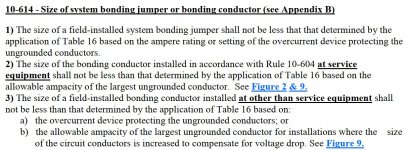
I think it is. #10 conductors get a #12 bond/EGC per table 16. Doesn't matter if its in a 20A or 30A circuit.

Here's the 2018 CEC: (3a and 3b most pertinent)
 

Attachments

  • cec10-614(3).jpg
    cec10-614(3).jpg
    145.4 KB · Views: 20
Last edited:
To avoid these ads, REGISTER NOW!
Top Bottom