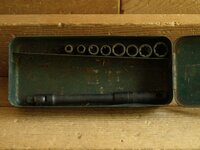
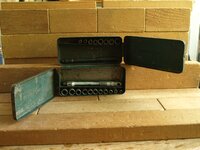
four.cycle
Well-known member

1920 Kelley-How-Thomson Co. catalog pp 416 Walden Worcester ad


Speeders...
6020 (5/8") speeder with doorknob end
6020 (5/8") with ball end
... I have a fixed speed wrench, Model No. 6020 with a 5/8" socket press-fit on the business end, and the same exact ball knob. I guess I should've used the d42jeep-esque line, "That looks familiar."I posted it back in 2019 in this thread, linked here. It accentuates just how early your interchangeable socket set is.

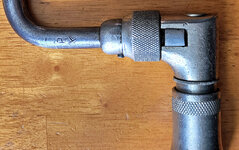


I totally agree.That "5/8" and "6020" says it was a fixed socket wrench modified to hold the brace chuck.
IMHO.
 DSCF3918 (2) by wvwheaties, on Flickr
 DSCF3920 (2) by wvwheaties, on Flickr
 DSCF3922 (2) by wvwheaties, on Flickr
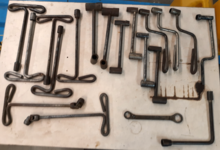
Like the Walden Flex - haven't seen a flex end before.Some items from Sunday's auto swap meet and flea market:
Walden 1020 Flex T 5/8"
SW spintite 3/8
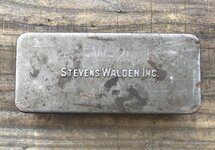
Stevens Walden offset screwdriver
Walden 2720 T 5/8

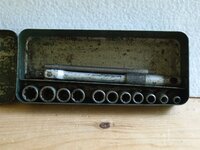
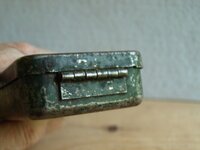


Nice early war cad plated set. Here is an ad from 1942. How many hinge elements does the box have?
-Don

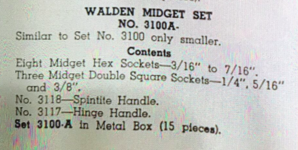


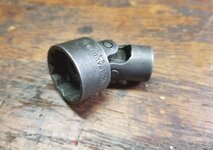
d42jeep said:I don’t recognize the mystery socket.
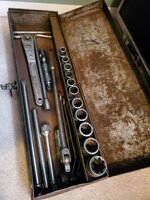
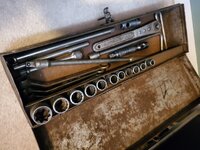
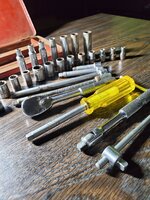
At one time (up through the end of 2011), on a site called G503.com, in the infancy of GMTK collecting (each GMTK had a 41-W-2615 midget socket set, among about a hundred other pieces), the "Conventional Wisdom" on WW midget sets was that all 5-hinge boxes were wartime and all 6-hinge boxes were postwar. Until sets with wartime construction, markings, configuration and finish started showing up in 6-hinge boxes. Mine was actually the first. Then the roof caved in. The CW changed to 5-hinge early, 6-hinge late and postwar, depending on the other factors (construction, markings, configuration and finish). Lately, though, this original pioneer is less definitive about any of the CW he was instrumental in developing.Not sure how they are classified, but here's a photo.
Yes, perhaps, but the CW would say your pieces don't match your box.Looking through, this is a complete 3100A
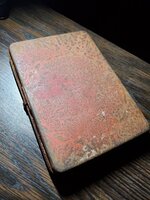
Does it look like it's been re-painted? I don't see anything under that kelly green but steel. I suppose it's possible someone completely stripped the original finish, and re-painted it that color. As I and others mentioned on the 'Midget' thread when you first posted this there, and as you can probably see from examples, there was a darker almost olive green, a much more common darker but truer (not olive) green, and then red (postwar)....and figuring something out with the case.

Those marking line up exactly with the bubble wrap it was shipped in! LOL I can’t see any paint under the green, but the green is a thick tacky type paint.Looking closely at the lid of Ed’s box looks like something was done to it while the paint was wet.
-Don
You left out one more "what if":
"OLD STOCK"
And it's possible WW was using old stock.
HAHA! Leave it to me (geodesic dome skylight and tree branches reflection) to miss the most obvious explanation!Those marking line up exactly with the bubble wrap it was shipped in!
FTR: unless I'm mistaken, I've got older WW boxes that are dark olive green, like some of Don's, as well as the lighter green.
No reason for me to think any of them were repainted anywhere along the way.
I am not at all certain that box is not original, despite it being Kelly-er, if that's what you mean. Those imprints could "buff out".
Private Lugnutz said:I am not at all certain that box is not original, despite it being Kelly-er, if that's what you mean.


Agreed. By the same thinking, one could find it equally less credulous that the ratchet, sliding tee, and extension that would just happen to make them a different set just happen to be missing. Therefore, "early" (IAW CW) 3100A pieces in a "later" (IAW CW) 6-element hinge box. That's why I have been staying with formulations like 'nice probable wartime set in a nice probable wartime box' with a color that is, er, different....I do find it harder to believe they took a complete (or almost complete depending on the set) and put it in a different case later.
I've only seen two greens. The sets that are more of a dark olive, and the sets that are more of a standard green, like Don is showing in post #395 above. I think those two are both factory, but clearly different. Some of the standard greens can have slightly lighter or darker shades than others. But it's the same color. If that's what you mean. But I've never seen one as kelly as mritchie's.I have WW sets in various shades of green.