To avoid these ads, REGISTER NOW!

P&C Stuff

To avoid these ads, REGISTER NOW!

Sunset_Z28

Well-known member
Joined
Dec 27, 2014
Messages
331
Location
Harrah, OK
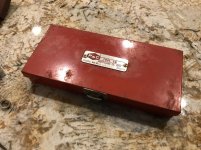
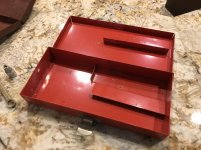
Found this little p&c box at a nearby estate sale today. No other p&c stuff was present. I'm assuming this probably housed a 1/4" drive set but I'm not positive.
 

Attachments

  • IMG_1816.jpg
    IMG_1816.jpg
    140.6 KB · Views: 19
  • IMG_1817.jpg
    IMG_1817.jpg
    133.5 KB · Views: 22

Sunset_Z28

Well-known member
Joined
Dec 27, 2014
Messages
331
Location
Harrah, OK
Now you have to fill it.

Id like to but I'm afraid it would probably take me forever. Around here p&c stuff is pretty uncommon. I come across 1/2" sockets occasionally but rarely anything in 1/4" drive. I've got a ratchet and a 8 point socket but that's about it in 1/4".
 

twertsy

Well-known member
Joined
Jan 5, 2014
Messages
6,725
Location
Reedville, VA
Today, I went back to the estate sale where I purchased the P&C punch & chisel set in the hopes of locating the 5 missing pieces. Sadly, I had no luck.

However, I was sorting through a drawer full of hardware in a built-in cabinet in the garage. I was trying to neatly stack things so I could see what I had already sorted when I grabbed this little box of staples and something spilled out all over the place.

Count em! 8 NOS P&C keychain screwdrivers! I burst out with "holy ****" then quickly gathered up all the little screwdrivers and closed them back in the box.

$2/all! :rocker:

Brian

Dang Brian, that is awesome! And, I NEED one of those! Trade?
 

B17E1943

Well-known member
Joined
May 29, 2010
Messages
754
Location
Far Northern Kommifornia
Today, I went back to the estate sale where I purchased the P&C punch & chisel set in the hopes of locating the 5 missing pieces. Sadly, I had no luck.

However, I was sorting through a drawer full of hardware in a built-in cabinet in the garage. I was trying to neatly stack things so I could see what I had already sorted when I grabbed this little box of staples and something spilled out all over the place.

Count em! 8 NOS P&C keychain screwdrivers! I burst out with "holy ****" then quickly gathered up all the little screwdrivers and closed them back in the box.

$2/all! :rocker:

Brian

If you happen to be selling a few of those, I would like to put in a bid for a lonely one. :)
 

d42jeep

Well-known member
Joined
Oct 22, 2014
Messages
16,497
Location
Northern California
This is my largest DBE wrench. It's a 1-7/16" X 1-1/2" P&C Wright Field wrench made for the US Army Air Corps. I've had it for a while and finally got around to taking pictures of it.
-Don
 

Attachments

  • IMG_5646.jpg
    IMG_5646.jpg
    156.3 KB · Views: 16
  • IMG_5643.jpg
    IMG_5643.jpg
    151.2 KB · Views: 14
  • IMG_5647.jpg
    IMG_5647.jpg
    143.2 KB · Views: 17

Private Lugnutz

Well-known member
Joined
Mar 30, 2012
Messages
30,473
Location
The Authentic Jersey Shore
This is my largest DBE wrench. It's a 1-7/16" X 1-1/2" P&C Wright Field wrench made for the US Army Air Corps. I've had it for a while and finally got around to taking pictures of it.
-Don

I’ve got the N-series version of that wrench, Don. Here’s a photo if you’re interested in comparing. Except for the model number, the markings look exactly the same, including the format for the sizes. At 18-1/2 inches long, it's almost 2 inches shorter than your WF89, though!!

View media item 74793
View media item 74794
The vintage tubular P&C might be my favorite DBEs. I really like the shallow (vs deep) offset and the feel of the wrench in the hand. And between that N89 above and these wrenches…

View media item 74790
View media item 74791
…I have a decent set on the upper end of the size range going. That’s N89 (which I could not find for the photo! Yikes!), N87, N85, N84, and WF83. I wish they were all the same finish. The N85, N84, and WF83 are natural steel, the N87 has a dusty phosphate on it.

The real odd duck though is the WF83.

View media item 74792
Going back to the comparison between the N89 and WF89, note that the WF-83 (7-8 x 3-4) at 11-1/2 inches long is actually a half-inch longer than the N84 (7/8 x 13/16) at 11 inches, even though the N84 is a bigger wrench and the WF83 is a /16th step down on one end.

Note also that the fraction is marked with a hyphen instead of a slash.

Would someone with an N83 tell me how long it is? Based on the N89 vs WF89 comparison, I am guessing the WF83 is longer than N83. And are there N-series P&C DBE’s out there with hyphenated versus slash sizes? We’ve seen this with Fairmount and other DOE wrenches and it seems to just be a random die thing. But I’m especially curious about the lengths. I never noticed the difference before and figured - it seems incorrectly - that the N and WF series wrenches were the same wrenches except for the markings!
 
Last edited:

d42jeep

Well-known member
Joined
Oct 22, 2014
Messages
16,497
Location
Northern California
Wow, Lugz! I didn't know that you had such a large group of those. That's very cool. Did you find those at the flea or in your large surplus tool sale with Steve? I assume that the N markings indicate that they were made for the Navy? I suppose that the marking differences could indicate that they were made in different Plomb/P&C factories but who really knows?
-Don
 

Private Lugnutz

Well-known member
Joined
Mar 30, 2012
Messages
30,473
Location
The Authentic Jersey Shore
The N87 with the dusty finish is the only wrench that came in the surplus lot. There were three of them, all the same size and finish. I'm only keeping one if you're interested. All of the others came out of the flea market near - you guessed it - Lakehurst Naval Air Engineering Station (now known as Joint Base McGuire Dix Lakehurst)!

Here's the "you idiot!" part of the backstory.

Believe it or not, all this time I just assumed that the N series was the commercial version of the USAAF WF series. These dull wits were further dulled by a distant memory of looking them up on AA, where there is no mention of a possible military contract. The only other P&C tool I have is one of the smaller wood-handled square-shanked screwdrivers, and that is a dead ringer for the same Plomb screwdriver, so I've never had a reason to dig into their catalogs or look into the P&C section on The Tool Archives. Now that I have (thanks for the prompt!), I see that there are no N-series double box end wrenches in the 1939 or the 1948. All 2xxx series! And Todd does attribute them to a Navy contract.

EDIT: I don't know the source for his attribution, but you know what I'm going to check as soon as I get to work. The 1944 US Navy Class 41! :bounce:
 
Last edited:

Private Lugnutz

Well-known member
Joined
Mar 30, 2012
Messages
30,473
Location
The Authentic Jersey Shore
I don't see a comparative analysis on the TA, but based on the N89 and WF89 comparison, and the WF83 being longer than a wrench (N84) it should be shorter than, I am convinced the length specs were different between the N and the WF wrenches of the same size combinations. Whether by contract or their own discretion, who knows.
 

d42jeep

Well-known member
Joined
Oct 22, 2014
Messages
16,497
Location
Northern California
It seems odd that P&C would use the same numbering system as the Wright Field wrenches when Plomb was using the actual NAF numbering from the Class 41 catalog for their Navy wrenches.
-DonIMG_5654.JPGIMG_5653.jpg
 
Last edited:

Username already in use

Well-known member
Joined
Sep 4, 2015
Messages
2,177
Location
Ohio
EDIT: I don't know the source for his attribution, but you know what I'm going to check as soon as I get to work. The 1944 US Navy Class 41! :bounce:

I'll save you the time since I have it digitally. :bowdown:
Looks like the DBEs in the Class 41 are clearly Plomb.

attachment.php
 

Attachments

  • class 41 DBEs.jpg
    class 41 DBEs.jpg
    64.2 KB · Views: 197

Private Lugnutz

Well-known member
Joined
Mar 30, 2012
Messages
30,473
Location
The Authentic Jersey Shore
It seems odd that P&C would use the same numbering system as the Wright Field wrenches when Plomb was using the actual NAF numbering from the Class 41 catalog for their Navy wrenches.
Very odd. Even odder is the underlying assumption that the Navy was using the USAAF numbering scheme, which the Class 41 shows they clearly were not. Also, note that the inventory is not the same. The Navy was buying twenty-four (24) wrenches with many different opening size configurations, while the USAAF WF- series only had eleven (11) wrenches. And, the Navy wasn't buying the WF-82 (11/16 x 5/8) configuration.

My initial SWAG is that the N-series was actually made for a different branch, other than the Air Corps, within the USAAF. (Wright Field was the traditional HQ for the Air Corps, subsumed by the USSAF in 1942.) Or, also Air Corps, but a different location/agency or something like that.

I'll check P&C in the CPA MWSC. As a subsidiary, their production would be reported through the Plomb entries, but you never know.

Maybe Todd can chime in with his source for attributing the N-series to Navy WWII contracts.
 

twertsy

Well-known member
Joined
Jan 5, 2014
Messages
6,725
Location
Reedville, VA
Very odd. Even odder is the underlying assumption that the Navy was using the USAAF numbering scheme, which the Class 41 shows they clearly were not. Also, note that the inventory is not the same. The Navy was buying twenty-four (24) wrenches with many different opening size configurations, while the USAAF WF- series only had eleven (11) wrenches. And, the Navy wasn't buying the WF-82 (11/16 x 5/8) configuration.

My initial SWAG is that the N-series was actually made for a different branch, other than the Air Corps, within the USAAF. (Wright Field was the traditional HQ for the Air Corps, subsumed by the USSAF in 1942.) Or, also Air Corps, but a different location/agency or something like that.

I'll check P&C in the CPA MWSC. As a subsidiary, their production would be reported through the Plomb entries, but you never know.

Maybe Todd can chime in with his source for attributing the N-series to Navy WWII contracts.

Happy to! It was you guys :lol_hitti
 

d42jeep

Well-known member
Joined
Oct 22, 2014
Messages
16,497
Location
Northern California
How about just a Navy wrench contract rather than a NAF contract. Just a thought. I hate to pick on Username although by now he should be quite a P&C expert. :thumbup:
-Don
 

Private Lugnutz

Well-known member
Joined
Mar 30, 2012
Messages
30,473
Location
The Authentic Jersey Shore
How about just a Navy wrench contract rather than a NAF contract.
That wouldn't explain why the Navy would be using a numbering scheme that has so far been seen only in conjunction with the USAAF. But it is something to look into.

If I recall correctly, I believe I drew that conclusion (along with others) from a thread on the G somewhere.
You give those guys way too much credit! They're always speculating without enough substantiation! :lol:

Why are you throwing shade on me, man!?! :lol: I had nothing to do with it! :sad:
Don't make me go find the thread Todd is talking about! :lol_hitti

Seriously, on the bright side, the numbering scheme itself (separate from the letter "N") implies at the very least military and WWII, probably USAAF, and possibly Navy. There's a lot of goodness in there and Todd can make an easy caveat on the TA.
 
To avoid these ads, REGISTER NOW!

Private Lugnutz

Well-known member
Joined
Mar 30, 2012
Messages
30,473
Location
The Authentic Jersey Shore
If I recall correctly, I believe I drew that conclusion (along with others) from a thread on the G somewhere.
I found the thread. A little bird reminded me where it was. But I gotta pull Jason out from underneath that bus..., and you need to find some old football pads and a helmet. :lol:

you said:
Is this wrench similar to the Plomb Navy contract wrenches? Never seen a P&C wrench with the 22xx round shank style marked like this one. Plomb Navy wrench pic included for reference.

me said:
I am inclined toward USAAF contract for that wrench. Note that the "WF-84" wrench had the same opening size combination (7/8 x 13/16) as your N/84 wrench. P&C definitely helped Plomb fill those orders. I have owned P&C round-shanked 22xx style DBE's marked "WF-**" before, and I have seen a few others. Possible explanations for the "N/" (instead of the "WF-") would be an early contract and an immature marking scheme (i.e., number 84) before they standardized on using the abbreviation for Wright Field, or a different customer inside the USAAF. The Plomb Navy wrenches all had the Navy stock number (NAF-***), which has no correlation to the USAAF numbering scheme.

you said:
Interesting Greg, and you're probably right based on the WF correlation.

:D

EDIT: I like my original explanations (different contract or different customer inside USAAF)! Not too happy having ZERO RECALL of this exchange! Yikes it ***** getting old. But at least I am consistent!
 
Last edited:

Private Lugnutz

Well-known member
Joined
Mar 30, 2012
Messages
30,473
Location
The Authentic Jersey Shore
An interesting development.

I just discovered that P&C had its own wartime contracts, separate from Plomb’s!

The conventional wisdom has been that the ‘[P&C] WF’ marked DBE’s were made to help fill Plomb WF orders. This information forces us to qualify that understanding. If you look over the data with the P&C acquisition in mind, an interesting possibility emerges.

Here are some scans and I will comment below:

View media item 74869View media item 74868
So, Plomb had two (2) Air Corps contracts before they bought P&C, awarded 1/41 and 6/41.

Plomb acquired P&C 8/41.

Plomb had three (3) more Air Corps contracts after they bought P&C, awarded 11/41, 1/42, and 3/42.

Plomb and P&C each had an Air Corps contract awarded 10/42. Note that they are different contracts with discrete contract numbers and values, as well as termination dates – Plomb’s ending 6/43 and P&C’s ending a year later (6/44).

Plomb had three (3) more Air Corps contracts in 1944 and 1945 that I am not showing in this scan.

P&C may have helped Plomb fill the early 1941 AC contracts as a subcontractor, although I question why Plomb wouldn't want them marked Plomb, which is consistent with their approach with other tools and subcontractors (Utica, JP Danielson, etc)

P&C may have helped Plomb fill the late 1941 and early 1942 AC contracts as a subsidiary, and the DBE wrenches we see marked ‘[P&C] WF 79’ through ‘[P&C] WF 89’ may be those wrenches.

P&C may also have helped Plomb fill the 1944 and 1945 AC contracts, and the DBE wrenches we see marked ‘[P&C] WF 79’ through ‘[P&C] WF 89’ may be those wrenches.

It’s also possible that P&C was filling its own 10/42 AC contract with DBE wrenches marked ‘[P&C] WF 79’ through ‘[P&C] WF 89’.

I would postulate, however, that it’s also very possible that the wrenches marked ‘[P&C] N 79’ through ‘[P&C] N 89’ are the wrenches they made for their own Air Corps contract!

The P&C contracts with the XSS (Ships) and XSX (Supplies & Accounts) agency symbols are Navy contracts. That does keep the specter of the 'N' on the '[P&C] N 79' through '[P&C] N 89' signifying 'Navy' alive, but the 79 through 89 is an Air Corps, not a Navy, numbering scheme, as discussed a few posts above, and keep in mind that N is awfully meaningless at the service level compared to AC as a US Army branch level, especially since XSS and XSX are Navy Bureaus equivalent to Army Branches.
 
Last edited:

Rileysan

Well-known member
Joined
Sep 11, 2015
Messages
4,298
Location
Milwaukie, Oregon
I know you spent a lot of time analyzing this, but I think I can simplify things a bit.

While the contracts shown give distinct company names and contract numbers, the reality is that both tool companies were divisions of Pendleton Tool Industries - a privately owned corporation.

Contract negotiations would have most certainly been with the parent company, not directly with P&C or Plomb. My guess is that contracts were awarded to each site according to their ability to re-tool to meet the government's standards. And clearly P&C was upgraded to meet those contract needs by Pendleton Tool Industries since all the wartime tools produced by each site were identical in all ways except the manufacturer's name.

Brian
 
Last edited:

d42jeep

Well-known member
Joined
Oct 22, 2014
Messages
16,497
Location
Northern California
I would postulate, however, that it’s also very possible that the wrenches marked ‘[P&C] N 79’ through ‘[P&C] N 89’ are the wrenches they made for their own Air Corps contract!

The P&C contracts with the XSS (Ships) and XSX (Supplies & Accounts) agency symbols are Navy contracts. That does keep the specter of the 'N' on the '[P&C] N 79' through '[P&C] N 89' signifying 'Navy' alive, but the 79 through 89 is an Air Corps, not a Navy, numbering scheme, as discussed a few posts above, and keep in mind that N is awfully meaningless at the service level compared to AC as a US Army branch level, especially since XSS and XSX are Navy Bureaus equivalent to Army Branches.

I like the theory that the N marked wrenches were for their own early contract. That would account for their relative scarcity compared to the WF marked wrenches which Plomb/P&C were continuing to provide all through the rest of the war (and after, based on the found examples of Proto WF wrenches). Below are the quite different appearing P&C and Plomb WF wrenches
-Don
 

Attachments

  • IMG_5689.JPG
    IMG_5689.JPG
    90.8 KB · Views: 20
  • IMG_5646.jpg
    IMG_5646.jpg
    156.3 KB · Views: 25
Last edited:

Private Lugnutz

Well-known member
Joined
Mar 30, 2012
Messages
30,473
Location
The Authentic Jersey Shore
I know you spent a lot of time analyzing this, but I think I can simplify things a bit.

While the contracts shown give distinct company names and contract numbers, the reality is that both tool companies were divisions of Pendleton Tool Industries - a privately owned corporation.
I know you thought you could simplify things, Brian, but in your haste, you seem to have neglected to recognize the basic chronological facts of the company's evolution and of history. Pendleton Tool Industries did not exist as a corporate entity until 1957. The name of the company in all public record period references (advertising, catalogs, contracts, legal notices, etc) was the Plomb Tool Company, from its inception, throughout the war, and even after it started branding its tools PROTO, after the Plumb lawsuit was fially settled. In short, there was no parent company called Pendleton Tool Industries during WWII.

I like the theory that the N marked wrenches were for their own contract. That would account for their relative scarcity compared to the WF marked wrenches which Plomb/P&C were continuing to provide all through the rest of the war (and after, based on the found examples of Proto WF wrenches).
A good complementary data point, Don. Thanks.
 

Rileysan

Well-known member
Joined
Sep 11, 2015
Messages
4,298
Location
Milwaukie, Oregon
I know you thought you could simplify things, Brian, but in your haste, you seem to have neglected to recognize the basic chronological facts of the company's evolution and of history. Pendleton Tool Industries did not exist as a corporate entity until 1957. The name of the company in all public record period references (advertising, catalogs, contracts, legal notices, etc) was the Plomb Tool Company, from its inception, throughout the war, and even after it started branding its tools PROTO, after the Plumb lawsuit was fially settled. In short, there was no parent company called Pendleton Tool Industries during WWII.

I did miss that point but the argument still amounts to semantics, imo. The Pendleton family owned Plomb and Cragin Tool (Bog) prior to the P&C acquisition, but still kept them as separate companies. If you think that each company (Plomb & P&C) signed contracts with the United States government without the involvement of the owners, you're assuming far more than I am.

I'd bet the farm that the Pendleton family signed these contracts for their companies, and there's nothing to suggest otherwise. In fact, using the anecdotal evidence of comparing tools made by both manufacturers is, in my opinion, enough to suggest that both Plomb & P&C contracts were signed by the same people.

Brian
 

Provincial

Well-known member
Joined
Sep 21, 2011
Messages
6,855
Location
Near Salem, OR
It is pretty clear that P&C provided WF tools. It is likely that Plomb was allowed to use P&C produced (and marked) tools to fill the Wright Field contracts. As such, P&C would have been considered by the government to be just one of Plomb's factories.

I have a N83 P&C wrench. All the rest are 2**** series. The N83 is plain steel. I assume that it was made during WWII, and for a government contract. It would make sense that it was made for the Navy under a separate contract unrelated to the WF contract. Between governent bungling and interservice rivalry, anything could happen.
 

Rileysan

Well-known member
Joined
Sep 11, 2015
Messages
4,298
Location
Milwaukie, Oregon
Adding one more thought.

Considering the timing of the purchase of P&C Tools, I think it quite possible that the owners of Plomb did so because of they saw the potential contracts to be had with the United States government. If expansion of their existing facilities were not feasible, why not go out and buy another company to expand your potential production?

I think you stumbled on to 'why?' Plomb bought P&C.

Any thoughts on that theory?

Brian
 
Last edited:

Private Lugnutz

Well-known member
Joined
Mar 30, 2012
Messages
30,473
Location
The Authentic Jersey Shore
If you think that each company (Plomb & P&C) signed contracts with the United States government without the involvement of the owners, you're assuming far more than I am...[ ]... I'd bet the farm that the Pendleton family signed these contracts for their companies, and there's nothing to suggest otherwise.
I have made no assumptions about who signed the contracts, nor do I need to. It's as irrelevant to my discovery as the familial oversight that I am as sure as you existed. The fact that has been established by the record that the War Production Board compiled and published in 1945 is that P&C Hand Forged Tools, Portland, Oregon, had its own distinct contract with the Air Corps. And that is certainly a new potential factor in understanding why some wartime P&C DBE's with Air Corps (Wright Field) stock numbers (79 through 89) are marked with the prefix WF, while others are marked with the prefix N.

It is likely that Plomb was allowed to use P&C produced (and marked) tools to fill the Wright Field contracts. As such, P&C would have been considered by the government to be just one of Plomb's factories.
You are re-stating what has been said a number of times when these wrenches come up, what d42jeep, twertsy, UNAIU and I have been talking about on the last page, and what I summarized as the conventional wisdom in the Plomb family tool collecting community in my post above. Given the contract awarded by the Air Corps to P&C Hand Forged Tools in Portland, Oregon, however, it is no longer completely accurate. P&C may have been considered one of Plomb's factories for the Plomb Air Corps contracts, but it has to be considered the OEM for its own Air Corps contract. Again, raising the possibility of this distinction being the explanation for why some P&C wrenches are marked WF89, for example, and some are marked N89.

Provincial said:
I have a N83 P&C wrench. All the rest are 2**** series. The N83 is plain steel. I assume that it was made during WWII, and for a government contract.
My post with the contract excerpts above is a continuation of a longer dialogue with d42jeep, twertsy, and UNAIU. If you go back a page, you'll see other P&C DBE wrench examples, including an N89, N87, N85, and an N84.

Please measure the length of your N83. Despite common yet erroneous statements to the contrary, not only are P&C WF and Plomb WF wrenches not identical, but I have discovered that P&C WF and P&C N wrenches are not identical either. P&C WF8x DBE wrenches seem to be longer than P&C N8x DBE wrenches of the same exact size.

I have a P&C WF83 wrench we can compare the length of your P&C N83 wrench to.

Provincial said:
It would make sense that it was made for the Navy under a separate contract unrelated to the WF contract.
Except for the fact that the numbers assigned to the WF series of tools were exclusive to the US Army Air Corps. The Navy had it own stock numbering system. Go back one page for a longer discussion on that point.
 
Last edited:

twertsy

Well-known member
Joined
Jan 5, 2014
Messages
6,725
Location
Reedville, VA
While I would love to take credit, Brian, I think it's pretty much the conventional wisdom that the impending war, the war, and the expanding military-industrial complex after the war were prime movers in all Plomb's expansions.

It would be interesting to discover how (or if) the "Fleet Tool Corp," (established by Plomb 12/1941) and later Penens Tool Corp. (a rename of Fleet by Plomb on 9/8/1943), and their stated purpose as the "Plomb Tool Contracting Company," managing wartime production contracts of AT LEAST 27 (as many as 31) factories fits into all of this.

Greg, have you looked for Fleet / Penens in the contract lists for the war? I'd be VERY interested to see if you found them, particularly Fleet. That would indicate that Plomb had even more contracts under management.
 

Private Lugnutz

Well-known member
Joined
Mar 30, 2012
Messages
30,473
Location
The Authentic Jersey Shore
Greg, have you looked for Fleet / Penens in the contract lists for the war?

Yes, I have. Bog, Cragin, Fleet, and Penens. And I just double-checked for them all again last night after my colossal P&C flub. (I had been reporting P&C as 'no contracts, likely part of Plomb's contracts' on the G for a few years, simply missing it on the page, or possibly being too smart for my own good and checking under Peterson & Carlborg instead.)

No entries.

Which was all very consistent with my understanding of Bog/Cragin and Fleet/Penens operating as subsidiaries (more or less extra factories, re-tooled with Plomb dies), with their wartime production being funded through Plomb contracts and resulting in Plomb branded tools, not Bog/Cragin, or Fleet/Penens branded tools, which don't exist in wartime as far as I know.

Also consistent with my previous understanding of P&C operating more like a managed brand.

Seeing that the US Army Air Corps and the several different bureaus of the US Navy awarding contracts to P&C as a distinct corporate entity certainly has my attention, and it's certainly making me re-think everything.

Judging solely by these contracts records, it looks like P&C operated both as a managed brand AND as its own entity, from the perspective of the US Government anyway.

Perhaps your research showing that Fleet/Penens was managing wartime production contracts (technically, not the same as being awarded contracts) is an organizational structure and function internal to Plomb, in essence, moving the coordination with the customer closer to the action (Wright Field) and some of its factories (Cragin, etc). Whereas the outwardly facing company on record for the contract awards was the Plomb Tool Company, Los Angeles, CA.

A reminder and a few further thoughts:

- The WPB did not track contracts under $50,000 in value.

Many collectors try to use that as an excuse for their favorite mfgr not having any wartime awards, but that it is a very low figure, even at 1942 prices, and it is clearly not the norm reflected by the data. It's possible, in other words, that Fleet/Penens was awarded many smaller contracts, rather than a few or even a dozen or so very large ones, but judging by the book, that's not how any of the major contracting agencies (i.e., Air Corps, Corps of Engineers, Ordnance, etc) liked to operate. Having been in and around modern Army contracting all my life, as I know you are too, it's not how any agency likes to operate, because of the time it takes to write and award contracts. The Small Business Administration was in no small part established as a reaction to the monolithic large sum multi-year contracts that made everyone in the WWII-instigated military-industrial complex fat, dumb and happy for many years.

- If you look at the contracts scans you'll see a FOOTNOTE column. It's for a 1, 2, or 3. Very few pages in the book have them. Neither Plomb's or P&C's data has them, for example. They correspond to footnotes at the bottom of every page.

1. Location of work not determined.
2. Contractor, manufacturer, and location of work not determined.
3. Manufacturer, but not contractor.

This all goes back to the foreword to the record, explaining that the WPB was most interested in knowing who the OEM was and where they were located, not so much the contractor, in cases where there were shell corporations.

- The range for all contracts in the record is June 1940 to September 1945. Perhaps Plomb's many pre-war and wartime corporate moves were just too sudden and rapid of a duty cycle for the WPB to even catch and track.

- A big caveat in the foreword warns that the WPB went to print before they could tally all of the contracts awarded after June 1945.
 
Last edited:

twertsy

Well-known member
Joined
Jan 5, 2014
Messages
6,725
Location
Reedville, VA
So, simply a management arm, coordinating all the work distribution to 27-31 factories it seems. It'd be great to find '42 contract documentation from Plomb..........
 

Private Lugnutz

Well-known member
Joined
Mar 30, 2012
Messages
30,473
Location
The Authentic Jersey Shore
So, simply a management arm, coordinating all the work distribution to 27-31 factories it seems.
Something like that. It's one explanation for making sense of your sources and the contracts information, anyway, rather than them contradicting each other.

twertsy said:
It'd be great to find '42 contract documentation from Plomb..........
Amen.
 

3baygarage

Well-known member
Joined
Sep 1, 2013
Messages
11,922
Location
SW Florida/from Buffalo,NY
No information to add, but this big P&C on the left is an N90 1-5/8 x 1-7/16 if that helps your study guys.

Lugz, if you want to do any trading around down the line to add to your set let me know.

attachment.php
 

Attachments

  • image.jpg
    image.jpg
    11.6 KB · Views: 243
To avoid these ads, REGISTER NOW!
Top Bottom