DuroChrome
Well-known member
Awesome scores! That punch set is amazing...

Now you have to fill it.
Today, I went back to the estate sale where I purchased the P&C punch & chisel set in the hopes of locating the 5 missing pieces. Sadly, I had no luck.
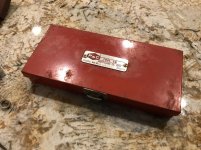
However, I was sorting through a drawer full of hardware in a built-in cabinet in the garage. I was trying to neatly stack things so I could see what I had already sorted when I grabbed this little box of staples and something spilled out all over the place.
Count em! 8 NOS P&C keychain screwdrivers! I burst out with "holy ****" then quickly gathered up all the little screwdrivers and closed them back in the box.
$2/all!
Brian
Today, I went back to the estate sale where I purchased the P&C punch & chisel set in the hopes of locating the 5 missing pieces. Sadly, I had no luck.
However, I was sorting through a drawer full of hardware in a built-in cabinet in the garage. I was trying to neatly stack things so I could see what I had already sorted when I grabbed this little box of staples and something spilled out all over the place.
Count em! 8 NOS P&C keychain screwdrivers! I burst out with "holy ****" then quickly gathered up all the little screwdrivers and closed them back in the box.
$2/all!
Brian

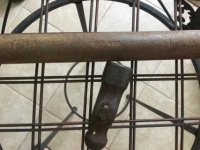
This is my largest DBE wrench. It's a 1-7/16" X 1-1/2" P&C Wright Field wrench made for the US Army Air Corps. I've had it for a while and finally got around to taking pictures of it.
-Don


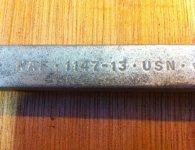
EDIT: I don't know the source for his attribution, but you know what I'm going to check as soon as I get to work. The 1944 US Navy Class 41!

Very odd. Even odder is the underlying assumption that the Navy was using the USAAF numbering scheme, which the Class 41 shows they clearly were not. Also, note that the inventory is not the same. The Navy was buying twenty-four (24) wrenches with many different opening size configurations, while the USAAF WF- series only had eleven (11) wrenches. And, the Navy wasn't buying the WF-82 (11/16 x 5/8) configuration.It seems odd that P&C would use the same numbering system as the Wright Field wrenches when Plomb was using the actual NAF numbering from the Class 41 catalog for their Navy wrenches.
Very odd. Even odder is the underlying assumption that the Navy was using the USAAF numbering scheme, which the Class 41 shows they clearly were not. Also, note that the inventory is not the same. The Navy was buying twenty-four (24) wrenches with many different opening size configurations, while the USAAF WF- series only had eleven (11) wrenches. And, the Navy wasn't buying the WF-82 (11/16 x 5/8) configuration.
My initial SWAG is that the N-series was actually made for a different branch, other than the Air Corps, within the USAAF. (Wright Field was the traditional HQ for the Air Corps, subsumed by the USSAF in 1942.) Or, also Air Corps, but a different location/agency or something like that.
I'll check P&C in the CPA MWSC. As a subsidiary, their production would be reported through the Plomb entries, but you never know.
Maybe Todd can chime in with his source for attributing the N-series to Navy WWII contracts.

Happy to! It was you guys


I am taking one giant step back on this one, Kemosabe. My under-the-bus-throwing money is on Mr. Jason "MC=Marine Corps" Username Already In Use!
I had nothing to do with it! 

That wouldn't explain why the Navy would be using a numbering scheme that has so far been seen only in conjunction with the USAAF. But it is something to look into.How about just a Navy wrench contract rather than a NAF contract.
You give those guys way too much credit! They're always speculating without enough substantiation!If I recall correctly, I believe I drew that conclusion (along with others) from a thread on the G somewhere.
Don't make me go find the thread Todd is talking about!Why are you throwing shade on me, man!?!
I found the thread. A little bird reminded me where it was. But I gotta pull Jason out from underneath that bus..., and you need to find some old football pads and a helmet.If I recall correctly, I believe I drew that conclusion (along with others) from a thread on the G somewhere.
you said:Is this wrench similar to the Plomb Navy contract wrenches? Never seen a P&C wrench with the 22xx round shank style marked like this one. Plomb Navy wrench pic included for reference.
me said:I am inclined toward USAAF contract for that wrench. Note that the "WF-84" wrench had the same opening size combination (7/8 x 13/16) as your N/84 wrench. P&C definitely helped Plomb fill those orders. I have owned P&C round-shanked 22xx style DBE's marked "WF-**" before, and I have seen a few others. Possible explanations for the "N/" (instead of the "WF-") would be an early contract and an immature marking scheme (i.e., number 84) before they standardized on using the abbreviation for Wright Field, or a different customer inside the USAAF. The Plomb Navy wrenches all had the Navy stock number (NAF-***), which has no correlation to the USAAF numbering scheme.
you said:Interesting Greg, and you're probably right based on the WF correlation.
AgreedThe good news is that we HAVE an explanation, unlike a popular tools research site, and it's an easy quick fix!
I would postulate, however, that it’s also very possible that the wrenches marked ‘[P&C] N 79’ through ‘[P&C] N 89’ are the wrenches they made for their own Air Corps contract!
The P&C contracts with the XSS (Ships) and XSX (Supplies & Accounts) agency symbols are Navy contracts. That does keep the specter of the 'N' on the '[P&C] N 79' through '[P&C] N 89' signifying 'Navy' alive, but the 79 through 89 is an Air Corps, not a Navy, numbering scheme, as discussed a few posts above, and keep in mind that N is awfully meaningless at the service level compared to AC as a US Army branch level, especially since XSS and XSX are Navy Bureaus equivalent to Army Branches.
I know you thought you could simplify things, Brian, but in your haste, you seem to have neglected to recognize the basic chronological facts of the company's evolution and of history. Pendleton Tool Industries did not exist as a corporate entity until 1957. The name of the company in all public record period references (advertising, catalogs, contracts, legal notices, etc) was the Plomb Tool Company, from its inception, throughout the war, and even after it started branding its tools PROTO, after the Plumb lawsuit was fially settled. In short, there was no parent company called Pendleton Tool Industries during WWII.I know you spent a lot of time analyzing this, but I think I can simplify things a bit.
While the contracts shown give distinct company names and contract numbers, the reality is that both tool companies were divisions of Pendleton Tool Industries - a privately owned corporation.
A good complementary data point, Don. Thanks.I like the theory that the N marked wrenches were for their own contract. That would account for their relative scarcity compared to the WF marked wrenches which Plomb/P&C were continuing to provide all through the rest of the war (and after, based on the found examples of Proto WF wrenches).
I know you thought you could simplify things, Brian, but in your haste, you seem to have neglected to recognize the basic chronological facts of the company's evolution and of history. Pendleton Tool Industries did not exist as a corporate entity until 1957. The name of the company in all public record period references (advertising, catalogs, contracts, legal notices, etc) was the Plomb Tool Company, from its inception, throughout the war, and even after it started branding its tools PROTO, after the Plumb lawsuit was fially settled. In short, there was no parent company called Pendleton Tool Industries during WWII.
I have made no assumptions about who signed the contracts, nor do I need to. It's as irrelevant to my discovery as the familial oversight that I am as sure as you existed. The fact that has been established by the record that the War Production Board compiled and published in 1945 is that P&C Hand Forged Tools, Portland, Oregon, had its own distinct contract with the Air Corps. And that is certainly a new potential factor in understanding why some wartime P&C DBE's with Air Corps (Wright Field) stock numbers (79 through 89) are marked with the prefix WF, while others are marked with the prefix N.If you think that each company (Plomb & P&C) signed contracts with the United States government without the involvement of the owners, you're assuming far more than I am...[ ]... I'd bet the farm that the Pendleton family signed these contracts for their companies, and there's nothing to suggest otherwise.
You are re-stating what has been said a number of times when these wrenches come up, what d42jeep, twertsy, UNAIU and I have been talking about on the last page, and what I summarized as the conventional wisdom in the Plomb family tool collecting community in my post above. Given the contract awarded by the Air Corps to P&C Hand Forged Tools in Portland, Oregon, however, it is no longer completely accurate. P&C may have been considered one of Plomb's factories for the Plomb Air Corps contracts, but it has to be considered the OEM for its own Air Corps contract. Again, raising the possibility of this distinction being the explanation for why some P&C wrenches are marked WF89, for example, and some are marked N89.It is likely that Plomb was allowed to use P&C produced (and marked) tools to fill the Wright Field contracts. As such, P&C would have been considered by the government to be just one of Plomb's factories.
My post with the contract excerpts above is a continuation of a longer dialogue with d42jeep, twertsy, and UNAIU. If you go back a page, you'll see other P&C DBE wrench examples, including an N89, N87, N85, and an N84.Provincial said:I have a N83 P&C wrench. All the rest are 2**** series. The N83 is plain steel. I assume that it was made during WWII, and for a government contract.
Except for the fact that the numbers assigned to the WF series of tools were exclusive to the US Army Air Corps. The Navy had it own stock numbering system. Go back one page for a longer discussion on that point.Provincial said:It would make sense that it was made for the Navy under a separate contract unrelated to the WF contract.
While I would love to take credit, Brian, I think it's pretty much the conventional wisdom that the impending war, the war, and the expanding military-industrial complex after the war were prime movers in all Plomb's expansions.I think you stumbled on to 'why?' Plomb bought P&C.
Any thoughts on that theory?
While I would love to take credit, Brian, I think it's pretty much the conventional wisdom that the impending war, the war, and the expanding military-industrial complex after the war were prime movers in all Plomb's expansions.
Greg, have you looked for Fleet / Penens in the contract lists for the war?
Something like that. It's one explanation for making sense of your sources and the contracts information, anyway, rather than them contradicting each other.So, simply a management arm, coordinating all the work distribution to 27-31 factories it seems.
Amen.twertsy said:It'd be great to find '42 contract documentation from Plomb..........