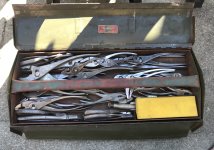
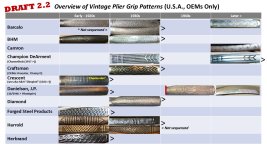
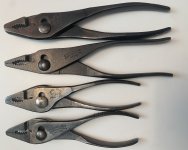
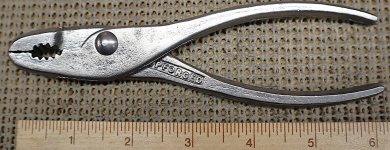
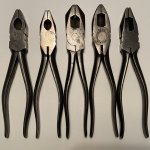
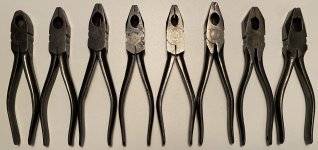
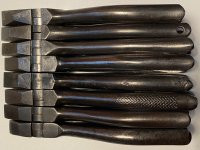
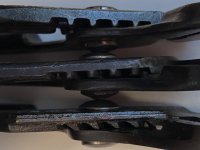
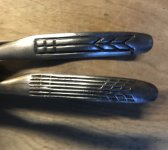
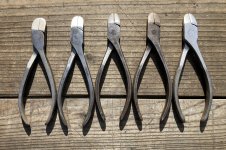
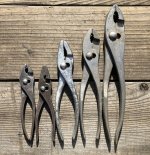
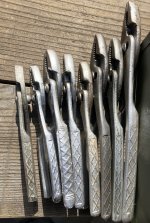
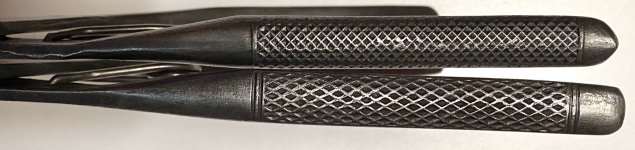
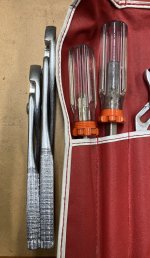
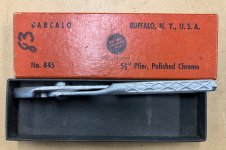
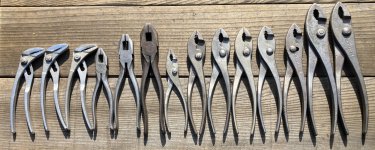
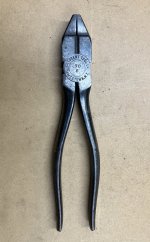
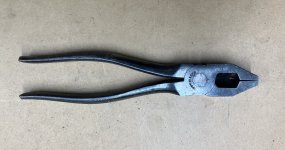
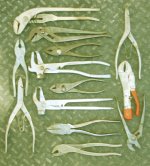
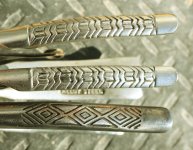
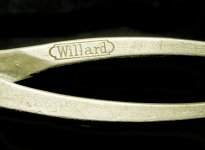
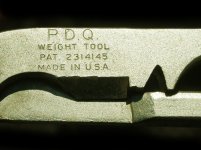
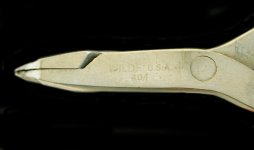
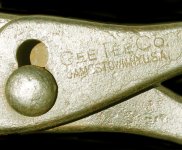
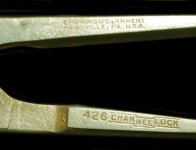
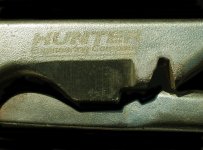
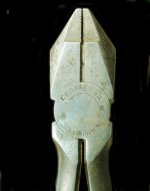
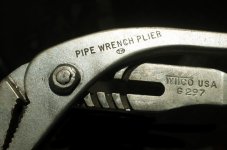
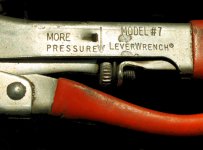
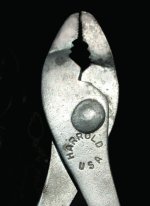
I am working on Page 2 today. Including Barcalo. In the grouping of pliers that followed this statement, I cannot discern any differences. Whatever we want to call this pattern, cross-hatched, forming the appearance of a field of many tiny diamonds (in between the cross-hatching), with borders on both sides that are usually either 2 or 3 longitudinal bars. I also discern no difference between the pattern in that grouping, and the groups of parrot nose and dykes that preceded that grouping.Barcalo had many different handle patterns over the years.
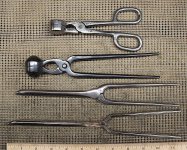
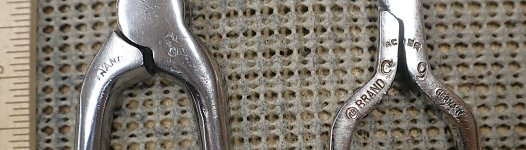
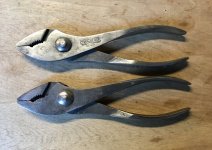
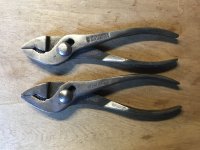
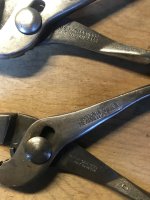
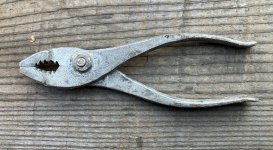
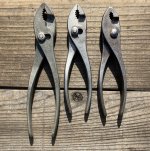
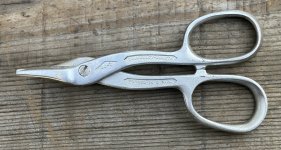
Found more info. According to some sources these may be for both curling using a wooden spindle and the round clamping area by the "jaws", and also for straightening in the smooth parts of the jaws.Not sure about these. The seller called them seaming pliers. They are marked "GERMANY" and a word I can't figure out (second picture). They are about 9" long. The head is somewhat ball shaped with flat gripping areas about 1" across.


The Indestro models are vintage.Don't make me get the "This is the Vintage Tools Discussion Forum" hammer out!
Agreed. Which is why I didn't include them in my quotes. But you know I was just teasing, right?!The Indestro models are vintage.
Snerk.Apology offered for my transgressions, kind sir!
Those all look J.P. Danielson to me. They have more border bars/bumps than Barcalo. And if that's the '41 catalog, they didn't move to the 'herringbone' pattern yet.wartime Bonney pliers illustrations,

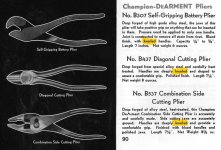
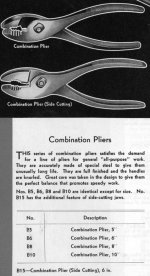
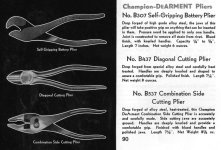
I don't either. By the way, I do have the B15 combination side-cutting slip-joints, sourced from J.P. Danielson. (See attached.)My attention was drawn to the B537, of which I do not own an example.
I never see them. Or maybe I subconsciously ignore them.
I know your point was to hypothetically emphasize their indistinguishability otherwise, but they would almost certainly have the Champ D arrow flight pattern if Champ D. But now I have a left field question for you. I don't own too many Bonney pliers, but of those I do, all of the pivot joints (dykes, needle-nose, etc) are sourced from Utica (smooth handle) and all the slip-joints are sourced from either Crescent or J.P. Danielson. Do you have ANY Bonney pliers made by Champ D? If so, they have the arrow flight pattern grips, right?If Channellock and Utica both made a sidecutting slipjoints with a “knurled” grip pattern for Bonney, I’m not confident I could easily distinguish between them.
Not to walk back that criticism concerning Utica OEM evidence for PEXTO linesman pliers, but I thought I should apply some of it to Bonney linesman pliers, with uncertain results.I was looking at Alloy Artifacts’ PS&W linemans pliers, which they credit to Utica, based on the nearly identical grip pattern. This has bothered me off and on, partly because I have bought rusted box joint PS&Ws thinking they were Utica, and partly because I thought I’d since learned to distinguish them.
PS&W handles are generally heavier, and the depressed diamonds grip pattern (when present), always has a V-terminating top and never has a speedbump at the bottom. Uticas usually betray the remains of a lower speedbump, even when it is mostly polished away.
(top pair above is Utica)
Further, the head is more like Utica’s lighter No50 than their heavier No1950, but always has a flat-walled (hexish) well for the cutters, whereas Utica 50s always have a round well and Utica 1950s always have the hexish well.
(PS&W at top, above, Utica at bottom)
(all PS&W)
The PS&W cutters are almost always on a convex surface proud of the rest of the head (I have one that is flat flush), while Utica cutters are almost always flat flush (I have one that is convex proud).
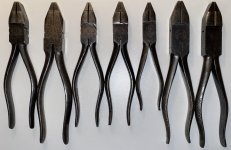
(all PS&W)
Most PS&W pivot pins (both lap-joint and box-joint) have five flats locking them - I have not seen this detail on Utica.
(PS&W above)
Lastly, Uticas of the era with V-terminating grip pattern always have a forged-in 3-diamonds logo inside the handles (or shadows if highly polished), but PS&W examples don’t, even when other forging marks remain after finishing.
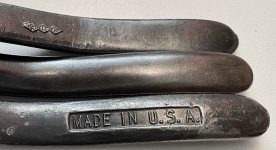
(Utica at top, above; two PS&W at bottom)
I’m not arguing that AA is necessarily wrong (surely, there’s SOME reason the two grip patterns are so similar), but to me, the preponderance of evidence of every other part of the pliers suggests their conclusion should be phrased in more tentative terms.



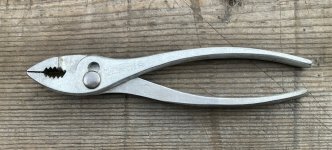

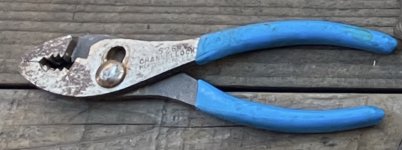
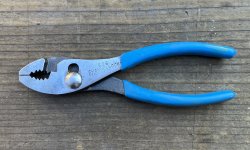
Oops! I missed this post, and I thought I had included this photo, showing that Channellocks sometimes have smooth handles (smoother than I’d assume the blue dip coat conceals).I know your point was to hypothetically emphasize their indistinguishability otherwise, but they would almost certainly have the Champ D arrow flight pattern if Champ D. But now I have a left field question for you. I don't own too many Bonney pliers, but of those I do, all of the pivot joints (dykes, needle-nose, etc) are sourced from Utica (smooth handle) and all the slip-joints are sourced from either Crescent or J.P. Danielson. Do you have ANY Bonney pliers made by Champ D? If so, they have the arrow flight pattern grips, right?


I have no Utica dopplegangers of them. I have multiple models of Utica sidecutter longnose, all with round cutter wells, and none with hexish wells. I’m thinking Crescent for both. 

despite being almost identical, it seems clear to me that the Bonney self-gripping pliers in this sandwich are Utica, not Channellock (all smooth grips). The “pat. apl’d for” indicates Utica’s US2622464, the forging process, not Channellock’s US2592927 rib pattern (both Utica and Bonney retain that), nor US2640381 imoroved rib pattern.
Yes. But if they have a grip pattern, it's only the early or later arrow flights. I've never seen Champ D pliers that weren't smooth or one of those patterns. I guess what I'm saying is..., I took your point to be purely hypothetical and rhetorical. You think the Utica and the Champ D combo S-J's with the ****-like side-cutters are so alike that if they were Bonney-branded and had the same grip pattern it would be hard to identify the OEM.Channellocks sometimes have smooth handles...
Right - there is a very slight difference of form, where the head and handles transition, and maybe an additional tooth in the Uticas’ jaws.Yes. But if they have a grip pattern, it's only the early or later arrow flights. I've never seen Champ D pliers that weren't smooth or one of those patterns. I guess what I'm saying is..., I took your point to be purely hypothetical and rhetorical. You think the Utica and the Champ D combo S-J's with the ****-like side-cutters are so alike that if they were Bonney-branded and had the same grip pattern it would be hard to identify the OEM.
Yeah! I think that corrals what otherwise has been presented piecemeal.All,
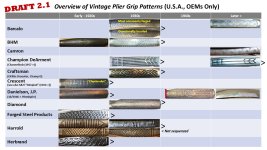
I updated the Grip Patterns Infographic based on some cogent feedback from LS. I'm not going to keep posting them with these incremental changes. I just edited the last post linked here.
Harrold is satisfied.I updated the Grip Patterns Infographic
Part two of the Barcalo handle pattern project.


Thanks, Don. If the hive mind agrees, I'll show a No Border, a One Border, and a Two Borders.Part one.
I think this is the reason why I wanted to avoid this kind of pattern altogether!what do you guys think?