OutlawDrifter
Well-known member
So when should I send my prints for cutting? 
You'll be fab'ing up all kinds of stuff now! Does everything get new bumpers?
You'll be fab'ing up all kinds of stuff now! Does everything get new bumpers?

Backing up to this pic, is that a Warn hawse fairlead? If not, whose is it?
Hopefully soon. Have some research and learning to do first. What did you have in mind? targets?So when should I send my prints for cutting?
You'll be fab'ing up all kinds of stuff now! Does everything get new bumpers?
That's the plan. make fire and smoke and see what happens.This is an awesome stage of the build! Fire that torch, make some sparks and see what she does!
Enjoy! This is a total game changer. I think you'll love the Langmuir!
Yes that is a Warn hawse fairlead from an Evo 12 with synthetic rope.Backing up to this pic, is that a Warn hawse fairlead? If not, whose is it?
On the threads engaged thing, I've been told by some vet Engineers that "you only get three threads" and that anything after that is lost/wasted/etc. Their operating theory is that only three threads make contact because of minor variations in the male and the female threads.
I'm of the opinion that when the load gets high enough that those three threads will distort until more threads come to bear, proceeding with more and more thread engagement until there are enough threads loaded to take the stress below the level needed to distort the most ductile of the two materials.
As to the fully threaded bung vs. partially threaded bung I suspect it's a cost thing. It's another operation to flip the bung around to bore the threads out of being under the weld zone and that takes time so it costs money.



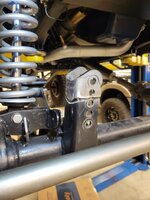


What plasma cutter is that? If you don't have a hypertherm, I'd highly recommend getting one dedicated to the table. For a couple of years I was running a harbor freight 45A plasma cutter with the table and I was even able to cut 3/16" faster than that (27ipm), but it definitely did not have the balls to quickly pierce the material on the starts. It had to bore a hole, which constantly caused molten metal to splash up and destroy the tip. I hated that machine. It finally died and I upgraded to a Hypertherm 45xp. Night and day difference. I never have to worry about number of pierces I get out of a consumable. They are definitely more expensive, but in the almost year I've had the machine, I'm only on my second set of consumables. I was spending way more on the HF consumables and replacing them almost every time I turned the machine on. Keep your current machine as a hand held unit, but for sure upgrade the table cutter.yes that is the plan. Back side is already gusseted to the top.
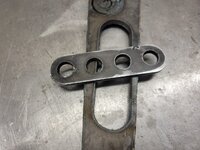
Still dialing in plasma machine settings. item above is cut at 27 A (max) and 20 ipm. Becoming more familiar with CAD/CAM tools. Round holes come out elliptical. Maybe time for new consumables or slower yet feed rate.
I’m pretty sure like 99% sure they are the same as the Lisle tap sockets as we have both at the shop. We have worn out one of the sockets as we use them on 1/4” impacts the metal is a little soft they are made fromI have a set of these: https://shop.snapon.com/product/Tap-Sockets-(1-4-3/8"-Drive)/8-pc-Tap-Socket-Set-(Blue-Point)/TDL8 that I use on smaller taps. Usually with one of these: https://www.amazon.com/dp/B00QB80UH8/?tag=atomicindus08-20


LOL, in spite of their color I don't think that they're intended to be driven with an impact of any size. Snap-On's whole Bluepoint line is normally sourced from other tool makers and not made in-house, so that they possibly are Lisle is not a surprise.I’m pretty sure like 99% sure they are the same as the Lisle tap sockets as we have both at the shop. We have worn out one of the sockets as we use them on 1/4” impacts the metal is a little soft they are made from

To test Y/X backlash just cut a large-ish hole and measure the dimensions. Backlash will reveal itself within the test.Thanks for the info. Could be a backlash issue from loose coupler. Going to check and do a run with a sharpy and paper so see if it is cutter or table.
Looking at cut outs, the pierce lead in is still not quite sufficient but that would only effect one area not two like I see. Lots for me to learn on this.


What about a glass top?Next steps are to fit drawer and apply a finish. Needs to be hard to protect the soft pine from ball point pens and so on.