To avoid these ads, REGISTER NOW!

Rebuilding a monarch 10ee lathe

OP
G

Grant Gunderson

Well-known member
Joined
May 17, 2013
Messages
2,320
Location
Bellingham, WA
Now I realized I have a bit of a problem on my hands.
IMG_0566.jpeg
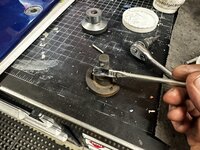
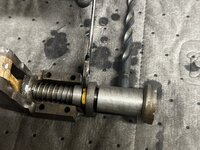
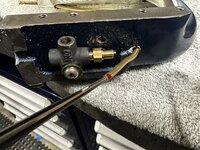
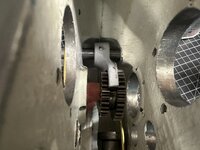
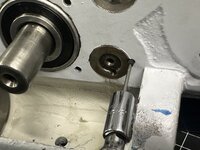
There is supposed to be a threaded hole under the spindle mount for a setscrew to secure the switch assembly. Apparently the silicone paint plug had gotten pushed in to far and it got bonded over. No sign of it at all. Pressing with my finger (revealed the other hidden plugs) was to no avail. The bore is completely lost. Thinking I may have to re-drill it, I used a depth mic, to measure where the bore enters the shaft bore for the switch. I then translated that to the front.
IMG_0629.jpeg
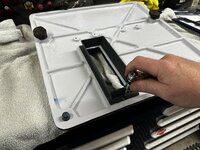
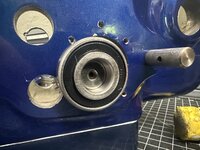
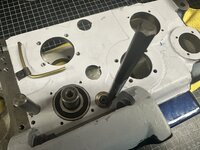
FYI, thats not a scratch. Its the reflection of the pin in the paint! I then went to mark the location using a pick with the intent of having to center punch it for drilling next. Luck was apparently on my side and the pick went directly though the Bondo and right into the silicone plug.
IMG_0630.jpeg
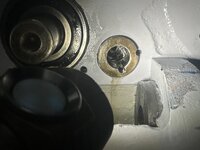
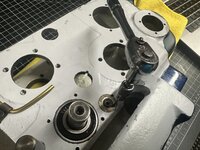
I was able to remove the silicone plug. Turns out the setscrew I had left in there to keep the plug from going too deep, was intact too deep.
IMG_0633.jpeg
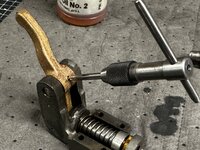
There is a detent for the lock plate as well. It also got a new spring and bunch of super lube.

IMG_0635.jpeg
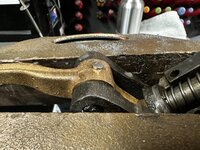
The lock plate is quite worn. If I ever find a replacement I will switch it out, or when I have more time I will make a new one, but it does work still. Once it was secured with the 4 countersunk screws I installed the plunger for the detent and lubed the plate with super lube as well.
IMG_0641.jpeg
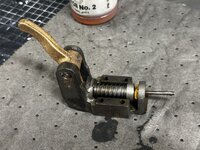
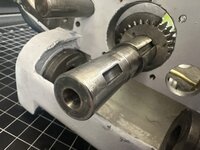
The handle assembly then gets slid in, and mates with the with in the rear. I then tightened down the Stainless set screw in the bed side of the head stock casting that secures it, followed by giving the rear switch plate its finally torque now that its aligned. Finally there is a dog point setscrew, followed by a Stainless hollow set screw that goes into the bottom of the switch plate assembly to keep it from over traveling. Man does it feel good to get some parts back together.
 
Last edited:
To avoid these ads, REGISTER NOW!
OP
G

Grant Gunderson

Well-known member
Joined
May 17, 2013
Messages
2,320
Location
Bellingham, WA
Been cranking away the last few days.
IMG_0645.jpeg
Got the insides of both the upper and lower drive side covers painted, and reattached the screens for the lower section
IMG_0649.jpeg
It used #7 drive screws to attach.
IMG_0651.jpeg
I talked to the guys at the local chrome shop, they are booked 3+ months out right now and he told me he wouldn't even give me a quote for at least another 6 weeks until they get a bit more caught up... so I clear coated the shinny bits that I had polished. Thinking these will have to wait till next summer to get chromed, but hopefully I can at least get the dial plaques chromed this winter.
IMG_0676.jpeg
Next up is getting some parts back on the lathe, I need to clear off some bench space! Note how the factory hole for the accent trim, is no where near centered. When I did the body work on these, I purposely filled the holes from the front with Bondo, as the plan was to drill new larger holes anyways, as I am mounting the accent pieces I made with blind holes, so there will be no fasteners showing from the front.
IMG_0677.jpeg
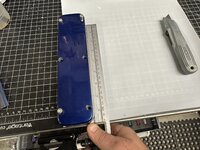
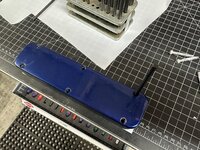
Some blue painters tape protected the my froth pain job. I then used the bracket I made to hold the accent plates in the mill vise as a drill template for them.
IMG_0678.jpeg
Laid them out, drilled them using the bracket from the front to keep the paint from chipping.
IMG_0679.jpeg
The locking cams got a nice coat of superlube on the shafts and bearing surfaces.
IMG_0681.jpeg
I then lined up the cams with their matting knobs, and cleaned out the taper pin holes with a #1 tapper pin reamer. FYI these use a #1 x 1" tapper pin.
IMG_0682.jpeg
I am using all new stainless steel taper pins, and I coated them with some Tea-Gel before I inserted them to make the removal easier for the next guy (most likely me). I pushed the pins partway in then drove them home with a brass pin punch.
IMG_0685.jpeg
There was no factory accent pieces on the tailstock end cover. I figured I should add some. I laid out the center section first, and drilled the first hole and inserted a ¼-20 screw in it.
 
OP
G

Grant Gunderson

Well-known member
Joined
May 17, 2013
Messages
2,320
Location
Bellingham, WA
IMG_0686.jpeg
The drill jig drops onto the screw, I square it up then use a transfer punch to mark the hole location.
IMG_0687.jpeg
I then repeated for the other two accent pieces.
IMG_0684.jpeg
I had family in town, so this was as far as I got installing the accent pieces and access panels before they woke up in the am. I do plan to get the start switch plaque and stop switch chromed.
IMG_0692.jpeg
My dad came up to visit for my birthday this weekend. It was a perfect excuse for Stian to finish the truck he made all by himself in the garage. With Dad's supervision he cut all of the blocks for the truck, and he used a hole saw in the Bridgeport to make the wheels. Not bad for a 5 year old. With lathe parts covering all of my work benches, a stack of Festool sustainers made a temporary workbench for Grandpa to attache the axels that Stian had cut and then threaded for the acorn nuts.
IMG_0707.jpeg
Success. A very happy kid and Grandpa!... and a proud Dad!

Back to the lathe. time to work on assembling the headstock, while I wait for Bondo to dry on the head stock end covers.

IMG_0656.jpeg
First to go back in is the Clutch Fork Rack assembly. Here it is all laid out after I cleaned it in the ultrasonic, and gave it a thin coating of Mobile DTE heavy / Medium to keep the parts from rusting.
IMG_0660.jpeg
The reverse Idler stud that gets pressed into the end of the headstock to hold the shaft in place, was the m out difficult part of the entire tear down to remove. It had a press fit plug inside of it that I had to drill and tap to remove. I need to plug this, so the plan is remove it, then tap the hole for a threaded plug.
IMG_0662.jpeg
That plug easily pressed out with the Arbor Press.
IMG_0666.jpeg
That leaves a .6870 bore. Closet size to it is a 20mm tap, but I dont have one that size and dont want to purchase one if I can avoid it. So the plan is to drill it out and tap with with a ¾ NPT thread to take a pipe plug, since I have that tap on hand and its not too far off in size. I actually found on McMaster they have threaded pipe plugs with standard thread adapters that will work perfectly for my sledgehammer for future removal if needed. So thats the plan.
IMG_0670.jpeg
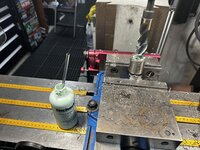
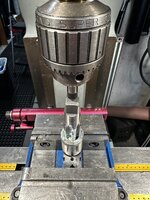
Since I dont have a working lathe yet, I need to bore the hole out for the pipe tap. It needs to be a 59/64" hole. This was a good excuse to practice dialing in the hole with my dial indicator, I actually got it with in =/- .0005" wit ha full sweep of the needle. I'll take that!
 
OP
G

Grant Gunderson

Well-known member
Joined
May 17, 2013
Messages
2,320
Location
Bellingham, WA
IMG_0675.jpeg
I worked my way up to the final dimension using 4 drill bits. This was my first time using Anchor lube. I'm pretty impressed with it for this. It actually stays put and makes a hell of a lot less mess than the tap magic stuff I have been using.
IMG_0723.jpeg
I couldn't find my good rigid ¾ tap that I used on the drain holes for the bed... I really need to sort out my plumbing tools. The only place in town that was open on Sunday and had any pipe taps was Horror Freight... so I gave their's a try. I was only able to get 3 threads cut into the bore before I could no longer advance the tap, despite having to reverse and break the chips each ¼ turn. I have had issues with pipe taps being difficult to cut threads with due to their tapper in the past, but this is ridiculous. I need to either find my good tap, and try it again, or go to plan "B" and use a standard tap.....
 
OP
G

Grant Gunderson

Well-known member
Joined
May 17, 2013
Messages
2,320
Location
Bellingham, WA
Well a few steps forward and a few steps sideways is the summery of today.
IMG_0725.jpeg
I went down to our local hardware store, (Hardware Sales) and bought a better quality pipe tap, and a Large Tap wrench that will fit the pipe taps. My nice Starrett ones dont go that bid and a Starrett one is like $250+ Dont want to do that for a one of job. I put some pipe on the ends of the top handles and managed to get 5 threads fully cut, but still not enough. I clearly need to ream the hole with the correct tapper. My experience with pipe reamers is to debure the ends of pipe to prevent cavitation, and my large Rigid Pipe reamer wont work for this.
IMG_0748.jpeg
I need a pipe reamer for cutting the internal tapper. Unfortunately, McMaster is out of stock, but I did find some on Ebay that look to be of decent quality for $25. Hopefully it gets here in time before I have my hand surgery next week.

It was way to smokey do to all of the forest fires here to work outside on sanding the drive end castings, let alone to paint. Not to mention my son woke up at 5 am puking with a stomach bug, so I got to spend most of the day on vomit patrol. I did however pick up two 16 drawer lists cabinets at an auction that I will have to pick up next Monday. I desperately needed the storage, but my wife is going to kill me when she sees what I paid for them.

Needing to get some space cleared in the shop, so that I can reconfigure it for the new Lista's I need to start to get as much back on the lathe as I can. So back to working on the access panels.

IMG_0727.jpeg
The knobs for the access panels are held together with #1 tapper pins. To align the holes, I used a flashlight to backlight them to make it easier to see when they are properly configured. Since all of different I spent a bit of time sorting them all out, and then once they where matched up I reamed them with a #1 tapper pin reamer to clean up the bores. Its worth noting the cams are all the same, but the hole is drilled at a different height on it depending on the panel. The front panel has the holes the lowest on the shaft, and the rear its the highest. This accounts for the difference in thickness in the base castings for each of those locations.

IMG_0729.jpeg
Tail stock end access panel is on, with the custom made accent pieces I made for it. I think this lathe is going to look pretty damn sharp when its done. Its nice to get a bit of a tease.
IMG_0736.jpeg
The rear panel has two bent holes but Monarch has a second dummy trim and screen piece on there for "looks" I'm surprised they did that during the war, especially in the back of the machine.
IMG_0738.jpeg
The internal vent bracket gets screwed on with two countersink screws. I purposely left it the same original color the lathe was along with the DC control panel... bit of a homeage to the lathes original color.
IMG_0743.jpeg
The two stainless screens get held in place by their covers on the rear. I replaced the screws with new Oval head Stainless ones. Looks pretty good.
IMG_0745.jpeg
 

Shiseiji

Member
Joined
Apr 11, 2011
Messages
12
Location
Alexandria, VA
That is not entirely accurate, there were several machines produced after 1949 with motor/generators. The Navy comes to mind as a customer who used M/G in post 1948 orders. The choice was available well into the 1950's

You mention a "pure DC" drive? What is that? I am aware of a few machines being sold to factories with DC generators but, all the standard drives use AC current to supply incoming power.

Steve
Very late addition. I have a 1954 Square Dial motor generator specified by DoD and to be prepared for long term storage. Also metric change gears that didn't accompany the lathe to me :cry:

All three of my resistors were 1600 ohm. Installation error or running low on MG parts though it may have been temporary out of stock. Who knows?
 
OP
G

Grant Gunderson

Well-known member
Joined
May 17, 2013
Messages
2,320
Location
Bellingham, WA
Hey Grant, any new updates?
Well, F#(k, where to begin.

I haven't even signed on to the forum since my last post. I left off, trying to get as much painted as possible before I had a hand surgery late October, and the start of my work season in November.

Life ended up having other plans. The hand surgery was unsuccessful. I ended up with the same range of motion as I had prior. At the same time my wife served me with divorce papers. That resulted in a battle over custody of my child.... not fun times. Fast forward a few months, I put together a work trip to Japan to take my mind off of the divorce BS. That trip ended up being my worst nightmare, and I lost an athlete in an avalanche that killed one other, and should have killed my best friend that miraculously served being buried 5 feet deep for 25 minutes. It was a high profile accident as Kyle was not only a very good friend of mine, but he was a former World Champion, and the other skier that died was the Austrian champion. That accident was covered globally by CNN, Fox News, etc. It was everything I have worked my entire career to avoid, and while dealing with trying to get him back home, we were bombarded by the media vultures from all of the major news networks, today show, etc. Thankfully we were able to ignore almost all of the media ****, but being interrogated by the Japanese Organized Crime Unit for over 8 hours, then having to do the body ID and, holding my phone over his body so his newly wed wife could facetime her good byes was the hardest thing I have ever done.

After the Japan accident, I took almost all of February off, to get my mind right, and started to see a therapist that specializes in mountian accidents and PTSD. That has been extremely helpful, and to be honest, after the accident I have grown in ways I never thought possible. I am now a better person than I was before (surprising). I started back to work in March, and have been on the road non-stop since then. I am now at Mammoth mountian, with skier Daron Rahlves in hopes we get to witness them breaking their all time snowfall record tomorrow night.

I have another crazy busy month of work ahead, and then if everything goes according to plan I should be back working on the lathe end of April. I am looking forward to a much slower pace this summer and hopefully will be keeping the house (still to be decided).

I have been through a crazy amount of **** the last few months, but at the end of the day, I am a fundamentally happy person that always tries to see the best in any situation.... thats a large part of why I have had a successful career and is something that still holds true. I know at some point there will be this amazing ray of sunshine that comes into my life (no idea who or what yet), but I'll be ready for it and I'll be even more appreciative of it after going through everything that I have.
 

DocsMachine

Well-known member
Joined
Sep 16, 2006
Messages
1,867
I was wondering what had happened to the updates, I enjoyed following along.

Couldn't have imagined any of that, though, sincerely sorry to hear it, but glad to hear you made it through.

Doc.
 

MBfreak

MEMBER EMERITUS
Joined
Dec 10, 2010
Messages
2,301
Location
Linkoping , Sweden
Grant, sorry for your multiple problems. Tough.
My story on hand problems. Accident Dec 23 1986 in Iran. Left shoulder busted. Totally. But the trauma surgeons in Iran had LOTS of practice. The made a new shoulder joint ( ceramic coated hollow metal cast) and inserted it. After 3 months of physio, I did not even notice it. Worked perfectly to start of 2022.
Live in Sweden now. The part was worn out after + 30 years. A new one was made and inserted. Massive, no frictionless coating. And the nerve bundle for the three outer fingers was damaged. Lost motion and also feel. Two attempts to correct made it worse. I now have a special glove to keep the three fingers straight so that blood circulation is not damaged.
Since I am 77 I guess the problem will follow me.
GOOD LUCK WITH YOUR WONDERFUL LATHE JOB!!

Ola
 

Duker

Well-known member
Joined
Sep 25, 2010
Messages
10,861
Location
Livingston, TX
Grant, unfortunately having had a similar experience back in my ski patrol days many decades ago I am sad to say it will stick with you. However, that said it will change your outlook on life and for me it was for the better as you appreciate those around you. It sounds as if that is already happening to you. Rip on and continue to ski ABO....
 

M635_Guy

Well-known member
Joined
Dec 5, 2019
Messages
4,335
Location
NC
Dang brother - wishing the best for you. I always try to remember for tough stuff that a year from now it will be another thing I survived/got through.
 
OP
G

Grant Gunderson

Well-known member
Joined
May 17, 2013
Messages
2,320
Location
Bellingham, WA
After way too much elapsed time due to unfortunate life events, namely my still on going divorce and brutal custody battle over my son, and loosing my good friend and world champion athlete Kyle Smaine on my Japan shoot last winter. Despite those events life keeps marching on, and life has been good to me. I've meet a wonderful new woman while skiing with my son last winter (former WC Mtb racer, former world champ and now a family med doc). I just won Outside magazines photo contest, and I've been spending more time then ever on my bike and at 43 am in the best shape of my life. I am now finally getting back to the lathe. However, it's not for a lack of shop time during all of life's chaos. I did a ton of work on bikes, replaced the spindle bearings on my Bridgeport,
71476647228__D3B88E4D-4CF9-481D-A336-2FDECF0BA393.jpeg
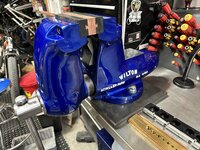
rebuilt a Wilton C3 vise
IMG_5451.jpeg
and anvil,
IMG_6672.jpeg
IMG_6673.jpeg
IMG_6678.jpeg
and Made custom dovetail jaws for the vise for interchangeable soft jaws and shaft clamps
IMG_6867.jpeg
And restored a 40" Lista cabinet I found for sale cheap. I'm also part way into a restoration of a Bridgeport 15" rotary table too.

So in the gist of getting you all caught up, I'm going to start with a few things I did last winter, but didnt get a chance to post.
IMG_0006.jpeg
I got the apron's Bijur pump all cleaned up and order new parts to rebuild it. Including a new Bijur Check valve #3815, and a new filter set S175
IMG_0011.jpeg
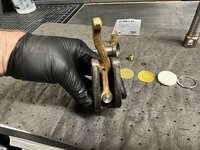
The lever arm goes back into the casting first
IMG_0012.jpeg
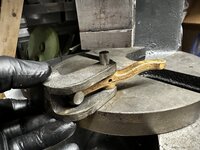
and its main pivot gets pressed back in using the arbor press.
IMG_0013.jpeg
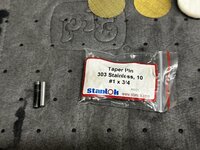
It is then secured by a new #1 x ¾" stainless taper pin
 
OP
G

Grant Gunderson

Well-known member
Joined
May 17, 2013
Messages
2,320
Location
Bellingham, WA
IMG_0015.jpeg
A taper pin reamer cleans the bore before pressing the pin
IMG_0016.jpeg
IMG_0018.jpeg
IMG_0019.jpeg
I then primed the pump intake with some Vetra#2 way oil.
IMG_0022.jpeg
And used a 18mm low torque wrench and a 11/32drill bit inserted into the counterbore under the intake to secure it in place
IMG_0032.jpeg
A brass o-ring spoon inserts the o-ring for the check valve seal
IMG_0034.jpeg
and finally the check valve gets tightend
IMG_0036.jpeg
The inlet check valve gets inserted and then
IMG_0038.jpeg
and then a #5 hollow ground flat head driver torques it down next up the filter stack
IMG_0042.jpeg
IT seems a bit odd to me it goes fine to coarse the way the fluid sees it, but thats how they had it originally.
 
OP
G

Grant Gunderson

Well-known member
Joined
May 17, 2013
Messages
2,320
Location
Bellingham, WA
IMG_0047.jpeg
I used the Brass o-ring tool again to secure the retaining clip for the filter stack.
IMG_0051.jpeg
The pump is finished!
IMG_0052.jpeg
Next up is all new oil lines for the apron. I ordered new brass tubing from Bijur.
IMG_0053.jpeg
First I used a tapered reamer to clean out all of the line bores. I then needed to make the first flared end for the line.
IMG_0054.jpeg
After cutting the tube, I reamed the opening.
IMG_0057.jpeg
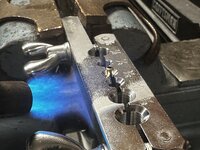
I then clamped it in an automotive flaring tool. It's not the correct size for the tubing, but it's just close enough to kinda work. I then heated the tubing end to make it more malleable.
IMG_0061.jpeg
It then gets flared.
IMG_0062.jpeg
aint perfect, but that should work well enough for this application.

IMG_0070.jpeg
I did my best to estimate the length needed for each run and rough cut them to size.

IMG_0071.jpeg
I then routed all of the lines. That was a real pain in the ***.
 
To avoid these ads, REGISTER NOW!
OP
G

Grant Gunderson

Well-known member
Joined
May 17, 2013
Messages
2,320
Location
Bellingham, WA
IMG_0066.jpeg
The lines get secured using some RTV sealant under the flairs and pressed into the ports.
IMG_0073.jpeg
I installed the Tee and its metered outlet valve Bijur# FJC00
IMG_0074.jpeg
The compression fittings are composed of the inner ferrule, the olive and then the compression nut. Compression fittings work by the compression nut compressing the olive to create the seal. On thinner tubing the inner ferrule is in place to prevent the tube from compressing as well.
IMG_0077.jpeg
It's important to note that teflon tape is not to be used on compression fittings.IMG_0079.jpegI used a tubing bender to form the bends needed in the lines as you do not want to kink the tubing.
IMG_0081.jpeg
compression nut assembled for the pump.
IMG_0086.jpeg
and connected to the inlet of the Tee. I was a bit worried that I may have kind that last bend when securing it.

IMG_7747.jpeg
So I tested it with compressed air.
IMG_0083.jpeg
I then secured the line to the pump, and thats where I left off leading up to my hand surgery.
 
Last edited:

tarmy

Well-known member
Joined
May 28, 2014
Messages
4,690
Location
Nor Cal
I just realized that I am passing thru your hometown tomorrow on our way back from 3 weeks in Canada.

I like like my filets MR and a baker is good with that…should be by around…welp…dinner time!😎
 
OP
G

Grant Gunderson

Well-known member
Joined
May 17, 2013
Messages
2,320
Location
Bellingham, WA
How's your hand doing?
The surgery last year was unsuccessful. The curvature from the duptyrens contracture came back immediately. At least it hasn’t significantly progressed past that. If it does progress I’ll need to research trying to find a DR that specializes in it outside of the seattle area or look at doing radiation (appears to have mixed results) for it.
 
OP
G

Grant Gunderson

Well-known member
Joined
May 17, 2013
Messages
2,320
Location
Bellingham, WA
IMG_7748.jpeg
I bolted the pump down with 4 stainless SHCS
IMG_7750.jpeg
Then pulled all of the apron parts out of the storage box. Despite having labeled everything in ziplock bags it took me for ever to sort through the parts. Seems like no matter how well organized you are with this many parts. Pieces are bound to end up in the wrong box. Having the Apron, Gear box and Headstock torn apart is probably the equivalent of having your Engine, transfer case and transmission fully torn down at the same time and then walking away from it for a year. So going to be a bit slow going back together as I gotta wrap my head around it all. We will see how good my notes from the disassembly were! Haha.
IMG_7753.jpeg
Next step is pressing the bushings for the lead screw and worm gear back in. Since I’d rather not damage the paint trying to do it in the arbor press I used some ⅝ all thread and some grade 8 washers. I have the bushings a light coat of super lube then pressed them in.
IMG_7758.jpeg
I used an alignment punch to center the recess in the bushings for the dog point set screws.
IMG_7754.jpeg
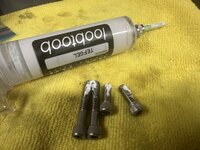
I then injected some Tef-Gel into the holes for the set screws. I really like using these syringes for applying grease / antiseize.
IMG_7755.jpeg
Finally the dog point set screws lock the bushings into place.
 
OP
G

Grant Gunderson

Well-known member
Joined
May 17, 2013
Messages
2,320
Location
Bellingham, WA
IMG_7770.jpeg
Ok, next is getting the fork shifter back in. The bearing retainer plate goes over it. As you can see here I didnt do a good job of keeping the body filler out of the mounting holes. I need to clean them out.
IMG_7771.jpeg
I chucked a drill bit into one of my Starrett tap handles to clean out the holes. You can't do this with a cheap tap handle.
IMG_7772.jpeg
And then attempted to clean the bores out.
IMG_7773.jpeg
Well ****, it blew the paint out of the counter bores. I'll have to repaint this when I do the next batch of small parts. I'm sure during reassembly there will be some touch up work to do.
IMG_7774.jpeg
The shifter fork is held on by a #1x1" taper pin. I am replacing the taper pins with new stainless ones.
IMG_7775.jpeg
All of the parts going back into the apron get a thin coating of Vector #2 way oil. Here the sifter fork shaft is getting lubed.
IMG_7778.jpeg
I slid the shifter fork on to the shaft and rotated it until it all lined up. I then reamed the pin hole with a #1 taper pin reamer.
IMG_7780.jpeg
I then used my extra long Knipex needle nose pliers to insert the taper pin.
IMG_7781.jpeg
and then one of my extra long Starrett pin punches to drive it home.
IMG_7782.jpeg
I then need to put the oil pan on over the pump so I can rest the apron right side up for assembly. First I need to cut a gasket for it. I am using some UHMW gasket material for this. Here I am getting ready to rough cut the external dimensions.
 
OP
G

Grant Gunderson

Well-known member
Joined
May 17, 2013
Messages
2,320
Location
Bellingham, WA
IMG_7783.jpeg
I used my transfer punches to make the hole locations for the mounting bolts.
IMG_7785.jpeg
IMG_7786.jpeg
I then use my Mayhew gasket punch to make the holes.
IMG_7787.jpeg
And then check the fit.
IMG_7788.jpeg
I then trim it to size using an exact blade. You can see here I still need to finish trimming it.
IMG_7789.jpeg
I then bolt the oil pan on.
IMG_7790.jpeg
and finally trim it to size with a razor blade.
IMG_7807.jpeg

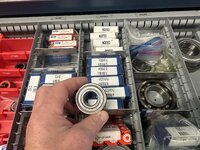
I then need to put the worm gear shaft in. First I need the proper bearing. I keep all of my bearings by size in one of my Lista drawers. The original is a New Departure C8504 bearing.
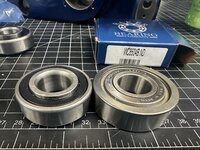
IMG_7809.jpeg
Note the difference between the C8504 on the left and the 8504B bearing on the right. The C8504 has a raised center section on both sides of the shaft and is the correct bearing for this location.
IMG_7811.jpeg
here is the orientation of the worm gear shaft. NOTE, the worm gear is facing the wrong side here.
 
OP
G

Grant Gunderson

Well-known member
Joined
May 17, 2013
Messages
2,320
Location
Bellingham, WA
IMG_7813.jpeg
It's hard to see but when I disassembled the apron, I marked the shifter gear with an "R" to indicate the side that faces the rear of the
apron.
IMG_7815.jpeg
The shifter gear slides into the shifter fork.
IMG_7818.jpeg
I can then slide the worm gear shaft into place.
IMG_7819.jpeg and then the bearings onto shaft and into the bores, front and rear
IMG_7821.jpeg
Now I need to press the bearings in. I dont want to tap new bearings into place, so I'll use the bearing retainer plates to push them into postion
IMG_7823.jpeg
The correct screws for them are #8-32 Oval head screws. I'm going to use all Stainless hardware on the lathe.
IMG_7825.jpeg
All of the fasteners first get a dab of Ted-Gel. Note I already chased all of the threads after I painted the castings.
IMG_7826.jpeg
Front plate temporarily screwed down
IMG_7827.jpeg
The rear then gets temporarily installed I then needed to use some longer 1.25" screws to get the rear retainer plate started.
IMG_7828.jpeg
I then switched them out for the proper Oval head screws. Using a good hollow ground tipped flat head screw driver is essential for not mangling the tips of the Stainless flat heads.
 
Last edited:
OP
G

Grant Gunderson

Well-known member
Joined
May 17, 2013
Messages
2,320
Location
Bellingham, WA
IMG_7829.jpeg
The lower Idler gear shaft goes in next.
IMG_7830.jpeg
First I pull the bearing retainer plate off of the worm gear shaft bearing and then lube the bores with way oil.
IMG_7831.jpeg
Someone told me the name of this type of shaft lock, but I can't remember it. First the rear bushing portion of the scotch lock gets aligned and pressed in with a section of all thread.
IMG_7834.jpeg
I then do my best to eye ball the alignment of the shaft into the bushing.
IMG_7836.jpeg
a 6-32 set screw locks the bushing into the casting.
IMG_7839.jpeg
I then use an alignment pin punch to correct the line up of the shaft into the bushing.
IMG_7840.jpeg
I then chase the threads
IMG_7842.jpeg
and insert the 8-32 set screw that locks it all in place.
 
OP
G

Grant Gunderson

Well-known member
Joined
May 17, 2013
Messages
2,320
Location
Bellingham, WA
IMG_7843.jpeg
I then used a gasket punch to make the gasket for the rear bearing retainer for the worm shaft.
IMG_7844.jpeg
IMG_7845.jpeg
and then secure it into place for the final time.
IMG_7846.jpeg
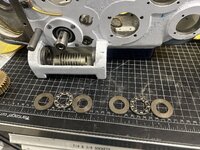
The worm gets dropped in. It has a thrust bearing on either side.
IMG_7848.jpeg
Unfortunately the replacements I ordered are too thin, so I need to find some thicker ones that match the originals.
IMG_7855.jpeg
Moving on, I lube the worm gear shaft with way oil, then insert the woodruff key into it.
IMG_7856.jpeg
I then used a large socket as a drift to tap the gear on.
IMG_7858.jpeg
It gets secured with a ¼-20 dog point set screw.
IMG_7859.jpeg
Finally I align the oil line to drip into the center of the gear.
 
OP
G

Grant Gunderson

Well-known member
Joined
May 17, 2013
Messages
2,320
Location
Bellingham, WA
IMG_7860.jpeg
Next up is installing the Hand Wheel shaft. This also serves as the cam that drives the oil pump. It uses two SKF BR88503 bearings
IMG_7862.jpeg
I cleaned all of the parts in my ultrasonic. I then lubed it all with way oil and slide the first bearing on.
IMG_7863.jpeg
The hand wheel spacer goes on next.
IMG_7864.jpeg
I then placed the hand wheel shaft into my Starrett Vee blocks so I could tap the woodruff key in.
IMG_7865.jpeg
I then placed the oil pump cam under the oil pump lever and slid the hand wheel shaft into position.
IMG_7867.jpeg
Front with the hand wheel shaft installed.
IMG_7868.jpeg
The retainer for the hand wheel shaft gets screwed into the back side.
IMG_7869.jpeg
And then torqued down with a pin spanner
 
OP
G

Grant Gunderson

Well-known member
Joined
May 17, 2013
Messages
2,320
Location
Bellingham, WA
Next Up is the Longitudinal Friction assembly. Since it and the Cross Feed Friction assembly, use identical housings, I being by cutting gaskets for both of them.
IMG_7870.jpeg
Once, again I am using my Mayhew hole punch set of for this.
IMG_7872.jpeg
Here are the parts laid out from back to front of the apron
Rear bushing. Rear thrust bearing assembly, Friction gears inner thrust bearing, spring, washer, drive gear, front thrust bearing assembly.Friction bushing, and the friction stem.
IMG_7874.jpeg
The friction housing has an oil port drilled into it. This side must go up with the bevel. The other side thats just through bored is the drain and goes down.
IMG_7875.jpeg
Here you can see the drain hole.
IMG_7873.jpeg
I gave everything a good coat of way oil before assembly. First the front bushings slides over the friction stem.
IMG_7876.jpeg
I loosely mounted the friction housing to the apron. You do not want to fully lock it down yet. Note, I need to do some minor paint touch up around the screw counter bores.
IMG_7878.jpeg
I then place the front thrust bearing onto the friction stem and slide it into into the housing
IMG_7879.jpeg
I then lower the front friction gear into place, and slide the friction stem into it to hold it. The front friction gear should slide into the friction housing, however the oil line routing for the oil pump is in the way. I'm going to have to redo my oil line. Ugh. More on that latter.
IMG_7889.jpeg
Here you can see the oil fill port for the friction housing. You can see how the friction gear is drilled to allow oil to enter it when it spins. The friction gear then gets slid all the way into the housing.
 
OP
G

Grant Gunderson

Well-known member
Joined
May 17, 2013
Messages
2,320
Location
Bellingham, WA
Look at the back of the apron now, I then start to assemble the inner part of the friction assembly.
IMG_7891.jpeg
The inner thrust washer goes on next
IMG_7892.jpeg
followed by the spring
IMG_7893.jpeg
and then the inner thrust bearing stack. Now the tricky part, the friction shaft and the spring and thrust bearing stack all needs to get slid back flush with the rear of the front friction gear.
IMG_7894.jpeg
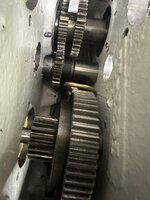
The rear friction gear slides down and the friction stem shaft gets pushed through it. Wasn't as difficult as I thought it would be.
IMG_7895.jpeg
Rear view from back of apron
IMG_7896.jpeg
The rear thrust bearing stack then slides on.
IMG_7901.jpeg
Next the friction lever gets inserted into the friction housing and stem. It is then retained by a 6-32 dog point set screw that locks into the bronze bushing on the lever shaft.
IMG_7902.jpeg
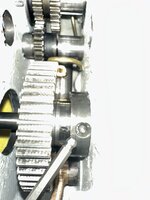
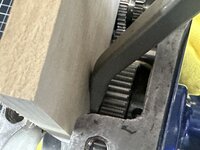
The rear bushing then slides on to the rear of the friction stem. You need to compress the spring, by pressing the two friction gears together to do this. I sued some scrap wood and a small crow bar.
IMG_7897.jpeg
The rear bushing is locked in place by a #1 x ¾" taper pin.
I reamed the taper pin hole and then drive a new stainless pin in.
IMG_7903.jpeg
Even after reaming, it remained slighted proud.
 
OP
G

Grant Gunderson

Well-known member
Joined
May 17, 2013
Messages
2,320
Location
Bellingham, WA
IMG_7904.jpeg
So I filed it down flat. The rear cover plate can then be screwed on, but I still need to cut gaskets for those and paint them.
IMG_7905.jpeg
The friction stem retaining nut then gets installed on the front. I used a camera filter spanner wrench to do this. This nut, sets the preload on the spring in the friction assembly, so if the gear isn't engaging, then first then to do is to adjust the preload here. The longitudinal friction assembly is now done minus the rear cover plate.
 
OP
G

Grant Gunderson

Well-known member
Joined
May 17, 2013
Messages
2,320
Location
Bellingham, WA
Next I need to install the compound gear and stud
IMG_7907.jpeg
First I tap in the rear locking bushing and make sure it's aligned with the casting. Once again everything gets a coat of way oil prior to installation.
IMG_7908.jpeg
The compound gear then gets lowered in. Note the large diameter side gets toward the front of the apron.
IMG_7909.jpeg
The compound gear stud then gets slid in to hold the gear in place and I eyeball its orientation to line up with the rear lock.
IMG_7911.jpeg
I use a brass drift to drive it in flush.
IMG_7913.jpeg
I then use a ⅛" alignment punch to align the locking bushing to the casting and the shaft.
IMG_7914.jpeg
and then chase the holes with a 8-32 forming tap.
IMG_7915.jpeg
and finally lock it in place with the two set screws coated with Ted-Gel. The compound gear and stud are now installed.
IMG_7917.jpeg
I then spun the gears and slid the shifter fork back and forth to make sure everything so far was meshing well and nothing was binding.
IMG_7918.jpeg
 
OP
G

Grant Gunderson

Well-known member
Joined
May 17, 2013
Messages
2,320
Location
Bellingham, WA
Now its time to install the half nuts.
IMG_7920.jpeg
I lubed the pivots with way oil
IMG_7922.jpeg
and then pressed them by hand into the half nut shaft. and then locked them in place with dog point set screws
IMG_7923.jpeg
Both pivot arms installed.
IMG_7924.jpeg
The assembly then gets installed. Here I noticed yet another problem with the routing of my oil lines. I'm going to have to pull them and replace them. The Bronze lines were a ***** to install, so I ordered some copper lines to redo these two with. I'll finish the 1/2 nut install then pull the lines and reinstall the nuts once they arrive.
IMG_7925.jpeg
The cross feed nut studs then get inserted into the pivot arms.
IMG_7927.jpeg
The back of the bronze ½ nuts get coated with way oil, Its amazing how well these cleaned up in the ultrasonic.
IMG_7928.jpeg
The ½ nut ways also get a coat of way oil and I then slid the half nuts onto the studs.
IMG_7929.jpeg
notice how the back of the ½ nuts engage with the shoulder of the studs.
IMG_7930.jpeg
I then slid the feed reverse lock on to its stud
IMG_7932.jpeg
Note that the heavy hex nuts used to secure the ½ nuts have one side that is slightly raised. These are supposed to face the washers.
 
OP
G

Grant Gunderson

Well-known member
Joined
May 17, 2013
Messages
2,320
Location
Bellingham, WA
IMG_7933.jpeg
I then torqued down the nuts to lock the ½ nuts on to the studs. Note the heavy washers get installed with the bevel side facing out.... just as every washer should be installed.
IMG_7934.jpeg
The RH retaining plate gets a good coat of way lube on all of the bearing surfaces. note the notched section needs to align with the lock plate for the feed / reverse.

IMG_7935.jpeg
I inserted the lock plate into the feed / reverse shaft first, then installed the RH retaining plate.
IMG_7936.jpeg
the plunger gets installed next
IMG_7937.jpeg
followed by the spring
IMG_7938.jpeg
and then the set screw
IMG_7939.jpeg
I gave all of the stainless mounting hardware a dab of Ted-Gel
IMG_7940.jpeg
and installed the LH bracket. Checked functionality and then removed, so I can replace the oil lines.
 
OP
G

Grant Gunderson

Well-known member
Joined
May 17, 2013
Messages
2,320
Location
Bellingham, WA
Next up is the cross feed friction assembly.
IMG_7941.jpeg
Here are all of the parts laid out from back to front. other than the gears its identical to the Longitudinal friction assembly.
IMG_7942.jpeg
The friction stem with the bushing and front thrust bearing stack assembled. My friction stem has a lot of wear on the shaft. I need to see if I can source one. It's good enough to work now, but if I can I'd like to replace it.
IMG_7944.jpeg
Friction stem inserted into the housing.
IMG_7945.jpeg
Once again, note the oil port for the friction housing must face up.
IMG_7946.jpeg
The front gear gets lowered into place and I then push the fraction stem through it.
IMG_7947.jpeg
The inner thrust washer gets installed.
IMG_7948.jpeg
followed by the spring
IMG_7949.jpeg
and the inner thrust bearing stack
IMG_7950.jpeg
Notice the helical oil passages ground into the rear friction gear inner busing. Talk about well made.
IMG_7951.jpeg
With the friction stud pulled forward so the inner thrust bearing is even with the rear of the front friction bearing, I then lower the rear gear in. Notice the bevel faces into the front friction gear.
 
To avoid these ads, REGISTER NOW!
Top Bottom