To avoid these ads, REGISTER NOW!

Rebuilding a monarch 10ee lathe

DocsMachine

Well-known member
Joined
Sep 16, 2006
Messages
1,844
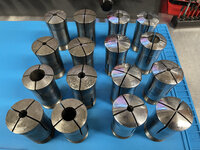
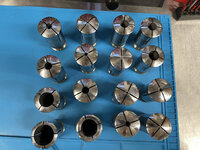
The collet set is a full set of Hardinge 2C collets. All the way down to 1/32”.

-Probably 2J, not 2C. Slightly better capacity than 5C, going up to a max of 1-3/8". And those Sjogren chucks are a blast to use. :D

Next step is figure out a leveling foot / castor setup.

-I absolutely would not recommend trying to use casters of any kind on that machine- or really, on any lathe. The only way I'd consider it, personally, is to make a "cart" where the wheels are outboard of the base casting, and the whole mess is only raised up maybe half an inch, max.

That's a really nice machine, and lifting it up on casters is a really good way to wind up dumping it on it's face, and damaging enough to scrap it.

Doc.
 
To avoid these ads, REGISTER NOW!

matt_i

Well-known member
Joined
Mar 14, 2008
Messages
10,714
Location
SE Michigan
The people suggesting pallet jacks are spot-on. I suggest to use 2 stacks of 2x6 cribbing until you decide you want something more permanent.
 
OP
G

Grant Gunderson

Well-known member
Joined
May 17, 2013
Messages
2,312
Location
Bellingham, WA
Grant,

I have some of those, they are fine for many things. They would be a pain in the **** on a 10EE. For the price of three of these you could buy a nice pallet jack. I don't know how tall you are but, many folks put 4X or other blocking to raise their lathe. I am not that tall 5'8" and my 10EE is on Veler leveling feet that are high enough to get a pallet jack under.

I get the idea that you want the lathe to be mobile. One thing about lathes, they are top heavy and have known to flip over when a wheel gets stuck. A pallet jack provides excellent mobility and maneuverability. You have that flooring in your garage that will make moving a chore regardless. The only way I could recommend caster wheels is on a perimeter frame that is longer and wider than the machine base. To add that caster wheels should be at least 6" and 8" is better. The small wheels on leveling casters is too small for the weight and any thing on the floor can stop them in their tracks.

I have a huge shop with big machines and big forklifts to move them around. That is now, I was in your shoes once upon a time. A pallet jack is a small garage is like a forklift in a big shop. Once you have one you'll wonder how you ever got along without.

Steve
I totally get what you are saying. I will be moving the mats prior to moving the machine, then reinstalling the matts. Biggest issue with a pallet jack is I have no room at all to store one. I'm more than maxed out on space and I am pretty sure if I add one more thing to the garage right now, my wife will kill me, or at the least divorce me. So before going that route, I want to explore all of the options first.
 
Last edited:
OP
G

Grant Gunderson

Well-known member
Joined
May 17, 2013
Messages
2,312
Location
Bellingham, WA
-Probably 2J, not 2C. Slightly better capacity than 5C, going up to a max of 1-3/8". And those Sjogren chucks are a blast to use. :D


-I absolutely would not recommend trying to use casters of any kind on that machine- or really, on any lathe. The only way I'd consider it, personally, is to make a "cart" where the wheels are outboard of the base casting, and the whole mess is only raised up maybe half an inch, max.

That's a really nice machine, and lifting it up on casters is a really good way to wind up dumping it on it's face, and damaging enough to scrap it.

Doc.
Yes, 2J.... its damn hard to keep straight all of the collet names out there. At least I just have these, the R8's and the grizzly R8 quick change collets for the mill to keep track of now.
The people suggesting pallet jacks are spot-on. I suggest to use 2 stacks of 2x6 cribbing until you decide you want something more permanent.
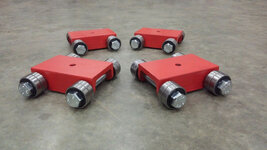
I agree. Any time I am trying to solve a problem I like to look at all of the options and then get some feed back from people better experienced in the direct matter than I am.... So thinking of a system similar to what this guy did, using machine skates. Monarch on wheels. Thoughts on that set up?

Dealing with a machine this heavy, its important to make sure what ever I do is safe and a factor of safety is also included. Dropping that damn cover panel on my foot when I slipped on the wet trailer deck is more than enough of a reminder about that.....hence I am up at 5 am icing my foot.....its also why I pressure wash my deck every year. Any horizontal surface that isn't, gets a good layer of evergreen tree pollen on it every spring, if that stuff isnt removed it's slicker than ice when it gets wet... especially if the surface is wood.
 
Last edited:

dutchgray

Well-known member
Joined
Sep 28, 2014
Messages
6,461
Location
Dorset. England.
That is well tooled for a used lathe, will save you a small fortune not having to buy it all. Both of mine came with pretty much nothing.

I would put it roughly in its location with the rented forklift on 4 by 4 cribbing, then buy a set of machine skates and a toe jack for future lifting and moving. A lathe is something you don't want to move around any more than you have to.
That said I have a pallet jack which moves my small lathe very easily.
 

dr_clyde

Well-known member
Joined
Jan 7, 2009
Messages
6,421
Location
Holland, MI
Skates are a very different animal than casters, and I still wouldn’t recommend it if it can be avoided.

Machine tools are designed to be properly leveled on a solid base.

Will it work on skates or casters? Probably. Is it recommended? Not really. Accuracy and precision comes from a leveled machine. Lathes in particular.

Granted, it sounds like the 10ee’s bed is mounted to the base in such a fashion that it is more resistant to twist than say a leblond, it’s still good practice and stewardship of machinery to have it properly installed.
 

IndyGarage

Well-known member
Joined
Apr 29, 2010
Messages
9,669
Location
Indy
They are pretty heavy, but I wouldn't say top heavy. Most of the weight in those old ones is right in the bottom, where that heavy motor/generator/motor setup is.

I would leave it on the leveling pads. I would not put it on wheels or skates except to move it. The problem with a pallet jack, as opposed to a forklift is the forks are much thicker, and I don't think they will fit under a 10EE - whereas a forklift goes right under it.
 
OP
G

Grant Gunderson

Well-known member
Joined
May 17, 2013
Messages
2,312
Location
Bellingham, WA
I ended up ordering some skate wheels and leveling feet from McMaster today. Once they arrive in a few days I will custom make a skate / leveling foot setup for the machine. Once thats done I can get it unloaded from the trailer and in the garage.... at least the weather looks decent, and the tarp is keeping it dry until then.

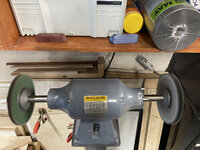
While I am waiting to get the lathe unloaded, I started in on cleaning the tooling. First up is the collets. For anything that doesn't have bearings and that will fit in my ultrasonic cleaner, I like to start with that. I have found a solution of 1 gallon water with a few gulps of simple green does a great job of cleaning all of the swarf off, and it even gets into areas I couldn't otherwise, such as the threads and the slits in the collets. I start with a 30 min run In the ultrasonic cleaner, then pull them, take a brass brush to any areas that have excessive build up and then toss them back in for another 30 minutes. Next, I pull them, and give them a light buff with my Baldor buffer.
IMG_0333.jpeg

Depending on what I am polishing I can start with a scotch bright sandpaper combo wheel and then work my way threw the various compounds / wheels. Since the collets are precision, I dont want to remove anymore material than needed. I just want to clean off the 70 years of cutting fluid residue. So for these I just started with a quick pass with the red compound, and then switched to my blue compound wheel. Here is a before / after pic of two batches of the collets.IMG_0331.jpeg
And the two batches I got done today:IMG_0334.jpeg

While I was waiting for the ultrasonic cleaner to do its thing, I scrubbed the wrenches that I got with the machine with some degreaser and a brass brush. It was nice to see the included spanners where good quality Willams USA. I'll add those to the collection of the ones I already own as these are much larger than anything I had. I had to buy a bunch of spanners for the Bridgeport rebuild, so I'll be curious to see If I'll need these, or if these where from some old chucks that where not included. Most likely I'll clean them up a bit more at least.
IMG_0352.jpeg

Most of the wrenches where of usa brands. Some of which I have not heard of before. Not sure what I'll do with these, other than the pin spanner, as I have a very complete set of Snapon.
IMG_0351.jpeg

The lathe specific wrenches all seem to be of good quality as well.
IMG_0350.jpeg
 
Last edited:
OP
G

Grant Gunderson

Well-known member
Joined
May 17, 2013
Messages
2,312
Location
Bellingham, WA
Now, one of the coolest things I found in the Monarch tool cabinet that I got with the lathe, was an original Federal dial indicator specifically made for Monarch, and its case to attache it to the lathe. It was filthy. The clam shell case was packed full of chips, and the indicator didn't seem to work. I cleaned it all up, pulled the back off of the indicator and cleaned out of 70 years worth of dirt.
IMG_0340.jpeg
Low and behold, after cleaning its internals it works perfectly now. Next I pulled off the front bezel, and used some lens cleaner that I use for my day job. ROR (residual Oil Remover) is the best lens cleaning fluid I have found in all the years I've worked as a photographer. It did a great job of getting all of the old cutting fluid and grime off of the lens. The plastic of the lens has heavily yellowed over the years, and its got a few distortions due to age where its no longer perfectly smooth (plastic like glass will creep over the years). So I did my best to polish the lens best I could with a graphite lens pen. While its not perfect, It cleaned up pretty well and is very usable now.
IMG_0343.jpeg

The dial indicator attaches to the clam shell case via the post on the back of it. It's fitment is quite critical, as too deep or too shallow the indicator rod will bind on the case. I lightly tighten the set screw on the case and then moved the indicator by hand until I could fill the set screw drop into the recess on the indicator post.
IMG_0346.jpeg
It is a well thought out setup, and its amazing it still works all of these years latter. I'm not sure how much this indicator will get used by me, as I have more modern ones and plan on putting a DRO on the machine when its done. I do plan on painting the case to match the machine, once I decide on paint for the machine.... thinking a polyurethane paint, but not sure what yet. I used the rustoleum hard hat machine grey on the mill and it has held up pretty good, so far other than one brand of cutting fluid attached it. I'm thinking the 10EE deserves something a bit special tho.
IMG_0347.jpeg

IMG_0345.jpeg
IMG_0348.jpeg
 
Last edited:
OP
G

Grant Gunderson

Well-known member
Joined
May 17, 2013
Messages
2,312
Location
Bellingham, WA
The parts for the skates / leveling feet where supposed to be delivered today, but /UPS decided to stall another day on them. Thats ok, it gave me some more time to focus on cleaning up the tooling. I got all of the collets (1/32 all the way up to 1-⅜ by 32nds) cleaned and polished, as well as a few of the wrenches, a stop and a center.IMG_0363.jpeg

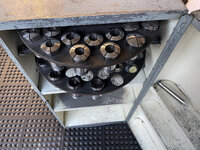
The lathe came with one of the original Monarch tooling cabinets. I dont know if I will keep it yet, as space is at a premium in the garage, so I just gave the cabinet a good wipe down to get all of the swarf, chips, cob webs etc out of it. If I decide to keep it I will paint it to match the lathe. The cabinet is cool as it has built in storage for all of the collets and then some.
IMG_0373.jpeg
IMG_0375.jpeg
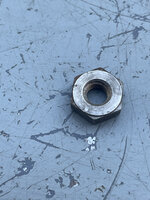
Even the tool cabinet is well made. Looking at the nuts that hold the collet rack in, they are machined with a washer surface on side.

IMG_0355.jpeg
Those nuts were so thin that when I needed to start the bolt in the back of the cabinet behind the collet rack, it would fall down too far in even my shallow broached Snapon socket. So I used a few o-rings in the socket to get the nut to set flush, to make it easer to start in the hard to reach spot in the back of the cabinet.
IMG_0359.jpeg
I then started in on the tool holders.. The 3 way Armstrong had me puzzled at first, then I relized you need to pull out on all 3 pistons at once to release the center. Since I only have two hands I let gravity work as the third.
IMG_0378.jpeg

The tool holder is in good shape, but figured it was about time to clean out 70 years of old grease / swarf. The nice thing about using the eyebolts when I pulled the pistons out to release the handle, is that it then allowed me to use the eyebolts to push the pistons all the way back in to remove them. Each one has a spring on it, and I have a feeling it will feel way nice once the old grease is cleaned out and the springs are free to move properly again.
IMG_0383.jpeg

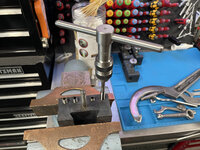
Turns out all but two of the tool holders where shop made, but they all cleaned up nicely with a good soak In the ultrasonic cleaner, and then some scotch bright. On one of the shop made tool holders, two of the set screws where extremely tight. I figured that the threads just needed to be chased. Since I dont have a thread chaser set (maybe its time to by one) I just attempted to chase them with a tap. They where so tight with the tap I thought I was going to break it. So I pulled it out, and checked the clearance hole with the proper tap drill. Turns out those two where drilled undersized.... guess that one was made by an apprentice. I have no idea how they taped them with out breaking a tap! So I re-driled those two and then ran a tap down them again and now the set screws fit perfectly.

IMG_0371.jpeg
Normally when I tap a hole I use a tap guide in the Bridgeport right after I drill it, but figured for something this easy that was over kill. BTW, If you have never used a Starrett tap handle, you should give them a try, they are lightyears better than any other one on the market.

Next, I wiped the tool holders down with acetone, and then applied some blueing fluid to them. Gave them a quick rinse in water, then repeated after a light rub with steel wool. After the second coat of bluing fluid, I gave them all a wipe down with Boeshield T3 ( this stuff is also the best bike chain lube I have found for the PNW). I think they turned out pretty good. If anyone has any tips for blueing I am all ears, as I am always trying to improve on the finish. I highlighted the text on the factory tool holders and the collets using a Laquer stick.
IMG_0384.jpeg
And here is the before photo of the tool holders:

IMG_0283.jpeg
 
Last edited:
OP
G

Grant Gunderson

Well-known member
Joined
May 17, 2013
Messages
2,312
Location
Bellingham, WA
The one thing I don't see that you will probably want, is a live center....You don't really want to mess with white lead or high pressure lubes unless you really have to.
I’m not going to screw around with any lead in the garage if I don’t have to….Striping the lead paint will be enough of that! The lathe came with 7 live centers. I haven’t gotten too going through them yet. So no idea on condition. One thing I didn’t get was any cutting tools. So I’ll need to look for a set plus a knurling tool. All in due time as I got a lot of work ahead of me before I start using the lathe.03AC9797-F420-49B0-960A-A6C6FDA5DC17.jpeg
 
Last edited:

matt_i

Well-known member
Joined
Mar 14, 2008
Messages
10,714
Location
SE Michigan
One of my favorite tools is a CCMT - 80 deg diamond which can turn and face without changing. Yes there are others like a TCMT triangle which can do the same but its not as tough.

2Js are awesome, they could be had a couple years back, new for ~75 each but Hardinge may have stopped making them. Have saved me a bunch of time modifying small gears....
 
OP
G

Grant Gunderson

Well-known member
Joined
May 17, 2013
Messages
2,312
Location
Bellingham, WA
One of my favorite tools is a CCMT - 80 deg diamond which can turn and face without changing. Yes there are others like a TCMT triangle which can do the same but its not as tough.

2Js are awesome, they could be had a couple years back, new for ~75 each but Hardinge may have stopped making them. Have saved me a bunch of time modifying small gears....

LOL, depending on what type of lathe work you plan, I would get a couple of bit holders and bits before laying out much for inserts and insert holders. Learning to grind your own bits is well worth the time and effort.
Thanks for the tooling suggestions. Now that I got the lathe I’m going to keep an eye out for any used insert holders that pop up for sale at a reasonable time. If I get in a pitch Grizzly’s headquarters is just 5 minutes down the hill from me. However I have found their cutting tools can be a hit or miss if they are actually sharp or not.
 
To avoid these ads, REGISTER NOW!
OP
G

Grant Gunderson

Well-known member
Joined
May 17, 2013
Messages
2,312
Location
Bellingham, WA
I generally avoid the Asian import tools.
I’m right there with you. I find 99% of the time they are a disaster unless it’s made in Japan, then they can actually be really good. For example my Nepros ratchets that I brought back from a work trip years ago are way better than my Snapon ones.
 

dutchgray

Well-known member
Joined
Sep 28, 2014
Messages
6,461
Location
Dorset. England.
I have been picking up insert holders and inserts since I bought my first lathe, about a year and a half now, was even given a bunch of holders from the guy who I bought the Bridgeport from, got some from my scrap guy to, though some of those were scrap. You can get them pretty cheaply if you are patient.
I keep the junk insert holders, they are usually good steel, when you want a short piece of square stock for something, though use carbide as they are hard on the outside.
Since the 10EE is a decent heavy industrial lathe with plenty of power it will run carbide well, and you can't beat carbide for getting metal cut fast.
 

dr_clyde

Well-known member
Joined
Jan 7, 2009
Messages
6,421
Location
Holland, MI
I run quite a variety of inserts and geometries, there are so many that it can be hard to keep them straight. Iscar and Ingersoll are the go to in my shop, while Tungaloy and a few others like Kennametal or Sandvik make good carbide as well.

To start off with, I'd get a WNMG (trigon) insert for roughing and a VNMG for finishing. There are lots, but those will get you by for a lot of lathe work.

Don't discount a good, sharp HSS tool for aluminum and plastic. Often more effective than carbide for the home shop.
 
OP
G

Grant Gunderson

Well-known member
Joined
May 17, 2013
Messages
2,312
Location
Bellingham, WA
UPS finally dropped off the parts for the skates / feet last night at 7pm. Sure miss the days when they actually delivered during normal business hours. I only got an hour of shop time in before my wife made me shut the mill down. Took me twice that to clean up the steel chips so my 4 year old doesn’t get into them.

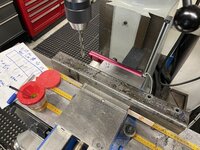
I had a stick of 2” ¼ wall square tube on hand so using that for the feet. First step was to drill the ⅜ holes for the axles for the skate wheels. Using the quill feed on the mill made quick work of this. Started with a ¼” drill bit then stepped up to a ⅜. Afterwords quickly hit each hole with a countersink in the hand drill to debur the hole.
79E3E1A9-27E6-4986-AE14-7C866481F9FB.jpeg

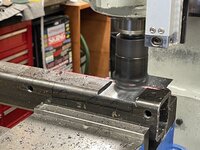
Next I used a 2” indexable mill with carbide inserts to machine a .5 deep by 4.5” slot in the bottom of the steel tube so the machine feet I ordered can retract enough to give the skate wheels clearance. The diameter of the feet is only 4”, but I wanted to have some leeway as I won’t drill the holes for the feet until I set the machine on the steel tube and mark them directly. My transfer punch set only goes to ½” so I’ll just use a drill to mark the hole location. Those will then get tapped to accept the feet
378E94F6-4D52-4886-9F34-04888FC8511D.jpeg

The skate wheels are rated for 400lb each and there will be a total of 16 of them so plenty of safety factor for weight. All of the hardware for the axles is grade 8. The feet I ordered from McMaster are made in the USA stainless steel machine feet. Each is rated for 2000lbs and has a 4” 5/8 stud that seems to perfectly fit the factory drilled holes for the machines kinematic base. Bellow is a shot checking the fit of the hardware and making sure my clearance slot of the feet is deep enough at .5”

C5BB71E8-F17A-4E44-A695-15A694390851.jpeg
The nice thing about this is if I decide to get a pallet jack in the future I’ll have plenty of room to get it under the machine.
 
OP
G

Grant Gunderson

Well-known member
Joined
May 17, 2013
Messages
2,312
Location
Bellingham, WA
Got the retractable machine feet and skates that I made all finished up. Just need to set the machine on them to mark the location for the tapped holes for the feet. I painted the steel tube with POR15. That stuff seems to be exceptionally durable, but is so thin its impossible to apply via brush and not get any streaks. At least these will never be visible underneath the machine, so it was a good place to try out a new to me paint product. Thinking I need to either figure out at spray system (I doubt my little makita compressor will support a HVLP system) or I need to look into other paint options for the lathe.
IMG_0480.jpeg
IMG_0483.jpeg

I was hoping to move the lathe in over the weekend, but no rental equipment deliveries on weekends, and its pouring rain today, so its looking like hopefully tomorrow will be the big day!

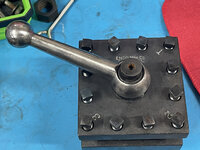
Spent my free time this weekend, cleaning up more tooling. The quick change tool post and the Enco 4 way (old usa one too) both turned out looking like new! The Quick change post is serial number 1200. Seems quite low.
IMG_0429.jpeg
IMG_0453.jpeg
IMG_0454.jpeg

I found a bunch of cutting tools tools in one of the boxes of misc stuff I got with the lathe, so cleaned those up too. That will get me started, but I a sure I will need more, and will need to get a good knurling tool too.
IMG_0467.jpeg

I also got both steady rests and the follower rest all cleaned up and ready to be stripped for paint. (Still gotta sort out what I will do for paint. Any suggestions are welcome!)

Before pic of one of the steady rests:
IMG_0423.jpeg

And after cleaning:
IMG_0457.jpeg

I noticed a few things while cleaning up the steady / follower rests. These along with two of the chucks all have matching EE numbers from Monarch that match the lathe's. So these where part of the original equipment that was sold with the lathe... cool!

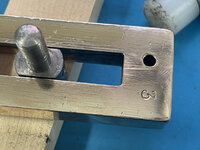
The level of detail that Monarch put into even the steady rests is amazing, and that simply doesn't exist anymore today in manufacturing. For example all of the brass inserts for the rests are hand fitted to each position. They are each stamped with a number that corresponds to the correct spot for them in the steady / follow rests.
IMG_0444.jpeg

IMG_0447.jpeg
Its a bit hard to see in the last image, but the slot of that casting has a corresponding #3 next to the mount hole to match these two brass inserts. The three spots on the steady rests are also marked for the corresponding brass inserts. Seems overkill, but if monarch was that specific about how each of these fit, its best to pay attention and do as they intended. I cleaned all of these, by tapping out the retainer pin that holds the adjustment screws captive, and then cleaning in my ultrasonic cleaner. I then lubed everything with Super Lube and reinstalled the pin.
 

Steve from Socal

Well-known member
Joined
Jan 27, 2009
Messages
3,490
Location
Hutchinson Ks.
Grant,

The Enco turret tool post was a Monarch supplied part as well, can't say it that one is original to your lathe, they were part of the sales order. The numbered accessories are always a nice thing, the tool cabinet as well. You mentioned selling the cabinet, I would urge you not too. Think of of it like a factory luggage kit for a classic car. The completeness of your lathe and accessories adds value to the whole lot.

As far as paint DO NOT use POR15 to paint the lathe or accessories. Several folks have used Tractor Supply enamel with hardener. The polyurethane paints like Imron and Polane are great but likely to much hassle.
All of these can be applied with a brush. Spraying any paint that uses a isocyanate as a hardener will require some significant study in use and precautions. The issue is there with brush or roller application but the product is not aerosolized.

Paint over rust (POR) or converting paints are a FIX for objects that can not be preped for standard paint process application. They are not a top coat product. Any enamel paint will work, without a hardener enamel will take quite some time to cure, days to weeks. I would suggest a good primer like Southern Polyurethane Epoxy Primer as a base coat, it has ISO but can be brushed and dries in hours. Do you want to "fair in" the castings using filler? Just remember, this is a machine that makes hot sharp chips not a show car.

Steve
 
OP
G

Grant Gunderson

Well-known member
Joined
May 17, 2013
Messages
2,312
Location
Bellingham, WA
I was finally able to get a forklift to unload the machine. They joy I got out of letting my son go for a ride on it / play with the controls with me was worth the price of the rental alone. Here he is showing the older neighbor kid how the controls work.
IMG_0518.jpeg

The rental forklift only had 42" forks and apparently the one we loaded it with had longer 48" ones. I had no idea there was different sizes. so ended up having to buy a 6 foot lifting strap as the original 3 foot one I bought was to short, to give enough purchase on the forks to safely lift it. Once we had it all set up, I lifted it a few inches to clear the trailer, and had a bike bud pull the trailer out from under it. Next we lowered it onto some 4x6 wood blocks, so I could safely attached the shop made skates / leveling feet setup. I marked the hole locations using a scribe, then drilled and tapped them on the Bridgeport. Since the tail of the machine only has provisions to add one leveling foot, I drilled and taped the skate base I made for a 5/16 socket head bolt that I installed to keep that skate from rotating relative to the machine. Next I lifted the lathe from the bottom with the forklift and we placed it just inside the garage door.

Hot damn, the home made skates work better than expected. I can slide the machine around by my self, and turn it with the help of one person.

IMG_0489.jpeg

The machine is covered in a light. oil residue.
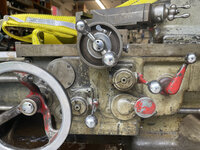
IMG_0499.jpeg
Luckily, this stuff dissolved quiet easily and with a light spray of degreaser it wipes right off.

IMG_0578.jpeg

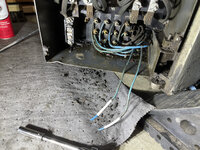
Now I can at least see what I am work with. First step is going to be pulling all of the electrical off of the machine. The wiring is very old, and is saturated with oil. The wiring insulation has holes in places where I can see right through it to bare wire... thats all gotta go. I'm going to pull it all so I can clean the machine and minimize the amount of cleaning fluids / oil getting on the control panel.
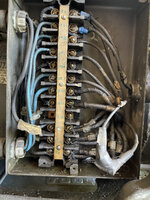
IMG_0540.jpeg
IMG_0574.jpeg

First time I have ever come across these sort of round terminals.... going to replace those with proper crimped ones with heat shrink.
IMG_0575.jpeg
Luckily all of the wire terminals on the machine are very well labeled. The wires themselves have these brass tags on them that are stamped with the name of the correct terminal. My plan is to pull each wire one by one and put a new heat shrink label on each end, so I know exactly how everything is supposed to reconnect when I replace the wiring.

I have a Brady PM21-Plus cable maker that I bought years ago. That thing is awesome, and unlike most lable makers it doesn't waste a ton of consumables, as you tell it exactly how long you want each label to be. Plus they make these permeated heat shrink labels for it that are ideal for labeling wires.

It looks like most of the machine uses 18 and 12 gauge wire. I am planing on replacing it all with Machine Tool Wire. THHN would most likely work, but MTW is the proper stuff for the application and the price difference isnt horrible. I'll also bump up the 18 guage stuff to 16 or 14 while I am at it.

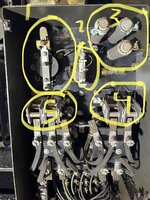
The control panel doesn't appear to be in horrible shape, but the items labeled #3 in the pic bellow are quite coroded. I think these are old oil filled capacitors, but not sure. Can anyone ID the Componets bellow? I'll make a post over on PM and see what those guys say. I have the faculty manual and wire schematic for the machine, but it doesn't give specifics on any of the components.....
IMG_0552.jpeg

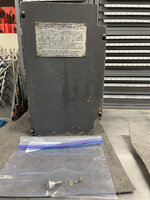
On another note, here is the machine plaque. I thought all of the round dials where the old 12" height, but this says its the newer 12.5
IMG_0581.jpeg
And here is the SN stamped on the ways. I am curious what that triangle with the 35 is stamped in it. This machine also has a Westinghouse inventory tag, and I believe they were the original owner.
IMG_0580.jpeg
 
OP
G

Grant Gunderson

Well-known member
Joined
May 17, 2013
Messages
2,312
Location
Bellingham, WA
Back to painting, I think it might make sense to invents in a HVLP setup for this project. A guy local is selling a BINKS 2001 setup quite reasonably, but not sure if my little Makita MAC2400 will support it with enough air flow as its only a 2.5HP machine. I dont have room to install a larger compressor. So I have been looking at this Fuji setup. What do you guys think of those options? Figure I can always sell that fuji setup afterwards and if I get even. $150~200 back out of it, $2~250 plus materials to do the paint right, isnt horrible.
 

ez-duzit

Well-known member
Joined
Jun 24, 2013
Messages
5,094
Location
Marina del Rey
It is always tempting to simply go out and spend a bunch of money on tools we really don't need just to solve a problem that doesn't even exist. :)

Try the Preval spray system, if you must use spray.
 
OP
G

Grant Gunderson

Well-known member
Joined
May 17, 2013
Messages
2,312
Location
Bellingham, WA
It is always tempting to simply go out and spend a bunch of money on tools we really don't need just to solve a problem that doesn't even exist. :)

Try the Preval spray system, if you must use spray.
Ive never heard of that system, so I'll look into it. Thanks. I'd prefer to not buy more tools, but I also, would rather spend a bit if I need to, in order to do it right the first time.
 
OP
G

Grant Gunderson

Well-known member
Joined
May 17, 2013
Messages
2,312
Location
Bellingham, WA
Ok the guys on PM got me sorted with ID'ing the electrical components.

#1 is the field acceleration relay. When you have too much current draw on the armature it'll pull in to make sure that there's enough field. Field is weakened for speed above about half. It's hard to accelerate with low field so this is there to let you start the drive in a high speed

#2 is the antiplugging relay. It keeps you from going from forward to reverse unless the spindle is slow enough that it won't put a big load on the drive. Generally this is about 100-300 rpm.

#3-those are resistors

The 2000 Ohm resistor (B-E) in the upper right corner of the panel is probably bad. The two 1600 Ohms resistors (A-B) should probably be replaced as well:

image.jpeg

The 1600 Ohms resistors are not a stock item. Since they are connected in series a 3000 and a 200 Ohm resistor can be used instead.

You can order them from Newark for $7 to $9 each. Here’s what I would order:
L50J2K0E (2000 Ohm, 50W, 5%) Newark #64K5003
L50J3K0E (3000 Ohm, 50W, 5%) Newark #64K5013
L50J200E (200 Ohm, 50W, 5%) Newark #64K5007


#4 and 5 are forward reverse contactors.

The guys over there suggested Tefzel" stranded and tinned wire. How does this differ from Machine Tool Wire? I am not familiar with the Tefzel designation..... I haven't had an electrical EE class is over 20 years! So needles to say there is a lot a dont remember, a bit thats changed and I dont think we spend too much time covering this older stuff anyways.
 

ttpete

Well-known member
Joined
Mar 8, 2011
Messages
6,737
Location
Dearborn, MI
Ok the guys on PM got me sorted with ID'ing the electrical components.

#1 is the field acceleration relay. When you have too much current draw on the armature it'll pull in to make sure that there's enough field. Field is weakened for speed above about half. It's hard to accelerate with low field so this is there to let you start the drive in a high speed

#2 is the antiplugging relay. It keeps you from going from forward to reverse unless the spindle is slow enough that it won't put a big load on the drive. Generally this is about 100-300 rpm.

#3-those are resistors

The 2000 Ohm resistor (B-E) in the upper right corner of the panel is probably bad. The two 1600 Ohms resistors (A-B) should probably be replaced as well:

image.jpeg

The 1600 Ohms resistors are not a stock item. Since they are connected in series a 3000 and a 200 Ohm resistor can be used instead.

You can order them from Newark for $7 to $9 each. Here’s what I would order:
L50J2K0E (2000 Ohm, 50W, 5%) Newark #64K5003
L50J3K0E (3000 Ohm, 50W, 5%) Newark #64K5013
L50J200E (200 Ohm, 50W, 5%) Newark #64K5007


#4 and 5 are forward reverse contactors.

The guys over there suggested Tefzel" stranded and tinned wire. How does this differ from Machine Tool Wire? I am not familiar with the Tefzel designation..... I haven't had an electrical EE class is over 20 years! So needles to say there is a lot a dont remember, a bit thats changed and I dont think we spend too much time covering this older stuff anyways.


J king

Well-known member
Joined
Jun 1, 2013
Messages
786
Location
Ne oh
Looks like you are set up great! lots of extras . I bought my 10EE probably 20 years ago. It is a 43 round dial. It had been rebuilt prior to me acquiring it. Bed was Re ground,tailstock and feec screws and nuts replaced as well. the drive had rebuilt tags on but I was having speed issues and decided to put an A/C drive on it. Works good and no issues since I have had it.
I even used the original speed knob to adjust the A/C drive‘s speed.
 
OP
G

Grant Gunderson

Well-known member
Joined
May 17, 2013
Messages
2,312
Location
Bellingham, WA
Last night I disconnected the wires from the control panel one by one and labeled them with permatex selves.
IMG_0598.jpeg
The wires did have the factory metal tags on them, but those are not the easiest to read after 80 years. At least the panel's control terminals are still quiet easy to ready. I noticed that the F2 and GF2 connections each had 2 wires going to them, and the E1-2 wire was marked from the factory with two E1 tags.. guess they didn't want to make a E1-2 tag for that one. The E2 connection was interesting as it had 3 wires going to it and one of them was actually marked F1, but the panel has no F1 connection...

With the panel out, I can get a better view of what I got to work with.
IMG_0606.jpeg
That unit at the top of the frame is the very Large speed control potentiometer. It is controlled via a chain attached to the speed control knob on the front of the machine. Looking at it, its nice that it's wire terminals are very clearly marked. So that will make it easier when I compile my list of where each wire from the control panel terminates as I pull them one by one.

The panel was pretty filthy with 80 years of oil and grime on it.
IMG_0607.jpeg
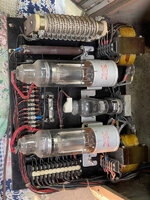
Also of note thats the machine's 1944 circuit board. Those large coils are Zirconium wire. Same as your toaster over. When the machine switches from Forward to Reverse, it uses electronic breaking... similar to an electric car. Instead of dumping the excess electricity into a battery, it burns it off as heat with these coils. Positioned right next to oil soaked wires, what could go wrong? All of those wires will be getting replaced with modern ones.

I got the control panel all cleaned up with some degreaser and denatured alcohol. I tossed the mounting hardware for the control panel in the ultrasonic cleaner. The mounts have a rubber bushing inside them for the mounting pins to pivot in, and each pin had a rubber washer top and bottom that was totally disintegrated. I guess that was 1944 tech for insulating the rest of the machine from the control panel. I'll have to be sure to remember to replace those!
IMG_0641.jpeg
IMG_0640.jpeg
I kept two of the factory wire terminals, as you dont see those anymore.

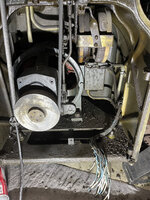
Next up, will be removing the belts from the machine, disconnecting the chain to the speed pots, remove the wiring to the part and write the locations on the terminal diagram I made of the control panel, then remove the pots.
 
OP
G

Grant Gunderson

Well-known member
Joined
May 17, 2013
Messages
2,312
Location
Bellingham, WA
Looks like you are set up great! lots of extras . I bought my 10EE probably 20 years ago. It is a 43 round dial. It had been rebuilt prior to me acquiring it. Bed was Re ground,tailstock and feec screws and nuts replaced as well. the drive had rebuilt tags on but I was having speed issues and decided to put an A/C drive on it. Works good and no issues since I have had it.
I even used the original speed knob to adjust the A/C drive‘s speed.
My back up plan is to put a 7.5 Hp 3 phase motor in it if the DC drive system is too costly to safely get going. So far it’s looking not too bad but once I pull the drive system I’ll take it to the local electric motor shop for new brushes at a minimum and see if I can get them to inspect the windings etc.
Monarch has some used electrical components available for these.
That’s good to know. I need to get a list together of what I’ll need to order from them. At a minimum it will be new felt wipers and all new gaskets unless I decide to make my own gaskets.
 
To avoid these ads, REGISTER NOW!
Top Bottom