I was finally able to get a forklift to unload the machine. They joy I got out of letting my son go for a ride on it / play with the controls with me was worth the price of the rental alone. Here he is showing the older neighbor kid how the controls work.

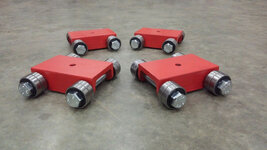
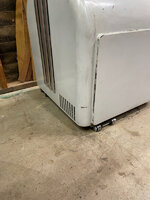
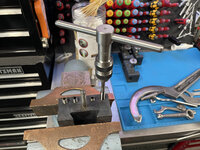
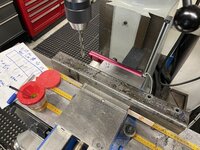
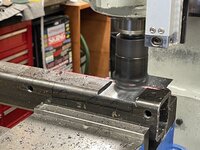
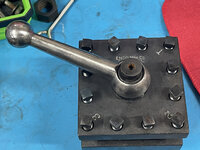
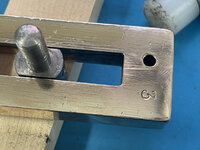
The rental forklift only had 42" forks and apparently the one we loaded it with had longer 48" ones. I had no idea there was different sizes. so ended up having to buy a 6 foot lifting strap as the original 3 foot one I bought was to short, to give enough purchase on the forks to safely lift it. Once we had it all set up, I lifted it a few inches to clear the trailer, and had a bike bud pull the trailer out from under it. Next we lowered it onto some 4x6 wood blocks, so I could safely attached the shop made skates / leveling feet setup. I marked the hole locations using a scribe, then drilled and tapped them on the Bridgeport. Since the tail of the machine only has provisions to add one leveling foot, I drilled and taped the skate base I made for a 5/16 socket head bolt that I installed to keep that skate from rotating relative to the machine. Next I lifted the lathe from the bottom with the forklift and we placed it just inside the garage door.
Hot damn, the home made skates work better than expected. I can slide the machine around by my self, and turn it with the help of one person.

The machine is covered in a light. oil residue.
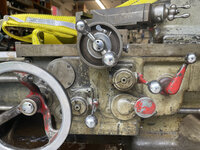
Luckily, this stuff dissolved quiet easily and with a light spray of degreaser it wipes right off.

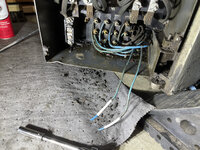
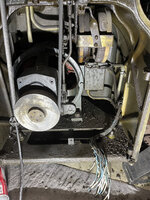
Now I can at least see what I am work with. First step is going to be pulling all of the electrical off of the machine. The wiring is very old, and is saturated with oil. The wiring insulation has holes in places where I can see right through it to bare wire... thats all gotta go. I'm going to pull it all so I can clean the machine and minimize the amount of cleaning fluids / oil getting on the control panel.
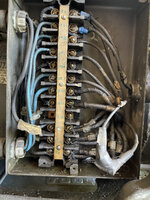

First time I have ever come across these sort of round terminals.... going to replace those with proper crimped ones with heat shrink.

Luckily all of the wire terminals on the machine are very well labeled. The wires themselves have these brass tags on them that are stamped with the name of the correct terminal. My plan is to pull each wire one by one and put a new heat shrink label on each end, so I know exactly how everything is supposed to reconnect when I replace the wiring.
I have a Brady PM21-Plus cable maker that I bought years ago. That thing is awesome, and unlike most lable makers it doesn't waste a ton of consumables, as you tell it exactly how long you want each label to be. Plus they make these permeated heat shrink labels for it that are ideal for labeling wires.
It looks like most of the machine uses 18 and 12 gauge wire. I am planing on replacing it all with Machine Tool Wire. THHN would most likely work, but MTW is the proper stuff for the application and the price difference isnt horrible. I'll also bump up the 18 guage stuff to 16 or 14 while I am at it.
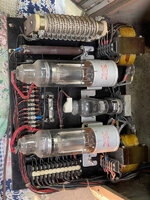
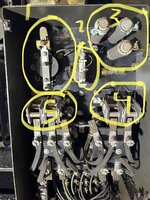
The control panel doesn't appear to be in horrible shape, but the items labeled #3 in the pic bellow are quite coroded. I think these are old oil filled capacitors, but not sure. Can anyone ID the Componets bellow? I'll make a post over on PM and see what those guys say. I have the faculty manual and wire schematic for the machine, but it doesn't give specifics on any of the components.....
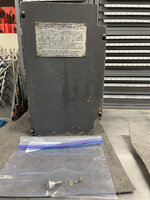
On another note, here is the machine plaque. I thought all of the round dials where the old 12" height, but this says its the newer 12.5

And here is the SN stamped on the ways. I am curious what that triangle with the 35 is stamped in it. This machine also has a Westinghouse inventory tag, and I believe they were the original owner.