
Re: GUS Update
Hi Christopher and welcome to the thread. Yeah the shop tuned out pretty well and at times Chris has accused me of living out there because I spend so much time out in the shop. It's a great work space.
Thomas
Bob your service chart is very similar to ones in the Willys shop manual for Gus. There are grease fittings all over Gus. Someone in the recent past took it upon themselves to grease them and not just a little bit. There is grease all over the underside from over servicing it with grease and more grease. Additionally the grease seals in the wheels didn't really seal grease in the wheel. The wheel hubs had boat loads of grease all over them as well. Maybe that's why there's so little rust?!
Gus doesn't have an oil filter (very common back in the 1940's and earlier) and at this juncture I don't know if I'll be putting one on. It will depend on how much driving I do once we get him back up to snuff and out on the road. I'd be doing an oil change once a year no matter how few miles I drive and I bet I don't put 500 miles on in a year so we'll see.
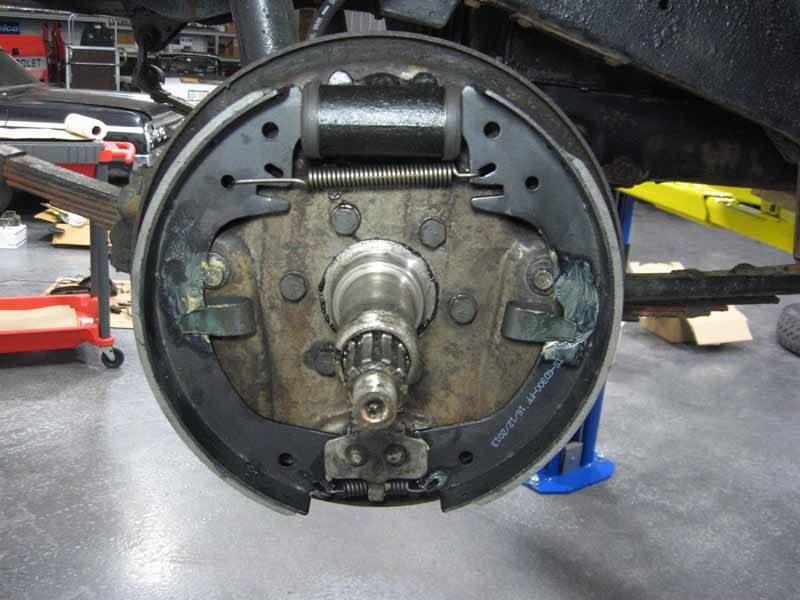
Here's what the Lockheed style brakes on Gus look like when completed and here's a close up of...

...one of those pesky, stubborn brake shoe adjusters installed and in use. Note how it's rotated against the inside of the brake shoe.

As the shoe wears it's rotated to take up slack and keep the shoe close to the drum.
You might also want to know this about Lockheed style brakes. Hydraulic pressure expands the wheel cylinder cups, which push the shoes against the drum. The shoes are NOT self-energizing. The Lockheed system is a front/rear shoe design with the bottom pivot for each shoe anchored to the backing plate. This design requires more pedal pressure to stop than self-energizing brakes since they rely solely on hydraulic pressure. The front shoes (primary) do most of the stopping and normally use a longer friction band. The rear shoes (secondary) normally use a shorter friction band. That might help some of you who think the shoes were installed backward as they would be if these were a Bendix style. Read the shop manual!
I'll get a post on here showing how to make double flares which you'll need to do if you make your own brake lines. It's so easy even a retired airline pilot can do it! Thanks everyone.
Thomas
I'd live in there

Hi Christopher and welcome to the thread. Yeah the shop tuned out pretty well and at times Chris has accused me of living out there because I spend so much time out in the shop. It's a great work space.
Thomas
Thomas, seeing those grease fittings brought back memories. Of the cars I've owned, my 1947 Ford had the most grease fittings but every car since then has had fewer and fewer. My 2004 PT Cruiser has none.
I expect an oil change and grease job on Gus is a pretty long and involved process to do correctly.l........

Bob your service chart is very similar to ones in the Willys shop manual for Gus. There are grease fittings all over Gus. Someone in the recent past took it upon themselves to grease them and not just a little bit. There is grease all over the underside from over servicing it with grease and more grease. Additionally the grease seals in the wheels didn't really seal grease in the wheel. The wheel hubs had boat loads of grease all over them as well. Maybe that's why there's so little rust?!
Gus doesn't have an oil filter (very common back in the 1940's and earlier) and at this juncture I don't know if I'll be putting one on. It will depend on how much driving I do once we get him back up to snuff and out on the road. I'd be doing an oil change once a year no matter how few miles I drive and I bet I don't put 500 miles on in a year so we'll see.

Here's what the Lockheed style brakes on Gus look like when completed and here's a close up of...

...one of those pesky, stubborn brake shoe adjusters installed and in use. Note how it's rotated against the inside of the brake shoe.

As the shoe wears it's rotated to take up slack and keep the shoe close to the drum.
You might also want to know this about Lockheed style brakes. Hydraulic pressure expands the wheel cylinder cups, which push the shoes against the drum. The shoes are NOT self-energizing. The Lockheed system is a front/rear shoe design with the bottom pivot for each shoe anchored to the backing plate. This design requires more pedal pressure to stop than self-energizing brakes since they rely solely on hydraulic pressure. The front shoes (primary) do most of the stopping and normally use a longer friction band. The rear shoes (secondary) normally use a shorter friction band. That might help some of you who think the shoes were installed backward as they would be if these were a Bendix style. Read the shop manual!
I'll get a post on here showing how to make double flares which you'll need to do if you make your own brake lines. It's so easy even a retired airline pilot can do it!
Thanks everyone.Thomas


 Comfortable cruise for now is about 40 mph (64 Km/hour). I still need to have the front end alignment checked before we really push the envelope. I think factory literature states top speed in the 48 mph (77 Km/hour) vicinity with the present gearing. All in all a very successful outing. Gus is standing tall once more.


 That's just a bit more than I need, unless I want to see a major flooding event like we had this spring.
 These old draw through systems are just a bit finicky about to much fuel and can catch fire when they flood.


