Ray Bell
Well-known member
Visiting a friend, Norm, of whom you might hear more over time, his wife said to me, "Ray, you're putting on weight!"
Well, though I wasn't used to the idea, nor to the attention of others falling on it, I was quick to respond: "Yes, other people have mentioned that to me." And I added as a continuing thought, "I wonder what's causing it?"
Quick as a flash came her reply, "Well, it could be middle age spread."
That thought didn't appeal to me, which I guess showed in my next reply: "Yes, others have said that too. But what I don't understand is why I've got it so early!"
All of this took place nearly a quarter of a century ago, so I'd say 'Middle Age' has well and truly caught up with me now. So getting about jobs in my workshop isn't as easy as I once found it to be, and others will agree that you lose some muscle tone when you're in your late sixties and seventies. This is a difficulty at times, but even more so as I usually work alone. Almost always, in fact.
For instance, when I was driving my Subaru Foresters a lot they needed a bit of attention from time to time. One problem was with rear wheel bearings, another with CV joints. Both required that struts would have to be removed. Well, that's easy enough, gravity can be a great aid there. But to once again feed the strut back up into its tower, and position it so one or more of the studs came through its hole, that required greater strength and flexibility than I could easily muster.
Hence I devised this piece of equipment:

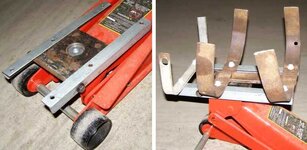
Strut lifter. Using a piece of 4" square tube (salvaged from a scrapheap somewhere) I've drilled a hole for one of my cheap-and-outdated spring compressors to fit through, then the Angle Grinder Engineering Division of my outfit (ie. me with a dangerous tool in my hands) hacked it all to a shape that would allow the job to be done.

The lower end. There is just enough thread standing proud on the strut top for a 12x1.5mm nut to screw on and hold the weight. I welded a wheel nut of that size to the head of the through-bolt of the spring compressor for this purpose.

Strut lifted! Once the strut is attached you can stand up and simply lift it into place. No need to stretch an arm around the mudguard like a contortionist with no hope of seeing what you need to do, it's something that makes the job pretty easy. Screwing down the 'nut' on the spring compressor through-bolt will hold it in place if needed. Or lift it if you're feeling like that's the way to go.
Of course, this was all done years ago and the photos were taken five years later. The whole lot's had a good chance to rust up.
Another effort-saver with the Foresters was a simple rig to hold the gearbox up a little for removal and replacement of the engine. There are a couple of facets to this job which can cause grief, the need to slip the engine in and out while it's elevated to a level so the studs on the engine mounts clear is the first. Equally important is that you don't strain the CV boots by moving things around so that they will come off. And they will.
To avoid the CV problem you have to crack the tension of the retaining circlip on the end of the spline in the differential, a quick flick with a big screwdriver between the CV joint and the side housing of the differential and that's accomplished. You then put something in there so it can't slip back in place, I've always used a piece of rope that I've wrapped around, but maybe something more solid with a gap cut in it would be as good or better.
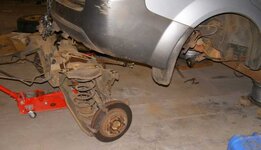
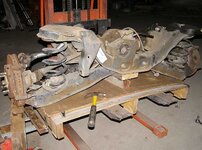
To hold up the gearbox I relied on a piece of lightweight steel tubing that was formerly the top bar of a child's swingset (more from that scrapheap), shortened and drilled to bolt onto a strut-top stud on both sides of the vehicle. A couple holes through it, two pieces of lightweight round tubing flattened and drilled appropriately and the bolts which were then removed from the engine to bellhousing joint go through to hold it all in place:

Holding the gearbox in place. Simple, cheap and easy to make, I've used this now four times when doing work on my Subarus.
I'm sure others here have become inventive in the same way to save themselves effort and to overcome issues which befall us as we become less flexible in our later years.
Well, though I wasn't used to the idea, nor to the attention of others falling on it, I was quick to respond: "Yes, other people have mentioned that to me." And I added as a continuing thought, "I wonder what's causing it?"
Quick as a flash came her reply, "Well, it could be middle age spread."
That thought didn't appeal to me, which I guess showed in my next reply: "Yes, others have said that too. But what I don't understand is why I've got it so early!"
All of this took place nearly a quarter of a century ago, so I'd say 'Middle Age' has well and truly caught up with me now. So getting about jobs in my workshop isn't as easy as I once found it to be, and others will agree that you lose some muscle tone when you're in your late sixties and seventies. This is a difficulty at times, but even more so as I usually work alone. Almost always, in fact.
For instance, when I was driving my Subaru Foresters a lot they needed a bit of attention from time to time. One problem was with rear wheel bearings, another with CV joints. Both required that struts would have to be removed. Well, that's easy enough, gravity can be a great aid there. But to once again feed the strut back up into its tower, and position it so one or more of the studs came through its hole, that required greater strength and flexibility than I could easily muster.
Hence I devised this piece of equipment:
Strut lifter. Using a piece of 4" square tube (salvaged from a scrapheap somewhere) I've drilled a hole for one of my cheap-and-outdated spring compressors to fit through, then the Angle Grinder Engineering Division of my outfit (ie. me with a dangerous tool in my hands) hacked it all to a shape that would allow the job to be done.
The lower end. There is just enough thread standing proud on the strut top for a 12x1.5mm nut to screw on and hold the weight. I welded a wheel nut of that size to the head of the through-bolt of the spring compressor for this purpose.
Strut lifted! Once the strut is attached you can stand up and simply lift it into place. No need to stretch an arm around the mudguard like a contortionist with no hope of seeing what you need to do, it's something that makes the job pretty easy. Screwing down the 'nut' on the spring compressor through-bolt will hold it in place if needed. Or lift it if you're feeling like that's the way to go.
Of course, this was all done years ago and the photos were taken five years later. The whole lot's had a good chance to rust up.
Another effort-saver with the Foresters was a simple rig to hold the gearbox up a little for removal and replacement of the engine. There are a couple of facets to this job which can cause grief, the need to slip the engine in and out while it's elevated to a level so the studs on the engine mounts clear is the first. Equally important is that you don't strain the CV boots by moving things around so that they will come off. And they will.
To avoid the CV problem you have to crack the tension of the retaining circlip on the end of the spline in the differential, a quick flick with a big screwdriver between the CV joint and the side housing of the differential and that's accomplished. You then put something in there so it can't slip back in place, I've always used a piece of rope that I've wrapped around, but maybe something more solid with a gap cut in it would be as good or better.
To hold up the gearbox I relied on a piece of lightweight steel tubing that was formerly the top bar of a child's swingset (more from that scrapheap), shortened and drilled to bolt onto a strut-top stud on both sides of the vehicle. A couple holes through it, two pieces of lightweight round tubing flattened and drilled appropriately and the bolts which were then removed from the engine to bellhousing joint go through to hold it all in place:
Holding the gearbox in place. Simple, cheap and easy to make, I've used this now four times when doing work on my Subarus.
I'm sure others here have become inventive in the same way to save themselves effort and to overcome issues which befall us as we become less flexible in our later years.