To avoid these ads, REGISTER NOW!

Shop air lines

DocsMachine

Well-known member
Joined
Sep 16, 2006
Messages
1,850
The only downfall to the rapid air is the cost. I need 400' to do it and that's 500 bucks, plus all the additional fittings, I end up close to a grand in the whole system.

-That's kind of my point. Copper is certainly by no means cheaper, and black-iron pipe probably isn't too far behind. Both are considerably more diffcult to install.

Plain PEX might be cheaper per foot of the tubing, but how much of a savings is it by the time you take into account all the wall clips, end fittings, those cool manifold blocks, and so on?

Doc.
 
To avoid these ads, REGISTER NOW!

haveissues

Well-known member
Joined
Feb 9, 2011
Messages
379
Location
Hudson Valley NY
I'm going to install a ring of 3/4 pex around the perimeter of my shop since I have several hundred feet left over from my floors. My old shop was copper but I later installed some drops with pex I had laying around and had no issues. Copper is nice and I enjoy sweating it but 3/4 is now $3.50 a foot and 3/4 pex-a has a burst pressure of something like 800psi for liquid so it will be just fine for the 160psi my compressor is set to.

On a side note I was in a facility that was piped with 4" copper for air throughout its many buildings and 2 million sq feet. I can't even imagine what that cost, even back in the day. Plus there were several other large lines for other gases.
 

PhantomEB

Well-known member
Joined
Feb 6, 2006
Messages
6,707
Location
Medicine Hat, AB, Canuckistan
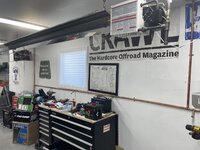
Due to already built in cabinets etc, I only ran remnants of my old copper lines into the new garage. Gotta finish it off today by tying in the new to me compressor. Dual 50’ reels will make this garage a lot more practical.
 

Attachments

  • DB2D02D9-CEFB-490D-94BF-A6D3F1EFD192.jpeg
    DB2D02D9-CEFB-490D-94BF-A6D3F1EFD192.jpeg
    301.4 KB · Views: 170
  • F7C3357C-9970-4B77-8839-7FABC897C692.jpeg
    F7C3357C-9970-4B77-8839-7FABC897C692.jpeg
    233 KB · Views: 164
  • 7F6C1B5D-DC90-4711-93C0-AB16E0AF6F8A.jpeg
    7F6C1B5D-DC90-4711-93C0-AB16E0AF6F8A.jpeg
    278.5 KB · Views: 164

BombShelter

Well-known member
Joined
Nov 16, 2015
Messages
543
Location
State of Hockey
Please do not use PVC, there's one kind of idiot, the one that uses PVC and he also likes to throw gas on open fires. You don't read about the explosions but trust me they happen everyday. More likely, there's kids around and it blows into their face, the idiot comes up somewhat unfazed.

Duraplus is the plastic ABS pipe used for air systems, it doesn't have shrapnel when it explodes, it's more like bubble-gum. It's installed the same as PVC, just a slightly different solvent for the joints.
 

metlmunchr

Well-known member
Joined
Sep 10, 2011
Messages
1,278
If a person can get by with the 3 drops included in the maxline kit, then that looks like a sensible way to go for the money and convenience. But, if you needed several additional drops, then using PEX-A and brass crimp fittings can save you some significant money.

Adding a drop on the maxline requires a tee for $18 and an outlet kit for $32, for $50 total. A 3/4 crimp tee and a 3/4 PEX x 1/2 female pipe drop ear ell plus 4 clamp rings can be had for a bit less than $9 total. Places like supplyhouse.com have multiple types of tubing hangers and supports for PEX at a fraction of the prices charged for additional supports if a kit doesn't include enough for the project, or if you're piecing together a system from a plumbing parts supplier.

There's a lot of "urban knowledge" on the internet regarding degradation of PEX when used for air lines. The big one is how oil in the air supposedly degrades the tubing over time. If you look up chemical compatibility with PEX, it's suitable for use with motor oil, ethanol, methanol, and a wide range of other chemicals. I assume people read about things that degrade PVC, and just make the false assumption that the same applies to PEX. Keep it clear of sunlight or other sources of UV, and the chance of problems due to degradation are remote unless you're pumping some really unusual stuff thru your air lines.
 

Walkers

Well-known member
Joined
May 17, 2021
Messages
3,912
Location
Cave Creek Az
Rapid air is fine stuff still. If the cost bothers you run a black iron trunk line that cover the majority of the distance and then go with the rapid air. I currently have copper, but simply because a friend demoed a copper system in a commercial building and I got the lengths free. I would build a black iron system today if I had to redo it, but I have a big power threader and decades of experience p,unbind with threaded pipe.
 
Last edited:

cruzer75

Well-known member
Joined
Feb 7, 2009
Messages
206
Do you guys loop your systems or just do straight runs? Looped will help increase your availability of CFM because it will draw from both sides of the loop. This is how we put air systems in at work, which work well and typically do not have pressure or volume issues.
 

DocsMachine

Well-known member
Joined
Sep 16, 2006
Messages
1,850
Do you guys loop your systems or just do straight runs?

-Wanted to, but the layout of the shop would have made that difficult. But with 3/4" ID, I get very little pressure drop even at the end furthest from the compressor. Admittedly I'm not trying to run a 3/4" impact, but I have no issues with die grinders or air sanders.

Doc.
 

racecougar

Well-known member
Joined
Jan 26, 2021
Messages
5,008
Location
Missouri
Do you guys loop your systems or just do straight runs? Looped will help increase your availability of CFM because it will draw from both sides of the loop. This is how we put air systems in at work, which work well and typically do not have pressure or volume issues.
Straight run with four drops here. Even running a sandblaster, it has been completely fine with the 3/4" line. I don't have a team of people working for me though; it's just me.
 

PoorUB

Well-known member
Joined
Mar 29, 2021
Messages
11,622
Location
Fargo, ND
A loop in a home shop is over kill.

Depending on where you get your information, 3/4" pipe is good for 25 CFM at 150 feet. 1/2" will do 15 CFM at 100 feet. I would assume that is plenty for most of us. A loop would double that.

Years go before PVC was considered dangerous I piped my home shop in 3/4" PVC. I put a pressure gauge at the farthest point. Running my largest consuming air tool the needle on the gauge would wiggle when I hit the trigger, but no noticeable drop in pressure.

I also get a kick out of the guys saying to run a 2" main for more air volume. 100 feet of 2" pipe gets you roughly 1-1/2 cubic feet. Pretty much nothing in the scheme of things.

I plumbed air lines in a truck shop, engineered job. The mains were 1" black pipe. There was about thirty service bays. Never heard a complaint.
 

egdede

ALLIANCE MEMBER
Joined
Dec 20, 2009
Messages
2,069
Please do not use PVC, there's one kind of idiot, the one that uses PVC and he also likes to throw gas on open fires. You don't read about the explosions but trust me they happen everyday. More likely, there's kids around and it blows into their face, the idiot comes up somewhat unfazed.

Duraplus is the plastic ABS pipe used for air systems, it doesn't have shrapnel when it explodes, it's more like bubble-gum. It's installed the same as PVC, just a slightly different solvent for the joints.
That's one approach to making plastic airlines safer. But, there is a better cheaper way to make PVC safe. Use schedule 20. The thinner plastic will fail with a split in the pipe and does not explode into shards like schedule 40. Schedule 20 for the win!
 

A1970Blazer

Member
Joined
Dec 5, 2017
Messages
6
Location
East TN
I have to laugh at the "PVC will explode and kill everyone in the building" :ROFLMAO:
I use CPVC and have since 1994 when the building was built...a few have broken over the years
but NEVER with an explosion and deadly shrapnel flying everywhere....
 

racecougar

Well-known member
Joined
Jan 26, 2021
Messages
5,008
Location
Missouri
I have to laugh at the "PVC will explode and kill everyone in the building" :ROFLMAO:
I use CPVC and have since 1994 when the building was built...a few have broken over the years
but NEVER with an explosion and deadly shrapnel flying everywhere....

It'll be funny right up until you have the pleasure of experiencing a real failure. OSHA logs have a number of reports like this:


PVC manufacturers even explicitly state that the product should not be utilized for compressed air.
 

PoorUB

Well-known member
Joined
Mar 29, 2021
Messages
11,622
Location
Fargo, ND
I have a friend with a 2" scar on his cheek from a ruptured PVC air line. Another inch higher and he would have lost an eye.

Years back when I had PVC air lines in my shop he walked in, took a look around and walked back outside and he wouldn't come back in. That is when he explained the scar on his cheek.

I had PVC air lines for maybe ten years, never killed anyone, never ruptured, but I wasn't taking a chance so they got ripped out.
 

Steve in UT

Well-known member
Joined
Oct 30, 2018
Messages
205
Location
....
Did my shop/garage in 3/4 pex with 1/2 drops. If you haven't seen this video, its kinda fun to watch.
Pressure testing pex
Here is how I terminated the ends. My only advice is keep your mounting points close(< 3') on horizontal runs to reduce sagging.
20210423_175524.jpg
 

nikerret

Well-known member
Joined
Jan 22, 2015
Messages
757
Location
Kansas
I went with black steel pipe. Biggest issue I currently have is one of my valves at the bottom of a drop no longer works. I’m not sure what happened. I can turn it and feel it turn, but it doesn’t even slow the air down. Right now, it’s not an issue. I’ll fix it, one of these days.

Shortly after I did mine, I made a crappy YouTube video. Warning: It’s time you’ll never get back, but you can skip around and see if anything is useful.

 
To avoid these ads, REGISTER NOW!

dfiler2

Well-known member
Joined
Dec 15, 2014
Messages
2,858
Location
NW Minnesota
I used pex based on my experience at work. I worked for a manufacturer for 27 years (retired in May) that had thousands of feet of 1" pex for airlines. The company has been part of the MNSTAR program for about 15 years, this is a safety program where OSHA agrees to never show up unannounced as long as you pass their initial inspection which is also announced. I asked an inspector one time about the pex airlines and was told they are not on any list because no one has ever had an issue with them. That was good enough for me.
 

PoorUB

Well-known member
Joined
Mar 29, 2021
Messages
11,622
Location
Fargo, ND
-That's kind of my point. Copper is certainly by no means cheaper, and black-iron pipe probably isn't too far behind. Both are considerably more diffcult to install.

Plain PEX might be cheaper per foot of the tubing, but how much of a savings is it by the time you take into account all the wall clips, end fittings, those cool manifold blocks, and so on?

Doc.
Price it out. I just was browsing PEX tubing and fittings on Amazon and the stuff is pretty inexpensive.
For example a 3/4 copper a sweat elbow is $5. A 3/4" PEX elbow is $1. You can find 3/4 PEX for close to 50 cents a foot, M copper is $2.40 a foot.

You can also find all kinds of fittings, drop ear tees and elbows, drop ear ball valves, all less money that their sweat copper counterpart. my guess is with PEX taking over plumbing in homes and copper losing favor the prices are reflecting that. PEX is cheap because the volume, and cooper is higher price because of the lower of volume.
 

RPhil

Member
Joined
Aug 20, 2018
Messages
23
Location
MD
Any pros or cons to crimp vs. expansion pex when used in compressed air applications?
 

DocsMachine

Well-known member
Joined
Sep 16, 2006
Messages
1,850
Price it out. I just was browsing PEX tubing and fittings on Amazon and the stuff is pretty inexpensive.

-My system, which included two 3/4" Max kits and one 1/2" Rapid kit, plus a bunch of extras like more wall clips, extra tees, elbows and reducers, more wall mounts, a set of optional dual wall mounts, new QDs, a pair of water separators, a regulator, a big 3/4" disconnect for the compressor, and a bunch of miscellaneous plugs and fittings, all cost me less than a grand.

Had I done it in PEX, I might have saved $200 and wouldn't have the beefy wall outlets. Those, to me, were the main selling point- I wanted rugged, sturdy mounts for the QDs, so that no matter how much you pull on the hoses, or how badly you bash something into them, they're not going to pull off the wall or get loose and wobbly.

If you get those, and use household PEX to plumb them, and wind up doing a small one-kit garage, what's the savings? Fifty bucks?

Doc.
 

dfiler2

Well-known member
Joined
Dec 15, 2014
Messages
2,858
Location
NW Minnesota
"Any pros or cons to crimp vs. expansion pex when used in compressed air applications?"

I used the Oetiker style but the copper crimp style works well also. The Oetiker tool can be used for different sizes. I believe, the expansion style does take a specific size pex.
 

Firebrick43

Well-known member
Joined
May 12, 2015
Messages
14,003
Location
West central Indiana
Any pros or cons to crimp vs. expansion pex when used in compressed air applications?
Yes there is. Upnor propex (expansion pex) fittings are much less flow restrictive. Since they expand the tubing and insert the fitting it can have the same ID as the tubing. With crimp type fittings they have an ID at the fitting about the same size as the next size smaller tube.

For example,

3/4" PEX has an ID of .681" (ID of type L copper is .785)
5/8" PEX has an ID of .584"
1/2" PEX has an ID of .485"

A plastic fitting for 3/4" crimp pex has an ID of .460" or .025" smaller than the id of 1/2 PEX.
Brass/SS fittings for 3/4" crimp pex has an ID of .530" or .034" smaller than the ID of 5/8 PEX

So you would need to up size the tubing to get the same flow.

Do not get a hand expander for pex. You will not like it. Get the m12 milwaukee tool if you go that route.

Also there is the PEX A vs B and C. Most of the crimp pex and tubing sold in the hardware stores is type B or C. It does not have the strength or kink resistance that PEX A has. PEX A HAS TO BE USED with the expansion type pex. If you kink it you can work it out with a heat gun. B or C you have to cut it and had another restrictive splice fitting.

Also since people are talking about push to connect fitting systems such as airbrake and rapid air systems, and then talking about leaks, I will make the following comments.

Push to connect fittings use O rings to make the seal. IF the tubing is sharp or not deburred it can put nicks in the orings causing leaks. Also I have seem plenty of new fittings leak from the factory. I am a CNC mechanic and many of the machines now use push connect metric fittings just like air brake hose. As the machines age (about 15 years) we start having multiple failures with the tubing and the fittings. The tubing gets brittle and splits, the fittings orings crack and leak. Many times its in places where the tubing isn't even moving in cable trays and such. We have been so frustrated with downtime on some machines we have had to go at it and replace every piece.

Experience with my dads semis and my personal truck is that the airbrake fittings will leak as well(no difference in how they are made. Seen plenty of split tubing as well but the natural color hard nylon does seem to last longer than the thinner more flexible newer types of tubing. Most trucks are clapped out with miles by the time the materials degrade however, and the alternative is rubber lines which are probably worse.

Not so cost effective when you have to go back and redo it compared to copper. Home environment will last longer than 15 years but how much so? Also would depend on UV light exposure. Many have quite good natural lighting (UV) compared to none in the industrial setting.
 
Last edited:

rayra

Well-known member
Joined
Dec 1, 2014
Messages
4,724
Location
Escaped from Los Angeles
Those ratings are for liquids, not compressed air. Two different things.
Nonsense. PSI. And the cutout on my compressor is ~140psi. Point being I never get anywhere close to the burst rating of the pipe. And I don't leave my compressor / air lines on 24/7. Nor is my PVC out in the sunlight to become embrittled. Frankly the amount of hysteria and lore about PVC is just nonsense.
 

Firebrick43

Well-known member
Joined
May 12, 2015
Messages
14,003
Location
West central Indiana
Nonsense. PSI. And the cutout on my compressor is ~140psi. Point being I never get anywhere close to the burst rating of the pipe. And I don't leave my compressor / air lines on 24/7. Nor is my PVC out in the sunlight to become embrittled. Frankly the amount of hysteria and lore about PVC is just nonsense.
It isn't lore. There are multiple documented by OSHA cases of injuries by PVC. The PVC manufactures warn in all their own literature not to use PVC for compressed gas systems.

PVC work hardens by pressure pulses which are particularly bad in an air system and not so much in a water system(especially a city water system)

With water the psi goes almost instantaneously to zero once the pipe burst(because water is incompressible) where compressed gas will continue to expand and propel shards after it burst

You have made assertations multiple times on this forum and have been shown the literature and proof not to use PVC and yet still push PVC use.

Just because you have not had a failure yet doesn't not equate to one is impending.

I don't know why you have not been banned yet for continuing to push for unsafe air systems.
 

csp

Well-known member
Joined
Mar 23, 2010
Messages
5,719
Location
Franktown, CO
Nonsense. PSI.
What happens when a liquid pushes past the pressure that PVC can handle? Basically nothing other than water draining out of hole it created. Liquids do not compress.

What happens when a compressed gas exceeds the pressure that PVC can handle? Being compressed it expands rapidly and blows out as fast as it can to get back to ambient pressure.

So no, it isn't nonsense and while PSI may be PSI, volume @ PSI is not.

I knew several smokers years ago who didn't have cancer or other health problems related to their smoking. Yet.
 

vwpieces

Well-known member
Joined
Apr 28, 2020
Messages
5,925
Location
Hills, PA
Isn't the rapid air measured by OD?
And PEX is measured by ID?

Had a short run of 1/2 Rapid Air years ago in an old garage.
I ran 3/4 PEX loop at the ceiling in my current shop with (12) 1/2in drops. All drops have 2ft drip leg with brass ball valve. Total run took 300ft of 3/4in and 200ft of 1/2in and I was well under $300 with all the fittings, valves etc. I used the stainless crimps.
While the home stores are reasonable for PEX rolls avoid them for any fittings or clamps.
Plan ahead and I used PEXuniverse.com for a majority of the fittings and rolls. Brass ball valves were dirt cheep too.

Big expense was ALL the air couplings because I changed style to ad another $250 to the total.

These are the PEX double ended Drop Ear T fittings I used to achieve the drip legs. Not easy to find...

71m-SW7dbtL._AC_SL1500_.jpg
 

PoorUB

Well-known member
Joined
Mar 29, 2021
Messages
11,622
Location
Fargo, ND
If you get those, and use household PEX to plumb them, and wind up doing a small one-kit garage, what's the savings? Fifty bucks?

Doc.
The post I was responding to was comparing to copper and black iron. No idea how it compares to Rapid Air. One benefit I can so to PEX is you can buy it any where, any home store will have parts to add or repair your system.

You can buy drop ear elbows and tees that are very inexpensive that will mount solidly to the wall.
 

rayra

Well-known member
Joined
Dec 1, 2014
Messages
4,724
Location
Escaped from Los Angeles
It isn't lore. There are multiple documented by OSHA cases of injuries by PVC. The PVC manufactures warn in all their own literature not to use PVC for compressed gas systems.

PVC work hardens by pressure pulses which are particularly bad in an air system and not so much in a water system(especially a city water system)

With water the psi goes almost instantaneously to zero once the pipe burst(because water is incompressible) where compressed gas will continue to expand and propel shards after it burst

You have made assertations multiple times on this forum and have been shown the literature and proof not to use PVC and yet still push PVC use.

Just because you have not had a failure yet doesn't not equate to one is impending.

I don't know why you have not been banned yet for continuing to push for unsafe air systems.

I'm not "pushing" for anything. This is probably the third? topic on air lines that I've ever commented on here. Over years - ETA 7yrs. Yet somehow you choose to mischaracterize my behaviour. I'm not the person insisting on only one point of view. I'm not even saying PVC is the best material or the only material to be used.
And frankly 'appeal to authority' - especially OSHA, given its fresh abuse re COVID - is one of the weakest methods in Rhetoric. THE weakest form of argument is to call for someone to get banned / silenced. And you've gone and done both.
Your statement re water vs air is deliberately misleading as it infers there is not a continued pressure source re water.
I'm observing the rated / stated mechanics of the material.
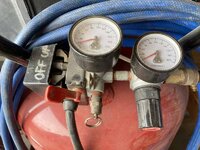
My compressor tops at 200psi. The emergency blowoff trips sooner. 150? 160?
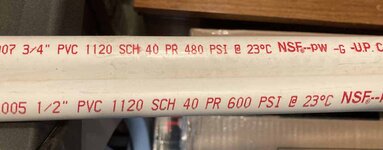
3/4" sched40 is rated at
1/2" sched40 is rated at 600psi
So I'm operating at half or 1/3 the rated pressures of the PVC. Why is that an issue.
I'm also pressurizing my system only for the period of time I'm actively using it. So frankly industrial or commercial incidents and OSHA have very little relation to my residential working environment.

For flow / fluid dynamics, anything much larger than the QD orifice size gives little benefit. Your tank size is more important, in that regard. So it is readily possible to use the smaller piping with the higher burst rating to assuage any system pressure concerns.

Earlier it is stated that air and water are different, as if air is somehow worse. Water is incompressible, less forgiving than an air system, so it is odd to me to see you invert that in your argument.

And frankly I'm not interested in, swayed by, or concerned about happenings in commercial shops. Their use cases are far removed from my own. And I understand the difference between Possible and Probable. And I am also not a 'safety uber alles' sort of person. Mike Rowe's 'Safety Third' is more my motto.
 

Attachments

  • pipes psi.jpg
    pipes psi.jpg
    45.3 KB · Views: 90
  • comp psi.jpg
    comp psi.jpg
    75.3 KB · Views: 104

LS6 Tommy

Well-known member
Joined
Dec 27, 2013
Messages
26,162
Location
Northern NJ
I'm not "pushing" for anything.
I'm observing the rated / stated mechanics of the material.
My compressor tops at 200psi. The emergency blowoff trips sooner. 150? 160?
3/4" sched40 is rated at
1/2" sched40 is rated at 600psi
So I'm operating at half or 1/3 the rated pressures of the PVC. Why is that an issue.
You're NOT observing the "rated / stated mechanics of the material". You're FAR from it. PVC is NOT rated for any type of compressed gas, period.

It's an issue because PVC is rated for those pressures when carrying non compressable LIQUIDS which do not store energy, unlike compressible gases, which do store energy and become a bomb when (not if) the PVC cracks.

Tommy
 
Last edited:

Firebrick43

Well-known member
Joined
May 12, 2015
Messages
14,003
Location
West central Indiana
I'm not "pushing" for anything. This is probably the third? topic on air lines that I've ever commented on here. Over years - ETA 7yrs. Yet somehow you choose to mischaracterize my behaviour. I'm not the person insisting on only one point of view. I'm not even saying PVC is the best material or the only material to be used.
Everyone is born ignorant of the facts, and we learn them at some point. I can see someone (ignorant of the facts) thinking that PVC is safe from your charts. You have posted charts and burst ratings multiple times. Anyone can search "PVC" with "rayra" as the member and bring up results showing that you have continuously pushed the viewpoint that PVC is ok and post multiple times the pressure rating chart but neglect to post that the manufacture doesn't recommend compressed gasses. You even post a picture of the PVC pipe in your last post with the pressure rating neglecting the fact that the manufacture doesn't recommend for use with compressed gases

Air lines pages 2 and 3

The above link shows this and also has multiple links on page 3 from manufactures and osha showing that it is not safe. You have had the resources to educate yourself and yet you still came on here and pushed it on this thread. IT IS NOT A SAFE OPTION.

One point of view? I will accept copper, steel, pex, rapid air, and air brake type lines. I think some of those materials are better than others due to longevity but they are all SAFE.

And frankly 'appeal to authority' - especially OSHA, given its fresh abuse re COVID - is one of the weakest methods in Rhetoric. THE weakest form of argument is to call for someone to get banned / silenced. And you've gone and done both.
This is hilarious. While I have qualms about the use of OSHA in todays political climate, that is not a discussion for here. The hilarious part is that the weakest methods is to associate one stance/point/policy with something completely unrelated like you are trying to.

OSHA has existed across multiple administrations and even if you ignore their advice they have simply documented multiple injuries due to PVC airlines since 1988 time frame, maybe even before. To ignore the facts that they have collected in the past because of current issues is mind boggling.

The old adage of its not freedom of speech to yell fire in a crowded theater applies here. When you advocate for PVC after being shown the facts of why not to, you are willfully pushing an ignorant false hood that can end in someone's injury. I rarely support censorship but in this case I do as you show no willingness to stop spreading falsehoods that can/will get someone hurt. I don't see how anyone else cant come to the conclusion that you have continually "pushed" pvc as a safe option in light of the facts.

Your statement re water vs air is deliberately misleading as it infers there is not a continued pressure source re water.
I'm observing the rated / stated mechanics of the material.
You still don't understand fluid dynamics and compressed gases vs uncompressible liquids. Water has zero pressure when it leaves the pipe, just some momentum due to its weight, and the water behind it has only 40 psi, not 125-150 psi of air and expanding multiple times its volume as its leaving
My compressor tops at 200psi. The emergency blowoff trips sooner. 150? 160?
3/4" sched40 is rated at
1/2" sched40 is rated at 600psi
So I'm operating at half or 1/3 the rated pressures of the PVC. Why is that an issue.
I'm also pressurizing my system only for the period of time I'm actively using it. So frankly industrial or commercial incidents and OSHA have very little relation to my residential working environment.

For flow / fluid dynamics, anything much larger than the QD orifice size gives little benefit. Your tank size is more important, in that regard. So it is readily possible to use the smaller piping with the higher burst rating to assuage any system pressure concerns.
This is false as well, pipe has friction losses, from both the walls, the fittings, and the restrictions. Its easy to see in long hoses.
Here is a calculator from gates to show this, although I highly doubt you will look at it or you will try to associate gates to some bogus issue.
Gates hose calculator
Measuring the set of stedlin fittings that I received the other day they are .208" id thru the ******. By your assumption a .250" id hose will give me all the flow i ever need. By the above calculator, at 100 psi and 10cfm I would have a pressure loss of 41.5 PSI at 100 feet. Only 5 PSI loss with a .375 hose and 1 psi loss with a .500" hose The issue is worse as you go up in cfm. At 20 cfm the .250 hose is unusable, and the .375" has a 20 psi loss and the .500 hose has a 4.3 psi loss. Yet the ****** of .208" diameter can support over 20 cfm as its only a short length.

Angle fittings and tees can add even more losses especially in small diameters.
Earlier it is stated that air and water are different, as if air is somehow worse. Water is incompressible, less forgiving than an air system, so it is odd to me to see you invert that in your argument.

And frankly I'm not interested in, swayed by, or concerned about happenings in commercial shops. Their use cases are far removed from my own. And I understand the difference between Possible and Probable. And I am also not a 'safety uber alles' sort of person. Mike Rowe's 'Safety Third' is more my motto.
How in the world is commercial shops removed from your own. The material is the same, the application is the same, and the compressed medium is the same. Maybe it wont happen as fast the number of cycles per day, but it will fail due to work hardening over time, uv exposure, and ozone exposure. You just don't know when. I guess ignorance is bliss.

And Mike Rowes comment on safety thirds was in no way applicable here. Compressed air has inherent risk no matter what you do. If you truly used safety first you wouldn't do anything with any risk including drive a car. He isn't advocating to use substandard materials that are know to be unsafe, even by the manufacture of said materials, for the application to save a few bucks. He has always stressed high quality work by the trades, not substandard hack work.
 
Last edited:

Stuart in MN

Well-known member
Joined
Sep 8, 2005
Messages
23,042
Location
Minneapolis
Thanks Firebrick for an eloquent response.

The problem with PVC is its ductility - when it fails, it tends to shatter. On the other hand, materials like copper or steel tend to bend. So, if there's a crack in a PVC pipe bits can fly off, while the material in a copper or steel pipe around a crack will just bend and it will stay intact.

I've personally witnessed what happens when PVC used for air lines fail. I was in the next room when a fitting spontaneously failed; it sounded like a bomb going off, and there were sharp shards of the fitting embedded in the walls. Fortunately no one was directly in front of it when it happened. It may be rare, but it does happen.
 
Last edited:

dkmc

Well-known member
Joined
Jan 20, 2008
Messages
949
Location
NYS--Upstate in the corn fields
I installed PVC in my shop in the late 1990's before you could read about the dangers on the internet, so I didn't know any better. And besides I knew a couple other people that had it in their shops. It had several failures over the years, mostly leaks from cracks developing, but there was the last time about 4 years ago when a 2" elbow failed as the compressor was pumping up the system (120 psi max). No shrapnel, but quite an explosion. I didn't repair the damage. I went back to just a couple air hoses as I try to decide which material to use when I take out the PVC. Without a basic understanding of high school psychics and/or ignorant refusal of same, some people will never be convinced of the science behind this bad idea. I've been fortunate enough to see the demonstrations first hand, and lucky enough to come out uninjured. PVC Is a BAD idea, take it from those of us that have seen it first hand. Or, spin the Russian roulett wheel and hold on...
 
To avoid these ads, REGISTER NOW!
Top Bottom