Private Lugnutz
Well-known member
Agreed. It's like someone designed half the die to stamp it out and went to lunch, and while he was gone, someone else finished the die. 

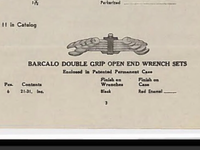



Skipping from "one" right over the numerical hump that represents "a couple" and "a few" is the least interesting part of that bona fide "collection". I don't recall anyone else doing it with Eccentric Brake Wrenches. I love it! And it will be fun. My half moon wrench fetish is up to a couple dozen unique (no dupes) examples now. You have to keep it going. That hand-forged Wright is just awesome.I recently went from having just the Blue Point B-1351 1/4" x 3/16" brake eccentric wrench (that's 41-W-895 to you folks driving WWII OD vehicles) to having one each of Bonney, BluePoint, Williams and Wright.
 Here is a picture of Bill’s beautiful Jeep.

That Bessemer steel needed all the help it could get!Look at the beam width!
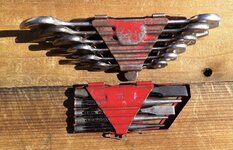
I'm too untidy to maintain that fastidious of an approach!Or place the wrenches in a "horizontal stack" on edge.
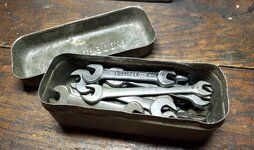
Great idea. I have another one and they're a tad deeper. This may get me another year or so before I have to go larger.You need another WWI bacon tin!


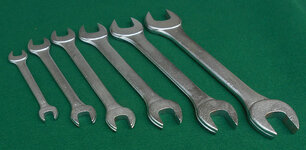

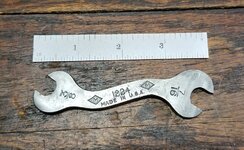
Didn't see this here. I replied to your query over on the Logo thread. Repeating it here, where the ISN and sizing discussion is more appropriate anyway.Stumped on this logo. H.D. Smith circle-S backward mistake? I'm pretty sure it's stamped "821", but possibly "621".
I will emphasize that I have no awareness of H.D. Smith or Starrett making DOE wrenches. I haven't re-checked any Starrett catalogs, but I did re-check H.D. Smith 1915 and 1924.I don't know what it is, but I can offer my thoughts for your consideration.
I suspect the reverse is unintentional and something to do with a flipped die.
The logo of an "S" in a circle was trademarked by H.D. Smith. Strangely, Starrett also used it, but only on pressed steel sockets. I am not familiar with either of them making DOE wrenches, though, which makes it even more odd. But those are the two I would search.
The "821" is also odd. It's not an ISN. It could be a model number, where the "8" is indicating the purpose of the wrench, possibly, but less likely, the composition, in a series of "8xx" model numbers, and the "21" is the ISN designator. It's an engineers' wrench, technically, and the markings (1/8" x 3/16") are correct for an ISN "21" wrench if they are expressed in U.S.S. nut and bolt sizes. The milled openings would be 5/16" x 13/32". With the jaws spread on that one opening, it's going to be hard to measure.
No idea on the "ACB."
Thanks for your insight on this. I hadn't been able to locate any H.D. Smith/Starrett cats with DOEs either.Didn't see this here. I replied to your query over on the Logo thread. Repeating it here, where the ISN and sizing discussion is more appropriate anyway.
I will emphasize that I have no awareness of H.D. Smith or Starrett making DOE wrenches. I haven't re-checked any Starrett catalogs, but I did re-check H.D. Smith 1915 and 1924.
That's just forging flash not being completely ground away......This little wrench has severe over-fill at the parting line,.....


CAP is for cap nuts. Up until May 1927, Bonney (and most manufacturers) sized wrench openings for the heads and nuts that fit the threads of a screw diameter, and marked the wrench with that screw diameter. SAE and CAP nuts that fit the same diameter thread can be different across flats, so a particular wrench opening might be marked with two or more screw diameters, as well as a hexagonal symbol for across-flats. There were also STD size nuts, which were not necessarily the same as SAE, since they were not designed for automotive use. Early catalogs present tabular charts for aligning these different sizing schemes.What's up with the Bonney? What are CAP sizes?
And for that, God bless!CAP is for cap nuts. Up until May 1927, Bonney (and most manufacturers) sized wrench openings for the heads and nuts that fit the threads of a screw diameter, and marked the wrench with that screw diameter. SAE and CAP nuts that fit the same diameter thread can be different across flats, so a particular wrench opening might be marked with two or more screw diameters, as well as a hexagonal symbol for across-flats. There were also STD size nuts, which were not necessarily the same as SAE, since they were not designed for automotive use. Early catalogs present tabular charts for aligning these different sizing schemes.
The wider opening on your 1723 wrench (industry standard 723 - the 1 prefix is Bonney’s way of letting you know it’s made from chromium/vanadium alloy in case you missed those words or the CV circle) is telling you it will fit both SAE and CAP nuts on 1/4” threaded screws, but you can measure for yourself that the opening is 7/16” across flats (or a little wider as some nuts may be oxidized or plated).
In 1927 tool manufacturers began just marking the across-flats openings. If you think about it, all this allows is distinguishing one similar size wrench from another - it tells you nothing about thread diameter of the fastener or of the hole it will pass through. You might as well just number your wrenches without sizes, which some manufacturers did for sets.
Simple, right? Notice I have not even mentioned metric or Whitworth?
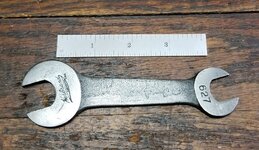
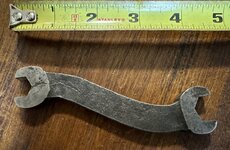
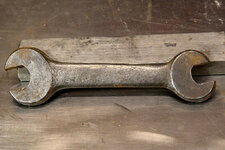
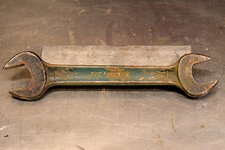
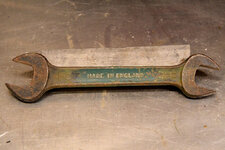
I picked up this entirely mystery DOE this AM:
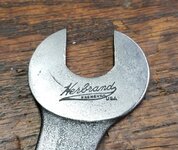
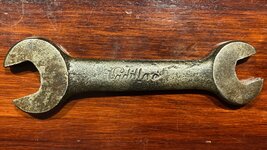
Turned up this Vlchek-forged Cadillac 13593 DOE this morning at the flea.


 progress-is-fine.blogspot.com