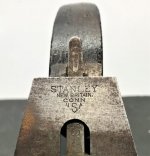
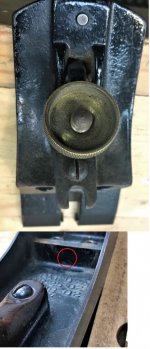
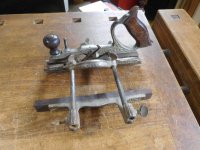
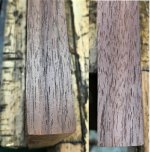
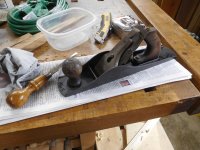
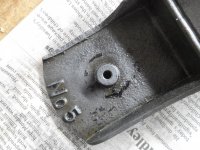
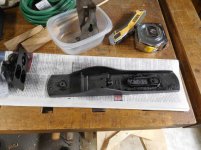
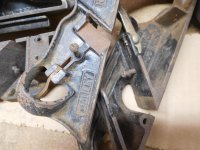
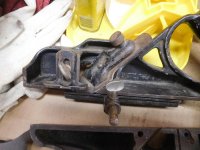
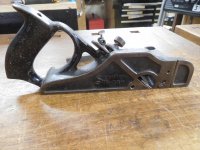
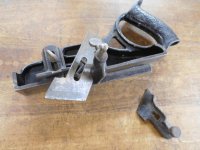
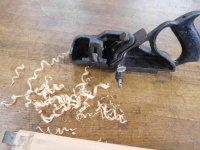
It doesn't say "Bedrock", it only has a "No.5" on it, and it doesn't have the usual truncated sides. How did you know even know it was a Bedrock model?
Thanks for your interest. I love to rattle on incessantly about Stanley plane minutia. For the Bedrock stuff, I like Bob Kaune's website.
https://www.antique-used-tools.com/brtypes.htm
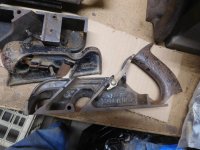
When Stanley first introduced the Bedrock series, they wanted to offer a premium line of planes that were a cut above in fit and finish with superior user characteristics. The user improvements were all about the frog. Metallic bench planes at the time were similar to the Bailey where the frog sat on the base with contact being a few points of machining. These frogs were adjustable but were prone to being slightly out of square unless the user was very careful. The Bedrocks were fully machined with a flat bottom on the frog and a flat surface on the bed. Once you see the Bedrock frog seating, you can recognize it immediately.
Just as the first Bailey plane soles were not numbered, the first Bedrock soles used Bailey numbers. By the time Bedrock type 2a rolled around in 1899, the Bedrocks soles were marked with the familiar "60x" series. As for the flat sides, they first appeared in 1911 on type 5 Bedrocks.
Knowing these little known factoids can help during purchase time. I have picked up bargains in early Bailey planes because they do not have the familiar marks. Ditto with round side Bedrocks. The only marking on the early ones was the "Bedrock" lever cap. But I have seen many round sided Bedrocks without lever caps and they go for a song.
Round side or flat side, the Bedrocks do perform better than Baileys in my experience. They are some of the highest quality planes Stanley made and backlash is almost always less on Bedrocks than on Baileys. And the fully machined frog means that you never have to worry about the frog being a few degrees off center.