To avoid these ads, REGISTER NOW!

Show us your handplanes

CRSINMICH

Well-known member
Joined
Aug 15, 2015
Messages
2,396
Location
Southeastern Michigan
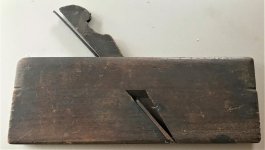
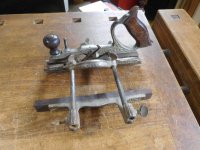
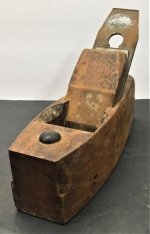
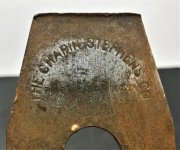
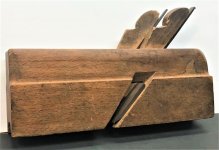
BB & WR NOYES #72 PLANE​
The Noyes brothers had a hardware store in Detroit from about 1845 to around 1850 so this plane has some age to it. I have one other Noyes plane and by a quirky coincidence I bought it 5/3/17 and this one was bought on 5/4/18. I already marked my calendar for 5/5/19.

I couldn't read the stamp while at the sale but I bought it anyway because of the size of the iron. It will make a very narrow groove. J Paterson and AJ once owned a nice user.

NOTE: I bought two other planes at this sale. Stay tuned.
 

Attachments

  • BB & WR Noyes plane #72 (8).jpg
    BB & WR Noyes plane #72 (8).jpg
    136.7 KB · Views: 19
  • Noyes both ends.jpg
    Noyes both ends.jpg
    130.6 KB · Views: 21
  • Noyes' iron.jpg
    Noyes' iron.jpg
    131.8 KB · Views: 18
Last edited:
To avoid these ads, REGISTER NOW!

jimreed2160

Well-known member
Joined
Aug 7, 2016
Messages
3,589
Location
Tallahassee FL
The "72" marking threw me off. I expected to see a lone "2" because it looks like a #2 round from an H&R set. Nice plane. Those smaller sizes are handy.
 

CRSINMICH

Well-known member
Joined
Aug 15, 2015
Messages
2,396
Location
Southeastern Michigan
The "72" marking threw me off. I expected to see a lone "2" because it looks like a #2 round from an H&R set. Nice plane. Those smaller sizes are handy.

The 72 threw me off too but this plane is 160+ years old. I have no idea when the numbers were more or less standardized. I'll just use it and worry about numbers later (or never). I also wasn't sure whether to call it a hollow or a round. The sole is round but it would cut the hollow.

Historical note: One of the Noyes boys was on the boards of several Detroit municipal organizations. Most of the names of the other board members show up as street names today. As far as I can tell, there is no Noyes Street in Detroit though.
 
Last edited:

jimreed2160

Well-known member
Joined
Aug 7, 2016
Messages
3,589
Location
Tallahassee FL
H&Rs

Yes. The nomenclature can be confusing but in reality it is just simple. The round sole plane is a "round" and the hollow sole plane is a "hollow". Even more confusing is that each maker determined his sizing. So a #2 from one maker may not be the same size as a #2 from another maker. The sizing started as a reference in 8ths. Where a #2 would cut an arc that is 1/6th of a circle that has a 2/8ths diameter. It kinda works on the smaller planes but falls apart on the larger planes.

The lack of sizing standardization is why users prize H&R sets from the same manufacturer. Harlequin, or assembled sets, usually do not match well.
 

jimreed2160

Well-known member
Joined
Aug 7, 2016
Messages
3,589
Location
Tallahassee FL
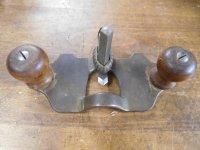
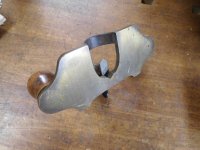
How about a bronze router plane? I have heard that patternmakers sometimes made their own tools like router planes. They often cast replicas of Stanley's popular #73 router plane. I have had a few of these. Today I found one of the bronze routers. It is the same size of the #71 but is not a direct casting copy. The blade keeper, however, is also cast and it does appear to be a direct cast copy of the Stanley.

This is one of the nicest non factory routers I have seen.
 

Attachments

  • DSCN6641.jpg
    DSCN6641.jpg
    128 KB · Views: 24
  • DSCN6642.jpg
    DSCN6642.jpg
    131.2 KB · Views: 25

Jim C.

Well-known member
Joined
Jan 8, 2010
Messages
2,598
How about a bronze router plane? I have heard that patternmakers sometimes made their own tools like router planes. They often cast replicas of Stanley's popular #73 router plane.....

Stanley made a #73? Are you thinking #71 or maybe #71 1/2?
 
Last edited:

jimreed2160

Well-known member
Joined
Aug 7, 2016
Messages
3,589
Location
Tallahassee FL
Ah, yes, the little known Stanley #73 router. It is similar to the well known #71 but has fixtures for THREE cutters--hence the #73 designation. :lol:

Or maybe my typing is faster than my editing. :eyecrazy:

Thanks for your good eyes.
 

Jim C.

Well-known member
Joined
Jan 8, 2010
Messages
2,598
Ah, yes, the little known Stanley #73 router. It is similar to the well known #71 but has fixtures for THREE cutters--hence the #73 designation. :lol:

Or maybe my typing is faster than my editing. :eyecrazy:

Thanks for your good eyes.

Yeah Jim, the Stanley #73 is highly collectible!!! It’s VERY scarce.
 

CRSINMICH

Well-known member
Joined
Aug 15, 2015
Messages
2,396
Location
Southeastern Michigan
STANLEY #5 Type 9.75?
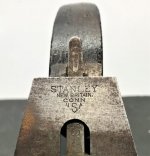
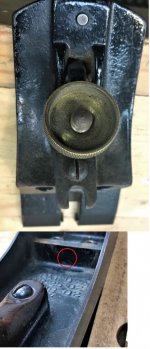
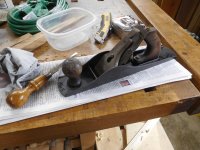
This was another estate sale find. The low rosewood knob showed that it was an older model and the price was low so it came home. On closer inspection, it turned out to be a Type 9 (1902-1907) - well, sort of. At first it seemed like the frog adjustment screw was missing but the main difference between Type 9 and Type 10 (1907-1909) is that Type 9's didn't have frog adjustment screws and Type 10's did. The frog on this plane had the yoke that goes over the adjustment screw but there was no tapped hole in the bed. Okay, so maybe Stanley had Type 9 beds to use up when they started using Type 10 frogs? Then things got interesting. Type 10's had a distinctive stamped logo on the cutting iron that read STANLEY RULE & LEVEL CO NEW BRITAIN, CONN. U.S.A in four lines. The logo on this #5's cutting iron says STANLEY NEW BRITAIN. CONN, U.S.A. in four lines in a V shape which is a Type 11 (1910-1918) logo. Taking all of this into consideration I'm going to call this a STANLEY #5 Type 9.75.

However, the answer to the mystery of all the inconsistencies might be on the lateal adjustment lever. This plane is actually a STANLE which makes it even rarer.:lol:
 

Attachments

  • (4) STANLE logo.jpg
    (4) STANLE logo.jpg
    88.1 KB · Views: 33
  • (3) Type 11 logo.jpg
    (3) Type 11 logo.jpg
    121 KB · Views: 27
  • (2) Stanley #5 over under.jpg
    (2) Stanley #5 over under.jpg
    65.3 KB · Views: 27
  • (1) Stanley #5 Type point 75.jpg
    (1) Stanley #5 Type point 75.jpg
    86 KB · Views: 28
Last edited:

jimreed2160

Well-known member
Joined
Aug 7, 2016
Messages
3,589
Location
Tallahassee FL
CRS--In spite of the inconsistencies, that is a nice handplane. My guess is that it was rehabbed by someone who swapped the mismatched parts. Type inconsistencies are not rare but they seem to happen more often on low volume planes. The blade is certainly much later than the sole and the frog adjuster mismatch is unrealistic to me. The frog AND blades from #4s and #4s are interchangeable and those were their highest volume planes. Mismatches of those parts would be extremely rare.

As for the lateral adjuster, it is a gem. Apparently the "Y" guy was out sick that day. :lol_hitti
 

CRSINMICH

Well-known member
Joined
Aug 15, 2015
Messages
2,396
Location
Southeastern Michigan
STANLEY PATTERN MAKER​
This is a page from a 1949 Stanley catalog. It shows the final hand refinements to a pattern for the bed of a plane. It looks like a number 5.
 

Attachments

  • 1949 Stanley pattern maker.jpg
    1949 Stanley pattern maker.jpg
    93.8 KB · Views: 49

CRSINMICH

Well-known member
Joined
Aug 15, 2015
Messages
2,396
Location
Southeastern Michigan
STANLEY #5 Type 9.75 UPDATE​
I could live with a plane that had the wrong frog or one with the wrong cutting iron but both of them being wrong was just a bit too much for my OCD tendencies so I bought a Type 9 frog and I'm feeling much better now. I'll keep the cutting iron with the Type 11 logo and use it happily. I guess I now have a STANLEY #5 Type 9.25
 

jimreed2160

Well-known member
Joined
Aug 7, 2016
Messages
3,589
Location
Tallahassee FL
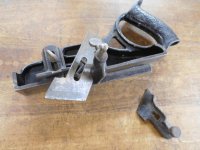
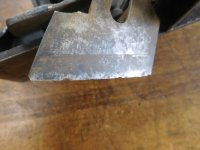
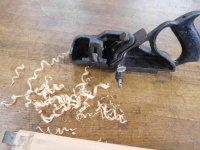
Stanley #46 dado plane

Speaking of types, I ran across this one in the shop today. It is a #46 dado skew plane, type 7, from 1893-1896. These combination planes were sold with a set of 11 graduated cutters. Although designed to cut dados (cross grained), they make pretty seashell looking shavings when cutting with the grain.
 

Attachments

  • DSCN6772.jpg
    DSCN6772.jpg
    153.6 KB · Views: 18
  • DSCN6769.jpg
    DSCN6769.jpg
    149.3 KB · Views: 17
  • DSCN6776.jpg
    DSCN6776.jpg
    149.9 KB · Views: 16

Jim C.

Well-known member
Joined
Jan 8, 2010
Messages
2,598
Hey CRSINMICM,

As for your mismatched Stanley #5, well, I feel your pain when it comes to chasing parts for hand planes, particularly when it comes to trying to keep things vintage correct. About a year or so ago, I posted a response in a handplane thread on another website. You might get a kick out of reading it. Click the link below. The link will take you to the correct page, then just scroll down to "reply #643 and #644." The topic is of the post is called " Chasing Parts." Pictures are included.

Jim C.


http://www.papawswrench.com/vboard/index.php?topic=9443.630
 
Last edited:

CRSINMICH

Well-known member
Joined
Aug 15, 2015
Messages
2,396
Location
Southeastern Michigan
Jim C: Well, okay. Thanks for that link. I'll take it as a warning or a PSA about OCD. There must be support groups for that. "Hi, I'm CRS and I - no wait. Let me start again. I'm CRSINMICH and I have a problem. Just a minute. That row of chairs over there is crooked. Let me straighten them." Maybe support groups wouldn't work for OCD after all.

I did enjoy reading your posts about the problems of "free" planes. I actually didn't get the period correct frog for that #5 simply to be correct, although I do feel much better now. Type 9 frog receiver ribs were straight and Type 10's were arched. Type 10 frogs had a much bigger slot in them so they could go over the rib. I was concerned that there might be too much slop and I'd have problems with chatter.

I hesitate to mention this in case you weren't aware of this little detail already. It would only make OCD tendencies worse. I attached a photo of the knob, the tote, and their threaded rods and brass nuts. Note that the nuts are simply short cylinders. Starting around Type 9 Stanley started machining a waist into the nuts. I'm choosing to believe that they hadn't begun to do that yet when they made the Type 9 nuts for my plane. That's my story and I'm sticking to it!

WARNING TO READERS: If you haven't already fallen into the Period Correct rabbit hole RUN AWAY FAST before we start discussing knurl patterns on adjustment wheels!
 

Attachments

  • Stanley #5 Type 9 (8).jpg
    Stanley #5 Type 9 (8).jpg
    149.8 KB · Views: 13
Last edited:

CRSINMICH

Well-known member
Joined
Aug 15, 2015
Messages
2,396
Location
Southeastern Michigan
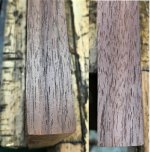
SPEAKING OF CHATTER​
I took these photos to illustrate chatter and to show that you always have to fine tune your tools to get the best performance. The wood is a beautiful dark walnut that has very wild grain. At the end of the board that is showing there was some really difficult grain. The wood in the picture on the left was planed with a new Lie-Nielson #5 1/2 that I am only beginning to fine tune. Notice the lines going across the grain. In the section of the board that did not have wild grain The L-N made smooth cuts. The photo on the right shows the same end of the same board after I had made two or three passes with a Stanley #5 Type 10 (all period correct parts) that I have already tuned. There are still a few faint chatter marks left but most of it is glassy smooth.
 

Attachments

  • Chatter comparison.jpg
    Chatter comparison.jpg
    150.6 KB · Views: 38
Last edited:

hsvtoolfool

Well-known member
Joined
Jul 29, 2015
Messages
185
Location
Rocket City USA
Stanley #46 dado plane...

One of my absolute favorite planes. It just works so darn well!
It's funny how you can pick up a #46 or #47 in good condition
for $100 or less, but a full set of the dratted original skew cutters
can set you back $250. One of my first projects for my "someday
soon" hobby machine shop will be making several sets of those
#46 cutters.
 
To avoid these ads, REGISTER NOW!

jimreed2160

Well-known member
Joined
Aug 7, 2016
Messages
3,589
Location
Tallahassee FL
One of my absolute favorite planes. It just works so darn well!
It's funny how you can pick up a #46 or #47 in good condition
for $100 or less, but a full set of the dratted original skew cutters
can set you back $250. One of my first projects for my "someday
soon" hobby machine shop will be making several sets of those
#46 cutters.

I collected a bunch of #46s back in the 1990s but the blades were either missing or in very poor condition. Solving that problem began my great blademaking enterprise. I knew nothing about metalworking when I started but I ended up making some great cutters. If you are serious about making some cutters, let me know because I can save you lots of time and frustration.
 

crguy

Well-known member
Joined
Jan 24, 2016
Messages
2,646
Location
SW Washington
I collected a bunch of #46s back in the 1990s but the blades were either missing or in very poor condition. Solving that problem began my great blademaking enterprise. I knew nothing about metalworking when I started but I ended up making some great cutters. If you are serious about making some cutters, let me know because I can save you lots of time and frustration.

St. James Bay tool company makes all sorts of replacement blades for Stanley planes. Nicely done. proper temper, etc. all that you could ask for. You can't make your own any better or cheaper.
 

jimreed2160

Well-known member
Joined
Aug 7, 2016
Messages
3,589
Location
Tallahassee FL
St. James Bay tool company makes all sorts of replacement blades for Stanley planes. Nicely done. proper temper, etc. all that you could ask for. You can't make your own any better or cheaper.


True. He started out making castings and hard to find screws. Once I defined the blade market, he started making those also. Great products.
 

jimreed2160

Well-known member
Joined
Aug 7, 2016
Messages
3,589
Location
Tallahassee FL
Early Bedrock type 1

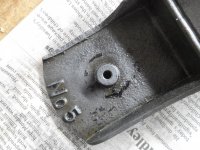
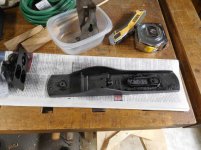
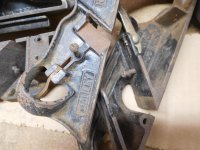
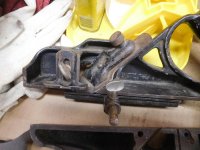
This guy arrived in bad shape but it is a rare type 1 Bedrock so I thought it deserved a little cleaning. When they were made in 1898, Stanley used the Baily numbers, so this one is marked "No 5", instead of "605". It has a few nibbles on the side of the toe and the frog is missing its lateral lever. Maybe they both broke in the same nose dive off a bench.

I found some parts to finish it out. It really needs a low knob and a Bedrock type 1 lever cap to make it authentic. But with its damage, it is destined to be a user plane and authenticity is less important. At least it can go back to work.
 

Attachments

  • DSCN6825.jpg
    DSCN6825.jpg
    150.6 KB · Views: 38
  • DSCN6824.jpg
    DSCN6824.jpg
    153.8 KB · Views: 31
  • DSCN6823.jpg
    DSCN6823.jpg
    147.8 KB · Views: 35
  • DSCN6822.jpg
    DSCN6822.jpg
    157.5 KB · Views: 40
  • DSCN6821.jpg
    DSCN6821.jpg
    152.2 KB · Views: 35

jimreed2160

Well-known member
Joined
Aug 7, 2016
Messages
3,589
Location
Tallahassee FL
Universal donor plane

Little known fact but I consider the common Stanley #78 to be the universal donor plane. Kinda like blood type "O" in humans. The pieces and parts of that plane, and there are many, are used in many other Stanley products. The depth shoe can replace a missing part on the rare Stanley #289 skew rabbet plane. Ditto with the rod and fence. Not a true #289 fence but certainly one that is very serviceable. The rod and fence also work on the uncommon #278 rabbet plane. This is good to know because those two planes are often found incomplete.

The blade keeper screw fits the blade keeper on the Stanley #95 edge plane. It also fits the (often missing) fence on the #71 router plane. Even if you are lucky enough to find the fence, you rarely find the fence with its screw.

So if you are restoring vintage Stanley planes, don't despair if you need critical parts. There are a surprising number of donors and substitutes out there that will get your plane back on its feet and earning its keep.
 

Attachments

  • DSCN6828.jpg
    DSCN6828.jpg
    144 KB · Views: 20
  • DSCN6829.jpg
    DSCN6829.jpg
    147.6 KB · Views: 16
  • DSCN6826.jpg
    DSCN6826.jpg
    152.3 KB · Views: 21
  • DSCN6827.jpg
    DSCN6827.jpg
    150.2 KB · Views: 20

CRSINMICH

Well-known member
Joined
Aug 15, 2015
Messages
2,396
Location
Southeastern Michigan
jimreed: We must be on similar wavelengths today.


PLANE MODIFICATIONS​
I DO NOT RECOMMEND ANY PROCEDURE OF THIS TYPE. IT'S ONLY ORIGINAL ONCE!​
However, I may try one or two of these modifications​

IF YOU ARE A PURIST YOU MAY WANT TO SKIP THIS​

The first link is to a Paul Sellers' video on converting a Stanley #78 (or anyone else's 78) to a scrub plane. The only modification is to the cutting iron. He put a huge camber on it. It works like a #40. If you're hinkey about doing that to a vintage iron you could buy a new one to convert then you could keep the cambered iron around and pop it in as needed. I wish I had known about it before I passed on the approximately 1,579 Number 78's I have seen over the last few years because they didn't have a depth adjuster, the rod, and/or a fence. It's a great use for a $15 plane that could cost another $20 to $80 to complete.

The second link is to a Paul Hamler video. It's about the modifications/conversions he has made to planes. Most of them became scrapers. Imagine what you could do with a cabinet scraper in a #7 plane body. As the video progresses, the modifications get more technologically advanced but for the first few he only had a drill press and a radial arm saw. Eventually Paul Hamler specialised in making working miniaturized versions of tools. In one of his videos he made a working miniature Wilton Baby Bullet vise.

Paul Sellers:
Paul Hamler:
 
Last edited:

exmaxima1

Well-known member
Joined
Jun 25, 2011
Messages
6,339
Location
Midwest
Early Bedrock type 1

This guy arrived in bad shape but it is a rare type 1 Bedrock so I thought it deserved a little cleaning. When they were made in 1898, Stanley used the Baily numbers, so this one is marked "No 5", instead of "605".


It doesn't say "Bedrock", it only has a "No.5" on it, and it doesn't have the usual truncated sides. How did you know even know it was a Bedrock model?
 

jimreed2160

Well-known member
Joined
Aug 7, 2016
Messages
3,589
Location
Tallahassee FL
It doesn't say "Bedrock", it only has a "No.5" on it, and it doesn't have the usual truncated sides. How did you know even know it was a Bedrock model?

Thanks for your interest. I love to rattle on incessantly about Stanley plane minutia. For the Bedrock stuff, I like Bob Kaune's website.
https://www.antique-used-tools.com/brtypes.htm

When Stanley first introduced the Bedrock series, they wanted to offer a premium line of planes that were a cut above in fit and finish with superior user characteristics. The user improvements were all about the frog. Metallic bench planes at the time were similar to the Bailey where the frog sat on the base with contact being a few points of machining. These frogs were adjustable but were prone to being slightly out of square unless the user was very careful. The Bedrocks were fully machined with a flat bottom on the frog and a flat surface on the bed. Once you see the Bedrock frog seating, you can recognize it immediately.

Just as the first Bailey plane soles were not numbered, the first Bedrock soles used Bailey numbers. By the time Bedrock type 2a rolled around in 1899, the Bedrocks soles were marked with the familiar "60x" series. As for the flat sides, they first appeared in 1911 on type 5 Bedrocks.

Knowing these little known factoids can help during purchase time. I have picked up bargains in early Bailey planes because they do not have the familiar marks. Ditto with round side Bedrocks. The only marking on the early ones was the "Bedrock" lever cap. But I have seen many round sided Bedrocks without lever caps and they go for a song.

Round side or flat side, the Bedrocks do perform better than Baileys in my experience. They are some of the highest quality planes Stanley made and backlash is almost always less on Bedrocks than on Baileys. And the fully machined frog means that you never have to worry about the frog being a few degrees off center.
 

hsvtoolfool

Well-known member
Joined
Jul 29, 2015
Messages
185
Location
Rocket City USA
Once you see the Bedrock frog seating, you can recognize it immediately.
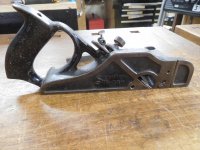
Jim, allow me to rephrase Exmaxima1's question...

When you're browsing in a flea market and find a shelf of fifty
common Stanley #5 planes, how can you spot an early Bedrock
model without disassembling the plane?

Exmaxima, while I've never seen an early "no sixty" Bedrock,
I'd guess that JimReed's starting point is the patent date cast
into the bed. If the plane is old enough, he then takes a closer
look at the frog adjusting screw. There may be differences at
the back of the frog you can spot. Then again, maybe you must
disassemble the plane and look at the frog.
 

jimreed2160

Well-known member
Joined
Aug 7, 2016
Messages
3,589
Location
Tallahassee FL
My guess is that the type 1 Bedrocks used some of the same Bailey casting forms as a starting point, so the bed numbers will look alike. So one must look for the patent date and the milled out patent date--that is a dead give away. Only Bedrocks have the patent date and the milled out date.
 

CRSINMICH

Well-known member
Joined
Aug 15, 2015
Messages
2,396
Location
Southeastern Michigan
I think I may need professional help. I picked up five more wooden planes in the last few days. Here's the latest. It's a J Pearce coffin smoother with a Chapin-Stephens iron. Hermon Pearce started making planes in the 1820's. I think this was his grandson. Pearce and Chapin-Stephens collaborated on planes until the late 1920's when they were swallowed whole by Stanley.
 

Attachments

  • J Pearce plane with Chapin Steohens iron (2).jpg
    J Pearce plane with Chapin Steohens iron (2).jpg
    66.5 KB · Views: 18
  • J Pearce plane with Chapin Steohens iron (3).jpg
    J Pearce plane with Chapin Steohens iron (3).jpg
    150 KB · Views: 20
Last edited:

jimreed2160

Well-known member
Joined
Aug 7, 2016
Messages
3,589
Location
Tallahassee FL
Not all Bedrocks had the milled out space below the '95 patent date.

You are correct. Only type 1 and early type 2s had milled out dates along with the Bailey plane number cast into the bed. Type 2b and subsequent Bedrocks have the Bedrock 60x numbers cast into their beds.

The question was how to tell if a round sided plane marked with a Bailey bench plane number was really a Bailey or an early Bedrock. One way is to remove the frog and examine the seating. Bedrock planes are milled flat on their entire surface. BUT you can look for the patent date with a milled out date underneath. If you find that, then the plane is an early Bedrock.
 

CRSINMICH

Well-known member
Joined
Aug 15, 2015
Messages
2,396
Location
Southeastern Michigan
BARTLETT'S OHIO PLANES NOSING PLANE​
I found this one in a box of planes I got through CL. It's a nosing plane meant to put a round on the leading edge (or nose) of a board. It was most often used to round the nose of stair treads. The catalog item is from a 1910 Hibbard, Spenser, and Bartlett catalog.
 

Attachments

  • Hibbard Spenser Bartlett 1910 catalog p78.jpg
    Hibbard Spenser Bartlett 1910 catalog p78.jpg
    106.7 KB · Views: 14
  • Bartletts Ohio Plane #113 Nosing plane (10).jpg
    Bartletts Ohio Plane #113 Nosing plane (10).jpg
    148.6 KB · Views: 12
  • Bartletts Ohio Plane #113 Nosing plane (7).jpg
    Bartletts Ohio Plane #113 Nosing plane (7).jpg
    47 KB · Views: 13
  • Bartletts Ohio Plane #113 Nosing plane (4).jpg
    Bartletts Ohio Plane #113 Nosing plane (4).jpg
    50.7 KB · Views: 13
  • Bartletts Ohio Plane #113 Nosing plane (1).jpg
    Bartletts Ohio Plane #113 Nosing plane (1).jpg
    148.3 KB · Views: 13

CRSINMICH

Well-known member
Joined
Aug 15, 2015
Messages
2,396
Location
Southeastern Michigan
jimreed: Thanks! I actually had a use for this one on the Project in Progress but didn't have time to tweak the Bartlett's beforehand. Coincidentally, I found another Bartlett's Nosing plane with a smaller radius in an antique shop a few days ago. I didn't buy it because both wedges were missing and the body had some extra holes in it. I might have to go back and get it. I did buy a J Pearce/Chapin-Stephens jointer (see post #352 ). I had never heard of either J Pearce or Bartlett's Ohio Plane and now in a matter of two weeks I have a collection. Go figure.
 
Last edited:

Bill vonSteuben

Well-known member
Joined
May 5, 2018
Messages
60
Location
Atlanta, NY 14808
I found this mid 60's Stanley 9 1/2 with a Craftsman crown logo recently. I cleaned it up enough to use and found what I believe to be the factory grind on the blade.
 

Attachments

  • PICT0737.jpg
    PICT0737.jpg
    143.9 KB · Views: 27
  • PICT0738.jpg
    PICT0738.jpg
    138.9 KB · Views: 29

jimreed2160

Well-known member
Joined
Aug 7, 2016
Messages
3,589
Location
Tallahassee FL
Stanley #289 Skew Rabbet

Not a common plane to find, the #289 is fun to use in the shop. It makes spiral shavings that remind me of seashells. This one arrived with a punked out blade. The way to fix these is to grind it flat past the defects and then reapply the bevel. I had to take off about 1/16" on this one. But now it kicks out nice spirals.
 

Attachments

  • DSCN6927.jpg
    DSCN6927.jpg
    137.9 KB · Views: 21
  • DSCN6928.jpg
    DSCN6928.jpg
    150.5 KB · Views: 19
  • DSCN6923.jpg
    DSCN6923.jpg
    127 KB · Views: 21
  • DSCN6924.jpg
    DSCN6924.jpg
    97.3 KB · Views: 18
  • DSCN6935.jpg
    DSCN6935.jpg
    150.4 KB · Views: 23
To avoid these ads, REGISTER NOW!
Top Bottom