CRSINMICH
Well-known member
Joe: That's an incredible haul of planes etc. Are they for bragging or using? I wonder if that small router isn't actually made of bronze. I would think brass would be too soft in that application.

That just means an owner sharpened it incorrectly.I bought a No 12 about 2 yrs ago. I found it interesting that the blade is sharpened to 45*. Not 90* like a scraper, or 28-ish* like a plane.
Maybe. Maybe not. From the Hock Tools website …That just means an owner sharpened it incorrectly.
That's a matter of opinion and usage. I got my LN 112 before I ever saw a real #12, and their monstrous thick blade is sharpened at 45°. During my early struggles, one of my buddies, much more knowledgeable on #12s etc, tried to sharpen my #112 to a scraper profile, with the burnished edge, rolled appropriately. Could not get it to cut to save his @$$. The blade worked freehand tho. I took it back to 45°, set it up per directions, and it cut great. He was stupefied. I later put a 45° on a regular #12 blade, and it did work just fine, and much easier than burnishing the scraper edge.That just means an owner sharpened it incorrectly.

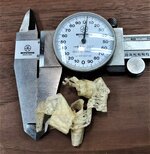
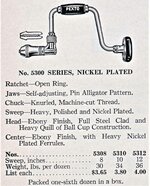
The OVB is a Stanley Everlasting made by Stanley and sold by Hibbert Spencer & BartlettHit an estate sale this morning after seeing the wooden handle of what I thought was a chisel in an ad pic. Turned out to be a vintage Greenlee 1/2" gouge but there were some other finds as well... Stanley No 4 type 16 smoothing plane, Pexto 5310 ratcheting brace, OVB 1/2" chisel and a Pexto 3/4" chisel. I don't know anything about the Pexto brace but I have been hoping to come across a decent brace. Is this good one? They seem to sell for around $20 on ebay. I spent $7 this morning.
Nice finds.In an 1898 STANLEY catalog, I found some indirect support for the idea that blades for #112 scraper planes were sharpened to 45 degrees. Look carefully at the bottom of the extra blade. It looks like it could be 45 degrees however, it's also a toothing blade so there's that. Just to muddy things a little more, the second picture is of a #80 from a 1914 STANLEY catalog. The drawing of the replacement blade looks like it was meant to show bevels on the top and bottom edge. What I really found interesting is that the top edge looks like it has a radius. What's up with that?
CRS Thanks! I found that same catalog yesterday as well! I certainly noticed the Pexto claim that the first brace made in America was a Pexto brace. In 1850 no less. So the Archive comment associated with the catalog says this was probably a 1938 or 1939 catalog. I loved finding the 5310 there but noticed it was one of their lower models. I was trying to decipher that 1/6th of a dozen and came to the same conclusion you did - 2. What a funny way to list those. I'm going to further clean this brace up and oil it then look for a set of bits. I need to figure out how the ratchet was used and how to properly put bits in the brace but I'm actually thinking I might use this. Good stuff!tx: Serendipitously, while I was looking for the STANLEY scraping plane information, I found a PEXTO catalog. Here's your 5310 brace and some information about PEXTO braces in general. After some quick math on my calculator, I figgerd that 1/6th of a dozen is 2.

You can make a scraper work almost anyway. I am not above grabbing a chisel to fix a problem in a small area, just be gentle. A very square piece of stock, like the side of a chisel, can also cut in some areas.I had a couple of freshly sharpened spokeshave blades, he picked up one and showed me how by holding it at 45 deg and drawing it trailing back across the surface with the bevel away from him it cut beautiful shallow curls and left a smooth finish. So, the point of this being, Stan says: "Scraper works with blade edge at 45 deg".. !
Yes, 'exchange of research notes', I like that term much better.Farmer J: I don't think it's a debate about scraper angles as much as it is an exchange of research notes. Thanks for your additions too, by the way. Your friend sounds like a very practical person and a bit of a bodger in both senses.
Speaking of bodgers, I remembered hearing about a tool that I've never used called a chair devil. It's simply a thin piece of steel, like an old saw plate which is held in a simple holder at 90 degrees to the wood. It smooths out irregularities in chair spindles by scraping. That got me thinking about my recently acquired STANLEY No.66 beading tool. It too works by scraping various profiles into wood. (It's fun to use, too.) The various cutters used in it are all cut at 90 degrees.
EDIT: I just watched Paul Sellers' video on chair devils and he makes his with a hook on the cutting edge.
I'm not sure what point I'm trying to make with all of this except that scrapers are probably overlooked and under utilized.

Thanks. I'm gonna try some of this!You can make a scraper work almost anyway. I am not above grabbing a chisel to fix a problem in a small area, just be gentle. A very square piece of stock, like the side of a chisel, can also cut in some areas.
what CRS showed in #975 is the standard way to sharpen a handheld scraper, and by bowing or tilting it, you can go from a light cut to hogging off material with the same tool, without changing the hook. By putting a huge hook on with your burnisher, it is a transformational experience how much it can remove, and still not tear out.
it’s fun to play when you are not under pressure to finish a project.
my biggest problem is turning a big enough hook when I am working on a project.

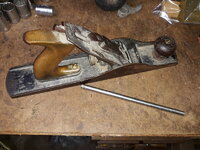

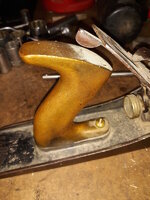
That handle was owner made by a patternmaker or someone with access to a foundry. Stanley did make some aluminum ones, largely used in trade schools where the planes were more likely to be dropped or abused.Dug this old girl out of the local Restore this afternoon.
a very nice working grade Stanley no. 5 sweetheart. One odd thing, the tote is made of brass.
Has anyone seen this before?
I had a 5 with a cast aluminum handle. Supposedly, they were sold as replacements to school woodshops. Sold it, because is was damn cold to hold. My guess is some patternmaker made yours with the intention of never having to fix it again.Dug this old girl out of the local Restore this afternoon.
a very nice working grade Stanley no. 5 sweetheart. One odd thing, the tote is made of brass.
Has anyone seen this before?
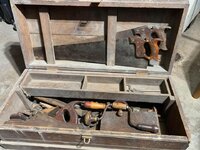

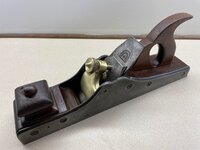
Any history on the maker and the plane? What is it's age? Are you putting it to work?Alex Mathieson & Son
Looks like some good info here. I knew of another page, but can’t find it now.Any history on the maker and the plane? What is it's age? Are you putting it to work?