CRSINMICH
Well-known member
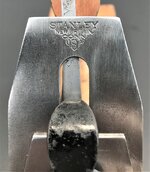
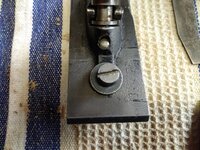
RTM: Thanks! I never thought to check G-P for shaves. The thumb screw had been nickel plated like the catalog said and the body was japanned.

Excellent overall. There are two I would have left there.Stanley #606
The sign said, "All planes $20" so I bought some
G.Baldauf scrub plane (German)
Stanley #40
Stanley#3
Stanley #12
Stanley #90
Stanley #35
Stanley #78 complete and in original box
Sometimes you get lucky
For $6, I'll take two of them - one as a spare.paulsomlo: I found this in a 1901 catalogue from Montreal while I was looking for information about the spokeshave above. You can make a side by side comparison and it's worth noting that the #20 was priced 50% higher than the #113.
I would have left the wood body German scrub and the 35 transitional.cr: There are four I should have left since they are duplicates for me but, really, how could I at that price? Just out of curiosity, which two would you have left?
hsv: There are no missing parts and all seem like they will work. I think the #3 is a Type 18 - immediately post war era. There was another #78 that was mostly complete but no box. Maybe I should have gotten it and parted it out. The German scrub plane has an ebony sole that looks like it might have been added but it might be original. Baldauf was said to be the first German wood tool maker or werkzeugmacher.
The Stanley #20 was a better plane in terms of quality/durability than the #113. Hence the 50% higher price. The Record #020 was also a very nice plane that was more heavy duty than the Stanley #113. While the #113 certainly sports some nice “contraptionisms” with the gears, etc., if you’re planning to use a compass plane, I’d go with the Stanley #20 or Record #020.paulsomlo: I found this in a 1901 catalogue from Montreal while I was looking for information about the spokeshave above. You can make a side by side comparison and it's worth noting that the #20 was priced 50% higher than the #113.
Now to find one at a reasonable price - I bid one on ebay this morning, but it went for $50 over my bid. There were a handful of bidders and something like 25 watchers.The Stanley #20 was a better plane in terms of quality/durability than the #113. Hence the 50% higher price. The Record #020 was also a very nice plane that was more heavy duty than the Stanley #113. While the #113 certainly sports some nice “contraptionisms” with the gears, etc., if you’re planning to use a compass plane, I’d go with the Stanley #20 or Record #020.
Jim C.
Kunz planes get little respect, and rightly so because of their low quality. If you want a plane to use, I'd be looking for a Stanley 20.I finally won the bid on a Kunz #20 off ebay. I've got it cleaned up, but it's got some issues. When I adjust the blade laterally, the frog shifts as well. I've got the frog adjusted "upwards", away from the sole, because when it's dropped down all the way, I can't retract the blade enough. Also, the male dovetail and frog are not aligned properly, so the iron is not fully supported. It does appear that the frog has been machined on both sides, but without the prominent bosses on the backside, that I've seen in pictures of the Stanley version. Also, the sole protrudes slightly beyond the male dovetail. It appears I've got some work to do with a file - anyone have any advice?
I was looking for a Stanley, but kept getting outbid and I've got chair backs to finish. I've got $100+ into this thing, so I'm gonna try to make into something useful, maybe at some point I'll happen upon a Stanley at a flea market or garage sale. The plane did fairly well on the deepest part of the inside curves of the chair backs, but lots of chatter elsewhere. I think it's just an improbable design and by its nature, prone to chatter.Kunz planes get little respect, and rightly so because of their low quality. If you want a plane to use, I'd be looking for a Stanley 20.
 www.garagejournal.com
I was looking for a Stanley, but kept getting outbid and I've got chair backs to finish. I've got $100+ into this thing, so I'm gonna try to make into something useful, maybe at some point I'll happen upon a Stanley at a flea market or garage sale. The plane did fairly well on the deepest part of the inside curves of the chair backs, but lots of chatter elsewhere. I think it's just an improbable design and by its nature, prone to chatter.
I‘d give some antique tools another try, particularly hand planes. When they’re set up and tuned in correctly with a super sharp iron, they are magical. There’s definitely a learning curve that goes into using them and purchasing them. I made some mistakes along the way. If you’re into old planes, you gotta start somewhere and that usually includes some mistakes. I will say that if Lie Nielsen or Lee Valley made a compass plane, you’d have paid more than $100 for it.Truthfully, I avoid antique tools, because I got burned early on, thinking they had some special magic to them. If Lie-Nielsen or Lee Valley were making a compass plane, I would have just rather bought a new one.
Maybe consider cutting your losses on this. It sounds like this plane with its shims and misaligned parts, etc., is just going to be a source of real frustration.For now, I've inserted some wood shims on either side of the frog, so it doesn't shift on me anymore. I need to tackle the misalignment between frog and mouth, either shimming the back of the frog, or filing the mouth.
Wish I'd seen that you had a #20 Stanley in there.I recently purchased between 80 and 90 hand planes from a local estate. He had somewhere between 500 and 1000 planes there, and I was fortunate enough to be the very first person to look through them. He said that somebody who came in after I was done purchased everything that was left. I honestly don’t know much about them, but selected the ones I felt were in good condition and/or were valuable. There were several there brand new in the box. You can see the majority of them in the photos in this discussion:
Vintage Wheeler Madden & Clemson Back Saw and Hand Planes
I recently purchased a very large number of vintage wood planes (mostly Stanley) and some other wood working tools from an estate. One of these tools is a very old miter saw. I tried performing an internet search and got a few hits on similar saws, but finding information on this specific model...
Be sure to scroll down to post #16. There were also several other items I purchased from this estate, and some of them are also shown in the pics. If anyone would like to see close-ups of any of these items I would be happy to provide them.
Maui
Planing the dip in the chair back, where the sole was well supported worked OK, but outside of that, it gave me fits.Sorry to hear that you had trouble, first trying to purchase some a compass plane, and second trying to use it. A compass plane is designed to cut on a consistent curve. If the arc of the workpiece changes even slightly from the arc set on the plane, you’re going to get chatter.
I‘d give some antique tools another try, particularly hand planes. When they’re set up and tuned in correctly with a super sharp iron, they are magical. There’s definitely a learning curve that goes into using them and purchasing them. I made some mistakes along the way. If you’re into old planes, you gotta start somewhere and that usually includes some mistakes. I will say that if Lie Nielsen or Lee Valley made a compass plane, you’d have paid more than $100 for it.
Maybe consider cutting your losses on this. It sounds like this plane with its shims and misaligned parts, etc., is just going to be a source of real frustration.
Jim C.

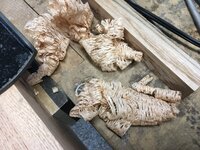

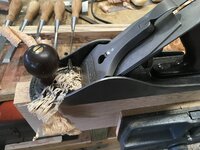


There’s also a Stanley #113, a #45 with the box of cutters, and two #2s.Wish I'd seen that you had a #20 Stanley in there.
I'll fish my 20 out later this weekend, see what help I can decipher.. Also, the sole protrudes slightly beyond the male dovetail. It appears I've got some work to do with a file - anyone have any advice?
Now you've seen 3:I just picked up this plane earlier today. It is an O. R. Chaplin’s Patent No. 3 plane, and has a cast iron handle and cast iron knob. I’ve never even seen one of these before. I believe this is one of the first ones they produced because there are no patent dates on it anywhere that I can find. The only ID markings are around the base of the knob where it reads “O. R. Chaplin’s Pat”. It measures approximately 8 1/4” in overall length.
Maui

Nice! They look to be in very good condition. Are they both the same model number as the one I posted or are they different?Now you've seen 3:
 www.lie-nielsen.com
I did a similar project once, turning a bigger board into a smaller board with a plane to fit where it needed too. It worked, and is a great exercise (pun intended) as it teaches how heavy a shaving you can take. But next, try the hatchet, drawknife, or adze to rough it in, or you can split it with hatchet, wedge, or froe depending on the situation, then plane it to final.MATHIESON & SONI had to reduce the width of a 1/2" thick and 6" wide board by about three quarters of an inch and I chose to plane it down rather than sawing. It was a lot of wood to remove and on a whim I grabbed a razee style wooden try-plane. It hogged off the wood easily because it was not taking wispy shavings. Somehow, the edge stayed square to the face which is hard for me to do. This may be a Frankenplane. There is no manufacturers' name stamped into the wood body but the heavy cap iron is stamped AlexR MATHIESON & SON Glascow. The cutting iron has a stamp that is upside down from the cap iron stamp. The name on the cutting iron stamp is unreadable. It looks like it was overstruck with a different name. I think the original stamp ended ...ORBY. That could be SORBY. Does anyone recognize the Maltese Cross logo?
or something
I did a similar project once, turning a bigger board into a smaller board with a plane to fit where it needed too. It worked, and is a great exercise (pun intended) as it teaches how heavy a shaving you can take. But next, try the hatchet, drawknife, or adze to rough it in, or you can split it with hatchet, wedge, or froe depending on the situation, then plane it to final.

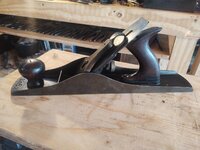
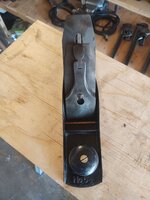
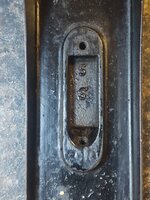

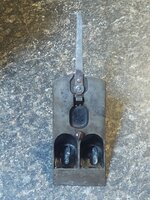

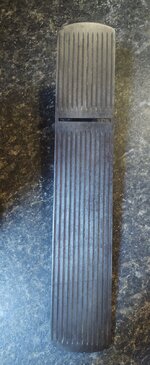
I wrote something about the Stanley #5 1/2 and #605 1/2 blade widths changing at some point. Check out this link.I also noticed that specs say the No. 5 1/2 is 2 3/8" wide but mine measures just shy of 2 3/4". Not sure why??
Lie Nielsen or Lee Valley both sell great tools. LN is very traditional, and expensive. LV s a bit of newer technology in some planes, and a bit more reasonable. Both will kick the doors off anything you can get in the big box stores.
I have a handful of each, but none in the traditional 3,4,5,6,7,8 sizes. I have LV bevel up planes, and some joinery stuff. My LN are all specialized ones where the vintage versions were much too dear and rare to use.
for table tops, I’d look at a 5 or bigger.
Bench Planes Lie-Nielsen Toolworks
Form Follows Function. The mid-sized planes are best for roughing work. These include the No. 5, 5½, 6, 10¼, and 62. The longest planes are designed for flattening. These include the No. 7 and 8. The shortest, widest planes are ideal for finishing. These include the No. 3, 4, 4½, and 164.These...
The Stanley #5 1/2 and #5 1/2C were available between 1898 and 1958. The Stanley #5 1/2H was available between 1902 and 1924. The Stanley #605 1/2 and #605 1/2C were produced between 1898 and 1935.I was measuring the bottom. Yes...my irons are 2 1/4". I was wandering, are the type 7's the only ones stamped with the "S" for the Sessions foundry? I know the type 6 wasn't & had the little knib on the frog & the type 8 had the "B" stamp with Bailey on the body. I was also wandering when Stanley first came out with the No. 5 1/2?