bpwoodworking
Well-known member
- Joined
- Jul 6, 2023
- Messages
- 254
Thank you! That was an 18’ long cabinet. I make furniture and interiors.Nice... also... what's the project in walnut you got going on there....?

Thank you! That was an 18’ long cabinet. I make furniture and interiors.Nice... also... what's the project in walnut you got going on there....?
it's less of an issue with 230v supplies (vs the higher voltage motors/supplies), and the PWMing means it doesn't matter much what the "frequency" is. even if you're running it at 30V RMS, the insulation still sees peak to peak 680v (or whatever it is) at 7kHz.Be careful turning that motor down that far. They don’t recommend running non inverter rated motors below 20hz. The way inverters form the wave forms causes very high voltage spikes. This will blow holes in the insulation of the motor windings. Inverter rated motors have a higher class of insulation to deal with those spikes.
Very nice job with your implementation!
I like how you built the one in the bandsaw, looks factory. Nice workI have VFDs on two current tools, a Delta 30c RAS and a Delta 20 bandsaw. I used the mag switch to power on the VFD and wired the VFD directly to the motor. On the RAS, I made a small switchblock using some aluminum, rosewood and two momentary contact pushbuttons so I could turn the saw on and off while holding the handle.
On the bandsaw, I stashed the VFD in the box that the optional blade welder would normally sit the cut out an opening for it. What is very nice about using the VFD on this saw is that it gives me variable speed on the saw too.
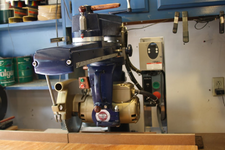
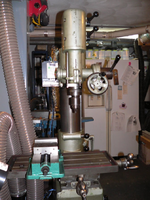
I had an Arboga mill that was 3 phase and had it mounted up and to the left, I wanted to keep any potential metal shavings out of the electronics.


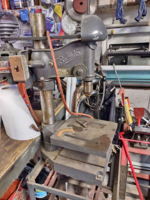
switchmode PS sitting top of the VFD 20V 2A the tach is an automotive 10,000 rpm I made a new face. and use a photo reflective sensorInteresting tachometer, what powers it.
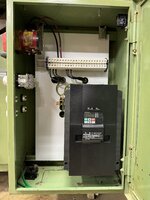
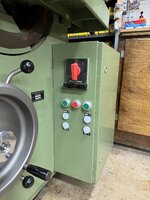
You don't have to drive all of those things off of the vfd. They can be driven by whatever drives the vfd. The pump can be turned on by the fwd/rev signal feeding the vfd. That would allow you to include a delayed on or off if so desired, for example.Really cool!
Got started on this vfd install. This is for the Martin shaper. It has a two speed motor and my plan so far is to connect to the low speed windings and over speed them for high speed.
The machine has some original functions that I need to tap into such as a light for each speed that is switched by a part that operates off the belt. Not sure if I’ll get that going or just show high/low.
The machine also has an oil pump for the bearings. The original is long gone and also the original pumps are all dead or dying by this age so no sense in trying to use one. Instead I bought a bijur surefire that I need to operate via relay with the vfd. So I’ll have to figure out how to do that.
You don't have to drive all of those things off of the vfd. They can be driven by whatever drives the vfd. The pump can be turned on by the fwd/rev signal feeding the vfd. That would allow you to include a delayed on or off if so desired, for example.
I've done a handful of projects with the WJ200 line, and they've got programmable outputs so you can run a pilot light or 24v relay directly off the drive. Most of the outputs are logic based aka sinking/sourcing, so you're likely better off driving a relay with it to keep the drive wiring simple, then wire your feature (oil pump controller) to the relay outputs.Good point, in the past I’ve used the onboard 24v to power the control circuit. I haven’t opened up the oil pump yet to see if this is enough voltage to run the relay.


I think I forgot all about this. I should still have it at work.Would you be willing to scan and share the addendum? I haven't seen it and I use these drives in my machinery builds often.
Although Hitachi does not offer inverters above 3 hp specifically sized and rated for single-phase operation, single-phase power can be safely used with larger 3-phase rated inverters, provided that care is taken to properly upsize and apply the inverter.
As background, for a given power (kW/hp) and voltage, the ratio of current for a single-
phase circuit will be 3 (1.732) times that of a three-phase circuit. This means that the input rectifier will see 1.732 times the current of the output devices. When powered by three-phase, these currents are nearly the same. This higher current would destroy the input of the drive if an oversized inverter were not used. Furthermore, full-wave rectified single-phase power has a much higher harmonic content than full-wave rectified three- phase power. This would introduce large ripple into the DC bus of the inverter, potentially causing other malfunctions. Larger size inverters have larger bus capacitors, thus more inherent filtering. So upsizing the drive ameliorates the ripple problem as well.
The rule of thumb Hitachi recommends is to start with the 3-phase motor’s nameplate full load amperage (FLA) rating and double it. Then select an inverter with this doubled continuous current rating. This will give adequate margin in the input rectifier bridge and bus capacitors to provide reliable performance. NOTE: Fusing or Circuit Breakers should be sized to match the INVERTER input current rating, NOT the motor current rating!
I picked up a solid state relay to click on the oil pump. It’s a DIN rail mount relay, so should look clean.
Does the Martin have a electro mechanical brake? I think I have the deceleration ramp set to 20 seconds to keep the internal resistor from tripping the unit. Bigger heads certainly take more to stop.I did that on my tablesaw and got the stop down to 2 seconds with up to a 5/8” set of dado blades using this
Powerohm Type CR Case Resistors CR200-150X-L24 150 OHMS/200W +/-5%
So I’m assuming for this setup I’ll need something fairly large to get it to stop fairly quickly.

You could also look into dynamic breaking via the VFD. Might need too add an extremal breaking resistor, VFD manual should have sizing information. What VFD do you have?Following.
I would like to get the integral motor brake functionality back on my casolin shaper and would need a similar setup.

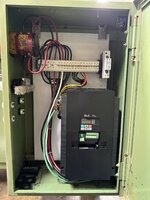
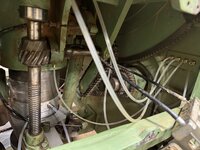
that's how almost all 120V switching is done in your house - neutral runs uninterrupted to the receptacle/appliance, hot runs through a SPST switch.Up and running, now I need to wire in the controls and the oil pump.
It’s satisfying to rip out all of the **** installed a few owners ago in regard to the oil system. A hodgepodge as it were.
Question for you all. This relay has an input for one line, is it incorrect to install one line directly to the pump and only run one line through the relay?

If you go that route you should probably add a diode across the coil of the relay, or just make sure you buy one with it built in.Its an 'ice cube' style relay rather than the Solid state type I installed previously.
have you considered a multi-position switch for speed selection instead of a button?I’m running into a hiccup in my plan here. I have the 3 wire switch working and I setup the additional push button for high speed but when I bring it up to speed the button does not hold and the speed returns to 60hz (1750rpm) immediately after letting go of the button.
Hitachi recommended a maintained button, but I worry that is problematic when setting up multiple speeds.
I am not sure if perhaps I’m just setting this up incorrectly and there is an easy solution.
I had a little "oh ****" incident with this last night when I was almost ready to shut down. The blower gets shut off each time I open the firebox to add wood. I shut it off, added some more wood, and the motor didn't start again when I pushed the button. I'm thinking," Why now, when I'm already stressed out with strange weather, firewood shortage, and personal health problems?"My installation is a little different from most of yours. I replaced the two ancient furnace blowers that provided combustion air to my maple syrup evaporator. The new blower is a Dayton 1.5 Hp. unit specified by a manufacturer for their similarly sized evaporator. I upgraded the VFD to a WEGO washdown unit, which is way overkill as far as features. All I really need is on/off and speed control.
I got a friend of mine, who is a retired industrial electrician, to do the wiring. I told him, " I could wire it myself, but it would look like I had." The installation is all done with PVC conduit and rain tight/ liquid tight enclosures and connectors.