jeepinerdeep
Well-known member
A hand rail and some new shop tables I posted up in my shop thread this week. 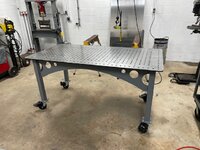


Livestock shelters attempting to sell locally. Right now I got 10 bacon seeds in that particular one. Thought about pulling a PR move and parking my ATV on top to show strength of them. Might still do that, BTW the ATV weighs 1100 plus lbs.
Some of the 1000 cc ATVs are heavy pigs and pushing 1000lbs.Like the shelters
I would not have guessed an atv weighed that much. I'd have guessed south of 500 lbs.




Stellar job Colin!Got a couple projects I could share here.
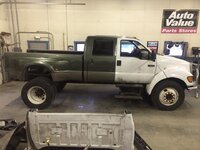
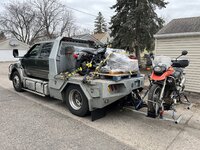
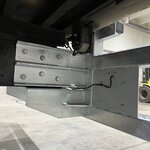
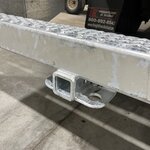
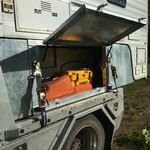
I designed and built this flatbed body after I blew a recap drive tire on my F-650 and destroyed the dually box. It was designed with hot-dip galvanizing in mind, so drainage, venting, and warpage were major considerations. I dropped it off at the galvanizer and held my breath, and thankfully the bet paid off.



Awesome job. I'd love to hear about what it took to accomplish.Thanks! It's so much more functional now, and it doesn't elicit all the dumb questions when I stop at the gas station.
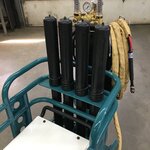
You will fit in just fine around hereAnother project: cart for my Square Wave 175. I got a Lincoln water cooler for $20 because it was leaking coolant out of the heat exchanger. Found a heater core from an old Buick that was a perfect fit, but the cooler wouldn't fit on my old TIG cart. Built this one to fit everything. Got a CK superflex torch lead and immediately became a way better TIG welder because I didn't have that awful rigid vinyl lead trying to rip the torch out of my hands.
Awesome job. I'd love to hear about what it took to accomplish.


I stopped short of painting whitewalls on them. Don't tempt me!
Yes he isYou will fit in just fine around here

Thanks for the detailed response, I will be reading it for quite a while.With regards to the galvanizing? Venting and drainage are pretty straightforward - you're suspending the part in a liquid and you want to eliminate any air pockets. With regards to the thermal aspect, the molten zinc is about 850°F and the expansion has to be taken seriously. I considered these to be a few major factors in minimizing warpage:
1. Use uniform material thickness, so everything heats up and cools at more or less the same rate.
2. Avoid the use of materials with asymmetrical profiles or possible stresses baked into them (diamondplate, for example.)
3. Luck.
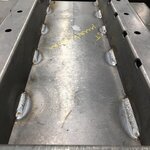
4. Don't do anything to constrain the expansion of the parts - you get ripples and waves when a thin sheet heats up and expands, but is constrained on its edges by thicker material or more rigid forms. If you look at the skirts of the flatbed, you can see how the wheel tubs and toolboxes are lined with stainless bolts. The skirts were completely unsupported and allowed to expand freely during the dip. I built a wooden pallet to support the flatbed body with all its guts removed, as the skeletonized skirts were super flimsy. The tubs were slightly thicker than the skirts to take any impacts from road debris. The toolboxes were each made up of three parts - the inner tub, the outer frame, and the lid. During assembly, the flatbed skirt was sandwiched between the inner tub and outer frame of each toolbox. I chose to use an apitong deck because I thought a framework of crossmembers would fare better than a monolithic steel deck. (Plus it's annoying as hell to throw chains across a steel deck, and they get slippery.)
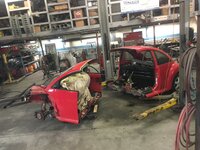
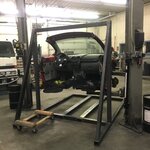
Here's the transport pallet and all the parts blown apart and loaded for transport to the galvanizer:
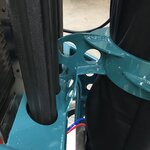
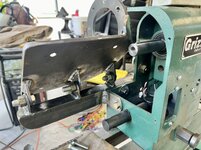
Here's a close-up shot of one of the formed crossmembers. I used those extruded U-nut things to avoid piercing the galvanized steel surface and giving corrosion an opportunity to begin. Plus, the crossmembers are fairly thin and I didn't trust there would be adequate thread engagement on the deck bolts. You can see that oval-shaped drain hole in the bottom of the part. I punched all the holes with my Strippit turret punch before forming the crossmembers in the press brake:
The same U-nuts were used on top of the wheel tubs, but the crossmembers were a little different dimensionally to fit under the deck:




Thanks, I appreciate that. Took a lot to build that not many will understand.@_Weldman_ I like your shop.
Like the shelters
I would not have guessed an atv weighed that much. I'd have guessed south of 500 lbs.
This isn't a average ATV and isn't a 4x4 ATV either. It's on a different level, it's a 6x6. As with my 5 ton in the picture, the two rear axles are always active and the front axle can be engaged or disengaged.Some of the 1000 cc ATVs are heavy pigs and pushing 1000lbs.
A good number of midsize 4x4 ATV's are around 500-600 lbs

Dang you've got some skills my dude!Lots of welding...
I did manage to avoid that nightmare, had to redo a bunch of the crappy Dodge wiring anyway so I did the install myself.and the average upfitter installing it is even worse.

nice work on the beds! What sort of cost is it to galvanize all that?
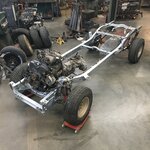
I am sure it rides better than the 5 ton, My kidneys were always sorry when I did years ago. The 7 tons were a Cadillac in comparison.Thanks, I appreciate that. Took a lot to build that not many will understand.
This isn't a average ATV and isn't a 4x4 ATV either. It's on a different level, it's a 6x6. As with my 5 ton in the picture, the two rear axles are always active and the front axle can be engaged or disengaged.
The 5 ton rides like a Cadillac for this road, and will have to do until I am able to get a 7 ton or larger. As if is, you don't have a 6x6 or 4x4 you aren't getting here to my home 9 months a year or more.I am sure it rides better than the 5 ton, My kidneys were always sorry when I did years ago. The 7 tons were a Cadillac in comparison.
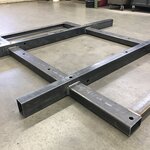
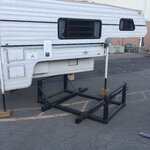

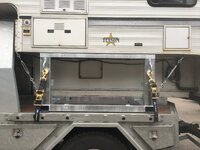





Thanks Ron, I appreciate it.


