I do apologize for my aberrant tendencies of popping in and out around here. Time is always on a budget hahaha!
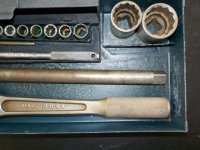
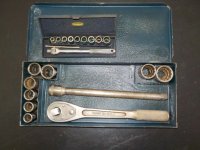
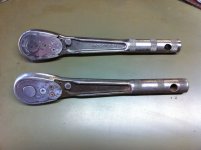
Anyway, the "amber handles" are a unique animal. Some believe they were made of butyl acetate and others thought it was Lucite. I did a chemical analysis on them about 5 years ago and found they were composed of cellulose acetate.
With a pretty simple extraction, you can create a plastic that has favorable properties for use in something like a plastic handle for a tool or even eye wear. For the technology and processes at the time, the molecule made sense to use as the possibilities of application were well understood, was easy to thermo-form/machine, and had a great longevity/durability to cost ratio.
Today, lower cost plastic handle screw drivers use butyl acetate, which is used in a variety of things from flavors, plastics, etc. It is easy to thermo-form and very cheap; however, without a stabilizer, it is prone to degradation from oxidation and sunlight. This is why they start to stink and become sticky/slimey, as they form a molecule, butyric acid, in your GI system. Since the "amber handle" Craftsman ratchets are not made of the same material, they do not deal with this problem. Had they been, based on my experiences with 80 year old butyl acetate, we would see fewer examples of Craftsman tools with their handles still around.
JoCo, honestly, I can only speculate what specifically was going on. A lot of the folks that would have been in the "know" about this are long gone. Some companies, such as Snap On, have strong connections to their history, having many original documents and various artifacts of their works. SK, for example, quite literally referred me to Alloy Artifacts, as that company has no archivists/historians or any focus on keeping information related to their past. Sears seems to follow suit in some regards. Conversations I have had with Sears reps today appear to reflect current or recent philosophies of distribution.
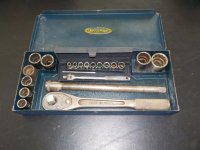
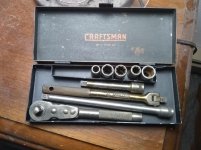
Since these sets were never offered directly in the Sears catalog and only via brochures that were intended for, yet not specifically exclusive to, the trades, my guess would be that, given their cost, these "amber handle" sets, initially, would have been directed to these audiences and not the general public. It is my belief that the only reason why these special sets were offered in 1942 at all was due to the fact that supplies were already made with the intention for sale that year. It is my belief that US entering WW2 was the reason why the "amber handle" program was killed off.
I think it is completely reasonable to believe that sometime around then the tool sets were available at stores or even individual pieces. Sears had done that in plenty of occasions over the last several decades that follows this philosophy, where catalog/brochure exclusives are liquidated at stores and no longer available via their previous means.
I did see that ratchet you mentioned. I do not think it was a prototype. I have run a few experiments on several poor condition "amber handle" tools. They are very susceptible to common organic solvents and inorganic salts that would be easily found in any garage, shop, or industrial setting. I have seen similar other examples analogous to the one you mentioned. If I had to guess, it is more likely that this specific piece was just more "traveled/seasoned" than others.