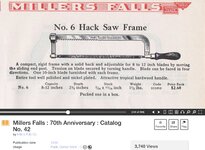
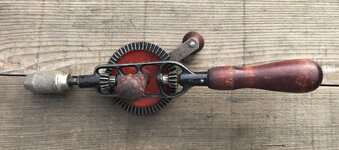
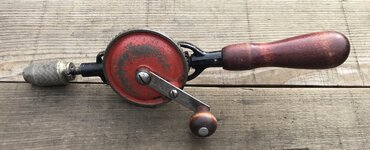
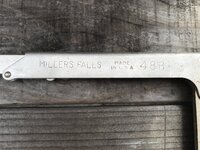
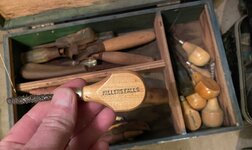
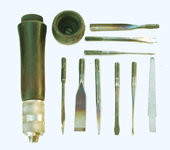
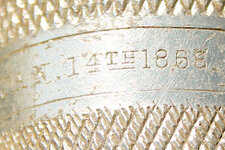
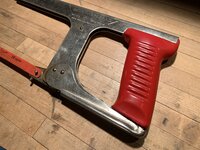
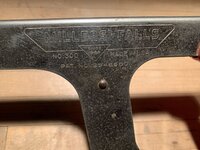
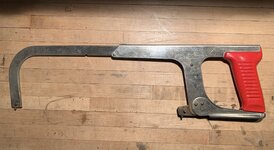
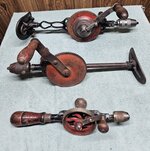
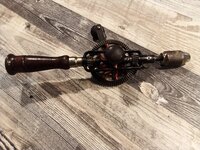
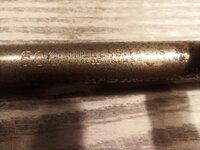
That looks a MF #5 with a replacement top handle and a missing side. They made them for almost a 100 years, so narrowing the age isn't easy.
Hi, erm... "That looks a MF #5 with a..." no need to swear mate! Oh! I see what you mean, my mistake

I've been finding the same problem. The easiest difference I can see across the range and down through time is the curves on the spokes of the main gear.
But the problem with that is once you've got a nice master to cast from (I think one would've been made by lathe & the spokes using hand tools. That's a lot of work) just pushing it into moulding sand would wear it out so they'd be kept & used for donkey's years!
Which seems to be the case...
I taken this one apart, took a scrubbing brush & some washing up liquid to get all the old oil and dirt off. Taking care not to lose any more of that gorgeous red paint and put some modern grease on the gear teeth and a light coating of oil over everything else.
It looks and sounds much better.
It's a very useful device. For quick, small holes, pilot holes ect. it's perfect and that chuck moves like honey coated cat! Smooth as silk and it grips like sh... Ahem, mud to a blanket.
Modern chuck manufacturers could learn, or re-learn, a thing or two by examining what you say could be a 100 year old device!
Thanks for the No.5 detail. That's very handy, thank you.
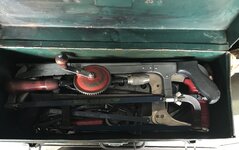
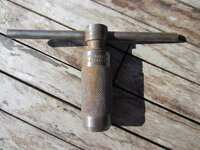
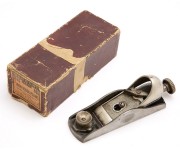
I've a few old tools from his toolbag. There's no more MF stuff (you've got me with the bad effing & jeffing now!

) so this wouldn't be the place to post them.
Where would you post them? Maybe others would like to see some old British tools that aren't old enough to be noteworthy except for us tool nerds. Maybe turn of the century... Oh! ******, that means 2000 now! Around 1900 is my guess.
Thank you for the input.
Keep safe,
P


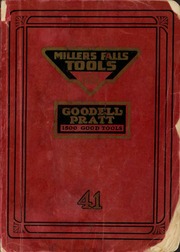
 , apologies for the late reply. And thank you for pointing me to that wonderful resource. I'm a ****** for catalogues & the older, the better!