You are using an out of date browser. It may not display this or other websites correctly.
You should upgrade or use an alternative browser.
You should upgrade or use an alternative browser.
Show Your Structural (SPUD) Wrench
- Thread starter MisterEd
- Start date


Ton ton
Well-known member
Thank you for the originality. I love spud wrenches.Here's my vintage spud wrench doing what it does best...
Klein 3239 Spud Wrench
Lassen Forge
Well-known member
Aw ****, I wish I had some of my old spud wrenches around... IIRC the largest was 5" (migh have been 5 1/2 or 6" - it was a big honking mofo)... the smallest was 1 3/4... used them extensively for bridge bolts... we had specially made 6-12' (yes 12 FOOT) extension handles (cheaters) that weighed about like a small sherman tank to handle the torque involved in some of them... I hung off one (open air at 175') to get a 4" tower bolt loose on the bay bridge, I was double harnessed in in case the thing slipped or broke. But yeah, Those were some awesome tools.
Here's my vintage spud wrench doing what it does best...
Klein 3239 Spud Wrench
Now I wanna see the french version
Beerhippie
Well-known member
Here's my "newish" Armstrong adjustable:
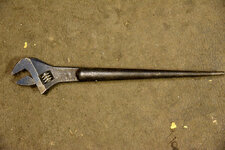
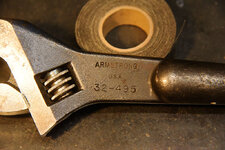
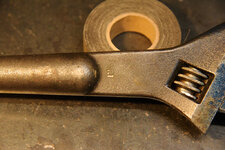
OAL is 16". I inherited it with the shop, but I know we used it 25 years ago when we were building out our brewery.
The number of uses I've found for the spud over the years is impressive.
OAL is 16". I inherited it with the shop, but I know we used it 25 years ago when we were building out our brewery.
The number of uses I've found for the spud over the years is impressive.
NORTON'S SHOP
Well-known member
Just curious. Wondering why open end appeared to be the standard over box end?
Provincial
Well-known member
Mix of square and hex head fasteners. Perhaps all one type on a particular job, but varied between jobs.
Private Lugnutz
Well-known member
I agree with Jock. I would add ease of access. The opening will find and slip onto a nut more readily without lifting and placing. I have a few though. I posted a huge Plomb in post #16 on page 1. I got curious and checked a bunch of catalogs. Williams did not introduce a box end wrench with a structural or construction pattern (i.e., colloquially, "spud") handle until Catalog A-409 in 1943. For Armstrong it wasn't until 1957. Plomb in 1939. There are three Woodings Verona catalogs on IA/ITCL. The oldest, probably 1920's or 30's, is not dated. A catalog dated 1949. And a much more modern catalog, guessing 1960's or 70's. None of those offer a box end spud wrench.Wondering why open end appeared to be the standard over box end?
wrenchguy
Well-known member
The long one is Iron City, and the short is stamped "PS" inside of a keystone.
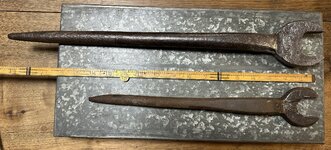
EDIT, MAY NOT BE AS POSTED, IN DISCUSSION.
PS = PITTSBURG & SHAWMUT RAILROAD according to "railroad reporting marks" online data base.
Last edited:
Ton ton
Well-known member
I prefer open end wrenches in general. I do use box ends as well.Just curious. Wondering why open end appeared to be the standard over box end?
Here's a trove of Bethlehem Steel Corp spuds: 5/8" REG-2pcs; 5/8" HVY-2pcs; 7/8" HVY-1pc, 1" HVY-6pcs; 1 1/8" HVY-1pc; 1 1/4" HVY1-pc. I've always been curious as to who actually made the BSCo wrenches, as Bethlehem was not known for making commercial-variety tools. Possible clues may be the forging marks "O" or "B" which are present on all these spuds. Another observation is that some have raised lettering, while some have stamped lettering. I've always thought that Bonney would be a good possibility, as they were located nearby to Bethlehem. I'd love to know your thoughts/opinions on this: Who did BSCo contract with to make their spud wrenches?

Private Lugnutz
Well-known member
Wow. What a lineup!Here's a trove of Bethlehem Steel Corp spuds:
Bonney is a good proximity guess. You might be able to do some visual comparisons. Are there any Bonneys on the thread? I don't have any. I was looking at my Williams, and I have to say, the shoulders, where the rounded handle necks down to the shank, looks different.I'd love to know your thoughts/opinions on this: Who did BSCo contract with to make their spud wrenches?
Book: https://books.google.com/books?id=f...=2ahUKEwjq5JWR6NmHAxXcF1kFHRPAETQQ6AF6BAgKEAE
That's a good idea: do side-by side comparisons (BSCO spuds to other brands). This will give me a good reason to round-up and organize my spud pile.Wow. What a lineup!
Bonney is a good proximity guess. You might be able to do some visual comparisons. Are there any Bonneys on the thread? I don't have any. I was looking at my Williams, and I have to say, the shoulders, where the rounded handle necks down to the shank, looks different.
Book: https://books.google.com/books?id=f...=2ahUKEwjq5JWR6NmHAxXcF1kFHRPAETQQ6AF6BAgKEAE
And, I had no idea that BSCo had a formal Small Tools Department, complete with catalogs. As soon as I figure out Google books, I'll be reading them for sure.
Private Lugnutz
Well-known member
Me neither. I was pleasantly surprised.I had no idea that BSCo had a formal Small Tools Department, complete with catalogs.
That book is not available digitally, in PDF or eBook. If it had been, you can be sure I would've posted some excerpts.As soon as I figure out Google books, I'll be reading them for sure.
Google Books, in the spirit of open source and open source foundations that I admire, very helpfully, magnanimously includes printed books that have not been approved for their project in their system, though, and even points you to the nearest sellers and libraries where a print edition can be found. I have ordered a lot of references from Interlibrary Loan that way.
Clicking on that link in this case indicates that Hagley Museum and Library, 298 Buck Road, Wilmington, DE, 19807, has a copy. You might want to call them tomorrow. If it's in their collection and available to view on a visit, I could plan to stop in next time I go down that way, which is fairly often. I would takes notes, and photos, if possible.
I'll Give Hagley a call to see if they have the Bethlehem Steel "Small Tools Department" books available for viewing. Thanks for your offer to stop by for a little research if you're in the Wilmington area. So much information hiding out there in seemingly unusual places.Me neither. I was pleasantly surprised.
That book is not available digitally, in PDF or eBook. If it had been, you can be sure I would've posted some excerpts.
Google Books, in the spirit of open source and open source foundations that I admire, very helpfully, magnanimously includes printed books that have not been approved for their project in their system, though, and even points you to the nearest sellers and libraries where a print edition can be found. I have ordered a lot of references from Interlibrary Loan that way.
Clicking on that link in this case indicates that Hagley Museum and Library, 298 Buck Road, Wilmington, DE, 19807, has a copy. You might want to call them tomorrow. If it's in their collection and available to view on a visit, I could plan to stop in next time I go down that way, which is fairly often. I would takes notes, and photos, if possible.
A trio of earlier Williams Spud wrenches. All marked Brooklyn.
(Williams called these offset style STRUCTURAL wrenches while the straight ones were called CONSTRUCTION wrenches.)
My daddy was an ironworker out of local 1 in Chicago. He worked on the Sears tower. He called them all SPUD wrenches.
(Williams called these offset style STRUCTURAL wrenches while the straight ones were called CONSTRUCTION wrenches.)
My daddy was an ironworker out of local 1 in Chicago. He worked on the Sears tower. He called them all SPUD wrenches.
Attachments


four.cycle
Well-known member

Armstrong model 906B Spud Wrench
marked "1"
milled opening size is actually 1-3/16"
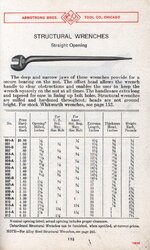
oddly, the 1935 catalog shows it as having a milled opening of 1" (I was not able to find it in any other catalogs.)
marked "HARDENED" on opposite side just below gullet
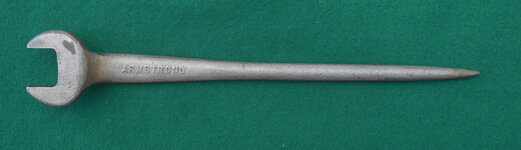
Armstrong model 906B spud wrench
Attachments
Private Lugnutz
Well-known member
That's a couple hairs larger than the differences all my spud wrenches measure between nominal milled opening and spec, but I am going to assume it's the rough nut clearance thing. If you look at the annotations at the very bottom of that table excerpt you attached, you'll see a caveat to that effect. All vintage catalogs have a similar caveat on their structural and construction wrench pages. Some catalogs are much more explicit. Williams, for example, says something about the actual openings being larger by some fraction. I can't remember how many 32/nds off the top of my head, but the difference you are measuring between the opening and the marking and the catalog is probably planned. If not, maybe spread from use, or a little of both.marked "1"
milled opening size is actually 1-3/16"
oddly, the 1935 catalog shows it as having a milled opening of 1"
john.k
Well-known member
A lot of big structural bolts and nuts were roughly made and the heads had a lot of taper -- forging draft it was called .........one bolt maker here called Trojan used to make the roughest bolts and nuts Ive ever seen,and Ive still got bags of them ......I had planned to use them as stay bolts in the 'mythical' boiler I have been threatening to make for 50 years now.
SkyPuncher
Well-known member
- Joined
- Dec 22, 2014
- Messages
- 242
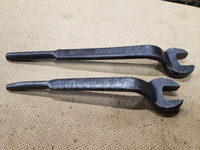
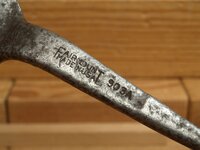
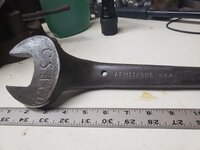
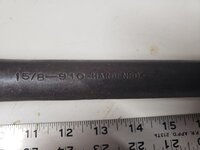
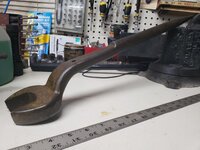
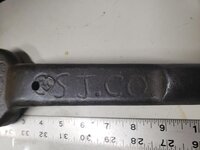
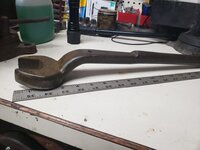
Armstrong 910, 1 5/8". Have no idea what the CSJ.co markings are, but they sure wanted you to see it from every side!

B Halverson
Well-known member
- Joined
- Sep 26, 2024
- Messages
- 304
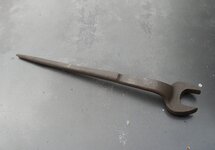
I rode my bicycle past a dumpster on 15th street a few weeks ago and this wrench was laying right on top. I grabbed it and put it through the belt holding my pants up and rode home.

FourthQuarter
Well-known member


Jay__Dub
Well-known member

SkyPuncher
Well-known member
- Joined
- Dec 22, 2014
- Messages
- 242
Billings and Spencer, Whitman & Barnes and a the big one Billings 911A.