rickhigginshtbr
Well-known member
Random thought. So Bonney originally started off in Philly, has anyone found any Bonney marked Philadelphia yet? I have a few marked Allentown, but never seen anything marked Philly.

Sweet catalog! I’d like to find one lol.
BTW all of my Bonney tools are working tools and used as such. They are NOT drawer queens and I use them a lot. Since these are now getting older I still like the feel of all my Bonney wrenches, pliers, sockets and extension and speciality tools, my ratchets well I don't use them much as I prefer my Snap-on ratchets but my Utica torque wrenches are used a lot also. Some of these tools will have pieces of chrome flaking, surface rust but I kept these tools spotless. They are cleaned after each and every use. Just last week I used my Bonney set when I was doing a brake job on my 1966 Falcon and then hopped over and replaced the shocks absorbers on my 2004 Dodge Ram 2500 4WD.Nice drawer of tools!
BTW all of my Bonney tools are working tools and used as such. They are NOT drawer queens and I use them a lot. Since these are now getting older I still like the feel of all my Bonney wrenches, pliers, sockets and extension and speciality tools, my ratchets well I don't use them much as I prefer my Snap-on ratchets but my Utica torque wrenches are used a lot also. Some of these tools will have pieces of chrome flaking, surface rust but I kept these tools spotless. They are cleaned after each and every use. Just last week I used my Bonney set when I was doing a brake job on my 1966 Falcon and then hopped over and replaced the shocks absorbers on my 2004 Dodge Ram 2500 4WD.

Random thought. So Bonney originally started off in Philly, has anyone found any Bonney marked Philadelphia yet? I have a few marked Allentown, but never seen anything marked Philly.
I have been able to identify some of my oldest Bonney pieces (a small Champion vise and a couple wrenches) only in the 1914 catalog, and while I suspect that they were probably being made in the Philadelphia plant prior to the move to Allentown in 1906, they aren't marked with any address, Philadelphia or Allentown. I've never seen a Bonney catalog earlier than 1914, or a tool marked "Philadelphia", even on-line. I remember seeing a tool - can't remember what or where - with a 1903 patent date that would've proven Philadelphia manufacturing, but that's the kind of thing you would need, I think. The question, a good one, is prompting me to do an early inventory.
As for use, if only to balance things out here with the utilitarians, and not to cause trouble (I respect everyone's prerogatives), I wouldn't dream of using any of my collectibles, including and maybe especially my Bonney, when a contemporary tool will do the same job. To me, and I emphasize that, it would feel like putting my 91-year old mother to work when she visits while my son sits around watching TV. They are cleaned, fixed, polished, admired, and handled with kid gloves in the Lugzsonian.
There are a few vintage specialty tools I have used because it was the only tool for the task at hand for an equally vintage vehicle.
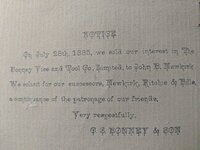
I had my 1888 Newkirk, Ritchie & Bills on TA. Coolest cat ever. Has a note from C S Bonney himself wishing well the new owners of his company. Can't seem to upload pics right now, I'll try later. Only wrenches are the Always Ready double S Gator and the Acme twisted handle. Neither those, nor any vise, lathe dog, or double auger illustrations show any markings.I have been able to identify some of my oldest Bonney pieces (a small Champion vise and a couple wrenches) only in the 1914 catalog, and while I suspect that they were probably being made in the Philadelphia plant prior to the move to Allentown in 1906, they aren't marked with any address, Philadelphia or Allentown. I've never seen a Bonney catalog earlier than 1914, or a tool marked "Philadelphia", even on-line. I remember seeing a tool - can't remember what or where - with a 1903 patent date that would've proven Philadelphia manufacturing, but that's the kind of thing you would need, I think. The question, a good one, is prompting me to do an early inventory.
As for use, if only to balance things out here with the utilitarians, and not to cause trouble (I respect everyone's prerogatives), I wouldn't dream of using any of my collectibles, including and maybe especially my Bonney, when a contemporary tool will do the same job. To me, and I emphasize that, it would feel like putting my 91-year old mother to work when she visits while my son sits around watching TV. They are cleaned, fixed, polished, admired, and handled with kid gloves in the Lugzsonian.
There are a few vintage specialty tools I have used because it was the only tool for the task at hand for an equally vintage vehicle.
I don't remember looking through that one!I had my 1888 Newkirk, Ritchie & Bills on TA. Coolest cat ever. Has a note from C S Bonney himself wishing well the new owners of his company. Can't seem to upload pics right now, I'll try later. Only wrenches are the Always Ready double S Gator and the Acme twisted handle. Neither those, nor any vise, lathe dog, or double auger illustrations show any markings.
colloquially.I don't remember looking through that one!
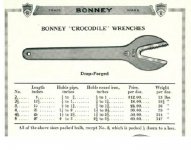
Was it really called a "Gator" in the catalog or are you using that colloquially? Reason I ask is Roebling Sons TM'ed the term "Alligator" and only Roebling Sons used it in ads and on the wrenches. I have a Bonney single end No. 2 "Crocodile" (no kidding, that's what they called them in the 1914 catalog!!) with what looks like an early Bonney logo to me. It's the name C. S. BONNEY inside an oblong. I have never seen that one anywhere else except Bonney pliers with a 1903 patent date.

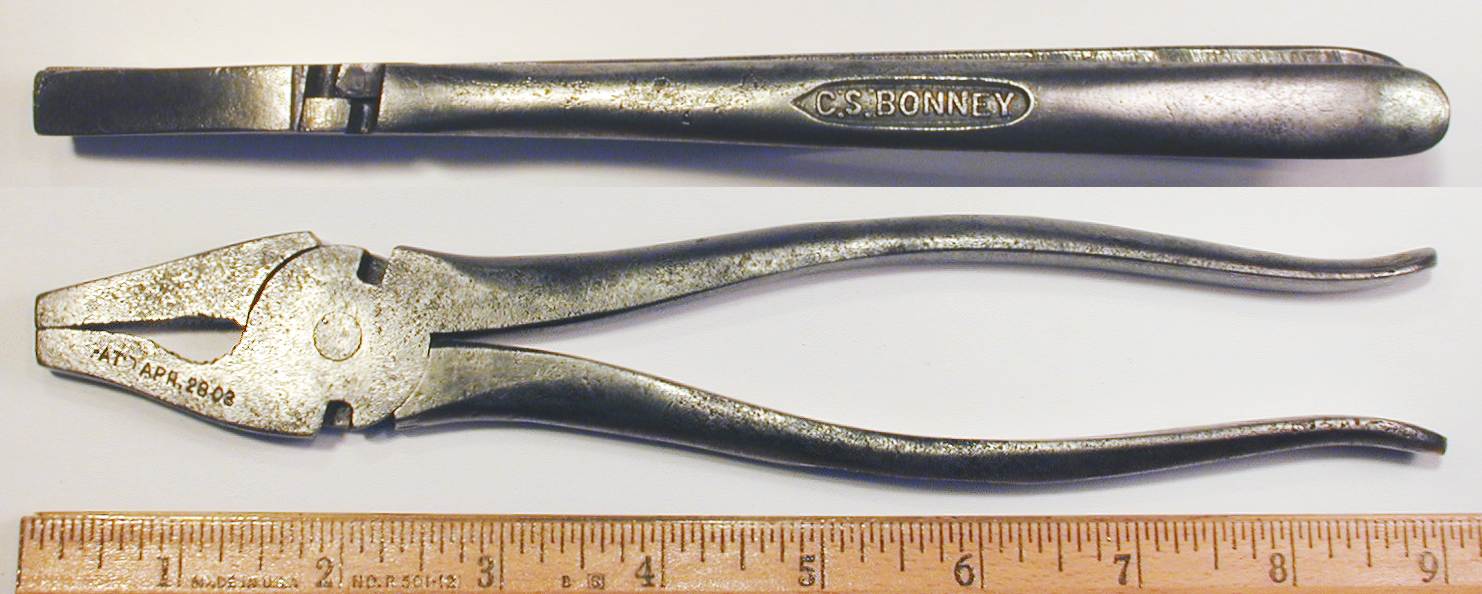

I have at least 1 Always Ready wrench with that "jelly Bean" Bonney logo.So, here is the logo on my BONNEY No. 2 "Crocodile" wrench...

Here is the figure for the "Crocodile" wrenches in the Bonney 1914 catalog...

See how it has the shield logo? All of the tools are shown like that in the 1914 catalog, including the "Always Read" wrench that Todd just showed in the older catalog without any logo. And my early Bonney tools all have that shield logo.
Now look at this very similar logo on pliers with a 1902 patent on AA...
That's my pitch for this wrench being a Philly tool!
Nice. Do you agree with my rationale? It isn't later, so it has to be earlier.I have at least 1 Always Ready wrench with that "jelly Bean" Bonney logo.
They are. But note that those are on AA. I just used the pic for the "jellybean" logo being similar to the "jellybean" logo on my Crocodile wrench.Awesome pliers Lug!
Absolutely. I have never seen one before. Have to modify my notes now. The DID put their address on at least some Philly tools. Thanks.At least it's a little more proof of production!
Originally Posted by rickhigginshtbr
At least it's a little more proof of production!
Originally Posted by Private Lugnutz
Absolutely. I have never seen one before. Have to modify my notes now. The DID put their address on at least some Philly tools. Thanks.
I see that. Not too close, though, I am thinking, territorially - which is good!We live close.

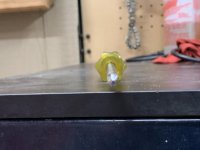
In case you didn't know it, Mikeske, Chevrolet was crazy for clutch head screws on their trucks in the 40's and 50's. I collect BHM-made clutch head screwdrivers - 5/32", 1/4", and 5/16" tips - for WWII-era Chevy trucks. Not easy to find. They had black wooden handles, pot steel ferrules, and carbon steel blades.
Yours is much newer of course with the triangle logo to the right of the BONNEY name suggesting Triangle era Bonney made in the Bonney-Utica-Herbrand conglomerated plant in Spartanburg, SC. So very late 50's and 60's at the earliest up to the 1986 catalog you found them in. I wouldn't know what the application would be in that era. Maybe the same.
In case you didn't know it, Mikeske, Chevrolet was crazy for clutch head screws on their trucks in the 40's and 50's. I collect BHM-made clutch head screwdrivers - 5/32", 1/4", and 5/16" tips - for WWII-era Chevy trucks. Not easy to find. They had black wooden handles, pot steel ferrules, and carbon steel blades.
Yours is much newer of course with the triangle logo to the right of the BONNEY name suggesting Triangle era Bonney made in the Bonney-Utica-Herbrand conglomerated plant in Spartanburg, SC. So very late 50's and 60's at the earliest up to the 1986 catalog you found them in. I wouldn't know what the application would be in that era. Maybe the same.
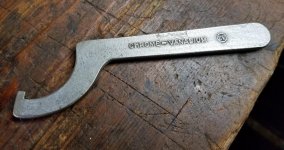
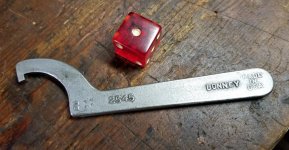
Some of you may remember the Bonney 2578 Ford fan belt hook spanner and Bonney 2531 Dodge rear motor support wrench I found last August, my post linked here. Well, I added another 25XX series tool to the Lugzsonian this morning. This is a Bonney 2545 hook spanner for Ford Model A and AA water pumps.


The "DU" date code and the CV marking indicates 1929. I've included a 1933 catalog excerpt for context.


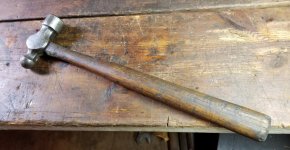
I just repaired the original handle on a vintage BONNEY 12 oz ball-pein hammer... Not my best work, but it'll do.
Hmm. That's interesting. That's not the way I was taught to make a whipping. Not saying 2oolhound's method is wrong. I trust him implicitly. Just pointing out there is more than one way, apparently. I make wire whippings the same way I make twine whippings on rope splices. For that method, see here. Honestly, I can see how 2oolhound's would be better for heavier gauge wire. With my way, you have to pull the wire through, underneath the wire whippings. That gets harder to do the heavier you go with wire. On the other hand, there are NO exposed ends when you do it my way. The end never meet, and there is nothing to twist. The lead end is pulled under the wraps.That's cool. I like that method. And for anyone like me who is new to this technique, GJ has a thread on this :
How to Make a Wire Whipping
https://www.garagejournal.com/forum/showthread.php?t=269263
I know you addressed this to Twertsy, who has delved much deeper into the period than anyone I know of, but I asked him a similar question a couple years ago, and have given his response some thought. CS Bonney’s patents and known products are mostly screw-driven vises and adjustable wrenches. Somewhere (Newark NJ, by Kraeuter & Ace) the alligator/crocodile wrench gets in there, but where are the fixed-opening automotive wrenches? Maybe they were not made by any “BONNEY” entity in the Philadelphia years.Do you agree with my rationale? It isn't later, so it has to be earlier.
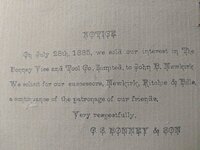
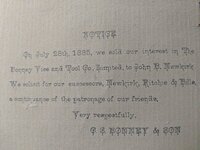
Here's the note from C S Bonney.
Sent from my Pixel 2 XL using Tapatalk
Great document just beautiful.
I’ve never seen that font before, anyone know what it is called?
Great document just beautiful.
I’ve never seen that font before, anyone know what it is called?
bonneyman How about "Manual Typewriter"?
Oldtuleguy That is spectacular