To avoid these ads, REGISTER NOW!

Sub-Panel in Garage-Adding 220v for Table Saw and Air Compressor

Model A Fan

Well-known member
Joined
Dec 1, 2011
Messages
1,220
Location
NW Washington
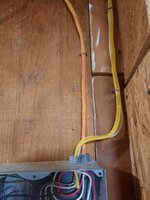
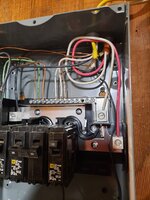
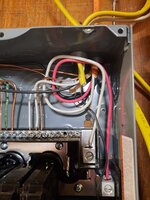
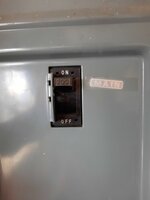
To make my garage more usable and to put my tools to work, I need to add 220v to run a table saw and an air compressor. I have included photos of a (poorly?) wired sub-panel that was in the house when I bought it. It currently runs off the main breaker in the house, which is where the orange wire is coming from in the photos. The panel has only one breaker currently hooked up to anything, and it is operating a light socket with one of those LED panel lights screwed into it. The other lights in the garage are powered off the main breaker panel in the house. I would also eventually like to add an oven (kitchen oven) so I can cure powder coating projects too big for a toaster oven. I have included photos of my sub-panel and the motors for my table saw (12.4A) and air compressor (15A).

I have a few questions regarding options for wiring my garage for these two units.

1. Am I able to run 220v out of this box with the set-up I currently have? What will determine the ability of my wiring?

2. I have watched April Wilkerson's video on YouTube (Running 220v in your Garage), and it looks like you can run two outlets for 220v off the same breaker as long as the overall amps don't exceed the breaker's amps? If this is the case, can I upgrade to a 30A breaker and have both of my machines on the one breaker? If not; do I just install a second breaker with proper amp ratings in the next slot and wire the second one the same as the first one?

3. I have 12/2 wire for this project; will this be sufficient or will I need to use something larger? Per the video I referenced, she used a gray PVC type conduit with loose wires inside. I think this was the "THNN" wire referenced, and she ended up using 10 gauge THNN. I think she should have used two blacks and a green for the hots and grounds instead of the white, or put a black electrical tape wrap around the white at least. If I use this type of conduit, should I use THNN and not the 12/2? If I don't use conduit, can I use the 12/2 or would I still need 10/2? The runs would be approximately 15' and 30' max from the sub-panel.

4. I'd also like to wire up some lighting for my shop as right now I have a bunch of those Harbor Freight and Costco LED lights hanging in the rafters because they're plugged into outlets. Given the wiring I want to do with the 220v, can I still fit the LEDs into the sub-panel?

5. I have a general understanding of how electricity works and that the 220v feed for the two machines will need two hots and a ground (two hots to breaker, ground to the grounding bar), is my plan for one 30A breaker OK, or should I split it into two 20A breakers? What happens if I use a 30A breaker for each? Would I run the risk of the machine burning up the motor and not tripping a higher amp breaker?

6. The yellow Romex coming in has a neutral and ground connected to the grounding bar. The black "hot" is loose and curled inside the box but not connected. What can/should I do with this to make it "safer" if it isn't safe currently?

7. Can I switch the black hot wire on the 15A breaker to the single 20A breaker so I can put another double breaker next to the 20A double breaker currently there? This is the circuit that currently runs the single light screwed into the light socket.

8. I have electrical spaghetti running through my rafters. If I identify what is connected to where in my house breaker, can I "detach" those from inside the house and connect them in the garage? All I currently have are two garage door openers and two surge protectors. This is how I run the majority of my lighting. The garage door openers are plugged into outlets running from inside the house, and I have other LED lighting plugged into the ceiling mounted outlets.

9. Would I be better off buying and installing a larger sub-panel for my garage for the future expansion? I could reuse this one in my barn for when I get 100A service to the barn for conversion into a shop. It seems like this panel is almost too small to truly be useful for anything of size or capability.

10. Should I separate the grounds from the neutrals and have them on separate bars?

11. Should I just sell my house and build new? :D This is my dream, but for now, I have to deal with this place. Thank you in advance for any info and help. I have a decent background in handyman stuff, but electricity is one I like to double and triple check, then hire an electrician :D. The cost of hiring someone is so high right now that I wanted to give it a go. But based on what I'm seeing, there were no clear "how-to" videos since most people's garages are already set up for bigger service and are done better to begin with.

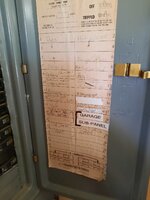
Here is the sub-par sub-panel. I didn't wire this, and when I opened it up, I was surprised it was done so sloppily.

Panel1.jpg

Panel1a.jpg

Panel2.jpg

Panel3.jpg

Panel4.jpg

Panel5.jpg

Panel6.jpg

Panel7.jpg

I would like to add an outlet to power my table saw. Here is the motor spec plate.
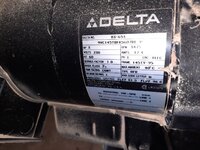
Unisaw Motor.jpg

Here is my air compressor data plate.

Compressor Motor.jpg
 
Last edited:
To avoid these ads, REGISTER NOW!

sparky 1971

Well-known member
Joined
Oct 9, 2018
Messages
7,971
Location
Central Iowa
The orange wire is 10/3 romex and is only good for 30 amps. You stated it's coming from the main breaker. Does that mean that the black and red are stuck under the lugs of the main? If so, that's a big no no. There is no protection for the 10/3, which should be fed from a 30 amp breaker max.
If you get that taken care of, you can then run your saw and air compressor, probably not at the same time though. And depending on what else is running out of that panel, you may not be able to get the compressor to start without the breaker in the main panel tripping. I wouldn't be too concerned about the saw since it's not starting under load, but it's still a possibility.

You also need to have an isolated ground bar in the sub panel. Neutrals and grounds will go to the same bar in the main panel, but need to be separated in the sub. That's a Square D Homeline and a ground bar should be available at any of the box stores. Just take a look at a panel like what you already have when you're there and the label will tell you which ground bar you need.

If it's easy or even moderately difficult, I would run at least a 6/3 and get 60 amps and a larger panel in your garage.
 
Last edited:

wyliesdiesels

Well-known member
Joined
Aug 14, 2012
Messages
20,006
Location
Modesto, CA
The orange wire is 10/3 romex and is only good for 30 amps. You stated it's coming from the main breaker. Does that mean that the black and red are stuck under the lugs of the main? If so, that's a big no no. There is no protection for the 10/3, which should be fed from a 30 amp breaker max.
If you get that taken care of, you can then run your saw and air compressor, probably not at the same time though. And depending on what else is running out of that panel, you may not be able to get the compressor to start without the breaker in the main panel tripping. I wouldn't be too concerned about the saw since it's not starting under load, but it's still a possibility.

You also need to have an isolated NEUTRAL bar in the sub panel. Neutrals and grounds will go to the same bar in the main panel, but need to be separated in the sub. That's a Square D Homeline and a ground bar should be available at any of the box stores. Just take a look at a panel like what you already have when you're there and the label will tell you which ground bar you need.

If it's easy or even moderately difficult, I would run at least a 6/3 and get 60 amps and a larger panel in your garage.
Fixed it for ya! :thumbup:
 
OP
M

Model A Fan

Well-known member
Joined
Dec 1, 2011
Messages
1,220
Location
NW Washington
I pulled the cover off my main breaker panel (also electrical spaghetti) and found the red and black wire running to the 30A breaker, neutral and ground to the bar.

If I understand what you're saying, I need to install another bar (Bus bar?) so I can separate the neutrals from the grounds?

Another thing you're saying is run 6/3 (red, white, black, and ground) from the main breaker panel to the sub panel to put a 60A "sub-panel main breaker" which powers the whole sub-panel? And from there have lower amperage breakers? I could run the 6/3 up out of the breaker box into the attic and then down into the garage.

When I run the wiring for the saw and compressor, would you advise using THNN and the gray conduit and then do junctions in boxes like the video I referenced used? Thank you, I appreciate your already thorough help.

20220319_163303.jpg20220319_163310.jpg20220319_164037.jpg20220319_165252.jpg20220319_165256.jpg
 

wyliesdiesels

Well-known member
Joined
Aug 14, 2012
Messages
20,006
Location
Modesto, CA
ok so is this an ATTACHED or detached garage?

That SQ D subpanel is wired incorrectly.

Grounds on neutral bar need to go to a ground bar. if there is a bonding strap or screw on the neutral bar it needs to be removed
 

wyliesdiesels

Well-known member
Joined
Aug 14, 2012
Messages
20,006
Location
Modesto, CA
as has been said, that orange NM-b is limited to 30a. if you want to run an oven, lights, 3HP compressor and table saw, youre gonna need more than 30a. #6 NM-b would probably be the minimum needed (55a max load on a 60a breaker) but you may want to go larger than that..
 

FredWanaker

Well-known member
Joined
Mar 27, 2021
Messages
1,470
Location
NorCal
can one just run exposed romex in a garage? I saw a light switch right below the panel so this appears to be a lived in area.
 
OP
M

Model A Fan

Well-known member
Joined
Dec 1, 2011
Messages
1,220
Location
NW Washington
The light switch is for a light above the electrical panel. No one "lives" in that area. There is exposed romex all over the garage...
 
OP
M

Model A Fan

Well-known member
Joined
Dec 1, 2011
Messages
1,220
Location
NW Washington
Here's a wild idea...can I have 6/3 wired in and a 60A breaker installed (with the 6/3) attached and have the 6/3 run to an entirely separate/new sub-panel? Is having two sub-panels a big no-no and going to get me in trouble? That way I could use the existing sub-panel for lighting, outlets, 120v stuff and use the second sub-panel for my 240v saw, compressor, etc.
 
OP
M

Model A Fan

Well-known member
Joined
Dec 1, 2011
Messages
1,220
Location
NW Washington
you can have as many subs as you want
So it sounds like my idea isn't crazy. Is it possible/permissible to wire a sub-panel in a way that it has a main breaker similar to my main panel? I was thinking of installing a main breaker (in the sub-panel) that would control the whole panel's electricity so I can shut down that panel if need be. I'd have my 220v equipment running off that sub-panel so I don't have to worry about the 110v wiring and I can keep my lighting and equipment separate in the current sub-panel.

Is this the type of 6/3 I should be using for indoor wiring of a 220v panel with a 60A breaker? It says max 55A for double ovens, and it was mentioned above to not exceed 55A.

6/3 Stranded Wire

Or would this one be better?

Romex 6/3
 
Last edited:

sparky 1971

Well-known member
Joined
Oct 9, 2018
Messages
7,971
Location
Central Iowa
So it sounds like my idea isn't crazy. Is it possible/permissible to wire a sub-panel in a way that it has a main breaker similar to my main panel? I was thinking of installing a main breaker (in the sub-panel) that would control the whole panel's electricity so I can shut down that panel if need be. I'd have my 220v equipment running off that sub-panel so I don't have to worry about the 110v wiring and I can keep my lighting and equipment separate in the current sub-panel.

Is this the type of 6/3 I should be using for indoor wiring of a 220v panel with a 60A breaker? It says max 55A for double ovens, and it was mentioned above to not exceed 55A.

6/3 Stranded Wire

Or would this one be better?

Romex 6/3
You can use a main breaker panel. You will be protected by the 60 amp breaker in the panel leaving the main as nothing more than a disconnect. Just make sure that whatever panel you get has a separate ground bar, or get one while you are there to save a trip back.

Either one of those cables will work with a 60 amp breaker. It probably says for ranges up to 55 amps because the next size up range will require a larger wire.
 

wyliesdiesels

Well-known member
Joined
Aug 14, 2012
Messages
20,006
Location
Modesto, CA
So it sounds like my idea isn't crazy. Is it possible/permissible to wire a sub-panel in a way that it has a main breaker similar to my main panel? I was thinking of installing a main breaker (in the sub-panel) that would control the whole panel's electricity so I can shut down that panel if need be. I'd have my 220v equipment running off that sub-panel so I don't have to worry about the 110v wiring and I can keep my lighting and equipment separate in the current sub-panel.

Is this the type of 6/3 I should be using for indoor wiring of a 220v panel with a 60A breaker? It says max 55A for double ovens, and it was mentioned above to not exceed 55A.

6/3 Stranded Wire

Or would this one be better?

Romex 6/3
yes you can get a subpanel with a main breaker. but just be aware that if you feed another subpanel off this one, it will lose power when you shut the main/disconnect off in the first subpanel

the wires you linked to are the same, just different lengths... both being 6/3 NM-b... how much do you need?

you could use 6/3 NM-b or save some money and go with #6 aluminum SER. This one is about $2/ft if you can find it.


or go bigger and get #2 SER which would give you 90a ampacity and save you over $2/ft

 
Last edited:
OP
M

Model A Fan

Well-known member
Joined
Dec 1, 2011
Messages
1,220
Location
NW Washington
yes you can get a subpanel with a main breaker. but just be aware that if you feed another subpanel off this one, it will lose power when you shut the main/disconnect off in the first subpanel

the wires you linked to are the same, just different lengths... both being 6/3 NM-b... how much do you need?

you could use 6/3 NM-b or save some money and go with #6 aluminum SER. This one is about $2/ft if you can find it.


or go bigger and get #2 SER which would give you 90a ampacity and save you over $2/ft

I'd say a 30' run should be sufficient to go from my panel to the garage, and then run wiring from the panel around my garage. My garage is roughly 30'x22'. I wish I had the ability to scrape off the garage that's there and build a 40'x50' with a mother-in-law suite above that would serve as a residence for my parents as they age. Right now though, I don't think its too feasible given the cost of building.
 

Norcal

Well-known member
Joined
Mar 16, 2008
Messages
13,754
I'd say a 30' run should be sufficient to go from my panel to the garage, and then run wiring from the panel around my garage. My garage is roughly 30'x22'. I wish I had the ability to scrape off the garage that's there and build a 40'x50' with a mother-in-law suite above that would serve as a residence for my parents as they age. Right now though, I don't think its too feasible given the cost of building.
A second story can be a problem for as they age, climbing stairs can very taxing.
 
OP
M

Model A Fan

Well-known member
Joined
Dec 1, 2011
Messages
1,220
Location
NW Washington
A second story can be a problem for as they age, climbing stairs can very taxing.
Yeah, I have been thinking thr same thing. I'm not sure how to have a mother-in-law suite without stairs being involved.

As for the panels and breakers, is there a recommended "style" to go with for my purposes? I've seen Eaton and Square D. The Square D has a few types as well, regular width with double pull, narrow with single, and then regular width with single it seems. One has more metal connectors to snap into on the breaker than the others as well.

Leviton seems to be very reasonably priced. 100A with 30 spaces is $115 for instance and a 20A breaker is $15.
 
Last edited:
To avoid these ads, REGISTER NOW!

Norcal

Well-known member
Joined
Mar 16, 2008
Messages
13,754
Either a Eaton CH, or SQ D QO, would do but since I see a QO panel in the photos above that would be my #1 choice, keep it all the same.
 
OP
M

Model A Fan

Well-known member
Joined
Dec 1, 2011
Messages
1,220
Location
NW Washington
Here's what I wound up buying tonight. I found a 100A sub-panel with 20 spaces (40 circuits) for $85 and it came with a single pole 30A double breaker and two single pole 20A breakers. I bought a two pole 30A breaker for my tablesaw (tablesaw is 20A, so I think I need a 30A breaker?).


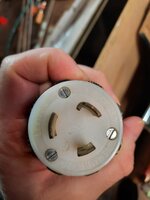
I got the 20A outlet for my tablesaw as well as a 23 slot bus bar for the new sub-panel and a 7 space bus bar for the current small sub-panel.


Did I get the right stuff to begin? Total was $150 for all the parts which I felt was a decent deal.20220322_205130~2.jpg20220322_205232.jpg20220322_120944.jpgeal.
 
Last edited:

pattenp

Well-known member
Joined
Jun 4, 2008
Messages
10,175
Location
Virginia - USA
20A receptacle is not to be used on a 30A circuit. Breaker needs to be 20A.
For 3hp, NEC wise, that's not compliant. Did that saw come with a cord and plug installed?
 
Last edited:

67carl

Well-known member
Joined
Dec 10, 2013
Messages
3,893
Location
California
While not exactly the same as your planned setup, I'm doing something similar. I like to visualize things so this is what I'm doing. Think about the breaker - it should be equal to or the weakest part of everything in the circuit so it trips before the wire or receptacle burn. A 30amp breaker on 20 amp receptacle with 12 gauge wire - the breaker is the strongest point.

Also, and I could be wrong here, the 20 amp recep in you pic should be the 125/250v version from Leviton, rather than just the 250v. Someone with more knowledge can speak to that.

This is my setup with a 2hp motor that will draw 8.7 amps using the 220/240v wiring configuration.


C03CC4D2-D825-46A3-AF83-9DB6C350A792.jpeg
 

wyliesdiesels

Well-known member
Joined
Aug 14, 2012
Messages
20,006
Location
Modesto, CA
Here's what I wound up buying tonight. I found a 100A sub-panel with 20 spaces (40 circuits) for $85 and it came with a single pole 30A double breaker and two single pole 20A breakers. I bought a two pole 30A breaker for my tablesaw (tablesaw is 20A, so I think I need a 30A breaker?).


I got the 20A outlet for my tablesaw as well as a 23 slot bus bar for the new sub-panel and a 7 space bus bar for the current small sub-panel.


Did I get the right stuff to begin? Total was $150 for all the parts which I felt was a decent deal.20220322_205232.jpg20220322_120944.jpg
As pointed out by 67 carl above, you bought the wrong receptacle since you want a neutral for 120v. the receptacle you bought is a 3-wire 6-20r 240v only/no neutral. you need a 14-20r 125v/250v 4-wire receptacle.
 

pattenp

Well-known member
Joined
Jun 4, 2008
Messages
10,175
Location
Virginia - USA
Okay guys but where did the OP say he wanted 120V also at the saw? I thought it was just a 240V only outlet for the saw.
 

67carl

Well-known member
Joined
Dec 10, 2013
Messages
3,893
Location
California
Okay guys but where did the OP say he wanted 120V also at the saw? I thought it was just a 240V only outlet for the saw.

I think you're right. I went back and re-read his posts and didn't find what I thought I saw the first time through. There's a lot there! So if he doesn't want 120v never mind.
 
OP
M

Model A Fan

Well-known member
Joined
Dec 1, 2011
Messages
1,220
Location
NW Washington
20A receptacle is not to be used on a 30A circuit. Breaker needs to be 20A.
For 3hp, NEC wise, that's not compliant. Did that saw come with a cord and plug installed?
I will get a 20A breaker for the saw then. I now understand the breaker is supposed to be the "weak point" so it can break contact with the machine.
Should have got a QO not Homeline.
What difference does it make? The existing sub-panel is a SQ D Homeline model I thought. I really would like to learn as I go through this. I like to learn these things because it's a different type of thinking than I am usually doing for my work.
While not exactly the same as your planned setup, I'm doing something similar. I like to visualize things so this is what I'm doing. Think about the breaker - it should be equal to or the weakest part of everything in the circuit so it trips before the wire or receptacle burn. A 30amp breaker on 20 amp receptacle with 12 gauge wire - the breaker is the strongest point.

Also, and I could be wrong here, the 20 amp recep in you pic should be the 125/250v version from Leviton, rather than just the 250v. Someone with more knowledge can speak to that.

This is my setup with a 2hp motor that will draw 8.7 amps using the 220/240v wiring configuration.


C03CC4D2-D825-46A3-AF83-9DB6C350A792.jpeg
I'm also visual when it comes to learning/planning. I don't need 120v at the machine, I just have it for my lighting circuits currently. Is there a reason to have 12/3 if I'm only running 240v(220v)?
As pointed out by 67 carl above, you bought the wrong receptacle since you want a neutral for 120v. the receptacle you bought is a 3-wire 6-20r 240v only/no neutral. you need a 14-20r 125v/250v 4-wire receptacle.
If I'm running just the saw on this circuit, do I need 120v for anything? This circuit will be a single 20A breaker in the new sub-panel, with 240v running it. Nothing else will be on it drawing power, so it will be a dedicated 20A breaker for that.
Okay guys but where did the OP say he wanted 120V also at the saw? I thought it was just a 240V only outlet for the saw.
Yes, only 240V needed at the saw, I'm not after any 120V service or electrical needs.
I think you're right. I went back and re-read his posts and didn't find what I thought I saw the first time through. There's a lot there! So if he doesn't want 120v never mind.
There is a lot there, I apologize for the walls of text. I just want to make sure I'm thorough in my description and what I'm saying in case I mis-describe something.

What I'm after is a 240v circuit to my saw and I plan to use the SQ D Homeline products. If I should use the SQ D QO, I'd appreciate knowing why, just for education's sake. If the Homeline is OK, I'll stick with that since everything is readily available "over the counter" no special orders required. Thank you all for the help on this.
 

wyliesdiesels

Well-known member
Joined
Aug 14, 2012
Messages
20,006
Location
Modesto, CA
I think the confusion lies in the fact your diagram has a 120v outlet built-in to the saw for lighting and other tools. Did you eliminate this from the design? if so then yeah you only need 240v receptacle.
 

pattenp

Well-known member
Joined
Jun 4, 2008
Messages
10,175
Location
Virginia - USA
I think the confusion lies in the fact your diagram has a 120v outlet built-in to the saw for lighting and other tools. Did you eliminate this from the design? if so then yeah you only need 240v receptacle.
That's not the OP's diagram. You're confusing with a different post by 67carl.
 

JKJEFF

Member
Joined
Jul 7, 2017
Messages
21
I used that same panel in my garage but only ran 90amps to it. It's a good panel.
 
OP
M

Model A Fan

Well-known member
Joined
Dec 1, 2011
Messages
1,220
Location
NW Washington
Homeline is okay. Don't worry about it.
Thank you for the reassurance...I could see the massive eye-roll my wife would give me if I told her I needed to take all the stuff back that I spent so much time scouring the shelves looking for 🤣 I had to take back a full set of outlets because I didn't read their teeny tiny print saying 125v when I needed the 250v. Someone put them in the wrong spot and I just grabbed what was left.
I think the confusion lies in the fact your diagram has a 120v outlet built-in to the saw for lighting and other tools. Did you eliminate this from the design? if so then yeah you only need 240v receptacle.
Yep, as pattenp says, that's for 67carl's bandsaw design.
That's not the OP's diagram. You're confusing with a different post by 67carl.
👍
I used that same panel in my garage but only ran 90amps to it. It's a good panel.
I'm glad I grabbed it, it was the last one shoved all the way to the back! Seems like lots of electrical supply shortages are occurring.
 
OP
M

Model A Fan

Well-known member
Joined
Dec 1, 2011
Messages
1,220
Location
NW Washington
To continue with this project, I am still gathering supplies and planning.

My goal is to have all my ducks in a row and then just knock it out in a long weekend. For my 20A 240v circuits, I already have 100' of 12/2 yellow Romex wire. Can I use this in conduit for a cleaner looking install or would I be better off installing it through the studs of the garage? I don't honestly plan to keep my garage forever since the previous braindead owners didn't do a good job (who doesn't install gutters the length of the garage?!?😤😡🤬) and the slab has sunk on one side causing a crack to run the length of the garage, so I plan to scrape it off and build a real shop; but that may be years in the future if we don't build new/move out of WA State instead.

With the 12/2, in the 240v role I need to mark the neutral white wire with a black electrical tape when I am running it to signify the two "hots". For my 15A (can I also put in 20A outlets for higher draw tools on separate 12/2 wire?) breakers for outlets and lighting, I plan to use my 14/2 wire I already purchased as well. I will likely have to use tamper resistant outlets to keep my kids from frying themselves when they get more curious about why the garage is so cool. I think they are now code despite it taking "Luke Skywalker torpedoing the Death Star precision" to plug stuff into them. 🙄

If I can use the Romex in conduit, I plan on using 1 1/4" due to the cost being reasonable and I can add more wiring in it later since it can handle many conductors over the 3/4" diameter. If I can't run Romex in conduit, I guess it leaves me at a quandary because I like the clean look and easy access possibility if I need to get into the wiring later for some reason.

Does anyone have any other recommendations for things I should consider when doing all of this work? Maybe things that would help prepare for future projects or expansion of some sort? Are there any glaring flaws?

I bought a second 100A panel because I'm going to replicate this project in my barn as well. A windstorm knocked out the power to the barn (which was run from the house for some reason despite a 200A service panel being installed behind it for an irrigation pump). I'm going to disconnect the wiring from the house to the barn and then have it connected to the 200A service panel behind the barn to give me a 100A service and a lifetime supply of circuits.
 
Last edited:

PCustoms

Well-known member
Joined
Jul 23, 2011
Messages
22,767
Location
VT
You can run Romex in conduit (though I think it needs to be derated, check on that), but why?

If you're doing all the conduit work it's way easier to run individual wires IMHO.
 
OP
M

Model A Fan

Well-known member
Joined
Dec 1, 2011
Messages
1,220
Location
NW Washington
You can run Romex in conduit (though I think it needs to be derated, check on that), but why?

If you're doing all the conduit work it's way easier to run individual wires IMHO.
Only real reason is so I don't have to buy more wire. The THHN through conduit is ideal, but I already have the 12/2 Romex and prefer a single conduit running the length of my wall rather than having to drill through each stud, and pull the wire through each stud, especially since I won't be insulating, sheetrocking or closing the walls given the desire for a bigger and better shop. I'd wind up buying the 500' rolls of THHN for $120 each which would increase overall cost. I'm just trying to do this on a budget is all.
 
To avoid these ads, REGISTER NOW!
Top Bottom