Teardrop Camper -- Structural Thoughts
I'm thinking about building a small teardrop trailer to pull behind my car for camping trips with my kids. (I know a pop-up camper would offer me more space, but there are a few things about teardrops that work better for my situation.)
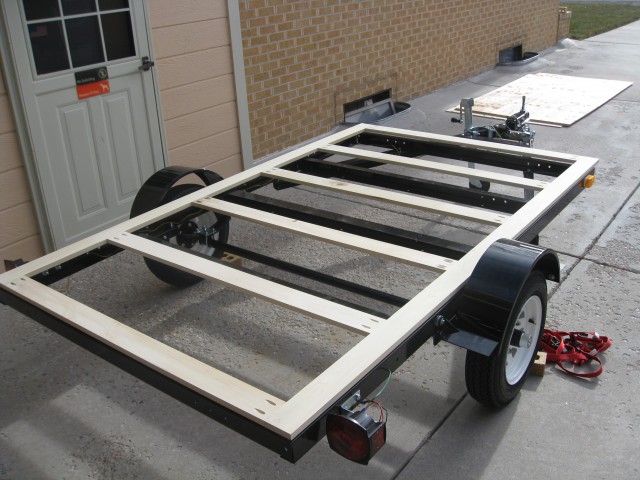
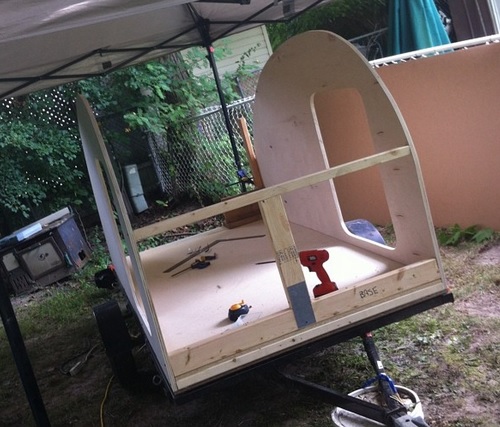
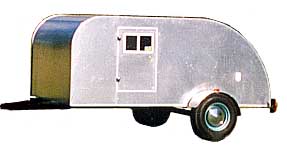
The basic design of the teardrop goes back to the 1930s, and usually involves a converted utility trailer with a wood-frame structure built on top of it. Like this:
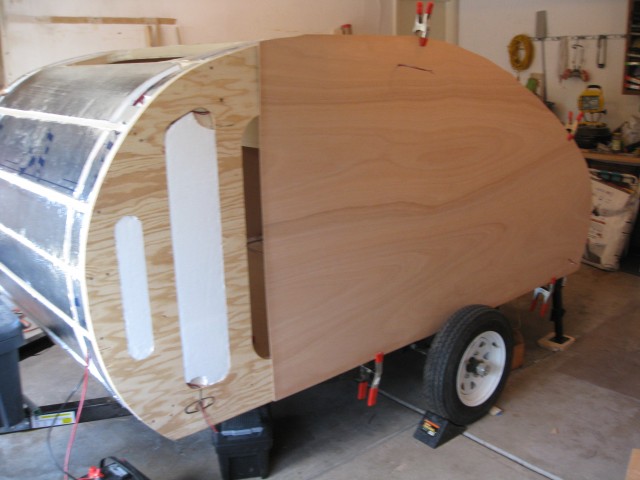
Then it gets skinned with aluminum sheet, and sometimes even the homebuilt ones come out looking pretty cool. The back usually opens as a hatch for a basic galley setup.
So that's all well and good -- and tried and tested. But these things often end up weighing close to 1500 pounds. And they also sometimes have weather-related problems, over time. I think part of the problem is that they tend not to be garaged. And they're made with wood.
I would like to make one that's much lighter. And I'd like to make it with no wood at all, and as little steel as possible.
To that end, I've been looking at material samples and testing adhesives with them. Right now, I'm thinking about using Aluminum Composite Panels (which is basically polyethylene Foam Core sandwiched with aluminum) for the walls and ceiling, and corrugated (polypropylene) plastic for the floor. I'd like to use aluminum to connect the floor, walls and ceiling, but I'd like to avoid (as much as I can) a traditional frame for it. And I think I can do away with a lot of the reinforcement typical in an open utility trailer's bed, since the box structure of the camper would provide strength for the floor.
I'm also considering using foam EPS or XPS insulation sheets, adhered to the aluminum composite panels -- both for insulation from cold and heat and also to further strengthen the panels. I will probably use 4mm corrugated plastic for inside the sleeping cabin, since I can cover it with self-adhesive vinyl and make it look like anything I'd like (and hide the wiring and such).
My concern is making a structure that is strong enough -- which is to say it won't pull itself apart under high-speed pothole impacts and the constant vibration and other stresses of being towed.
On the one hand, it seems like the monocoque aspect of the design should be pretty strong without much reinforcement. Using structural adhesives to create uniform adhesion along all the juncture points will distribute stress pretty broadly. And the way the leading edge of the structure curves as one piece from wall to ceiling seems like it would be creating a fairly strong unit, along with walls both fore and aft that will provide more lateral strength.
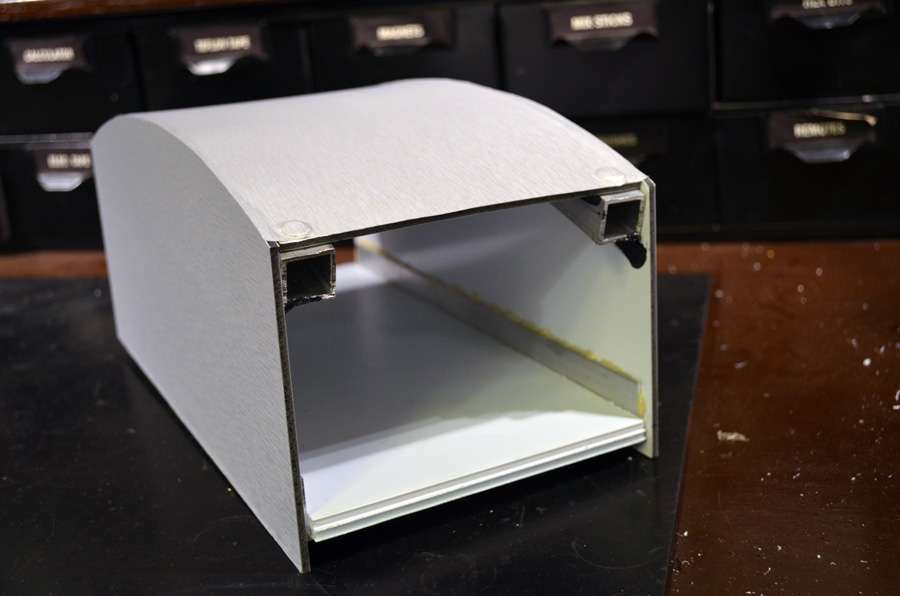
So in doing my materials/adhesive tests, I put together a toaster-size box that shows my current thinking. The square tubing frame piece along the top edge is one of the things I'm wondering about. I know that it's a stronger shape than L-shaped angle stock. But I wonder if using 1-1/2" angle stock might be better than 1" square tubing, considering the big picture of the whole structure.
Right now, I'm supporting the corrugated plastic floor with angle stock running along the walls. My thinking is that the trailer supports the walls, which in turn support the floor and ceiling. But the floor itself doesn't need a huge amount of support.
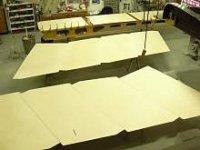
Here's the walls and roof:
And the floor being glued in:
And the whole thing, albeit without the front or rear sections.
I don't have much business making structural engineering decisions. But that doesn't stop me from trying to figure this out -- hopefully with the help of some guys who actually know the stuff.
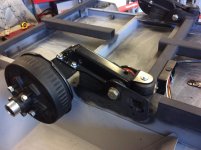
The forces the thing will be subjected to seem primarily to be a lot of vibration, and then some pretty hard lurches in being towed. I'm going to have the tongue and axle be steel, because aluminum will crack if it's flexed too much. But everything else I'd like to be plastic and aluminum.
Any thoughts?