Thanks. I ordered the TWP 100 series before I learned it couldn't be shipped to California. But my vendor had already sent it by then, so that's what I'm using. (So much for the enforcement of our state's regulations.)
Here's a summary of what I did and what I learned.
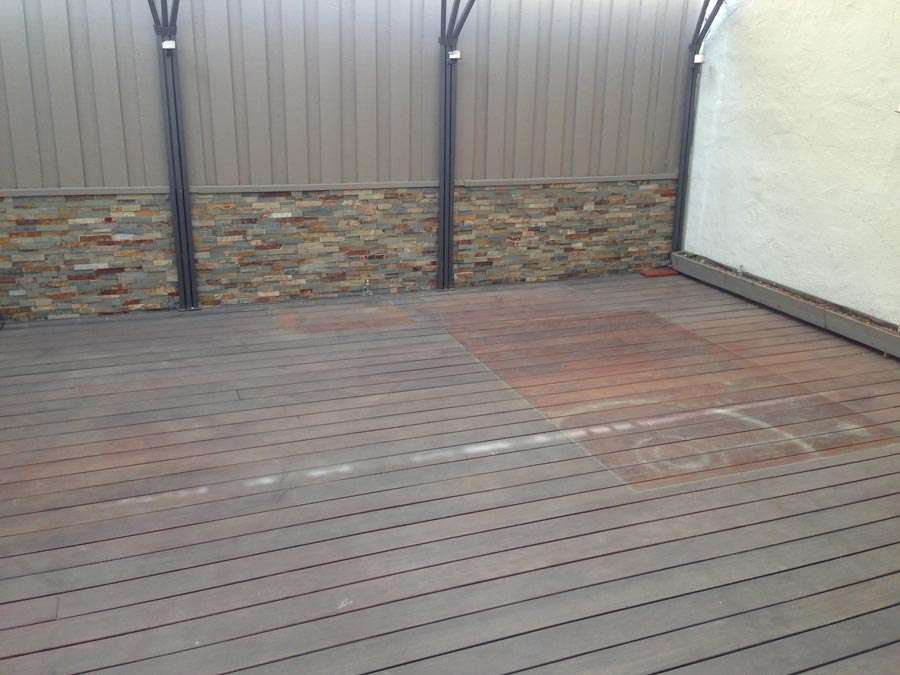
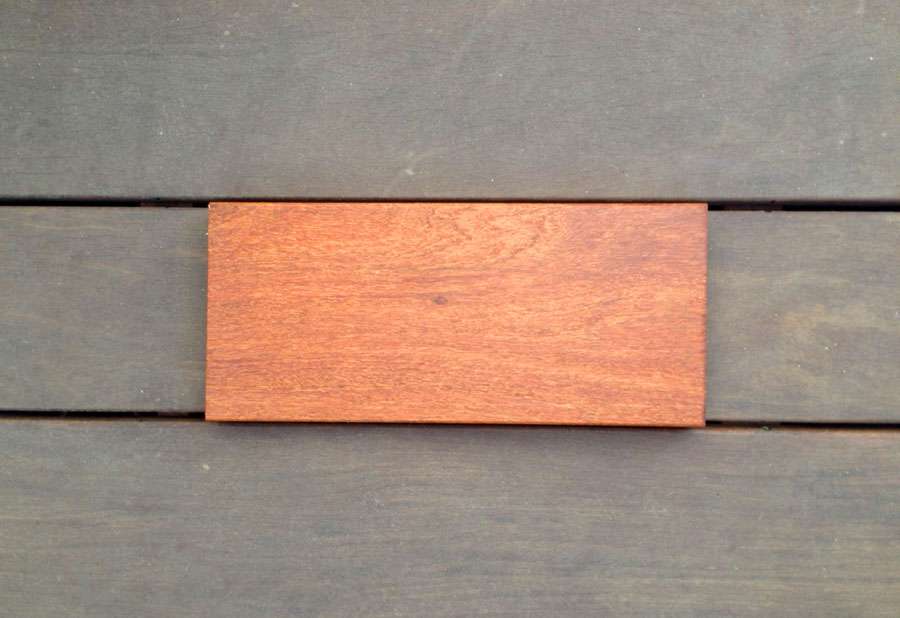
I started out with the graying/blackening as bad as it's ever been. I suppose that's because we had such a wet winter here. But whether it's mold/mildew/fungus or tannins drawn out by the water, it was pretty ugly. On the table, you'll see the piece of wood I stained as a sample -- it will appear in a lot of these pictures.
Here it is with the furniture removed. That circular pattern where my rug was is directly below one of the ceiling fans. I guess it's dust that has come down from the fan.
It should be noted that the wood itself is as smooth as the day I put it in. It will probably last forever and wouldn't require any real maintenance if the cosmetic issues didn't bug me.
But they do.
I tried scrubbing the heck out of it with the Oxy-type cleaner that they sell for this, and -- even with my power washer for the assist -- the results were pretty terrible. I think the hardness of this Brazilian wood means that this kind of cleaning is a waste of time.
Next up, the big guns came out. This is halfway through an application of Lye (or caustic -- it's the opposite of an acid). I used 6 oz of pure Sodium Hydroxide per gallon and wore a lot of protection. I used my dimestore pressure washer to take off the gooey layer of Lye and black stuff.
Next up, I used my old stand-by, Oxalic acid. Also applied with a Hudson-type sprayer and then worked in with a brush. Like the Lye, the acid dissolves the black stuff pretty well. And it also neutralizes the Lye and 'brightens' the wood.
But as nice as it looked wet, it dried out to a much flatter color. The important thing with this super-hard and dense wood is that you can throw chemicals at it and not have it eat into the soft part of the wood. This regimen would be terrible (I'm pretty sure) for traditional woods, or pressure treated soft woods, or even something like Oak or Mahogany.
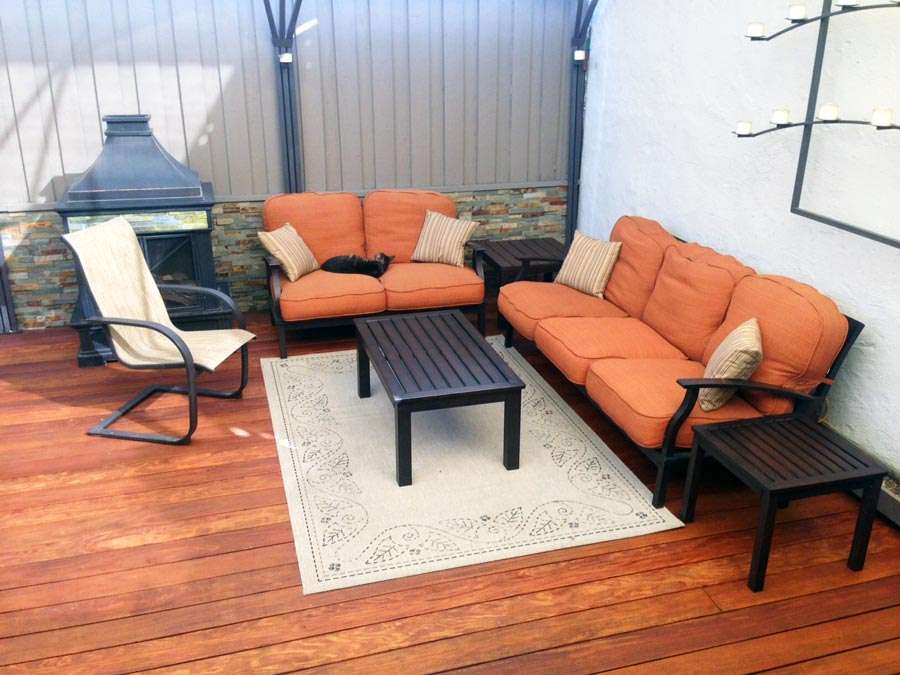
I let it dry for 48 hours and applied the stain: TWP 116, which is their 'rustic oak' color. I bought a few samples from them, and this was the shade I liked the most with my Cumaru hardwood.
And here's a reminder of how far from that it had gone. That's the same sample piece as you see in the other pictures.
Here it is with the furniture back in place. Next time, I might have to actually get out a sander. We'll see. I'll be interested in seeing how the midewcydes (and other cydes) in the TWP stain will keep this look going over the next 12 months.
The whole thing took a few days, but wasn't super time-intensive. Applying the stain took 90 minutes, for example. The Lye and acid treatments took less than that. The scrubbing with Oxy cleaner took longer, but I won't be doing that again. The most time-intensive part of the process was letting the wood dry between treatments.