To avoid these ads, REGISTER NOW!

The Everything 3D Printer Thread

JackOfDiamonds

Well-known member
Joined
Jul 31, 2020
Messages
706
Location
Idaho (USA)
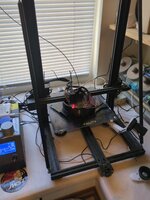
The temperature uniformity of my aluminum bed is, as expected, much better than the glass bed. The glass bed had a 20 degree difference from the center to the edge, and the very edge was nearly cool to the touch. The aluminum bed, after stabilizing, is more like 2 degrees uniformity in the usable area, and the edge of the bed is hot enough that you notice right away when you touch it by accident...

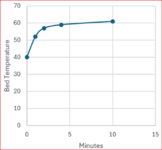
I'm not that happy with how long it takes to stabilize though. Here's the temperature trend AFTER the printer beeps saying the bed is fully heated...it takes another 1-2 minutes for the bed to reach the setpoint, and takes about 10 minutes before it truly stabilizes...all while the printer screen says the temperature is stable. I'm sure this is caused by using the thermistor embedded in the silicon heater, which gives the temperature of heater and not the bed, much less the steel sheet on top of the bed. But, I'm not sure what to do about it. For now I will probably just program in a minute or two of extra stabilization time before the print starts. I could embed a thermistor directly in the aluminum and use that instead of the one in the heater, but I don't know how much better the results would really be.
1723572732816.png
 
To avoid these ads, REGISTER NOW!

rlitman

Well-known member
Joined
Oct 18, 2010
Messages
24,579
Location
Long Island
The temperature uniformity of my aluminum bed is, as expected, much better than the glass bed. The glass bed had a 20 degree difference from the center to the edge, and the very edge was nearly cool to the touch. The aluminum bed, after stabilizing, is more like 2 degrees uniformity in the usable area, and the edge of the bed is hot enough that you notice right away when you touch it by accident...

I'm not that happy with how long it takes to stabilize though. Here's the temperature trend AFTER the printer beeps saying the bed is fully heated...it takes another 1-2 minutes for the bed to reach the setpoint, and takes about 10 minutes before it truly stabilizes...all while the printer screen says the temperature is stable. I'm sure this is caused by using the thermistor embedded in the silicon heater, which gives the temperature of heater and not the bed, much less the steel sheet on top of the bed. But, I'm not sure what to do about it. For now I will probably just program in a minute or two of extra stabilization time before the print starts. I could embed a thermistor directly in the aluminum and use that instead of the one in the heater, but I don't know how much better the results would really be.
There is a reason OctoPrint heats the bed before it starts the head heating cycle. Specifically to give the bed extra warmup stabilization time.

Have you done a PID bed heating optimization? That should fix most of this instability, and you certainly need to re-learn this when you change beds.
 

ArcReactorKC

Well-known member
Joined
Jun 1, 2019
Messages
2,237
Location
Out in the county NE of KCMO
There is a reason OctoPrint heats the bed before it starts the head heating cycle. Specifically to give the bed extra warmup stabilization time.

Have you done a PID bed heating optimization? That should fix most of this instability, and you certainly need to re-learn this when you change beds.
A pid tune isn't going to make the outer edges of the bed the same temperature as the center.

The usual routine of bed heating prior to nozzle also shouldn't long enough for actual bed temp stabilization. Even on my large printers with e3d volcanos the nozzle is up to temperature and stabilized within 90 seconds. On my biggest printer 500^3 the bed requires a minimum of 6 minutes to have full heat saturation across the surface.

I've remedied this by putting in a pause in my routines.
 

bugnut

ALLIANCE MEMBER
Joined
Jul 14, 2012
Messages
3,839
Location
Central Ohio
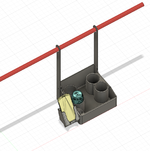
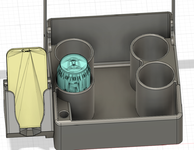
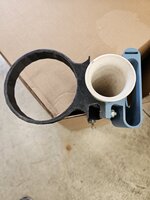
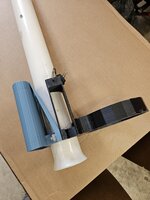
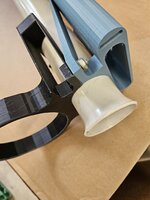
So its about time to hit the beach. Took a few minutes on sketchup and created a holder for my phone, knife and bait the fits my surf rod spike. Took a while to print=if I make more it needs a few modifications as the bolt holes are tough to get to.
 

Attachments

  • 20240816_131641.jpg
    20240816_131641.jpg
    548.2 KB · Views: 31
  • 20240816_131648.jpg
    20240816_131648.jpg
    597 KB · Views: 27
  • 20240816_131655.jpg
    20240816_131655.jpg
    556.6 KB · Views: 28

kaymccampbell

Well-known member
Joined
Feb 27, 2015
Messages
29,416
Location
Upstate New York
I hadn't heard that term before, and now I'll be spending some time looking back through your recent posts 😀
It's just printing 1-2 wall objects, burying them in plaster, cooking them in an oven, then burning out the plastic over the forge, to get a fairly detailed plaster mold, to get a pretty clean aluminum casting. I'm sticking to small things, that fit in a rattle can cover, for now.
 

TracerRound

Active member
Joined
Jun 24, 2019
Messages
43
Location
North Carolina
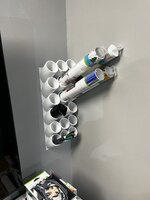
Is there a good walk through to convert/edit/remix existing designs from skadis to wall control compatible mounts? I have not tried but assume they are not interchangeable.
 

Firstram

Well-known member
Joined
May 16, 2017
Messages
1,390
It's just printing 1-2 wall objects, burying them in plaster, cooking them in an oven, then burning out the plastic over the forge, to get a fairly detailed plaster mold, to get a pretty clean aluminum casting. I'm sticking to small things, that fit in a rattle can cover, for now.
What PLA filament are you using? I understand some brands produce less ash.
 

kaymccampbell

Well-known member
Joined
Feb 27, 2015
Messages
29,416
Location
Upstate New York
What PLA filament are you using? I understand some brands produce less ash.
The cheapest **** PLA that Crapazon had at the time, CC3D silky green. Maybe $12 a roll when I bought it?

After I dry the molds in the PC oven at 500F, I stick them over the top of the forge at whatever ridiculous temp is generated there, in the thousands of degrees, I'm sure. Once the melt is ready, the inside of the molds are pretty much bone white. I give them a shot of air to insure cleanliness before pouring, and have seen no ash or dust or plastic.
 

loganb

ALLIANCE MEMBER
Joined
Dec 29, 2011
Messages
5,496
Location
Omaha, NE
Cool working concept for a potential bolt on multi-plate changer for a Bambu:


For those not aware, one of the challenges with running printers especially in a "lights out" or "hands off" mode for a print farm is you've got to get the completed print off the bed before you can start the next one. Various solutions, mostly highly customized have come out for this the most "commercialized" is probably the Creality bed mill where you print on a small treadmill belt. Other options with using the extruder head to "push" the finished part off the bed have been done, but they're generally pretty dependent on the parts/material being used. A bolt on plate unloader/loader like this would provide a much more repeatable solution that isn't dependent on a highly customized setup running the same thing over and over

Pair it with AMS units or even larger 3kg or 5kg spools and you could print fully unattended for days
 

wyb2

Well-known member
Joined
Dec 27, 2012
Messages
188
Location
Southern NH
The cheapest **** PLA that Crapazon had at the time, CC3D silky green. Maybe $12 a roll when I bought it?

After I dry the molds in the PC oven at 500F, I stick them over the top of the forge at whatever ridiculous temp is generated there, in the thousands of degrees, I'm sure. Once the melt is ready, the inside of the molds are pretty much bone white. I give them a shot of air to insure cleanliness before pouring, and have seen no ash or dust or plastic.
I’m also interested in this process and the results. Have you done it before?

I’ve been mulling over a lost-pla sand casting project.
 

Jehannum

Well-known member
Joined
May 3, 2012
Messages
1,348
Location
Albuquerque, NM
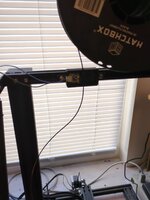
Had a print fail after running out of filament overnight (bottom of a cyclone separator for the same garage dust collection as previously), so I decided to print up a filament sensor.

Firing off the print again, it should pause instead of failing when this (almost empty spool) runs out. It uses the Z-axis endstop that I stopped using when I put the BLTouch probe on years ago.

messages_0(6).jpeg
 

no704

Well-known member
Joined
Apr 27, 2016
Messages
5,206
It's just printing 1-2 wall objects, burying them in plaster, cooking them in an oven, then burning out the plastic over the forge, to get a fairly detailed plaster mold, to get a pretty clean aluminum casting. I'm sticking to small things, that fit in a rattle can cover, for now.
I was doing a lot of this last year. Got a used pottery kiln for ~$100 and added an inkbird ramp controller. Works great for bake out.
 
Last edited:

no704

Well-known member
Joined
Apr 27, 2016
Messages
5,206
I’m also interested in this process and the results. Have you done it before?

I’ve been mulling over a lost-pla sand casting project.
I don’t think the green sand would like the 900c for hours. I use jewelers investment plaster. Was getting it on eBay, think 40lbs was like $50.
 
To avoid these ads, REGISTER NOW!

wyb2

Well-known member
Joined
Dec 27, 2012
Messages
188
Location
Southern NH
I don’t think the green sand would like the 900c for hours. I use jewelers investment plaster. Was getting it on eBay, think 40lbs was like $50.

Yeah, for sand casting I would follow a standard process for that. What I’m not sure about is if using a PLA print will work any different than a wax blank. I’ve done a small amount of lost wax casting and managed to get it to work.

I’ve never tried the plaster method, if it’s easier or about the same effort, and produces better results (seems like it would), maybe I’d go in that direction. But if 900 C is needed to bake the plaster, I don’t think I have a good way to do that, so sounds like it would be more legwork.
 

kaymccampbell

Well-known member
Joined
Feb 27, 2015
Messages
29,416
Location
Upstate New York
Yeah, for sand casting I would follow a standard process for that. What I’m not sure about is if using a PLA print will work any different than a wax blank. I’ve done a small amount of lost wax casting and managed to get it to work.

I’ve never tried the plaster method, if it’s easier or about the same effort, and produces better results (seems like it would), maybe I’d go in that direction. But if 900 C is needed to bake the plaster, I don’t think I have a good way to do that, so sounds like it would be more legwork.
Probably not. The PLA burns out hotter. I had to put the mold right on the split in the forge lid, so the stupid high afterburner heat could get it to do more than just melt. The 500° PC oven just dried the mold.

I was really impressed with the PLA method, because I could CAD and print my victim, paint it with really wet plaster, bury the mess in a plaster blob, and there was a detailed, one use mold that offered even the layer lines from the print.
 

Cue

Well-known member
Joined
Jul 25, 2013
Messages
291
Location
Zebulon, NC
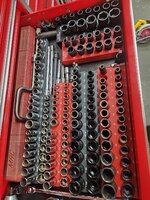
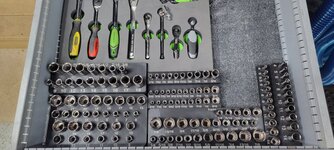
I think I finally finished my socket holders last night. I don't have anymore sets laying out that need a holder, and I can't find anymore loose parts that need placement. Mission complete! Here's one of the two drawers:
20240820_184055.jpg
Nice! I just got done doing the same thing, was a pain to measure each socket with a caliper ;) What did you use to mark yours? Multicolor print? I used my Fiber laser to mark mine.
 

Attachments

  • sockets.jpg
    sockets.jpg
    136.6 KB · Views: 74

Firstram

Well-known member
Joined
May 16, 2017
Messages
1,390
Yeah, for sand casting I would follow a standard process for that. What I’m not sure about is if using a PLA print will work any different than a wax blank. I’ve done a small amount of lost wax casting and managed to get it to work.

I’ve never tried the plaster method, if it’s easier or about the same effort, and produces better results (seems like it would), maybe I’d go in that direction. But if 900 C is needed to bake the plaster, I don’t think I have a good way to do that, so sounds like it would be more legwork.

Probably not. The PLA burns out hotter. I had to put the mold right on the split in the forge lid, so the stupid high afterburner heat could get it to do more than just melt. The 500° PC oven just dried the mold.

I was really impressed with the PLA method, because I could CAD and print my victim, paint it with really wet plaster, bury the mess in a plaster blob, and there was a detailed, one use mold that offered even the layer lines from the print.
This guy has some great stuff!


loganb

ALLIANCE MEMBER
Joined
Dec 29, 2011
Messages
5,496
Location
Omaha, NE
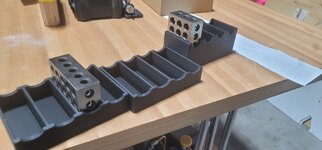
Holder for some 1 2 3 blocks

20240824_142606.jpg

Far right version was the file from online but standing up they were too tall. Middle print was after scaling down the height and stretching it out in the slicer... But didn't stretch enough.

Far left was after adding another 2mm... Fits nice and have a home for 2 more when I buy them

Link for original:


Printed in matte PLA
 

no704

Well-known member
Joined
Apr 27, 2016
Messages
5,206
Probably not. The PLA burns out hotter. I had to put the mold right on the split in the forge lid, so the stupid high afterburner heat could get it to do more than just melt. The 500° PC oven just dried the mold.

I was really impressed with the PLA method, because I could CAD and print my victim, paint it with really wet plaster, bury the mess in a plaster blob, and there was a detailed, one use mold that offered even the layer lines from the print.
If you’re shooting for dimensional parts don’t forget to factor in for shrinkage. I usually add 2.5% to the print for Al casting.
 

wyb2

Well-known member
Joined
Dec 27, 2012
Messages
188
Location
Southern NH
Probably not. The PLA burns out hotter. I had to put the mold right on the split in the forge lid, so the stupid high afterburner heat could get it to do more than just melt. The 500° PC oven just dried the mold.

I was really impressed with the PLA method, because I could CAD and print my victim, paint it with really wet plaster, bury the mess in a plaster blob, and there was a detailed, one use mold that offered even the layer lines from the print.

Maybe I’m just not reading this right but - Do you mean probably not as in it’s probably not much different, or it probably won’t work as well?

This guy has some great stuff!


Thanks for the video, that’s exactly what I was thinking. I did take note of all that fire shooting out during the pour, that definitely doesn’t seem ideal.
 

kaymccampbell

Well-known member
Joined
Feb 27, 2015
Messages
29,416
Location
Upstate New York
Maybe I’m just not reading this right but - Do you mean probably not as in it’s probably not much different, or it probably won’t work as well?


Thanks for the video, that’s exactly what I was thinking. I did take note of all that fire shooting out during the pour, that definitely doesn’t seem ideal.
Probably not much difference between lost wax and PLA, as in most things YMMV. IME the process is the same, but the PLA needs higher temps for burnout.
 

Firstram

Well-known member
Joined
May 16, 2017
Messages
1,390
Thanks for the video, that’s exactly what I was thinking. I did take note of all that fire shooting out during the pour, that definitely doesn’t seem ideal.
He seems to end up with nice castings even with the burning PLA.
 

Firebrick43

Well-known member
Joined
May 12, 2015
Messages
13,977
Location
West central Indiana
Thanks for the video, that’s exactly what I was thinking. I did take note of all that fire shooting out during the pour, that definitely doesn’t seem ideal.
If your wearing the right equipment the flames are non consequential. Fresh petrobond on bigger castings can have pretty good flames.

And the furnace to melt the metal is even worse?

The biggest safety concern with any metal pour is moisture and steam explosions that will send molten metal much higher than those flames.
 

wyb2

Well-known member
Joined
Dec 27, 2012
Messages
188
Location
Southern NH
If your wearing the right equipment the flames are non consequential. Fresh petrobond on bigger castings can have pretty good flames.

And the furnace to melt the metal is even worse?

The biggest safety concern with any metal pour is moisture and steam explosions that will send molten metal much higher than those flames.

Oh yeah, safety, that hadn’t occurred to me.

I was actually thinking about all that expanding gas increasing the chance of voids in the part.

He seems to end up with nice castings even with the burning PLA.

The results are encouraging. However he is (in that video at least) making a decorative part, whereas I would be making functional parts. This is why the amount of flame caught my attention. I would have a lower tolerance for trapped gas bubbles than he does on that part.
 

kaymccampbell

Well-known member
Joined
Feb 27, 2015
Messages
29,416
Location
Upstate New York
Oh yeah, safety, that hadn’t occurred to me.

I was actually thinking about all that expanding gas increasing the chance of voids in the part.


The results are encouraging. However he is (in that video at least) making a decorative part, whereas I would be making functional parts. This is why the amount of flame caught my attention. I would have a lower tolerance for trapped gas bubbles than he does on that part.
The worst gas bubbles are the hydrogen in the aluminum. I use a tablespoon-ish of pool chlorine granules to force the unwanted gas out.

As for the molds and tools. No moisture, ever. Not dew, rain, spit, sweat, beer, nothing. If you've ever seen a ladle with a small amount of water meet molten steel from the crucible, you'd understand. It caused a steel mill in a nearby-ish town to never open.
 
To avoid these ads, REGISTER NOW!
Top Bottom