Translation of the French Facom Wikipedia article:
Facom is a French tool brand, primarily present in Europe, founded in 1918 by engineer Louis Mosés. Its name is an acronym for "Franco-américaine de construction d'outillage mécanique" (Franco-American mechanical tool construction).
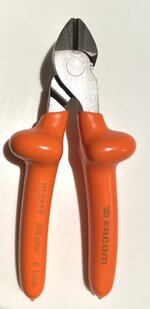
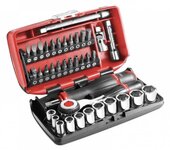
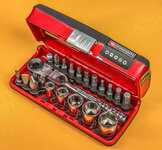
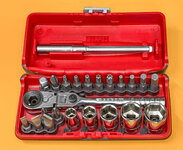
Facom was known for the robustness and warranty of its products among professionals in the maintenance of public works equipment, automotive repair, aeronautics, electricity, electronics, and industrial maintenance. Among the most representative product lines are wrenches, screwdrivers, ratchets and sockets, saws, hammers, toolboxes, mallets, and specialized tools for the automotive or aeronautic industries.
The brand is owned by Stanley Black & Decker and operated in France by Stanley Black & Decker France.
History
Beginnings: On May 8, 1918, Louis Mosés, an engineer from the Arts et Manufactures (former name of the École Centrale de Paris, now Centrale-Supélec), founded the Franco-American Mechanical Tool Construction Company (FACOM) with some family and friends. It specialized in hand tools. The name, chosen during World War I, reflects the popularity of the United States at that time, and the founder had spent part of his youth in Latin America, in Peru.
In the early years, FACOM operated in a workshop near the Gare de Lyon in the heart of Paris, where ten workers manufactured a new adjustable wrench called "Lachèze." The goal was to offer this unique tool to industrial mechanics and railway companies. In 1920, FACOM established a new forge in Gentilly (Val-de-Marne), and its product range expanded through contracts with Renault and Peugeot.
Development: During the interwar period, FACOM expanded its range of tools. The aviation market grew, leading to strong ties with Air France. By 1939, the catalog featured over 500 references. FACOM introduced its first logo, the "winged bolt," symbolizing the booming mechanical sectors of automotive and aeronautics. In 1937, chrome-plated keys were introduced, reflecting a luxurious image.
During World War II, FACOM managed to preserve its assets and industrial potential, as well as its workforce. André Mosès, the founder's son, joined the company, eventually becoming its president in 1945. Under his leadership, FACOM introduced innovations such as the first catalog, demonstration trucks, employee profit-sharing policies, financial control, and a lifetime warranty on tools (1952).
The post-war economic boom brought significant growth to FACOM, with a 13% average annual revenue increase during the "Trente Glorieuses." The company explored export markets in Northern Europe, the Mediterranean, South America, Southeast Asia, and Africa.
In 1956, FACOM expanded and relocated its facilities to Villeneuve-Le-Roi near Orly, with 460 employees. Philippe Zoummeroff, Louis Mosès' grandson, took over as director in 1958.
FACOM became the largest company in its sector in the 1960s. It established itself on the industrial site of Ezy-sur-Eure in 1967 and Nevers in 1974. The company went public on the Paris Stock Exchange in 1971.
From the 1970s onwards, FACOM expanded internationally, establishing subsidiaries in Belgium and Germany in the 1970s, followed by Italy (1971), the UK and the Netherlands (1977), Switzerland (1981), the US (1982), and Spain (1988). By 1983, FACOM became the leading European hand tool manufacturer (9% market share) and the third-largest globally.
Acquisitions: Over the years, FACOM integrated several companies, including Piolé (sheet metal), Bost (pliers), Garnache (screwdrivers), Virax (tube work tools), Dela (measurement), Mingori (bending), Britool (automotive and industrial tools), USAG (Italy's leading hand tool manufacturer), and SK Hand Tool Corp. (American clamping specialist).
From the 1990s, FACOM positioned itself as a multi-specialist, serving markets in mechanics, aeronautics, electricity, electronics, public works, construction, and automotive.
Acquisitions: In 1999, after a public takeover bid, Marc Ladreit de Lacharrière's holding company launched a surprise takeover of Strafor-Facom. FACOM then became part of the Fimalac group for 610 million euros. Due to factors such as low-priced imports from Asia, competition from American giants benefiting from the weak dollar, and the insufficient internationalization of the group, FACOM's profitability declined. In 2003, Fimalac implemented a restructuring plan, including the closure of the historic Villeneuve-le-Roi factory and the Hoffenburg site in Germany. On January 1, 2006, FACOM was sold by Fimalac to the American Stanley Works for 410 million euros.
In 2008, the FACOM catalog had 600,000 copies in 12 languages, with over 7,000 references across nearly 880 pages. It was distributed by 5,500 distributors worldwide.
In 2009, Black & Decker merged with Stanley Works, and the company became Stanley Black & Decker. On September 5, 2017, FACOM was absorbed by Stanley Black & Decker France and dissolved, generating 160 million euros in revenue, with almost 80% in France.
Centenary Celebration: For its centenary in 2018, FACOM celebrated at the Louvre. The company presented a major project, the "Facommunity," a 100% digital platform for FACOM enthusiasts, animated by personalities.
Continuation: In 2016, with support from Adar General Telecom Services, FACOM launched a range of mobile products designed to withstand extreme working conditions, including hybrid phones, tablets, and smartphones.
The FACOM brand is still used on basic tools (toolboxes, keys, screwdrivers, pliers) and ranges of power tools (impact wrenches, angle and torque adapters). Five of its nine factories are in France, including locations in Jura, Besançon, and Somme. France remains FACOM's primary market.