Hello A P mech (I'm guessing Airframe Powerplant?)
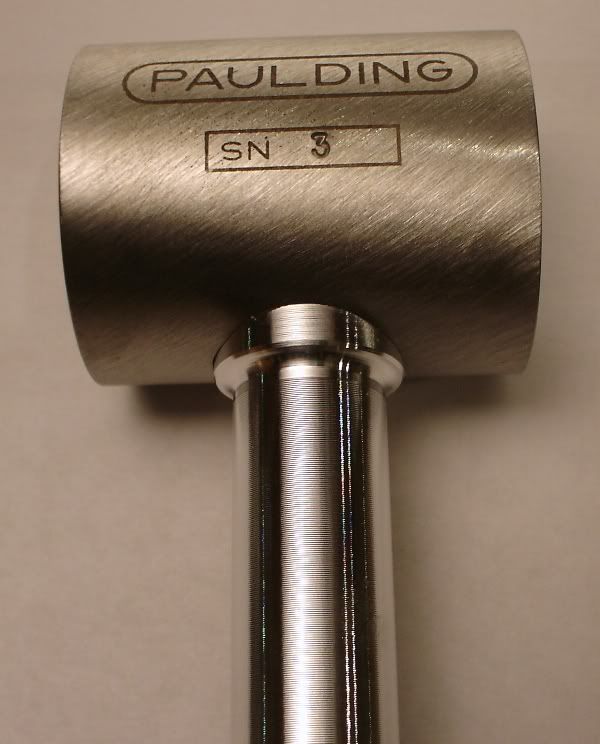
I'm going to add 2 more cents and bow out of this one. I can see by your lathe, part finishes and the quality of materials used that you are giving every pennies worth of your price in that hammer your making. It may well be the toughest hammer ever made. I believe at one point you talked about designing in the center of percussion for good balance and to reduce handle shock. So you're even using some physics with respect to the design of your product. Why not make it the most accurate and comfortable to use.
It's been said that the Hammer was the first tool used by man (more ways than one). He then made an anvil with that first hammer and then and only then, came everything else up to today's micro chips. Give a lowly Hammer the respect it deserves.
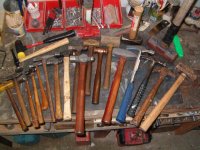
The picture of the hammers I use, 10 oz to 10 lb for everything from fixing clocks to building bridges all have one thing in common. A resilient, flexible, sweat absorbing, oval shaped comfortable handle. Its a must for ten strikes or ten thousand. You think, especially in days past with no machinery, somebody spend all that time carving that classic handle shape because it looked good.
Round is no good you'll lose the accuracy of your strikes. The oval shape gives you the ability to the guide and direct the blows without hand strain, hammer enough and half your strength that went to trying to keep the head straight makes you start sending bad blows. Now you need a punch holder to remedy hitting your hand with the hammer (at this point stay out of the garage and pay someone to fix it for you). That goes for hammering on clock parts, assembling small die sets or building bridges. One strike or one million.
All hammers always have a slight crown on the face (except for one, a planishing hammer, 5th from left in picture). Another must, it's to prevent slipping and marring. The planishing hammer is used on a round anvil so its left flat.
Look at the handles on your lathe dials. See the shape of the one on the cross feed vs. the carriage handles. That's so your hand doesn't tire and allows for accurate control of the finest screw on the lathe for precision work. Cheap Asian stuff doesn't always put time or money there into making that elaborately shaped handle. They use round or a taper at best. Most people don't realize why their Asian **** is such **** until they use it for real work. So in keeping true to USA quality of which is almost there in your product, put a slight crown on the faces and an oval slot in the head so it can be fitted with a good ole hickory handle. Make sure the major axis of the handle slot is dead nuts in line with the axis through the center of the faces.
Now for for $129.00 plus $10.70 for shipping, a guy can proclaim beyond all doubt, I have the best hammer in the world.
Bonus! You can buy a good hickory handle for a lot less than what your aluminum with machining time costs.